
You're reading with a seventh grader when a character's temper becomes a volcano. The student stops: Is there a volcano in this story? That's a useful teaching moment, not a wrong turn. The student can read the words but needs help deciding what they mean together.
For teaching figurative language in middle school, that distinction matters more than memorizing definitions. Start with a quick reference, then teach students to ask what the writer wants them to understand beyond the literal words.
Seven Types of Figurative Language at a Glance
Figurative language carries meaning beyond the dictionary sense of its individual words. Literal language gives readers a street address, a direct statement of what's happening. Figurative language offers a shortcut to something more vivid, such as a feeling, an impression, or a comparison.
Seven types of figurative language for grades 6 to 8
| Device | Plain definition | Example | What to look for |
|---|---|---|---|
| Simile | Compares two things using like or as | The classroom was as quiet as a library | The words like or as link the two things |
| Metaphor | Says one thing is another thing | Her ideas were a goldmine | A direct link with no like or as |
| Personification | Gives human traits to a non-human thing | The wind whispered through the trees | A non-human subject doing a human action |
| Hyperbole | Deliberate, obvious exaggeration | I have told you a million times | A number no one could mean literally |
| Idiom | A fixed phrase whose meaning is not the sum of its words | He let the cat out of the bag | The meaning breaks down when read word by word |
| Irony | Meaning is the opposite of what is said or expected | Great, another pop quiz | The situation contradicts the words |
| Allusion | A brief reference to a known person, event or text | He met his Waterloo in the final round | A name or event the reader must recognize |
Use the table as a starting point
Each row gives students a plain definition, a classroom example, and a clue to investigate. The last column is especially useful, but a clue isn't proof. Students still need to check the surrounding passage.
- Read for meaning first. Ask students to explain the example in everyday language before naming the device.
- Check the clue. Have students point to the comparison, human action, exaggeration, or reference that supports their answer.
- Return to the passage. Ask whether their interpretation fits what the character is doing and feeling.
A common confusion deserves an early correction: a metaphor isn't just a simile without like or as. Deleting those words doesn't automatically create a meaningful comparison. The writer must connect things through a quality the reader can understand.
Also, not every sentence containing like is a simile. In I like the library, the word expresses a preference, not a comparison. Teach students to identify what's being compared rather than circle a signal word and stop.
Keep the focus on understanding
Idioms and allusions require particular care because their meanings depend on prior knowledge, not on the words alone. A student might understand every word in let the cat out of the bag and still miss the message completely.
Other language devices can sit alongside this chart without becoming extra labels to memorize. For sound-focused lessons, these onomatopoeia examples offer a useful contrast: students can examine how a word sounds as well as what it suggests.
The progression is deliberate: New York's English Language Arts standards include personification in grade 6, add allusions in grade 7, and include irony and puns in grade 8. That's a progression in interpretation, not a rule against introducing a device earlier.
Quick self-check: If a sentence would be false when read literally, it's probably figurative. Then check the context, because a mistaken statement or a fantasy-world event isn't automatically figurative language.
Telling Similes and Metaphors Apart
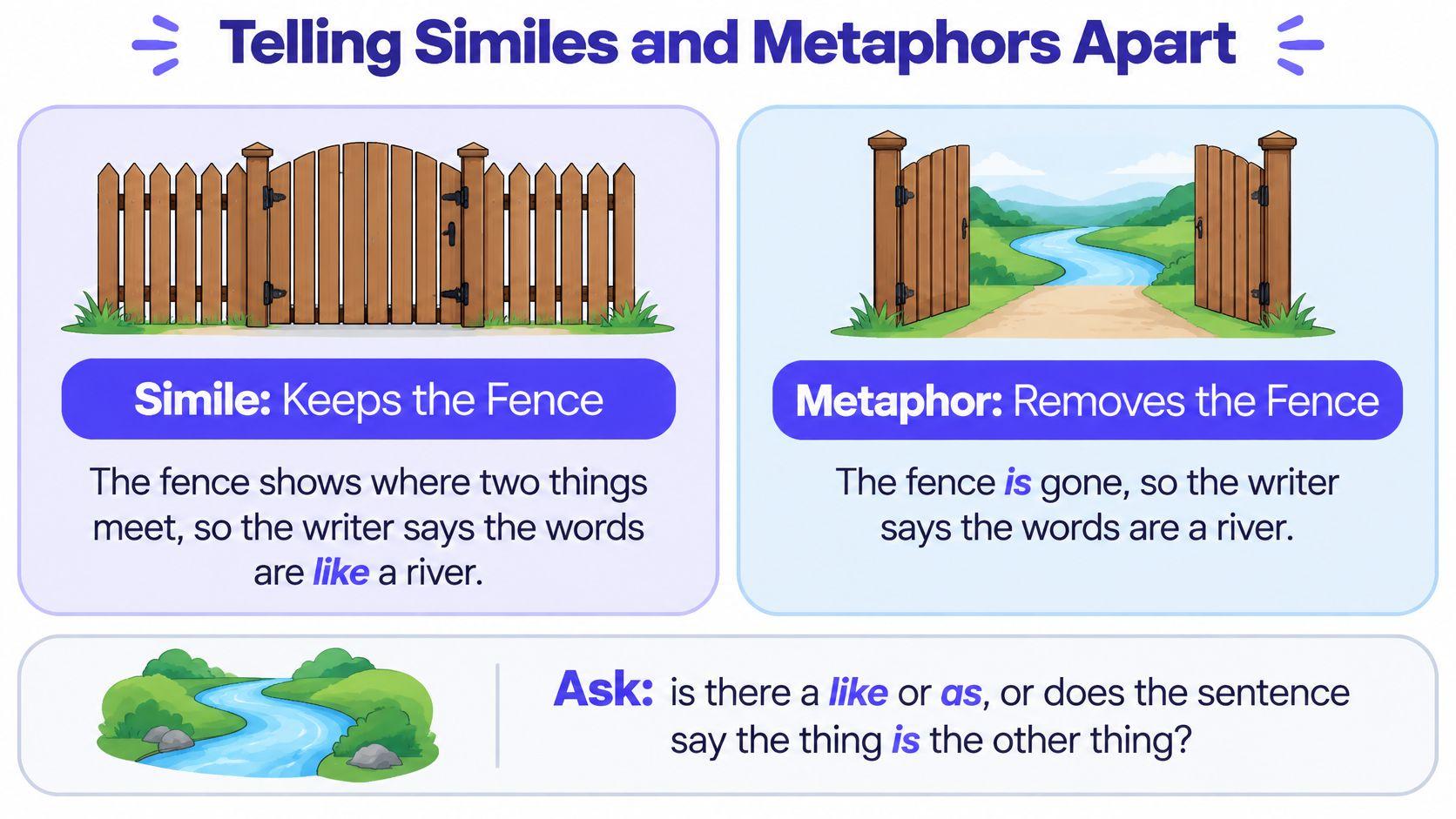
A simile keeps a fence between the things being compared. The fence shows where they meet: the writer's words are like a river. A metaphor removes the fence: the writer's words are a river.
Neither sentence means that water comes out of someone's mouth. Both invite readers to consider a shared quality, perhaps smooth movement, speed, or an unstoppable flow. The surrounding sentences help readers decide which quality matters.
Use this visual to make the distinction concrete.
Compare the meaning, not just the wording
These original examples resemble language students might encounter in middle-school fiction. Put the literal meaning underneath each comparison so students can see the thinking involved.
| Example | Literal meaning | Shared quality | Possible effect |
|---|---|---|---|
| Maya's thoughts darted like minnows. | Maya moved quickly from thought to thought. | Quick, unpredictable movement | Suggests distraction or nervousness |
| The hallway was a river between classes. | Students moved continuously through the hallway. | Flow and crowded movement | Makes the setting feel busy |
| His apology was a paper umbrella in a storm. | His apology offered little help during a serious conflict. | Weak protection against something powerful | Suggests that the apology was inadequate |
The third example is particularly useful because students can't explain it by matching a single adjective. They have to connect the umbrella's weakness with the apology's failure.
Ask what happened immediately before the apology. If the character caused serious harm, the comparison may suggest that words alone aren't enough. If the conflict is minor, the same image could sound exaggerated or comic.
Extend the comparison carefully
An extended metaphor develops the same comparison across a paragraph or poem. A writer might describe a friendship as a garden, then refer to roots, neglect, and new growth. Students should trace how those details develop the relationship rather than treat each garden word as an unrelated device.
An analogy uses a familiar relationship to explain something less familiar. For instance, comparing an essay's structure to a building's frame helps students understand how supporting parts hold a larger whole together.
For a teacher-facing revision exercise, you can browse the style boosting tools from Vocuno and compare alternative phrasings. Keep the instructional question specific: does the new comparison clarify the intended meaning, or merely make the sentence sound elaborate?
A peer-reviewed 2016 study of metaphor comprehension compared 11-year-olds, 15-year-olds, and young adults, finding clear gains between ages 11 and 15, with 11-year-olds performing significantly worse than 15-year-olds. The teaching implication is to provide more comparison scaffolding for younger middle-school learners, while adjusting support to individual responses rather than grade alone.
Give students a paraphrase frame before asking for analysis: The writer connects ___ with ___ because both ___. This suggests ___.
Hyperbole and Personification Make Ideas Bigger or Alive
Hyperbole is exaggeration that the reader is meant to see through. If a student complains that a backpack weighs more than a mountain, the point isn't weight measurement. The student wants someone to understand how burdensome the backpack feels.
Use the image below to start a discussion about the difference between measuring something and exaggerating it.

Test exaggeration against the situation
Hyperbole's test: Would a reasonable reader take this claim at face value in this situation?
A character who has been waiting forever hasn't lived outside time. The exaggeration might reveal impatience, frustration, or a tendency toward drama. Students should name that feeling rather than finish with it makes the writing interesting.
Contrast hyperbole with understatement, which deliberately makes something seem smaller or less serious. After a disastrous performance, a character might describe it as not my best afternoon. Depending on context, that restraint could sound embarrassed, dryly funny, or determined.
- Ask about feeling. What does the exaggeration or restraint make the reader feel?
- Ask about character. Does this wording reveal panic, confidence, annoyance, or humor?
- Check the stakes. Would the same expression feel playful in one scene and cruel in another?
Notice the human trait
Personification's test: Has the writer given something non-human a human trait, feeling, or action?
A stubborn engine seems unwilling to cooperate. A hungry fire seems eager to consume more fuel. A patient clock seems able to wait without frustration. The useful question isn't whether objects really have personalities, but why the writer chose that particular personality.
| Flat sentence | Personified version |
|---|---|
| The engine wouldn't start. | The stubborn engine refused to wake. |
| The fire spread through the dry grass. | The hungry fire devoured the dry grass. |
| The clock continued ticking. | The patient clock waited through her silence. |
The revisions don't just add decoration. They give readers different impressions of resistance, danger, and quiet tension.
Use the video as a pause-and-explain activity rather than uninterrupted viewing. Ask students to identify an example and explain its effect before continuing.
One helpful caution: an animal performing an ordinary animal action isn't personification. A dog running is literal; a dog judging someone's fashion choices gives the animal a distinctly human role. Personification is an appropriate early interpretation task for grade 6, but students should explain the trait, not merely locate the verb.
Idioms, Irony and Allusions Trip Up Readers
Spill the beans is a useful idiom to catch a reading problem: a student may picture scattered food when the speaker means reveal a secret. Don't assume that a familiar classroom expression is familiar to everyone. The phrase itself doesn't explain why beans should have anything to do with confidential information.
An idiom gets its meaning from convention, the way people have agreed to use it. Break a leg can express good wishes before a performance, but a reader who hasn't encountered that convention has good reason to find it alarming.
Familiarity isn't the same as reading ability
In a study of 150 students in grades 5, 8, and 11, idiom comprehension improved with age, and familiar, more transparent expressions were easier than unfamiliar, opaque ones. Transparent means the words offer useful clues; opaque means the intended meaning is difficult to recover from the words alone.
Sequence practice accordingly:
- Begin with familiar expressions in context. Use a short exchange or scene, not a disconnected phrase.
- Introduce unfamiliar, opaque idioms after students have practiced looking for contextual evidence. Supply the conventional meaning when the passage doesn't offer enough information.
- Require justification. Ask which action, response, or nearby detail supports the interpretation.
Make literal-versus-figurative contrast cards. One side can show actual beans falling from a container; the other can show a person revealing a secret. The illustrate idioms worksheet provides a practical starting point for that comparison.
Supply the missing knowledge
Irony involves a gap between words and intended meaning, or between expectations and events. In the pop-quiz example, enthusiasm is ironic only if the scene shows that the speaker isn't pleased. Without that context, great might be sincere.
Allusion presents a different challenge: the reader must recognize a reference. Before asking students to explain meeting one's Waterloo, explain its association with Napoleon's decisive defeat. Then students can consider why a writer uses it for a character's failure in a competition.
Don't turn missing background knowledge into a guessing contest. Give students the reference, then assess what they do with it.
English-language learners may need explicit support with culturally specific expressions, a challenge discussed in this Journal of Adolescent & Adult Literacy article. Students with dyslexia may also need supported reading and additional processing space, while autistic learners may benefit from direct explanation of the speaker's intention.
Allow home-language discussion, drawings, and oral explanations as routes into the same demanding task. Keep literary interpretation separate from guessing a speaker's social intention, and fade supports as students become more independent.
Classroom Examples Students Can Analyze and Explain
Suppose students encounter this original sentence in a scene about an anxious child arriving home: The house held its breath as Elena opened the letter.
Begin with the literal reading: a building is holding air in its lungs. That doesn't fit an ordinary realistic scene. The device is personification because the writer gives the house a human action.
The intended meaning is that the house seems unusually still while Elena waits for important news. Ask students to connect the stillness to Elena's anxiety, then check whether details nearby support that interpretation. The strongest response explains the atmosphere, not just the impossibility of a breathing house.
Try examples with different demands
These original practice sentences let students work through the same distinctions without needing a whole new text.
| Sentence and context | Literal reading | Device | Intended meaning and effect |
|---|---|---|---|
| During the argument, Jamal's voice was sandpaper. | His voice was an abrasive material. | Metaphor | His voice sounded harsh, making the exchange feel uncomfortable. |
| After rehearsal, Priya could have slept through a marching band. | Loud musicians wouldn't wake her. | Hyperbole | She was extremely tired; the exaggeration adds humor. |
| Before the audition, Luis told Ava to break a leg. | Luis wanted Ava injured. | Idiom | He wished her success, showing encouragement. |
| Wonderful, the printer has kindly eaten my only copy, Sam muttered. | The printer helpfully consumed paper. | Verbal irony and personification | Sam is annoyed, and describes the malfunction as a deliberate action. |
The printer example makes an important point: real sentences don't always belong in a single box. Accept overlapping labels when students can support each one. Don't reward extra labels that don't help explain meaning.
Move from shared talk to individual evidence
Choose a passage the class is already reading, and have groups locate an image, idiom, or comparison. Ask them to paraphrase the literal reading, explain the intended meaning, and connect the wording to tone or character.
Give students roles that require different contributions:
- The reader locates the expression and reads the surrounding passage.
- The interpreter proposes a plain-language meaning.
- The evidence checker tests that meaning against nearby details.
Then have every student write an independent explanation. A fluent group speaker shouldn't be your only evidence that everyone understood.
The Institute of Education Sciences review of Student Team Reading and Writing found potentially positive effects on reading comprehension but no discernible effect on general literacy achievement. That supports considering collaborative work within meaningful reading tasks, not claiming that this particular figurative-language activity has been independently proven effective.
Build Your First Figurative Language Lesson
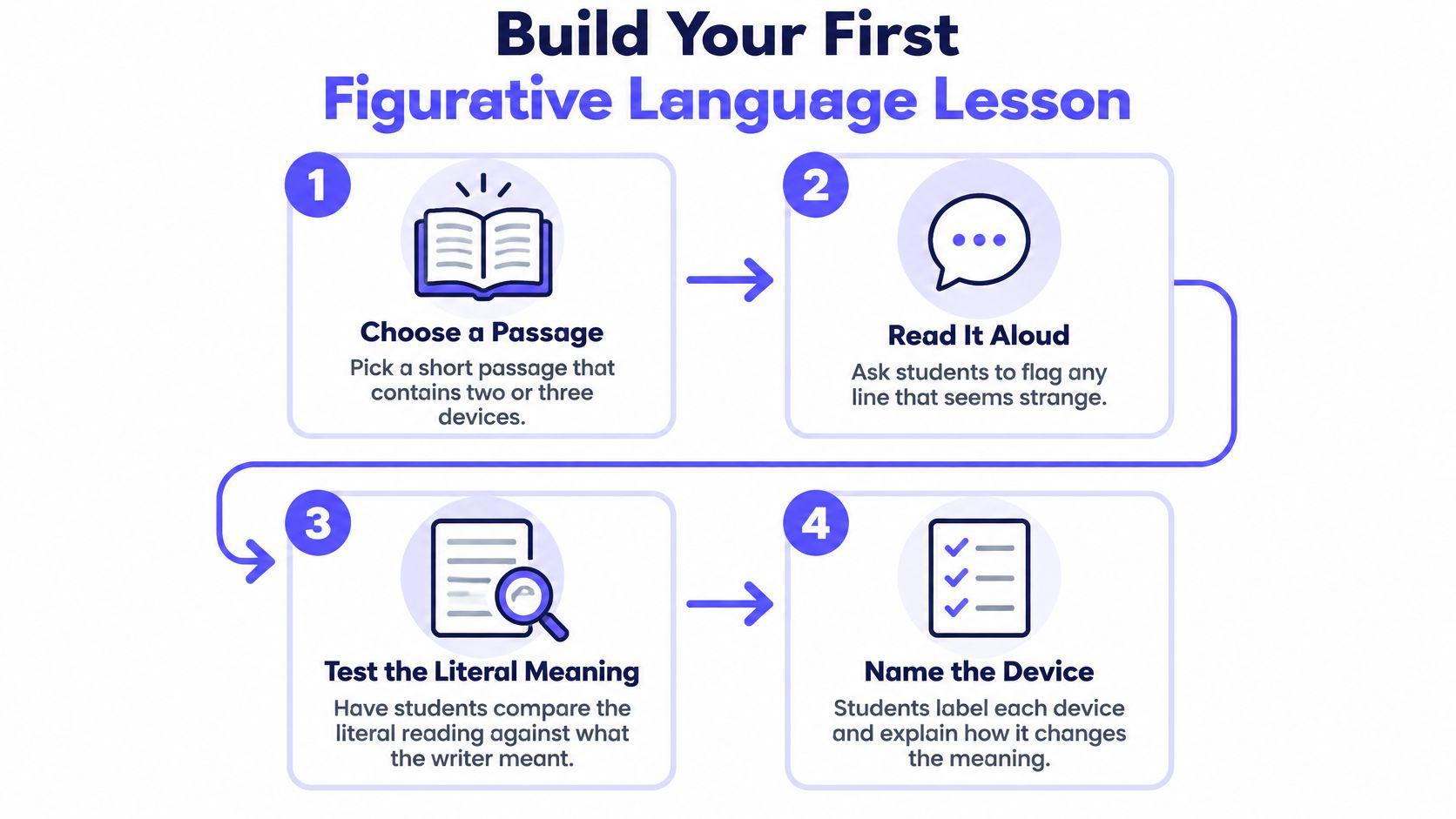
Choose a short passage with a few purposeful devices. Select something whose situation students can understand. Avoid a passage so crowded with unfamiliar references that explaining background knowledge becomes the entire lesson.
Read it aloud and flag strange wording. Ask students to mark language that seems impossible, surprising, or out of place. Don't require a device name yet.
Test the literal meaning against the context. Have students describe what would happen if the words were literal. Then check whether that event fits the scene.
Model a paraphrase with a think-aloud. For her confidence crumbled, explain that confidence isn't a physical wall. The writer suggests that her earlier certainty is breaking down.
Run the shared-passage group task. Require students to connect their interpretation to a specific detail. Offer a vocabulary gloss or an image when the obstacle is access rather than reasoning.
Check understanding independently. Ask each student to name the device, explain the intended meaning, and describe its effect. Include a fresh example so you can see whether students can apply the process.
Assess more than recognition
Figurative language rubric for a single student response
| Dimension | Strong work | Developing work |
|---|---|---|
| Device identification | Names the device and quotes the exact words | Names the device without quoting |
| Interpretation | States the literal meaning and the intended meaning | States only one of the two |
| Purposeful use | Explains what the device does to tone, character or theme | Describes the device without its effect |
Treat the rubric as a way to locate the next teaching move. A correct label with a confused explanation calls for interpretation practice. A sound interpretation with an incorrect label calls for a brief terminology correction, not a complete restart.
A pre-experimental study of 30 eighth-grade students reported mean performance increasing from 59.5 on the pretest to 70.67 on the posttest after figurative-language instruction. Because the study lacked a control group, the gain can't be credited to instruction alone.
Use this visual as a compact planning reminder, while keeping the fuller explanation and independent check in your lesson.
Check whether students can use the skill
Separate recognition from production. After students interpret a comparison, ask them to write an equivalent expression of their own and explain the quality they preserved. Someone who turns nervousness into a storm should explain which storm details convey that feeling.
Keep the passage, learning objective, support, and assessment aligned. This guide to how to write a lesson plan can help organize those decisions without letting the activity replace the learning goal.
For a practical planning option, Kuraplan can take any source you provide, adapt it for the reading age, gloss unfamiliar vocabulary, generate comprehension questions, and produce a NOP analysis grid in one go. Its lesson plans include differentiated instruction and assessment rubrics, giving you a draft to review for accurate interpretations, appropriate challenge, and useful evidence prompts.
Kuraplan offers lesson planning and worksheet tools you can use to prepare contextual figurative-language practice rather than another labeling sheet. Visit Kuraplan with a passage you're teaching, then build a lesson that asks students to explain what the language means, support their interpretation, and try the technique themselves.