The water tray is already sloshing over its edge, one child is adding cups faster than another can empty them, and a block tower is beginning to lean. Across the room, someone is trying to tell you about a weekend trip while another child calls for help with a coat. You spot a useful moment of learning and reach for the clipboard, then pause. If you stop to write, will you miss what happens next?
That small hesitation sits at the heart of formative and summative assessment in early years. We need evidence that helps us respond while children are learning, and we also need a clear summary of progress to share with families and other professionals. The challenge is collecting meaningful evidence without turning play into paperwork.
A Tuesday Morning in a Nursery Classroom
It's a Tuesday morning in a busy nursery. Wet coats hang by the entrance, the room smells faintly of toast and poster paint, and the arrival noise rises and falls as children settle into familiar areas. At the water tray, a stream runs across the table and drips onto the floor. Nearby, a child adds one wooden block after another to a tower that wobbles every time a new piece lands.
You crouch beside the tower with your clipboard balanced against your knee. The child looks at you, then reaches for a wider block. You could record the choice, the problem-solving, and the words they used. You could also stay fully inside the play and ask, “What might make it steadier?” The best assessment moment may disappear if you turn away to write.

A quick memory prompt, a voice note after the interaction, or a short sentence written later may capture more than a long paragraph written while the child waits for your attention. What matters is that the observation records something useful, such as the child's strategy, communication, persistence, or next step.
Looking at understanding child development over time can also help practitioners interpret one moment without treating it as the whole story. A child who struggles to balance blocks today may show careful planning during construction tomorrow, so patterns across experiences matter more than isolated snapshots. Understanding child development over time offers helpful context for thinking about development as a process rather than a single performance.
Both formative and summative assessment exist for a straightforward reason. Adults need to know whether teaching is landing, and children deserve to have their progress noticed, understood, and shared with their families.
What Formative and Summative Assessment Really Mean
Think of formative assessment as a daily weather report. You look outside, notice the conditions, and decide what you'll do next. In an early years setting, you observe what children are interested in, what they know, what they can do, and how they respond to an experience. You then adjust the environment, your questions, the materials, or the level of support.
England's early years guidance describes formative assessment as ongoing and vital to learning and development. It includes observations gathered during routine interactions, and it doesn't require practitioners to keep written records for every moment. The evidence should shape teaching and learning experiences for each child, rather than becoming a separate testing event. The official guidance on carrying out an assessment makes this practical distinction clear.
Practical rule: If an observation doesn't change what you offer, ask, model, or revisit, it may not need to be recorded.
Summative assessment is closer to an end-of-term report card. It brings together evidence gathered over time and gives a summary judgement at a particular point. In England, that summary may be shared with families and used within wider statutory processes, including communication with the local authority.
Summative assessment isn't supposed to be a high-pressure test for a three-year-old. Early years guidance and research describe it more usefully as a synthesis of observations, work samples, conversations, and other evidence against agreed criteria. A portfolio summary, project, or end-of-term review can all contribute, provided the judgement reflects more than one task or one unusually good or difficult day. Research on summative assessment in the early years supports this approach.
The difference in one sentence
Formative assessment helps you decide what to do next. Summative assessment helps you explain what has been learned and where development currently sits.
Most practitioners already use formative assessment all day. You notice that a child avoids the climbing frame, then offer a lower challenge and stay close. You hear a child use a new positional word, then introduce more language during small-world play. Summative checkpoints organise the evidence so that progress can be communicated clearly, without pretending that development follows a perfectly straight line.
How the Two Approaches Differ in Practice
The cleanest distinction is purpose. Formative assessment feeds the next interaction or experience, while summative assessment provides an overview at a defined point. The same child, the same play, and sometimes the same observation can contribute to both.
Formative vs summative at a glance
| Aspect | Formative | Summative |
|---|---|---|
| Purpose | Adapt teaching, provision, and support during learning | Summarise development and learning at a particular point |
| Timing | Ongoing, within everyday routines and interactions | Scheduled checkpoints or periodic reviews |
| Evidence | Observations, conversations, actions, play, and work samples | A considered synthesis of evidence collected across time |
| Who looks at it | Practitioners and the wider team | Practitioners, families, and relevant professionals or authorities |
| How it's used | Plan the next question, resource, challenge, or support | Communicate progress and inform a formal judgement or transition |
Consider a child counting stones in the garden. In the moment, you might notice whether they use one-to-one correspondence, lose track when objects move, or explain their strategy. That observation can immediately influence your next provision. Later, alongside other evidence, it may help you form a broader judgement about mathematical development.
The boundary blurs because early years practitioners often observe, interpret, record, plan, and report themselves. A note written as a formative prompt can become part of a summative portfolio. A summative review can also reveal a question that needs further formative observation. The categories describe the purpose of the evidence, not two completely separate kinds of child behaviour.
UNESCO recommends assessment frameworks, large item pools, and learning progressions that describe growth from emerging to highly proficient. This structure helps teachers map play-based evidence to development across both breadth and depth, rather than relying on one snapshot. UNESCO's guidance on assessing early childhood learning and development is useful when teams are trying to make observations more precise.
The danger lies in moving too far in either direction. If formative assessment becomes formalised, adults may interrupt rich play to collect proof. If summative assessment is treated casually, staff may reach the end of a reporting period with impressions instead of a defensible body of evidence.
Formative Assessment Examples You Can Use Tomorrow
Formative assessment doesn't need a special table, a silent child, or a worksheet. It can happen while you're already doing the work of caring, playing, talking, and setting up the room.
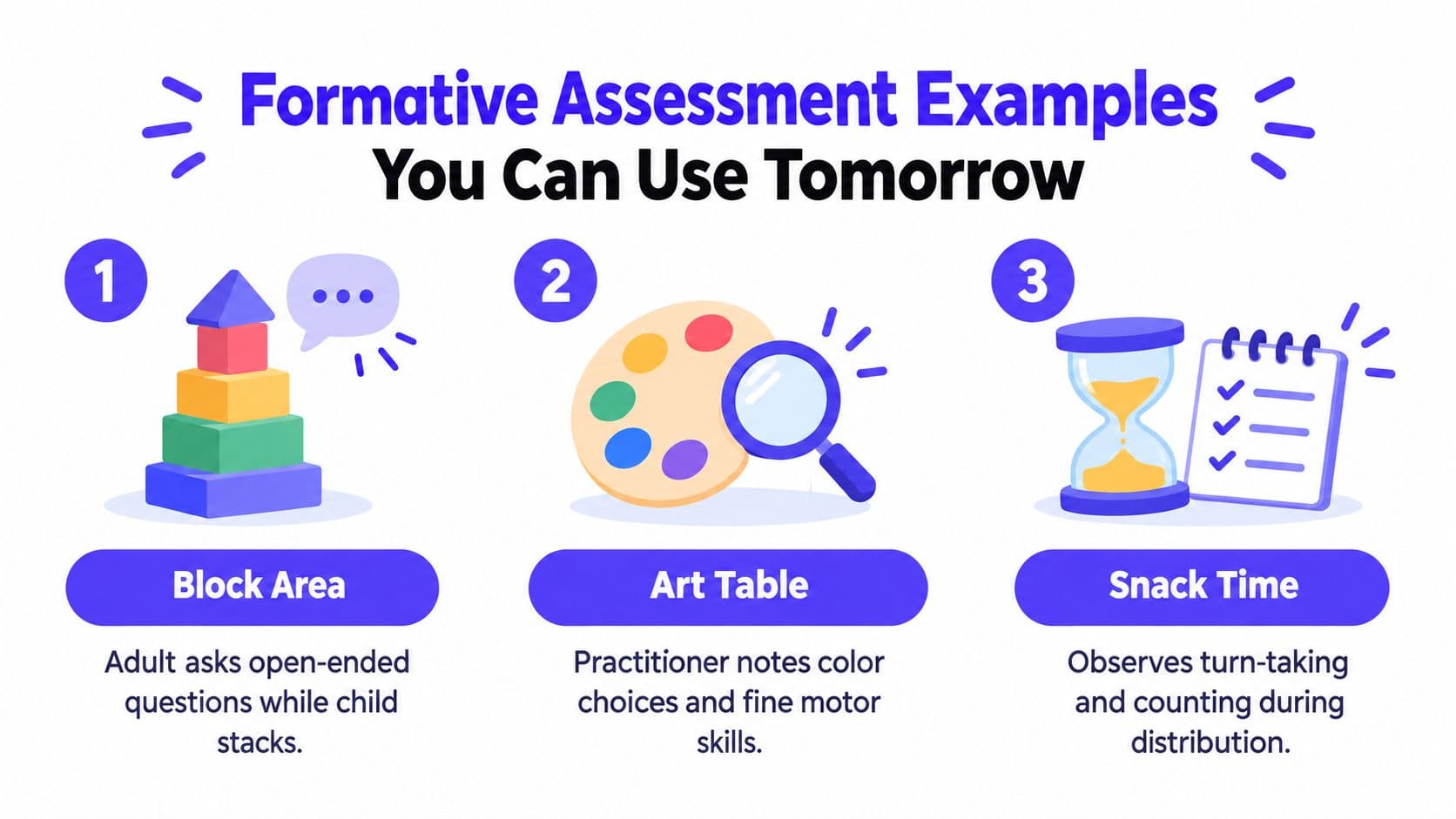
In the block area, kneel beside a child building a tall tower. Ask one open question, such as, “How will you stop it falling?” Then listen before helping. The child might widen the base, change the order of the blocks, or explain an idea with gestures rather than words. A short note inside the planning folder could read: Chose a wide block for the base after tower leaned, explained “strong here,” construction area, date.
Keep the record small: aim for one useful sentence per child, per week, dated and linked to an EYFS area. You don't need to capture every exchange.
At storytime, watch rather than trying to question everyone. Which children join in with repeated refrains? Who points to a picture that matches the text? Who leaves after two pages, and what happens just before they leave? Quick ticks on a group observation sheet may be enough, followed by one sentence about a child who needs a different kind of invitation into the story.
Snack offers another steady stream of evidence. You can notice who pours their own water, who uses a knife safely, who waits for a turn, and who attempts conversation with a peer. These observations can inform tomorrow's snack routine, perhaps by adding smaller jugs, modelling social phrases, or pairing children for a shared task.
The best formative note is often short enough to write without leaving the children.
A useful test is to add the next step immediately. If the note says a child counted three objects but skipped one when moving it, the next experience might involve touching or moving each object into a separate space. If a child communicates an idea through gesture, you might provide visual choices or model language without treating speech as the only evidence of thinking.
The formative assessment examples for early years practice can give you further prompts when you're building a shared approach with colleagues.
Here's a classroom moment worth preserving in another format:
Use photographs, children's words, and brief work samples selectively. The point isn't to create a complete visual diary. It's to keep enough context that another adult can understand what the child was doing, what it might show, and what you'll offer next.
Summative Checkpoints and Statutory Records
Summative assessment becomes easier when you know which evidence matters and when the formal moments arrive. In England, two key points are the age-two progress check and the EYFS Profile at the end of the Reception year.
The age-two check takes place when a child is 24 to 36 months old. It focuses on the three prime areas of the EYFS, Personal, Social and Emotional Development, Physical Development, and Communication and Language. The summary should help practitioners and families understand the child's needs and plan activities that support development. Where concerns arise, the setting should describe what it intends to do next and may involve other professionals where appropriate. The Know How Guide on the age-two progress check sets out this action-focused purpose.
The EYFS Profile is completed at the end of the year in which a child turns 5, usually at the end of Reception. It assesses development against the 17 early learning goals, giving families, schools, and local authorities a summary that supports transition and reporting. The evidence should come from what the child has shown across normal learning experiences, not from forcing every child through an artificial test.
Statutory Summative Checkpoints Compared
| Feature | Age-Two Progress Check | EYFS Profile |
|---|---|---|
| Timing | Between 24 and 36 months | End of the year a child turns 5 |
| Main focus | The three prime areas of the EYFS | Development against the 17 early learning goals |
| Evidence | Everyday observations, interactions, and family information | Evidence gathered across Reception experiences |
| Main readers | Families, practitioners, and health visitors where relevant | Families, Year 1 teachers, local authorities, and moderators where relevant |
| Main use | Identify needs and agree next steps | Summarise development and support transition |
A few habits prevent the familiar end-of-year scramble. Prepare templates at the start of the term, agree what terms such as emerging, expected, and exceeding mean within your team, and schedule moderation before deadlines become urgent. Moderation should involve looking at real evidence together, not asking staff to defend a label.
The common pitfalls are predictable. Staff leave evidence collection until the final half-term, treat a formative note as if it were already a summative judgement, or forget to share the age-two check with parents. The EYFS framework and assessment guidance can support consistent planning and language across a team.
Once the routine is established, the paperwork usually shrinks. You're not creating a new record from nothing. You're selecting and interpreting evidence you've already gathered.
Why Equity Changes the Whole Conversation
A set of assessment statements doesn't give every child an equal chance to show what they know. A 2025 equity-centered review argues that dominant early learning assessments can miss children whose language, disability, or cultural context doesn't match the design. It calls for assessment that is adaptable, developmentally appropriate, and useful across settings. The 2025 review on equity in developmental assessment places the question of validity at the centre.
A three-year-old who is asked to sit at a table and name flashcards may tell you very little about their understanding. They may recognise the objects in play, communicate through gesture, understand more than they can say in the setting's language, or need movement and repetition before responding. An autistic child may show careful pattern recognition while finding the social format of the task distracting or uncomfortable.
Fair evidence starts with the context
For a multilingual child, observe communication in the home language with support from a bilingual colleague or family member where possible. Treat pointing, gesture, signing, aided communication, and action as meaningful evidence rather than automatically ranking spoken English above them. A child can demonstrate choice, sequencing, problem-solving, and understanding without producing the exact verbal response an adult expects.
Play-based assessment supports this shift because children can show what they know through familiar activity. Watch how a child organises pretend play, negotiates a role, sorts natural objects, follows a visual routine, or persists with a physical challenge. Then record the context clearly, including the support provided and the child's own method of communicating.
Equity isn't an adjustment added after assessment fails. It's part of designing valid assessment from the beginning.
The issue also includes who gets assessed at all. If language differences, disability, or limited resources make documentation harder, a setting may have less evidence to review and still make a judgement. Teams need to ask whether the assessment process gives each child multiple authentic routes to demonstrate development, not only whether staff have completed the form.
Building a Weekly Rhythm That Actually Works
A workable assessment rhythm has to protect your time and your attention. It should make room for quick observations, child-led conversations, photographs, and work samples during the week, while leaving statutory checkpoints as planned review points rather than emergencies.
One simple flow might look like this:
| Day | Formative Focus | Summative Task | Time Needed |
|---|---|---|---|
| Monday | Observe a rotating focus child during child-led play | Identify evidence that may support a later summary | Short observation and brief reflection |
| Tuesday | Adjust provision or questions from Monday's evidence | None, unless a scheduled review is due | Quick planning update |
| Wednesday | Record patterns during a group experience | Add selected evidence to the child's developing record | Brief group notes |
| Thursday | Share a useful observation with a parent or carer | Gather family context for a broader judgement | Short conversation or message |
| Friday | Review the week and update relevant criteria | Check whether the evidence supports a developing summary | Team review in a protected slot |
Rotating focus children keeps the process fair without asking you to document everyone in depth every day. A note might be a sentence, a photograph with context, or a child's explanation captured immediately after the play. Set a realistic guardrail, such as capping note-taking at 10 minutes daily, and stop chasing perfect moments. A clear observation from ordinary play is often more useful than a staged task created only to fill a gap.
Use team meetings to compare interpretations. One practitioner may see a child's repeated filling and emptying as sensory exploration, while another notices early mathematical comparison. Discussing the evidence helps staff agree on what happened and what the next provision should be.
Digital planning can reduce repetition when it keeps the teacher's judgement in charge. Kuraplan offers weekly planning templates, standards-aligned planning tools, and assessment rubrics that can help a team organise criteria consistently without making every observation feel like a form-filling exercise. You can also use a weekly lesson plan template as a starting point, then adapt it to your setting's routines and EYFS expectations.
The aim is a gentle cycle: notice, interpret, respond, and review. Formative evidence keeps teaching responsive during the week. Summative records then grow from that living evidence instead of arriving as a paperwork project at the end.
Kuraplan helps educators build structured weekly plans, align activities with assessment criteria, and create rubrics and supporting resources without starting from a blank page. Visit Kuraplan to explore a practical way to organise formative observations and summative planning while keeping your attention where it belongs, with the children.