A coach can have strong conversations and good intentions, then lose the rest of the week to scattered plans, observation notes, resource creation, and follow-up. The problem usually isn't a lack of commitment. It's that the tools around the coaching cycle don't connect.
The most useful instructional coach resources support the full sequence: identify a teacher or student need, gather relevant evidence, choose a focused action, and revisit what changed. That requires more than a lesson library. Coaches may need standards-aligned planning, observation and video evidence, feedback protocols, professional learning, documentation, and district-level systems for role clarity and impact measurement.
Instructional coaching is now a regular part of many public-school operations. In the 2023–24 NCES School Pulse Panel sample, 59% of public schools reported at least one instructional coach, while 41% reported none. Literacy access was stronger than math access, with 64% of schools reporting at least one literacy coach and 56% reporting no math coach (NCES-based reporting). That uneven coverage makes tool selection a practical staffing decision, not a software preference.
The list below organizes resources by the work they support, from planning and evidence collection to professional learning and system building. Kuraplan is especially useful when coaches need standards-aligned lessons, assessments, worksheets, or visuals. Other options address coaching models, video evidence, educator development, and district implementation. The comparison focuses on fit, setup demands, concrete use, and limitations, rather than repeating feature lists.
1. Kuraplan
Kuraplan is the strongest fit when the immediate coaching bottleneck is co-planning. A coach and teacher can start with a standard, learning objective, or classroom need, then build a lesson or unit with differentiated activities, assessment rubrics, worksheets, visuals, and slides. That gives the coaching conversation something concrete to examine instead of leaving the teacher with general advice to “increase rigor” or “differentiate more.”
The platform is designed for K–12 educators and supports Common Core and other curriculum standards. Its outputs include print-ready worksheets with multiple-choice and image-based items, custom diagrams and classroom-safe visuals, and one-click slide decks that can source images and videos. A weekly planner can extract a timetable from a photo, while the AI teaching assistant provides planning ideas and classroom-management suggestions.
Best implementation scenario
Use Kuraplan before a planning-focused coaching session. The teacher brings a standard, an upcoming lesson, and a concern about student access or evidence of learning. The coach helps review the generated objective, activity sequence, differentiation, and assessment rubric, then agrees on one instructional move to observe.
For a grade-level team, sequential unit planning can help connect individual lessons to shared standards and assessments. The platform also offers 1,000+ free printable resources, and Kuraplan reports adoption by 1,000+ schools and tens of thousands of teachers on its website (Kuraplan).
Practical rule: Use the generated plan as a draft for professional judgment, not as a substitute for it.
What to weigh before adopting
- Strongest advantage: It reduces formatting and preparation work while keeping objectives and assessment visible.
- Best decision criterion: Choose it when teachers need usable classroom materials quickly, especially across several subjects or grade levels.
- Main limitation: Detailed public pricing isn't listed on the product page, so teams may need to sign up or contact Kuraplan for plan and district licensing information.
- Quality-control requirement: Teachers should review AI-generated content for accuracy, local curriculum expectations, accessibility, special education needs, and non-Common-Core standards.
Kuraplan works best when the coach uses it to sharpen a planning decision, such as what students should demonstrate and what evidence will count. It works less well when a team generates large quantities of materials without checking whether the tasks match the intended learning.
2. Instructional Coaching Group
A district may have capable coaches using different language, documentation, and expectations. The Instructional Coaching Group, founded around Jim Knight's work, addresses that coordination problem through a shared coaching framework. Its Impact Cycle and Partnership Principles give coaches a common process for setting a goal, examining current reality, and choosing an action with the teacher.
ICG offers institutes, virtual and on-demand workshops, consulting, books, and membership options. Membership combines a coaching platform with monthly sessions and community support. This range lets an individual coach start with professional learning, while district leaders can seek broader implementation guidance through consulting. Additional Meta advertising support is available through ShortGenius Meta ad creator.
Best implementation scenario
A district with several coaches can use ICG to establish consistent expectations for coaching conversations. Coaches study the framework, rehearse its language through role-play, and apply the same cycle when working with teachers. Principals then have a clearer way to distinguish coaching from evaluation and informal problem-solving.
The framework is most useful when coaches have strong individual skills but follow inconsistent processes. Shared routines can clarify referrals, goal-setting, documentation, and follow-up across schools. For example, a coaching lead might use the same cycle template in each school, then review completed cycles with coaches during regular team meetings.
What to weigh before adopting
- Strongest advantage: The methodology is research-anchored and supported by practitioner publications and tools.
- Best decision criterion: Choose ICG when consistency across coaches matters more than immediate access to individual forms or activities.
- Main limitation: Pricing varies, and district implementation may require a custom quote.
- Capacity concern: Consistent use requires protected learning time and leadership support, rather than a single workshop.
ICG will not solve a next-day need for a printable observation form. Its value grows when leaders protect coaching time, define the coach's role, and reinforce the framework across cycles. That operating support matters because a national study of instructional coaches found that coaches spent only 28% of their time on coaching-related tasks on average (study of coaches' time use). Without scheduling and role clarity, even a well-designed framework can remain separate from daily coaching practice.
3. Learning Forward
Learning Forward is a strong professional learning resource for coaches who need to connect their work to widely recognized standards for educator development. Its coaching hub, Standards for Professional Learning resources, Academy experience, conferences, journals, and member community give coaches more than a collection of isolated activities. They provide a way to examine whether coaching is collaborative, sustained, relevant, and connected to student learning.
Best implementation scenario
A district's instructional leadership team uses Learning Forward resources to audit its professional learning calendar. Instead of scheduling disconnected workshops, leaders map coaching, team meetings, observation cycles, and follow-up support against professional learning standards. Coaches can use the hub to prepare reflection prompts, plan learning sessions, and identify where teachers need continued support.
The Learning Forward Academy is better suited to a coach or leader who can commit to a longer development experience. It can support deeper learning than a one-off webinar, especially when the participant has a live school improvement problem to bring into the work.
What to weigh before adopting
- Strongest advantage: It offers standards-aligned, research-based guidance and a national professional community.
- Best decision criterion: Choose it when the coaching program needs stronger professional learning design, not just more coaching templates.
- Main limitation: The Academy can demand significant time and travel commitments.
- Implementation gap: Broad professional learning guidance won't automatically give a district a specific coaching model or workflow.
Learning Forward is also useful for content-focused conversations. A literacy coach might pair its professional learning guidance with practical formative assessment examples, then use the results of a classroom check to plan the next teacher learning experience. The resource is most effective when leaders translate broad standards into observable routines, such as how coaches prepare, collect evidence, and follow up.
4. BetterLesson
BetterLesson fits districts looking for job-embedded coaching and strategy support across a large teacher population. Its offering includes ongoing one-to-one virtual instructional coaching, leader coaching, workshops, and strategy libraries. The emphasis is on connecting professional learning to the teacher's current classroom work rather than separating training from implementation.
Best implementation scenario
A district adopting a new instructional approach provides teachers with ongoing virtual coaching. A teacher brings student work, a lesson challenge, or an observation question to the coach. The coach helps select a strategy, plan its use, and revisit evidence in a later conversation. Leaders can use workshops and leader coaching to keep the initiative connected to school priorities.
BetterLesson is also a practical option when a district has limited access to in-person specialists. Virtual coaching can extend support across schools, though the district still needs clear expectations for scheduling, communication, confidentiality, and follow-up.
What to weigh before adopting
- Strongest advantage: It combines coaching services, strategy libraries, workshops, and leadership support.
- Best decision criterion: Choose it when the coaching need is broad and tied to district initiatives or curriculum implementation.
- Main limitation: Pricing is typically quote-based and varies by contract.
- Content consideration: Some users may find that free lesson content has shifted as the offering has placed more emphasis on paid services.
A coach who wants to create a local planning routine can also use a lesson plan template alongside BetterLesson coaching. That pairing can work when the coach needs a consistent planning artifact but still wants a human coaching conversation around instructional choices.
BetterLesson is less appropriate if the district hasn't decided what its coaches are responsible for. A scalable service can't resolve unclear roles, competing initiatives, or a lack of protected coaching time.
5. TeachBoost Coach by SchoolStatus
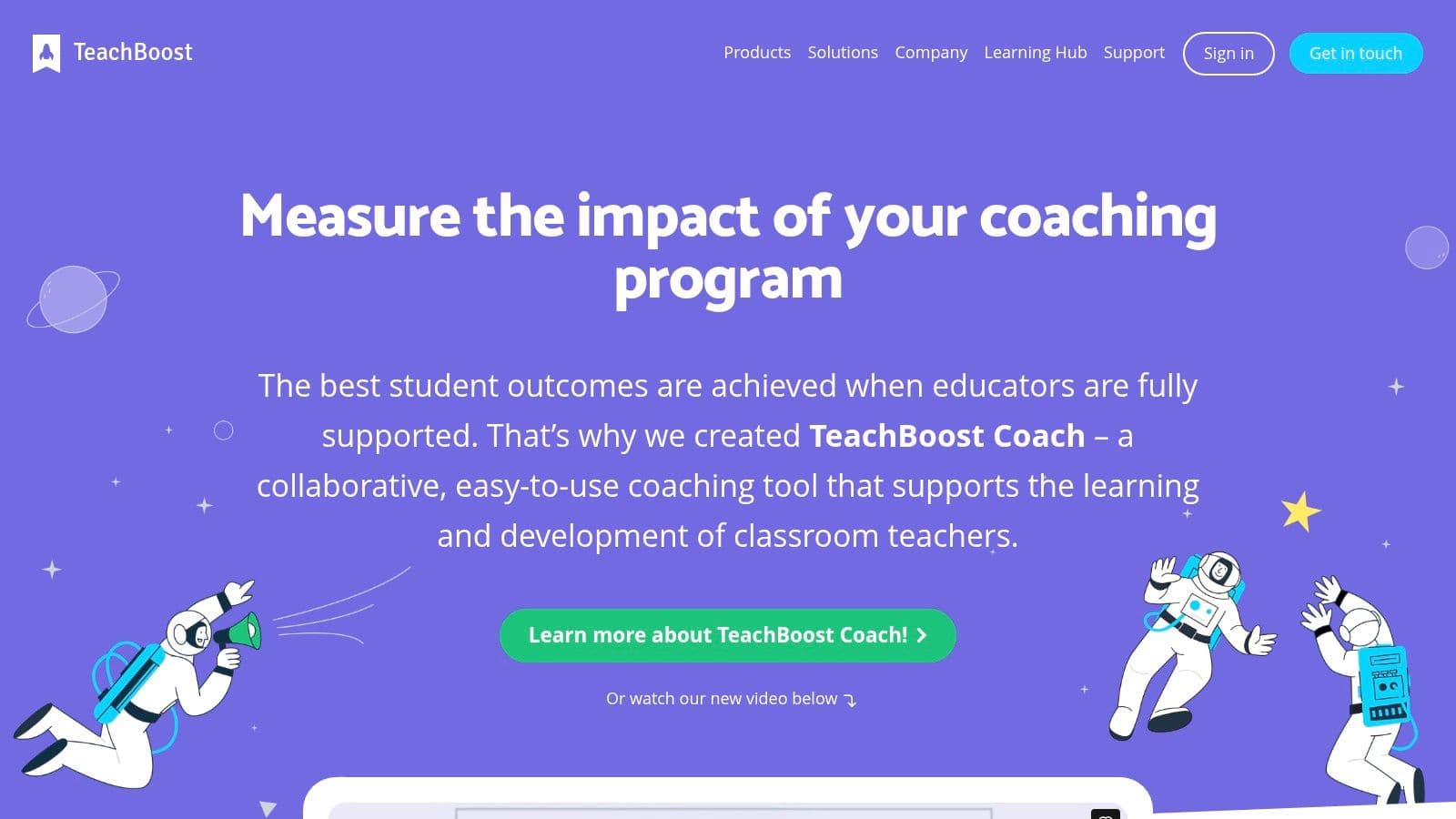
TeachBoost Coach is designed for the administrative side of coaching: planning cycles, setting goals, logging activity, recording feedback, and reviewing analytics. It's a sensible option when coaches are doing the work but leaders can't see the pattern of that work across schools.
A coaching platform can centralize information that otherwise sits in notebooks, spreadsheets, email, and private documents. The benefit isn't only cleaner recordkeeping. A shared system can help a coach remember the agreed action, schedule follow-up, and identify teachers who haven't received the support they were promised.
Best implementation scenario
A district asks each coach to document coaching goals, observation evidence, feedback, and next steps in one workflow. School leaders review dashboards for participation and activity, while coaches use the same system to manage individual cycles. Because TeachBoost supports multiple coaching frameworks, districts using Knight, Sweeney, Aguilar, or another model don't necessarily need to abandon their existing approach.
What to weigh before adopting
- Strongest advantage: It reduces administrative burden and gives leaders visibility into coaching activity and impact.
- Best decision criterion: Choose it when documentation, coordination, and reporting are the main problems.
- Main limitation: Pricing is quote-based and not publicly listed.
- Adoption risk: Coaches and teachers need training, clear data expectations, and reassurance about how records will and won't be used.
Measurement deserves special attention here. A national report found that 81% of schools and districts did not have the data or tools to measure coaching time, effort, and impact, and only 21% said they always use data to drive coaching decisions (national report on data-driven instructional coaching). TeachBoost can organize evidence, but it can't decide which indicators matter. Leaders must define those indicators before asking coaches to fill out another system.
6. Diane Sweeney Consulting
Diane Sweeney Consulting is built around Student-Centered Coaching, a model that organizes coaching cycles around student evidence and learning goals. That focus changes the opening question. Instead of beginning with a teacher's perceived weakness, the coach and teacher examine what students need to learn, what evidence currently shows, and which instructional response may help.
The organization offers consulting, online courses, institutes, a membership hub, workshops, practical forms, and coaching templates. The materials can help a coach move from a broad concern, such as “students need stronger discussion,” to a more specific cycle with evidence and a defined instructional goal.
Best implementation scenario
A coach and teacher review student work and identify a pattern in explanations or problem-solving. They set a student-centered goal, select an instructional strategy, collect classroom evidence, and meet again to study the result. The teacher remains an active decision-maker, while the coach helps keep the cycle focused on student learning rather than compliance.
The model can be particularly useful in schools where teachers are wary of coaching that feels evaluative. Shared attention to student evidence can create a more neutral starting point, although leaders still need to communicate role boundaries clearly.
What to weigh before adopting
- Strongest advantage: The model gives coaching a direct connection to measurable student outcomes.
- Best decision criterion: Choose it when student evidence should drive the coaching agenda.
- Main limitation: Services and membership pricing are generally available by inquiry.
- Integration concern: Districts may need support to connect Student-Centered Coaching with existing initiatives and evaluation systems.
A coach preparing a cycle around clarity of learning can pair the model with guidance on learning intentions and success criteria. Kuraplan can help turn the agreed objective into a lesson, assessment, or worksheet, while the Sweeney approach supplies the coaching structure for examining what students demonstrate.
7. New Teacher Center
New Teacher Center fits districts building sustainable induction and coaching systems. Its work connects mentor development, program design, equity, implementation support, and impact measurement. District leaders can use NTC for mentor and coach training, induction planning, instructional culture, and leadership support, rather than only downloading individual coaching forms.
Best implementation scenario
A district has many new teachers, but mentors use different routines and provide uneven support across schools. NTC can help leaders define a common induction model, prepare mentors, clarify support roles, and establish methods for reviewing implementation. That structure can also support broader instructional coaching when leaders want coaching tied to career-long development instead of treating it as a short-term response to staffing pressure.
A district should first map its current mentor roles, meeting schedules, evidence sources, and decision points. Then leaders can decide whether they need program design, mentor learning, implementation support, or a combination. The work is most useful when administrators are prepared to examine the conditions that shape coaching, including protected time, role clarity, leadership expectations, and access to relevant training.
Coaching quality depends on more than generic best practices. A recent ERIC literature review on scaling instructional coaching identifies content focus, alignment, implementation conditions, district infrastructure, and coach knowledge and skills as important considerations.
What to weigh before adopting
- Strongest advantage: NTC brings district-level expertise to induction, coaching design, mentor development, and program review.
- Best decision criterion: Choose it when leaders need a coordinated system, not just classroom-ready materials.
- Main limitation: Engagements are customized, so district timelines and costs vary.
- Fit concern: Its induction focus may feel less direct for veteran-teacher coaching, even though its broader work extends beyond new teachers.
NTC suits a district willing to review leadership conditions and program quality. A solo coach seeking an immediate observation template may find the entry point too broad. The central question is practical: what must the organization change so coaches have the time, preparation, and authority to support teachers well?
8. Edthena
Edthena uses video to make classroom evidence more accessible and specific. Teachers can upload secure video, add timestamped feedback, attach artifacts, and participate in asynchronous reflection. District dashboards support implementation, and the optional AI Coach can provide on-demand, self-directed reflection aligned to selected competencies.
Video doesn't automatically produce useful coaching. Its value comes from narrowing attention to a teachable moment: the wait time after a question, the distribution of student talk, the clarity of directions, or the response to an unexpected misconception. Timestamped comments can keep feedback anchored to what happened rather than what the observer remembers later.
Best implementation scenario
A coach can't visit every classroom regularly. A teacher records a lesson segment, identifies a question about student engagement, and adds context before the coaching conversation. The coach comments on selected moments, and the teacher reflects asynchronously before agreeing on a small change to test in the next lesson.
This approach can extend coaching across distributed schools and reduce dependence on the coach's physical schedule. It also creates shared evidence that a teacher can revisit, though schools must establish privacy, consent, storage, and communication expectations before video becomes routine.
What to weigh before adopting
- Strongest advantage: It lowers barriers to observation and supports evidence-rich reflection.
- Best decision criterion: Choose it when in-person observation time is limited or teachers and coaches work across different locations.
- Main limitation: Pricing varies by seats and features and is generally quote-based.
- Change-management issue: Teachers new to video reflection may need modeling, a low-stakes entry point, and careful norms around trust.
Edthena should not become a surveillance system. If leaders use video primarily for compliance, teachers may focus on avoiding mistakes instead of examining instruction openly. A coach should begin with a voluntary, clearly bounded cycle and agree in advance on what the recording will and won't be used to judge.
9. Google for Education Certified Coach Program
The Google for Education Certified Coach Program provides a free online curriculum and a five-step model for technology-integrated instructional coaching. It suits districts already using Google Workspace that need a shared process for coaching around digital tools, rather than a general framework for every instructional problem.
Best implementation scenario
A middle school coach begins with a teacher whose students submit work through Google Classroom, but rarely use feedback to revise. In the first cycle, the coach and teacher review a set of Docs, identify where comments stop at correction, and plan a short routine requiring students to respond to one comment before resubmitting. The coach uses Classroom and shared Docs to track the agreed action, while the teacher collects revised student work as evidence.
In the second cycle, they examine whether students' revisions address the feedback rather than just add more text. The teacher shares examples before the coaching conversation, and the coach helps refine the commenting routine. By the end, the evidence is visible in the sequence of original work, feedback, student response, and revision. The coach can also document coaching activities against the program's stated role and hour expectations, making the work easier for school leaders to understand.
This scenario works when the instructional goal drives tool selection. Google Classroom, Docs, and Slides can support planning, collaboration, feedback, and student-work review, while the community of practice and credential give participating coaches shared language. The trade-off is that the model may narrow attention if technology use becomes the goal.
What to weigh before adopting
- Strongest advantage: The training and resources are free and provide practical workflows for Google Workspace environments.
- Best decision criterion: Choose it when technology use directly supports the instructional goal.
- Main limitation: Its emphasis on technology integration does not address the full range of non-technology pedagogy.
- Eligibility requirement: Level 1 and Level 2 Google Certified Educator exams are prerequisites.
“Use more Google Slides” is not a coaching goal. “Help students explain mathematical reasoning through a shared response and revise after feedback” defines a stronger cycle. The program supplies structure, but the coach must still identify the learning problem and decide what evidence will show progress.
10. EL Education Professional Learning and Coaching
EL Education is a strong fit when coaching is tied to EL Education curriculum and core practices, particularly in literacy, student engagement, and continuous improvement. Its school-based coaching cycles, institutes, strategic planning, teacher and leader coaching, and implementation routines connect professional learning directly to curriculum use.
Best implementation scenario
A school adopting EL Education establishes coaching cycles around lesson implementation, student engagement, and the quality of student work. Coaches use defined routines and artifacts during classroom-based support, while leaders participate in strategic planning and coaching so the work doesn't sit only with individual teachers.
The content-and-pedagogy connection is the main advantage. Teachers don't have to translate a generic coaching model into curriculum-specific decisions on their own. Partner initiatives and evaluations also provide a way for districts to discuss outcomes and implementation, although leaders should examine how that evidence applies to their own setting.
What to weigh before adopting
- Strongest advantage: It integrates content, pedagogy, curriculum implementation, and coaching routines.
- Best decision criterion: Choose it when the district uses or plans to use EL Education curriculum.
- Main limitation: The model is less suitable as a general-purpose resource for districts with unrelated curricula.
- Procurement consideration: Services are proposal-based and pricing is custom.
A district shouldn't select EL Education coaching solely because it wants more coaching. The fit depends on curriculum alignment, leadership readiness, and the willingness to use the associated routines consistently. Without those conditions, a general coaching framework or planning tool may be more practical.
Top 10 Instructional Coaching Resources Comparison
| Product | Core features | UX / Quality (★) | Value & Pricing (💰) | Target audience (👥) | Unique selling points (✨) |
|---|---|---|---|---|---|
| 🏆 Kuraplan | AI lesson & unit planning; standards mapping; printable worksheets, visuals, slide decks; 24/7 AI assistant | ★★★★★, Trusted by 1,000+ schools | 💰 Free trial; school/district plans (contact) | 👥 K–12 teachers, curriculum teams | ✨ Auto-aligned standards, one-click worksheets & diagrams; weekly planner from timetable photo |
| Instructional Coaching Group (ICG, Jim Knight) | Impact Cycle framework; institutes & consulting; coaching tools | ★★★★☆, Research‑based | 💰 Quote-based (custom district work) | 👥 Instructional coaches, district leaders | ✨ Field‑tested coaching model; deep practitioner resources |
| Learning Forward | Standards for Professional Learning; Academy cohorts; conferences & journals | ★★★★☆, National standards steward | 💰 Membership & program fees (varies) | 👥 Coaches, PD leaders, district teams | ✨ Standards-aligned PD hub; multi‑year Academy cohort |
| BetterLesson | 1:1 virtual coaching; strategy libraries; workshops for districts | ★★★★☆, Scalable, job‑embedded | 💰 Quote-based; district contracts | 👥 Districts adopting curriculum, teacher leaders | ✨ Ongoing 1:1 virtual coaching + implementation supports |
| TeachBoost Coach (SchoolStatus) | Coaching cycle workflows; observations, feedback logs; analytics dashboards | ★★★★☆, Leader visibility & reporting | 💰 Quote-based SaaS pricing | 👥 Instructional coaches, school leaders | ✨ Centralized coaching evidence + actionable dashboards |
| Diane Sweeney Consulting (SCC) | Student‑Centered Coaching model; courses, templates, membership hub | ★★★★☆, Evidence-focused coaching | 💰 Membership & service quotes | 👥 Coaches focused on student-evidence goals | ✨ Ready-to-use artifacts; student-evidence-first approach |
| New Teacher Center (NTC) | Mentor/coach training; induction systems; impact measurement | ★★★★☆, Strong induction expertise | 💰 Custom proposals & district pricing | 👥 Districts building induction & mentoring systems | ✨ Deep program design for sustainable induction & mentoring |
| Edthena | Secure video upload; timestamped feedback; dashboards; optional AI Coach | ★★★★☆, Evidence-rich, asynchronous coaching | 💰 Quote-based; seat/features pricing | 👥 Distributed districts, coaches using video observation | ✨ Video-based reflection + AI-assisted coaching option |
| Google for Education Certified Coach Program | Free online curriculum; 5-step coaching model; community | ★★★★☆, Practical, workflow-friendly | 💰 Free (prereq: Google Cert exams) | 👥 Coaches in Google Workspace schools | ✨ Free credentialed program aligned to Google tools |
| EL Education (Professional Learning & Coaching) | Coaching cycles tied to EL curriculum; institutes; leader supports | ★★★★☆, Curriculum-integrated coaching | 💰 Proposal-based services | 👥 Schools/districts using EL Education curriculum | ✨ Strong ELA/student engagement integration and routines |
Choose the Resource That Matches Your Next Cycle
Start with the bottleneck you can name. If teachers spend too much time turning standards and objectives into usable lessons, worksheets, assessments, or visuals, a planning platform such as Kuraplan is the logical first pilot. If coaches use different language and inconsistent processes, a framework provider such as the Instructional Coaching Group or Diane Sweeney Consulting may matter more. If the problem is scattered documentation, TeachBoost Coach addresses a different need than Edthena, which is built around video evidence and reflection.
Next, decide whether the resource will serve an individual coach, a school team, or an entire district. Individual tools can be adopted quickly, but district systems need decisions about privacy, permissions, training, data ownership, and support. A professional learning organization may give a coach excellent ideas without supplying the workflow a district needs. Conversely, a platform may capture activity without improving the quality of the coaching conversation.
Use one defined coaching cycle as the pilot. Before choosing the tool, write down the baseline need, the evidence you'll review, the action the teacher will try, and the sign that the cycle deserves another conversation. That evidence might include a lesson plan, student work, an observation note, a video segment, a teacher reflection, or a coaching log. The important point is that the team agrees on the evidence before the tool starts producing records.
Coaching has demonstrated meaningful potential, but the results depend on implementation. A causal synthesis of 60 studies found pooled effects of 0.49 standard deviations on instruction and 0.18 standard deviations on student achievement (teacher coaching evidence synthesis). A separate meta-analysis reviewing 37 studies also reported positive effects on teaching practice and student achievement, including classroom-observation measures of instruction (education meta-analysis summary). Those findings support investing in coaching, but they don't justify measuring success by the number of meetings, forms, or platform logins.
Measure the decision, not the activity.
Ask coaches and teachers to record four things: the baseline need, the evidence reviewed, the action taken, and what changed for practice or students. That record can stay lightweight. The purpose is to help the team determine whether the chosen coaching move was useful, not to create another compliance burden.
Avoid a large platform rollout before the team agrees on a shared coaching purpose, workflow, and success indicators. Review AI-generated materials carefully, especially when using Kuraplan. Check local curriculum expectations, accessibility requirements, special education needs, and school policies before classroom use. A well-designed resource should give educators more time for professional judgment and student interaction, not make them responsible for correcting an unchecked stream of outputs.
Choose the tool that solves the next real problem. Pilot it with a small group, protect time for reflection, and keep the evidence close to the instructional decision. If the tool can't help a coach and teacher decide what to do next, it probably isn't the right resource for that cycle.
Kuraplan helps instructional coaches and teachers create standards-aligned lessons, units, assessments, worksheets, slides, and educational visuals in minutes, with differentiated activities and assessment rubrics built into the planning workflow. Visit Kuraplan to try its planning support and see whether it can remove preparation friction from your next coaching cycle.