It's the last stretch of May. The calendar is crowded with celebrations, half-packed cubbies spill onto the floor, and your kindergarteners seem to have discovered a fresh supply of energy just when you need calm, careful observations. Between rehearsals, classroom cleaning, and end-of-year activities, a formal kindergarten end of year assessment can feel like one more task to finish before the bell rings.
That assessment deserves more care than a final box check. It gives the first-grade teacher a practical picture of each child's starting point, strengths, support needs, and learning habits. It also gives families something more useful than a grade: a clear account of growth and sensible next steps.
A strong report doesn't reduce a five-year-old to a score. It combines direct literacy and mathematics evidence with work samples, conversations, teacher observations, and developmental information. The result is a documented narrative of the whole child, grounded in what the child can do and how they learn.
The May Chaos and Why Your Assessment Matters
On a late-May morning, one child may be practicing a graduation song while another searches for a missing glue stick. A small group is building a tower beside a table of unfinished writing, and your assessment clipboard is buried beneath artwork. This is ordinary kindergarten. The mess doesn't mean assessment has to become careless.
The most useful end-of-year record often comes from noticing what happens inside these ordinary moments. A child who avoids a formal writing prompt may explain a detailed story while drawing. Another may struggle to answer a direct question but independently sort materials, negotiate a turn, and persist with a difficult construction. Those observations belong in the final picture.
Treat the record as a bridge
Kindergarten assessment in the United States developed from a decentralized system rather than one national examination. A national review of state policies conducted from October 1999 through January 2000 collected responses from 71 state and education officials and found that states were moving away from broad, placement-oriented testing toward classroom assessment used to improve instruction. The review reported that 6 states mandated first-grade readiness testing, while 37 states said local districts used it. In 35 of those states, results could influence decisions at the end of kindergarten. The historical review of kindergarten assessment policy helps explain why a final assessment is better understood as a portfolio of evidence than as one universal test.
That portfolio becomes a bridge between classrooms. It can tell a first-grade teacher which phonics skills are secure, whether a child needs visual support for directions, how the child approaches unfamiliar tasks, and which interests may spark engagement. It also helps families understand progress without making a child feel compared with classmates.
Practical rule: Record enough evidence that another teacher can plan from it without needing to guess what you meant.
Families also value the community memories surrounding this transition. If you're collecting photos from the final celebration, a service for sharing graduation ceremony photos can make it easier for families to access those moments while you focus on the children and the assessment record.
Replace the final score with a useful profile
A single score hides too much. It can miss a child's developing oral language, physical coordination, self-regulation, curiosity, or ability to apply a skill during play. It may also overstate a weakness when a child is tired, anxious, unfamiliar with the task format, or still developing the language used for instruction.
Your final record should answer three questions:
- What can the child do independently?
- What can the child do with support or in a familiar context?
- What should the next teacher notice first?
That shift makes the assessment both more humane and more useful. You still collect concrete literacy and math evidence, but you place it beside the behaviors and developmental capabilities that shape first-grade success.
Mapping the Five Domains of Kindergarten Growth
A child may read a simple book accurately yet struggle to hold a pencil, join a group, or recover when a plan fails. The end-of-year profile should capture those connected parts of school readiness, not reduce the year to reading and mathematics. The U.S. Government Accountability Office's overview of state kindergarten assessments identifies domains commonly including physical well-being and motor development, social-emotional development, language and literacy, approaches to learning, and cognition or general knowledge. Early mathematics and science often fit within that wider cognitive domain.
Use five practical lenses to review the evidence.
Literacy and mathematics
Literacy evidence should combine direct measures with classroom work. Check letter-name fluency, letter-sound fluency, phonological awareness, and early word reading under consistent conditions. Then examine writing, story retelling, oral language, and the child's ability to connect speech with print. These samples show how a skill functions beyond a short testing task.
A longitudinal study of 412 students found that kindergarten letter-name and letter-sound measures predicted end-of-year word-reading fluency, although prediction was imperfect. For students below the 25th percentile, later assessments classified 64% for letter-name fluency and 60% for letter-sound fluency. Mid-year measures explained 72% of the variance in end-of-year word-reading fluency, compared with 53.7% for fall measures. The published literacy study supports using spring evidence to plan instruction rather than assigning a fixed label from one score.
What this means for your classroom: collect direct literacy data, then test your interpretation against writing, conversation, and independent reading behavior. A child's score may identify a need, but the broader record helps you decide what support is likely to work.
For mathematics, observe number sense, one-to-one counting, quantity comparison, composing and decomposing numbers, patterns, shapes, measurement language, and spatial reasoning. Block construction can reveal spatial thinking more clearly than a worksheet. Ask how the child knows two groups are equal, and record the strategy, vocabulary, and level of support.
Language, movement, and learning behavior
Language includes vocabulary, listening comprehension, expressive language, and following directions. Note whether the child follows a two-step direction during a routine, explains a process, asks for clarification, and sustains a conversation. Record the context, because a quiet response in a whole-group lesson may look different from thoughtful language during play.
Physical development belongs in the same profile. Observe pencil control, cutting, small-material manipulation, coordination, balance, and safe participation in movement. The guide to fine motor activities for kindergarten can help connect everyday routines with observable motor goals.
Social-emotional growth and approaches to learning overlap, yet each adds useful information. Look for turn-taking, emotional labeling, recovery after disappointment, persistence, attention, flexibility, curiosity, and willingness to try another strategy. These behaviors often determine whether a child can apply an academic skill in a busy first-grade classroom.
The statutory early years standards in England offer a useful comparison because developmental, communication, physical, and learning behaviors sit alongside early academic goals.
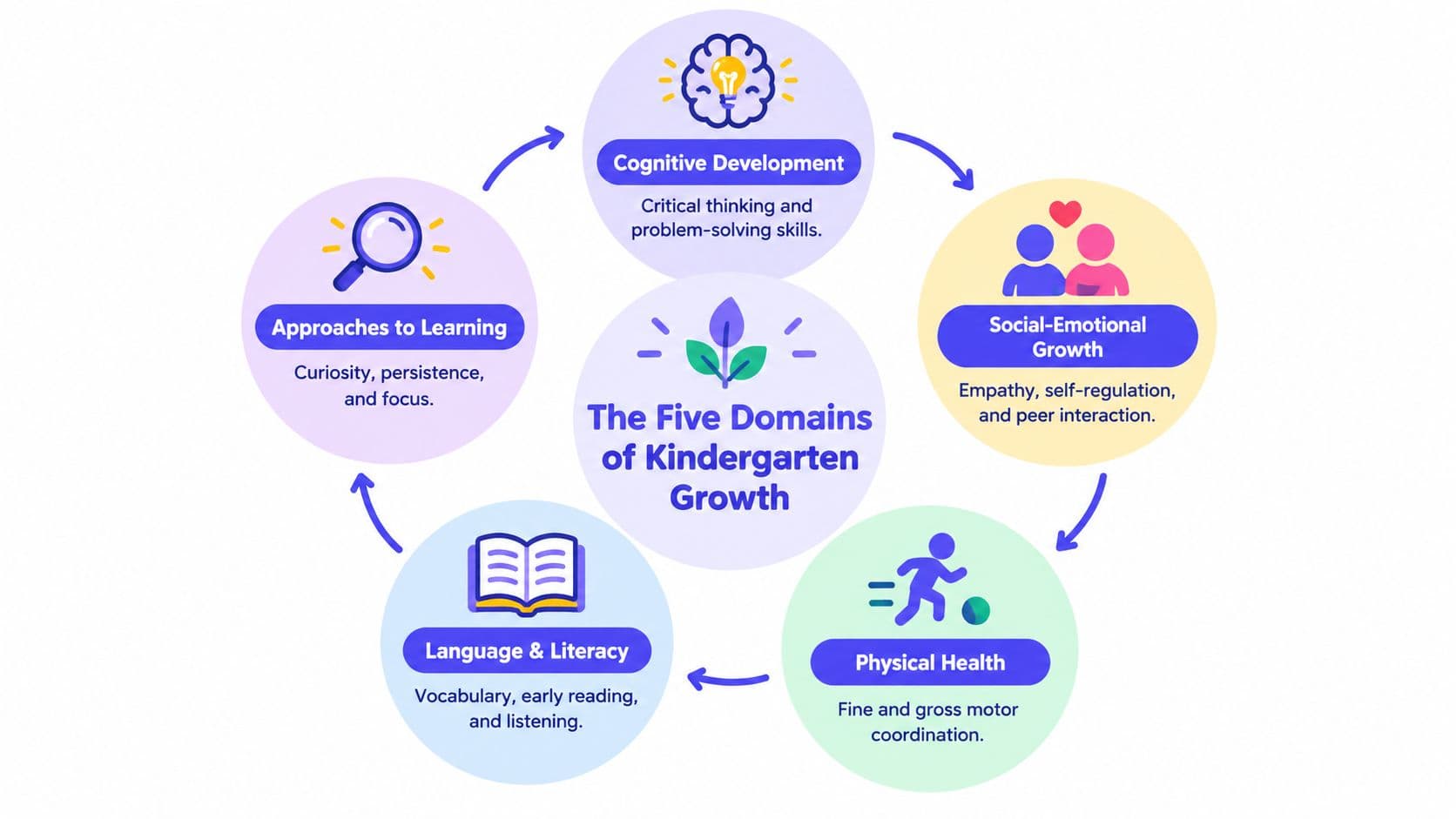
One block-building episode can document several domains at once. A child plans a structure, explains the design, negotiates materials, changes the plan after a collapse, and cleans up. That single observation includes cognition, language, motor control, social development, and persistence.
This video offers another way to consider developmentally appropriate evidence:
The purpose is not five separate tests. It is a documented narrative of growth that combines academic evidence with the capabilities first-grade teachers and families need to understand.
Building Your Assessment Workflow and Rubrics
The best workflow is the one you can complete accurately during a busy school week. Start by identifying the decisions the assessment needs to support. If the first-grade teacher needs reading-group information, collect direct literacy evidence. If a child needs support with independence or motor control, gather observations that show when the difficulty appears and what helps.
Gather evidence in manageable layers
Use a short sequence rather than one exhausting assessment day.
Review the baseline. Compare current work with earlier samples, but don't assume the same task tells the whole story. A child may have changed substantially in strategy, confidence, or independence even when a score moves slowly.
Administer direct measures. Use brief, one-to-one tasks for letter names, letter sounds, phonological awareness, word reading, counting, quantity, and other agreed learning targets. Record accuracy and fluency where timing is part of the measure.
Collect authentic work. Save a writing sample, a mathematics representation, a drawing with dictated language, and a task that shows problem solving. Add the date and a short note about the prompt and level of support.
Observe in context. Watch children during centers, transitions, group lessons, outdoor play, and collaborative work. A child's behavior across contexts is more informative than a single polished performance.
Invite family insight. Ask what the child enjoys, which languages are used at home, and where the family sees confidence or frustration. Family information can explain patterns that classroom data alone cannot.
A technical-quality workflow also checks reliability and measurement error. Guidance recommends selecting measures with reported internal or split-half reliability near or above .70, using at least two complementary indicators per domain, and verifying important decisions with repeated progress-monitoring data. One published computer-adaptive measure reported split-half reliability of .75, one-week test-retest reliability of .66, and generic reliability of .77, with correlations between administrations and year-end reading outcomes ranging from .36 to .46. The technical discussion of kindergarten progress monitoring shows why a score near a cut point shouldn't carry the entire decision.
Make the rubric observable
A rubric should describe behavior, not personality. “Is a strong reader” gives the next teacher nothing to plan from. “Reads familiar decodable words independently and uses the first sound when a word is unfamiliar” is observable and instructionally useful.
A simple three-level rubric can work:
| Level | Evidence language | Teacher question |
|---|---|---|
| Emerging | The skill appears inconsistently or only with substantial support | What does the child need to experience next? |
| Developing | The child demonstrates the skill in familiar tasks or with occasional prompts | Which supports help the child transfer it? |
| Secure | The child demonstrates the skill independently across more than one context | How can the child extend or apply it? |
Keep the evidence beside the level. If a child is “developing” in writing, note whether the child can represent sounds, form recognizable letters, separate words, or produce an idea with adult dictation. A Children Psych evaluation guide can provide useful background when you're distinguishing classroom evidence from formal achievement testing.
Kuraplan can be used as one planning option to organize standards-aligned checklists, rubrics, lesson materials, and printable assessment resources. Its formative assessment examples are most useful when they support your professional judgment rather than replace observation.
A reliable record is not the record with the most marks. It's the record that makes the next instructional decision clearer.
Ensuring Fairness for Multilingual Learners
A child may understand a mathematical idea without explaining it in the assessment language. A child who uses AAC may show comprehension through a device, gesture, pointing, or a selected response. A child with a disability may need a different access route to demonstrate the same concept. Fair assessment separates the learning target from the way the child communicates.
A newcomer sorts objects correctly by attribute, then answers the oral question in Spanish. Record the sorting target as demonstrated, and note that the explanation was given in the home language. That record is more accurate than marking the concept as missing because the child could not yet explain it in English.
A timed, adult-directed task and an observation-based portfolio provide different kinds of evidence. Treating them as interchangeable can hide either a skill or an access barrier.
| Evidence approach | What it can show | Where it can mislead |
|---|---|---|
| One-time standardized task | Performance under consistent conditions | Language proficiency, anxiety, unfamiliar routines, or disability may affect the result |
| Classroom observation | Skill use during authentic activities | Notes can vary unless teachers define clear look-fors |
| Work sample or artifact | Strategy, representation, and growth over time | The amount of adult support may be unclear |
| Conversation or demonstration | Reasoning, vocabulary, and conceptual understanding | The child may communicate more effectively in another language or mode |
Standardized information still has a place. A single score should not serve as proof of mastery or a complete description of ability. The spring classification figures discussed earlier show that borderline results need corroboration rather than a label. Compare the result with classroom work, oral-language observations, family information, and the child's usual communication mode.
Document access, not just performance
For each important observation, record the conditions that made the response possible. Note the language used, whether an interpreter supported communication, whether the child used AAC, which visual or physical accommodations were provided, and how much prompting was needed.
Ask:
- Did the child demonstrate the concept through objects, pictures, gestures, or the home language?
- Was the difficulty conceptual, linguistic, motor, attentional, or related to the task format?
- Did performance change during play, small-group instruction, and individual testing?
- Which support allowed the child to show the skill most accurately?
Assessment should draw on observations accumulated over time, using multiple formats and attending to academic and developmental learning. Queensland guidance on kindergarten assessment reinforces the value of observations, conversations, artifacts, and naturalistic performance.
Fairness does not lower expectations. It makes the evidence more precise. If the target is sorting by attribute, a child should not fail because the explanation required pictures or the home language. If the target is social participation, document the child's communication mode, the setting, and the conditions in which peer interaction succeeds.
Write “not yet observed in this format” when that is the truth. Don't turn limited access into a statement about limited capability.
Writing the Report Families and First-Grade Teachers Will Use
A useful final report reads like a professional handoff, not a data dump. It should help a family recognize their child and help the next teacher decide what to do first.
Begin with a brief statement of growth. Name a strength that is visible in more than one setting, then add the evidence. “Maya has become a confident participant in shared reading” is stronger when followed by the detail that she retells familiar events, identifies several letter sounds, and uses pictures to explain an unfamiliar word.
Pair every judgment with evidence
Avoid isolated labels such as “below,” “weak,” or “not ready.” Those words may be unavoidable in a formal system, but they don't explain the instruction a child needs. Describe the skill, the conditions, and the next step.
For example:
- Literacy: “Recognizes 18 of 20 letter sounds independently and uses beginning sounds when attempting unfamiliar words. Continued practice with vowel patterns and blending will support more consistent word reading.”
- Mathematics: “Counts a set accurately and explains which group has more when objects are arranged clearly. Continue practicing comparison when objects are spread out or arranged in different ways.”
- Language: “Follows familiar two-step directions and contributes detailed ideas during small-group conversation. Visual cues and extra processing time support participation in whole-group discussions.”
- Learning behavior: “Persists with construction and revises plans after a structure falls. During paper-and-pencil tasks, brief movement breaks help maintain attention.”
The 18 of 20 example is an illustration of how to write concrete evidence, not a universal benchmark. Use the actual observations and measures you collected for that child.
The South Carolina Kindergarten Readiness Assessment offers a useful reporting principle. Its technical report explains that raw scores are converted into scale scores because the conversion accounts for item and form difficulty, and it describes levels as Demonstrating Readiness, Approaching Readiness, and Emerging Readiness. The South Carolina technical report is a reminder that raw totals shouldn't automatically become percentages or grades. In a classroom report, clear learning targets and performance bands are often more meaningful than an unexplained total.
Write for two readers at once
Families need plain language, respect, and a clear way to help at home. First-grade teachers need enough precision to plan groups, supports, and starting lessons. You can serve both by using a consistent structure:
- Strengths and interests: What does the child enjoy and do confidently?
- Current evidence: Which skills are independent, developing, or emerging?
- Learning conditions: What language, tools, prompts, or routines support success?
- Next instructional steps: What should the next teacher continue or introduce?
- Family partnership: What simple activities invite practice without turning home into school?
Keep the tone descriptive rather than comparative. The UAE Ministry of Education's 2025–2026 assessment policy describes kindergarten assessment as continuous, inclusive, and developmentally appropriate, with achievement levels that are descriptive rather than comparative and focused on growth across domains. The UAE assessment policy aligns with a sound reporting habit: pair each level with evidence and a next step.
A report-writing tool can help you organize consistent language, but you must edit every statement against the child's actual record. Kuraplan's student report writer can support the drafting process when you provide specific observations, learning targets, and next steps. The teacher remains responsible for checking accuracy, removing generic wording, and protecting the child's dignity.
The final paragraph should leave the reader with direction, not anxiety. “Continue daily conversation, shared reading, and playful counting” gives a family something concrete. “Begin first grade with visual directions, repeated modeling, and opportunities to explain thinking with objects” gives the next teacher a practical starting point.
A well-made kindergarten end of year assessment closes the year by honoring what the child has learned, while opening first grade with useful information. It doesn't need to claim certainty where the evidence is mixed. It needs to make growth visible, describe context plainly, and point the next adults toward responsive instruction.
Kuraplan helps you organize standards-aligned kindergarten lessons, observation checklists, rubrics, worksheets, and student reports in one planning workflow. Use it to turn your end-of-year evidence into clear materials and actionable next steps, then visit Kuraplan to explore how it can support your assessment planning.