The bell goes in eighteen minutes. On the desk: a slide deck with nine activities, a worksheet downloaded at 10.30 last night, six printed sets and a board pen that's nearly dead. What's missing is the one thing that decides whether the next fifty minutes work, which is what you'll look at, before the bell, to know whether the lesson landed.
That gap is where planning time disappears. Teachers across OECD systems spent an average of 6.5 hours per week planning and preparing lessons, equal to 17% of their total working time and the second-largest reported work category after teaching itself, according to TALIS 2018. That's a full working day every week, and too much of it goes into documents nobody reads twice.
A lesson plan isn't a script or a compliance artefact. It's a set of decisions made before anyone walks in: what students will be able to do, what evidence proves it, and what you do next when the evidence is thin. Build it that way and the business of making lesson plan pages gets faster, not slower.
Lesson Plan Parts and What Each One Holds
A National Center for Teacher Quality analysis of federal data, cited in a RAND report on instructional materials, puts planning time for public-school teachers at roughly 53 minutes a day, or just under 4.5 hours a week, with about a third of the districts in its sample allocating around four hours weekly. The same report found teachers working with new materials spent 8.19 hours a week on instructional planning against 7.43 hours for colleagues using none.
That budget rules out the beautiful two-page narrative. If you can't rebuild the plan in twenty minutes, it won't survive a Tuesday. So the template stays fixed and only the content changes.
Seven boxes, always in the same order, with a Year 8 fractions lesson as the running case.
| Component | What to Write | Example (Year 8 Fractions) |
|---|---|---|
| Learning objective | One observable skill, measurable by the end of the lesson | Add two fractions with unlike denominators |
| Success criterion | The check a student must pass to show the objective | Converts both fractions to a common denominator before adding |
| Prior knowledge check | Two or three questions that reveal readiness | Find equivalent fractions for 1/2 and 2/3 |
| Sequence | Modelling, guided practice and independent work, with minutes | Model 8 min, partners 10 min, independent 12 min |
| Differentiation | What changes for students who are not ready yet | Use fraction strips instead of symbols for students who are stuck |
| Assessment | The exit ticket and the response that drives next lesson | Exit ticket with one sum; under 60 percent correct means remodel |
| Materials and timing | Everything needed and the minutes that fill the period | Board, printed set, fraction strips; 5 min check, 8 min model, 10 min partners, 12 min independent, 5 min exit ticket equals 40 min |
Two rows do the heavy lifting. The success criterion is the sentence that keeps the lesson honest, because it tells you what you're looking for while students are still in the room. The assessment row has to name a number and a response, not just a task. "Exit ticket" alone is decoration; "under 60 percent correct means remodel" is a decision.
The boxes travel across subjects. Swap the fractions for nine health lesson ideas from VirusFAQ.com and the structure holds unchanged: objective, success criterion, prior knowledge, sequence, differentiation, assessment, materials. Same page, different content. Once the template stops moving, next unit's plan takes a fraction of the time, and the thinking goes where it belongs.
How to Plan a Lesson From the Objective Backward
Start at the end and the plan nearly writes itself. Start with the activity and you'll spend the evening justifying it.
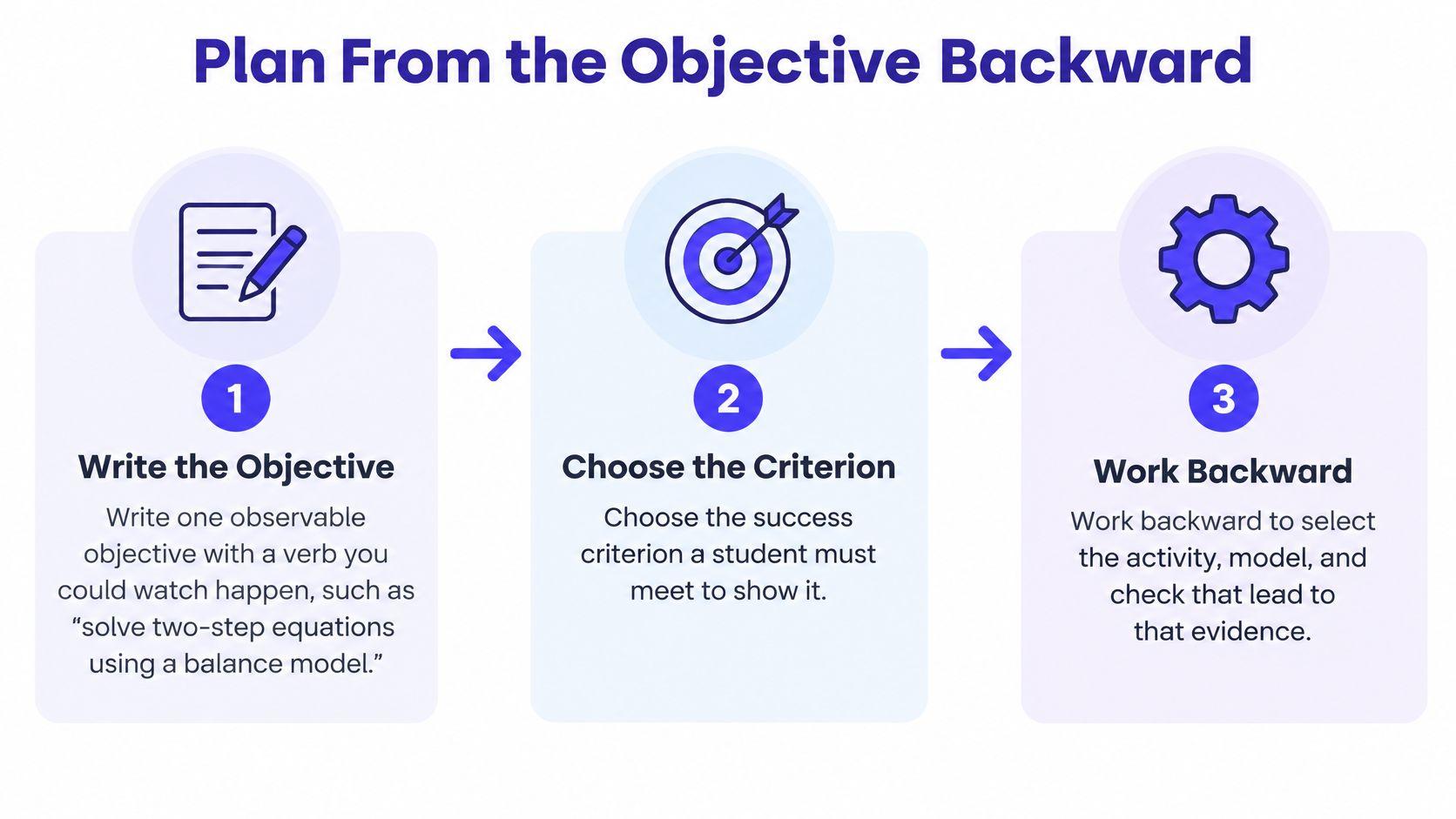
Write one observable objective. Use a verb you could watch happen: solve, convert, label, compare, justify. "Understand fractions" can't be observed on a Tuesday morning. "Solve two-step equations using a balance model" can. If you can't picture a student doing it, nothing that follows has a target.
Choose the success criterion before any activity. The criterion is the sentence that decides whether an activity earns its place in the period. Writing it first is what stops an activity you like from becoming the objective.
List the concepts, terms and skills the objective depends on, and cut the rest. Adding unlike denominators depends on equivalent fractions and multiplication facts. The history of fraction notation does not. Every item you keep is a minute you lose from practice.
Model the target skill and say the reason for each line aloud. The Institute of Education Sciences practice guide on organizing instruction and study recommends interleaving worked examples with novel problems, pairing verbal explanations with graphics, and linking abstract ideas to concrete representations. A model that produces only the answer teaches copying, which is why students can follow your board work and still freeze alone.
Give partially completed examples. Students finish the last steps themselves while the method is still fresh. This is the bridge between watching and doing, and it's the step teachers skip when time is short.
Assign an independent task that uses the same skill in a new context. New numbers in the same format tests memory. A word problem that requires the same conversion tests transfer.
Reserve the last five minutes for a short retrieval check, and place it before the end-of-unit test, not after it. The same guide recommends spacing practice so students meet each major element more than once, with weeks or months between exposures, and running closed-book quizzes diagnostically so you can reteach the high-error items rather than just record a score.
The logic mirrors what any coach does when building drills and movement patterns into a session: each drill exists to produce one specific observable action, and if it doesn't, you change the drill rather than the players.
Where the Sequence Breaks
The common slip is writing the activity first and back-filling an objective that matches it. That turns the objective into a label on a document nobody reads, and it's why so many plans describe what the teacher will do and never what students will show.
The second slip is concentrating all practice immediately before the test. Delayed review and spaced quizzing do more for retention than a revision lesson the day before.
There's also a quieter failure: a success criterion written so loosely that three different lessons could claim to meet it. If "students will understand equivalent fractions" sits at the top of your plan, every activity looks justified and none of them is tested. Tighten the criterion until one specific task either passes it or doesn't.
The test: if the independent task collapses, check the modelling and the partially completed examples before blaming the class.
For a longer treatment of writing criteria students can check themselves against, this guide to learning intentions and success criteria is worth twenty minutes.
Plan for Students Who Start in Different Places
Differentiation planned without evidence is guesswork in a nicer font.
Here's a pre-check that takes four minutes. Year 8 is adding fractions with unlike denominators next lesson, so the half sheet asks three things: find two equivalent fractions for 1/2, convert 3/4 and 2/3 to twelfths, and add 1/4 + 2/4. Sort the sheets by what they show, not by last term's report.
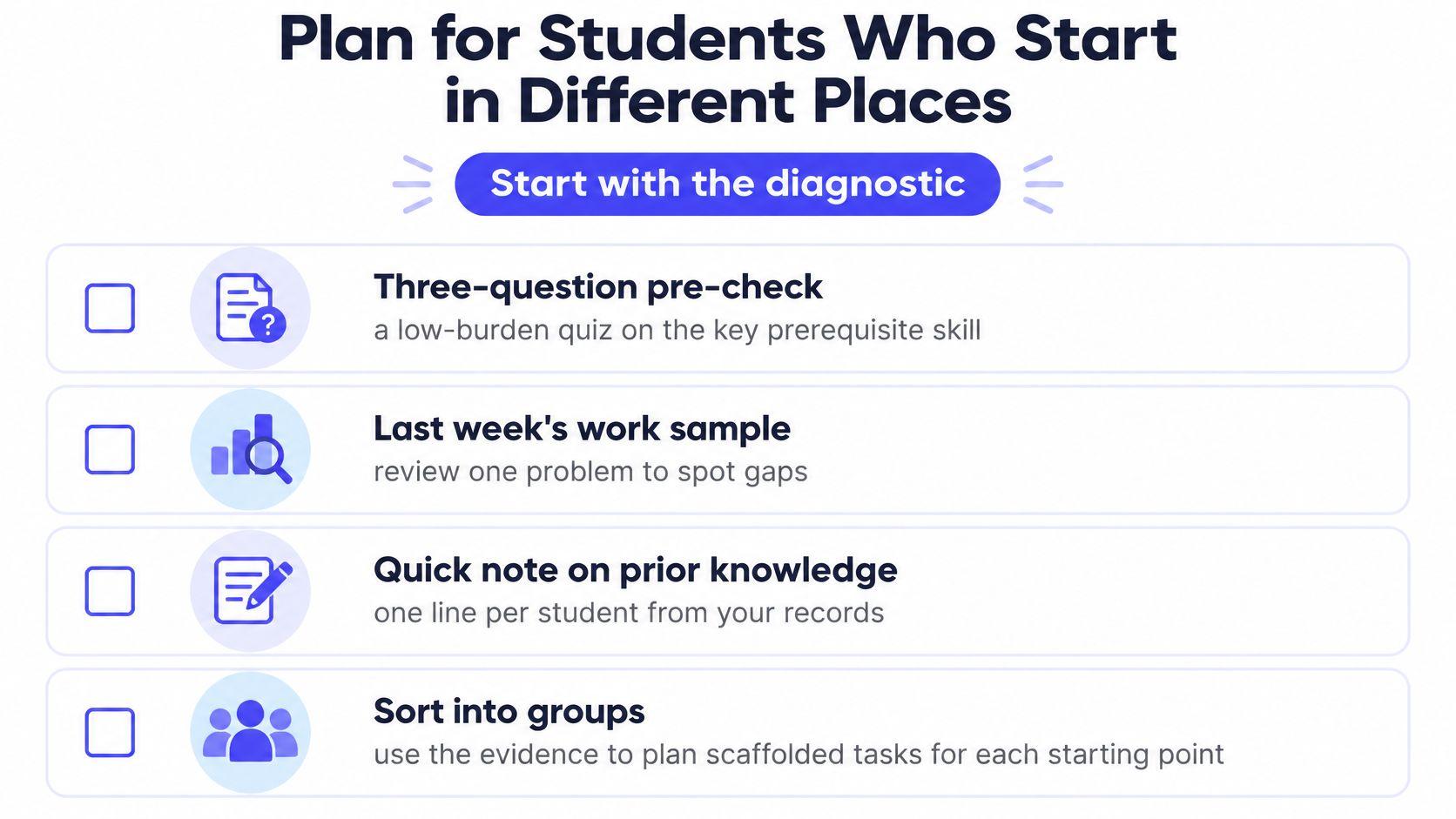
Three piles fall out. Students who can't yet generate equivalents get fraction strips and a model on the board. Students who convert but lose the denominator get a partially completed set. Students who are fluent get a problem that needs two conversions before the addition, not fifteen more of the same.
Then decide what flexes, because you can't flex everything without losing the objective.
- Content: a shorter set of examples, or the same examples with the numbers made friendlier.
- Process: a worked model left on the board, a sentence stem, or a partner to check each step.
- Product: a labelled diagram instead of a paragraph, or an annotated calculation instead of a written explanation.
- Success criterion: the same target with one fewer step, such as adding fractions where one denominator divides the other.
Keep the cognitive demand fixed. A scaffold should reduce the number of steps a student performs alone, not the thinking the objective asks for. Fraction strips for a student who can't picture twelfths is support; fraction strips for the whole class during independent practice is a downgrade.
Write the regroup point into the plan itself: "after the guided task, students move to the group that matches their exit answer." Groups that never shift are just sets.
The diagnostic is the part that gets skipped, and it's also the expensive part. A study in Cogent Education identifies pre-assessment, mapping students' academic competencies and using assessment evidence as feedback as some of the most time-consuming elements of differentiated instruction, with teachers also reporting limited skill in spotting learning progress and thin resources to work with. Time pressure and curriculum rigidity make it worse in multigrade rooms.
The pitfall to name and avoid is three worksheets that differ only in font size. That's formatting, not differentiation. For a fuller set of differentiation teaching strategies that start from evidence rather than labels, the workflow above is the one to keep coming back to.
Pick Activities That Match Each Stage
| Activity | Best Stage | Typical Time | Watch For |
|---|---|---|---|
| Worked example | Modelling | 5-8 minutes | Students copy steps without following the reasoning |
| Think-pair-share | Early practice | 4-5 minutes | One partner does all the thinking |
| Partially completed problems | Guided practice | 10-15 minutes | Students copy the filled-in part without completing the gap |
| Independent task | Application | 10-12 minutes | Errors surface only when you mark the work later |
| Station rotation | Mixed practice | About 4 minutes per move, plus station time | Transitions eat up time; keep one station teacher-led |
| Retrieval quiz | Closing check | 3-5 minutes | Results are collected but never used in the next lesson |
Modelling comes first because nobody can practise a method they haven't seen. A worked example earns its minutes only when it shows the reasoning, so narrate the choice at each line instead of narrating the arithmetic.
Pair talk works when each partner has to explain one step out loud before anything is written down. It fails when one student writes and the other nods, which is what happens if you set the task as "discuss" and walk away.
Independent tasks should be short enough that you can see errors during the lesson. Twelve minutes of work you mark on Sunday tells you nothing you can use on Tuesday.
Station rotations suit a mixed-readiness class, but the moves cost you. Budget about four minutes per transition, keep one station teacher-led so you get a live look at the students who need it most, and don't run four stations on a forty-minute period.
The same chunking logic applies to longer simulations. If you teach a role-play unit, Model UN lesson plans show how to break the preparation into blocks that each produce something checkable before the next one starts.
What to cut: anything that doesn't practise the objective, doesn't produce evidence you can read in two minutes, or doesn't fit the minutes left after the check.
Three questions, asked of every activity in the plan. Does it practise the objective? Does it generate evidence I can read quickly? Does it fit? Two yeses and a no on the third means the activity goes, however much you like it.
Check Understanding Before the Lesson Ends
Every check in a lesson plan is a decision made before class, with the next move already attached. The Education Endowment Foundation's account of adaptive teaching describes it as using what you know about prior knowledge, understanding and progress to change the level of challenge and support while holding expectations steady. In a plan, that means naming the evidence you will collect and writing what you will do for each response.
A hinge question goes where the lesson could split. Before independent practice on unlike denominators, put 1/2 + 1/3 on the board with three answer options, one of which is 2/5. Count hands. If the wrong option is common, remodel the representation with a second example before anyone opens a book. Skip the check and go straight to the worksheet, and you will meet the same error forty times in the marking.
Then write the response rules next to each check, so you aren't inventing them mid-lesson.
- Under 60 percent correct on the exit ticket. Reteach the modelled step at the start of the next lesson and recycle the high-error item in the warm-up.
- Most students meet the criterion. Extend with a case that needs two conversions before adding, not more of the same.
- Feedback move. Name the missing evidence, model one improved response, or ask for a revision against the criterion.
Feedback does more when it tells a student how to improve the task, the subject knowledge or their strategy, and the EEF's feedback guidance treats explicit formative assessment as the foundation for it. "Good effort" is not feedback. "Your numerator is right, the denominator isn't common yet" is.
Watching a check used mid-lesson, rather than bolted on at the end, is the fastest way to see the difference.
Metacognition belongs in the same box. Have students predict which step will be hardest before they start, then compare their work with the success criterion afterwards and choose a next action. The EEF's synthesis of 355 studies on metacognition reports an average effect equivalent to eight additional months of progress across literacy, mathematics and science, and cautions that it only works when teachers explain how and why the strategy supports the learning. Attach the prompts to the fractions, not to a separate thinking-skills lesson.
Drafting the check and the response into every plan takes discipline on a busy week. A standards-aligned planner such as Kuraplan generates lesson plans with assessment rubrics in minutes, and its worked formative assessment examples give you hinge questions and exit prompts you can lift straight into the fractions unit.
Decide What Stays Yours Before Using AI

The question isn't whether a tool can draft faster. It's what you do with the hours it gives back. In a 2025 Gallup and Walton Family Foundation survey of 2,232 U.S. public K-12 teachers, 60% had used AI for work during the 2024-25 school year, and weekly users estimated saving 5.9 hours per week, roughly six school weeks across the year. Time saved is not the same as better instruction.
So decide the boundary before you generate anything.
- Keep the judgement. Write the objective, the success criterion, the hinge question and the next-step rule yourself. Those four lines carry the instructional thinking, and they're the part you can't check at a glance.
- Let the tool draft the rest. Activities, examples, visuals and worksheets are where the typing goes.
- Verify every generated element for factual accuracy, fit with your students' experience, reading level, accessibility, and whether each assessment item measures the objective you wrote.
- Document the assistance and keep student data out of prompts. A line in your planner is enough.
- Reinvest the saved minutes in feedback, conferencing, family messages and reteaching, not in producing more materials.
A planner like Kuraplan drafts the parts that take the most typing, and its lesson planner creates standards-aligned lesson plans in minutes, with differentiated instruction and assessment rubrics attached, so the objective and the evidence arrive on the same page. You still supply the judgement.
The test for next week: if you can't say what evidence each lesson will produce, the plan isn't finished, however polished the document looks.
Kuraplan handles the drafting that eats your evenings, turning a grade, subject and standard into a full lesson plan with objectives, timed activities, differentiation and an assessment rubric, plus the worksheets and visuals to go with it. It's built for exactly this: keeping the decisions yours while the formatting takes minutes instead of hours. Pick one lesson you're teaching this week and see how much of the typing you can hand over at Kuraplan.