You hand out the sheet. Half the class starts calculating. Three kids stare at the paragraph like it's going to change if they wait. One circles every number, including the date.
That stare isn't usually a reading problem. Most of them can read the words. They can't decide what to do first, so they grab two numbers and add.
A math word problem graphic organizer gives that first move a shape. The seven below do it in different ways. Some help at the reading stage. Some help when a student has to choose an operation, ignore extra numbers, or check whether an answer makes sense. Each one also has a point where it stops helping, and that's worth knowing before you print a class set and store the rest in a drawer for a term.
I'll judge each one by that stuck moment and by the grade band where it earns its keep. Pick by the problem your students have, not by which template looks tidiest.
1. RUDE Strategy (Read, Underline, Draw, Equation, Answer)
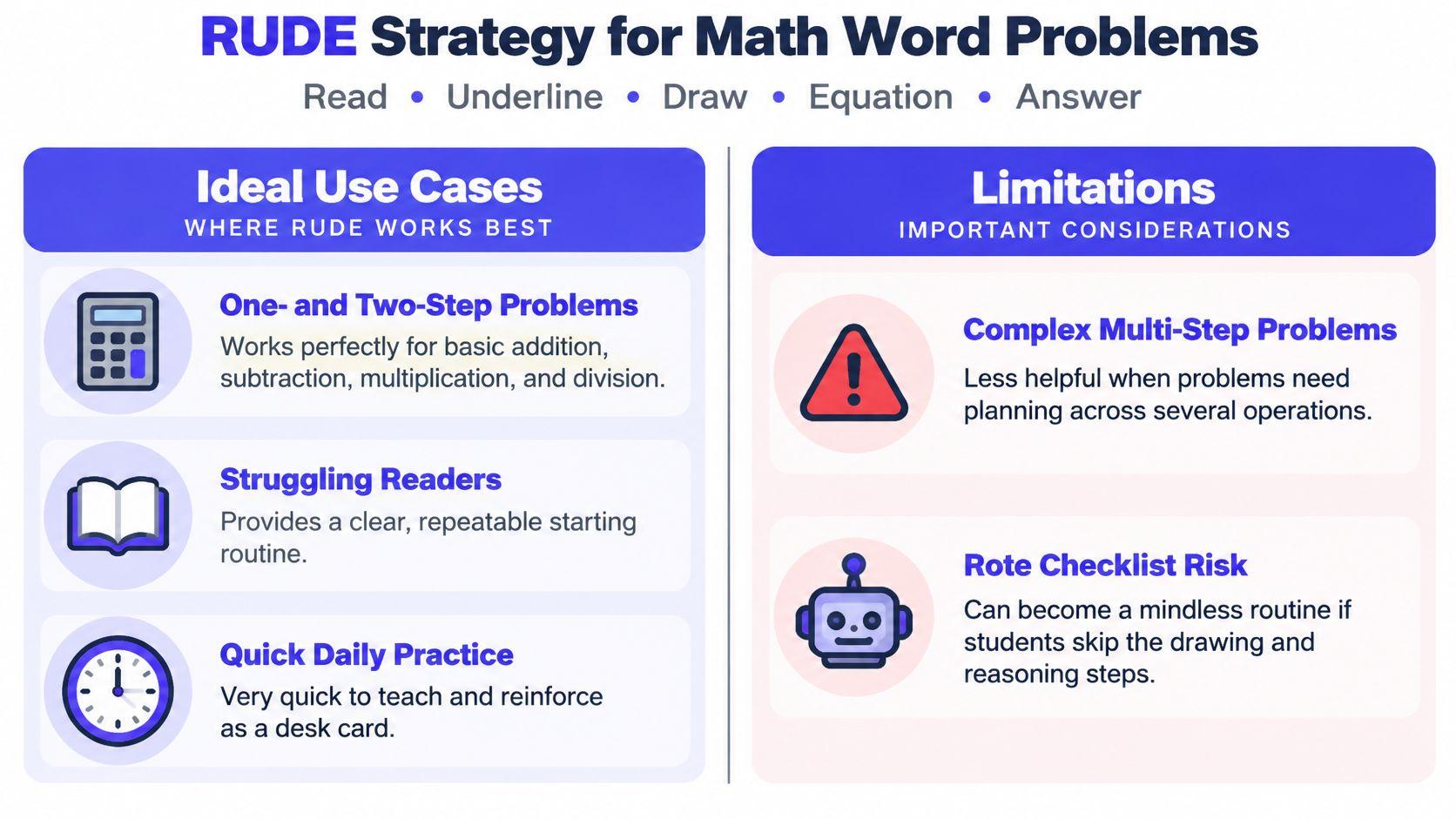
RUDE works when the stuck moment is the very start. Students Read, Underline the numbers and the question, Draw a quick model, write an Equation, then give the Answer with units. It's a routine, not really a worksheet, which is why it works on a laminated desk card.
I use it most in grades 2 through 6. Say a second grade center has three problems a day. Students work through the card and swap to check each other's equations. In a middle school intervention group, keep a number line beside the card, because that's where you'll see who skips Draw and jumps straight to symbols.
Where RUDE falls apart
Underline turns into decoration if you don't model it. Kids underline the whole problem in highlighter and think they've done the thinking. Model all five steps out loud with one problem first, and make Answer a full sentence that restates the question. Pairing it with the reading work in our reading comprehension strategies guide helps if the barrier is unpacking the text, not the math.
Practical rule: If the drawing could belong to any problem, it doesn't belong to this one. Make them label it.
RUDE also gets thin on multi-step problems. One equation box invites one operation. Once problems need a hidden first step, you'll need something built for sequence.
2. CUBES Strategy (Circle, Underline, Box, Eliminate, Solve and Check)
CUBES looks like RUDE with better manners, but the difference matters. Students Circle numbers, Underline the question, Box key information, Eliminate what doesn't affect the answer, then Solve and Check.
That Eliminate step is the whole point. This is the organizer for the student who melts down when a problem mentions 12 students, 3 tables, a Tuesday, and 48 pencils. In special education and intervention groups, start with one obvious distractor. Later, use subtler ones, like dates and times that look usable.
A grade 4 inclusion class might post the steps with a different highlighter color for each one. It's a bit much on the wall, but color keeps Circle and Box from blurring into one scribble.
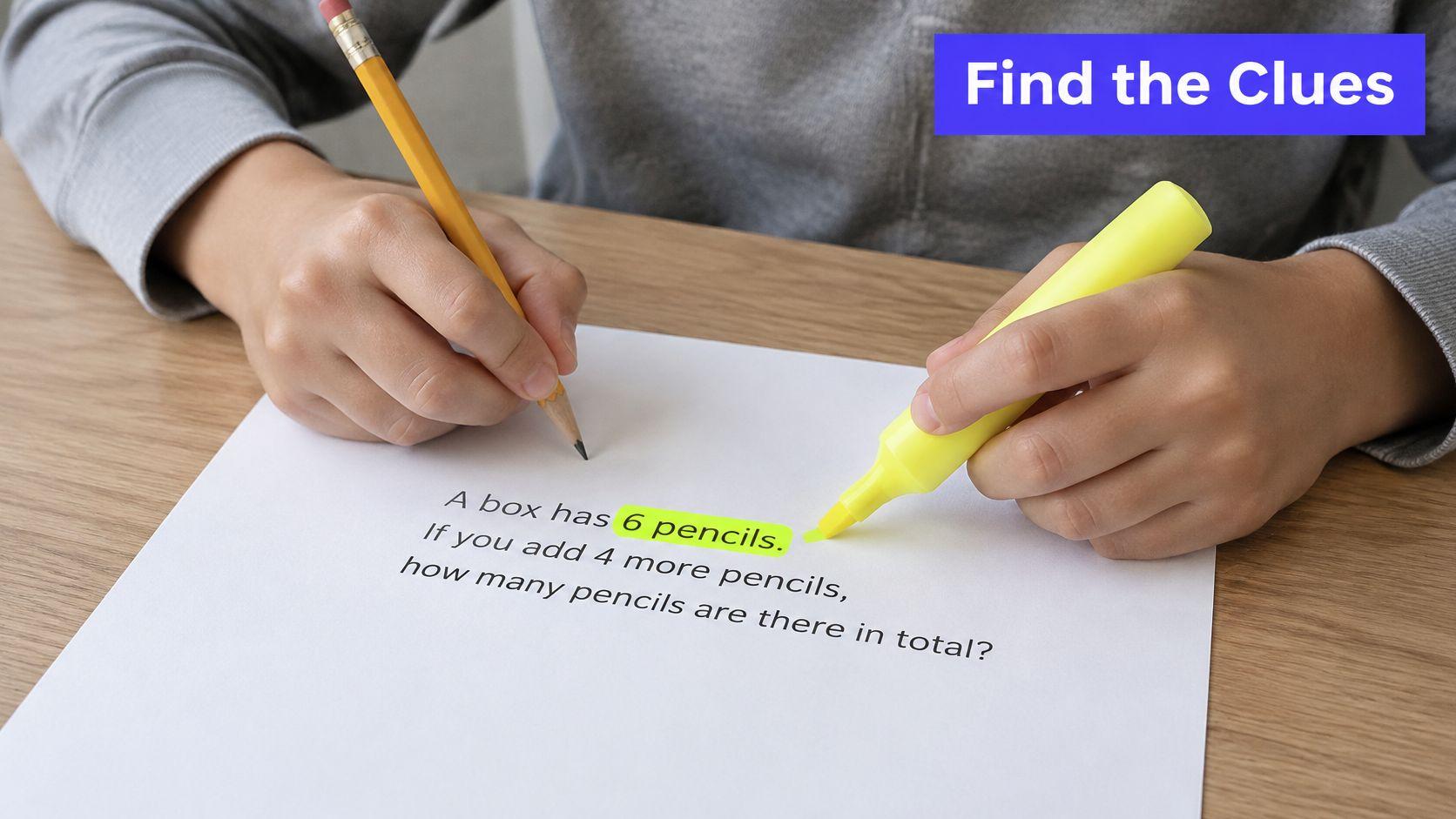
Have students cross out eliminated information with one line, not erase it. You want to see the reasoning, and sometimes they've crossed out the number they needed. That mistake is useful.
Where CUBES falls apart is keyword hunting. Box can turn into "find the word altogether." That breaks the first time a comparison problem uses altogether in a way that isn't simple addition. Kuraplan's differentiated worksheet options can make versions of the same problem with more or fewer distractors, which lets you raise the difficulty without rewriting the story. Keep the check step real, too, estimate first or work backward, not just "I checked it."
3. Polya's Four-Step Problem Solving Organizer
Some students can read a problem and still cannot decide what to do first. Polya's four steps, Understand, Plan, Carry Out, Look Back, give them a place to work through that pause.
Ask students to write the plan in their own words before calculating. “I'll find how many are left after the first group leaves, then split that amount equally” shows more thinking than “add.” If the plan is unclear, have them return to what the problem asks and what information it gives.
The organizer suits upper elementary and middle school students working on multi-step problems. In grade 5, Look Back can be a brief exit response: name the check, such as estimating or using an inverse operation. “It makes sense” does not show how the answer was checked.
- Assess the Plan separately: A sound strategy with an arithmetic slip shows more understanding than a lucky answer.
- Require a specific check: Students can estimate, use an inverse operation, or solve another way.
Four written boxes become busywork for a one-step problem, especially when students fill them in after solving. Use the organizer when a problem calls for planning, and accept concise responses in each box. Kuraplan's worksheet planner can generate Polya-style problem sets in seconds when you need several versions for reassessment.
4. Bar Model (Tape Diagram)
When students get stuck choosing an operation, I reach for a bar model before I reach for a mnemonic. A rectangle stands for a quantity. Parts, wholes, and comparisons become lengths you can see, and the unknown gets a question mark.
That lines up with the U.S. Institute of Education Sciences practice guide, which gives visual representations a moderate-evidence rating and recommends students build the representation before writing the equation. The order matters. Diagram first, symbols second.
Watch this in action before you model it for a class.
Say Maria has 24 stickers and gives away one-third. Grade 3 students draw one bar, split it into three equal parts, and the fraction stops being abstract. By grade 6, two comparison bars handle ratio problems about recipe ingredients without a keyword in sight.
Getting the bars right
Use grid paper early so lengths stay roughly proportional. Then fade on purpose, drawn bar to quick sketch to equation over several weeks. Our bar model maths guide walks through that progression.
The failure mode is a pretty bar with no labels. Students draw rectangles because you told them to, then guess the operation anyway. During your think-aloud, narrate which quantity goes where and why, every time, until they start doing it without you.
5. Schema Diagrams for Change, Group, and Compare Problems
Schema diagrams ask a different first question. Not "what are the numbers," but "what kind of problem is this?" Students sort it as change, group (part-part-whole), or compare, fill the knowns and the unknown into that structure, and the operation usually follows.
This is the strongest option I know for grades 1 through 3 addition and subtraction, and it stays useful when the numbers get bigger. A first grade team might sort a whole week's problems into the three types before solving any of them. That sorting is the learning. A grade 2 teacher can then show that "how many altogether" and "how many are left" can sit in the same group structure, which is exactly why keyword charts mislead kids.
Don't teach "altogether means add." It works just long enough for students to trust it, then it fails on compare problems.
The evidence for structured organizers is promising but modest in scale. In a 2022 Philippine action research study of 50 Grade 7 students, the group using graphic organizers scored a post-test mean of 7.64 against 6.44 for the control group. Useful, not magic, and it was embedded in guided modules rather than handed out cold.
Schema diagrams fall apart when a problem mixes structures or needs two steps. Students force it into one diagram and lose the second relationship. Use Kuraplan's worksheet tool to build sets grouped by type first, then deliberately mix them once recognition is solid.
6. Four-Square Problem Solving Organizer
A student may read a word problem correctly and still stall at the equation. Four-square makes the next step visible by dividing one page into four quadrants: words, picture or model, equation, and answer with explanation. The student records the same problem in each form, which can reveal whether the difficulty is choosing an operation, representing the situation, or explaining the result.
The layout suits grades 2 through 5. In grade 2, keep the explanation concrete, such as naming what the answer counts. By grade 5, ask students to connect their model to the equation and justify why the answer fits the question. For English learners, sentence starters can help in the words quadrant, but they do not resolve unfamiliar vocabulary or complex sentence structure. Add illustrated vocabulary or space to note a familiar-language equivalent when those are the barrier.
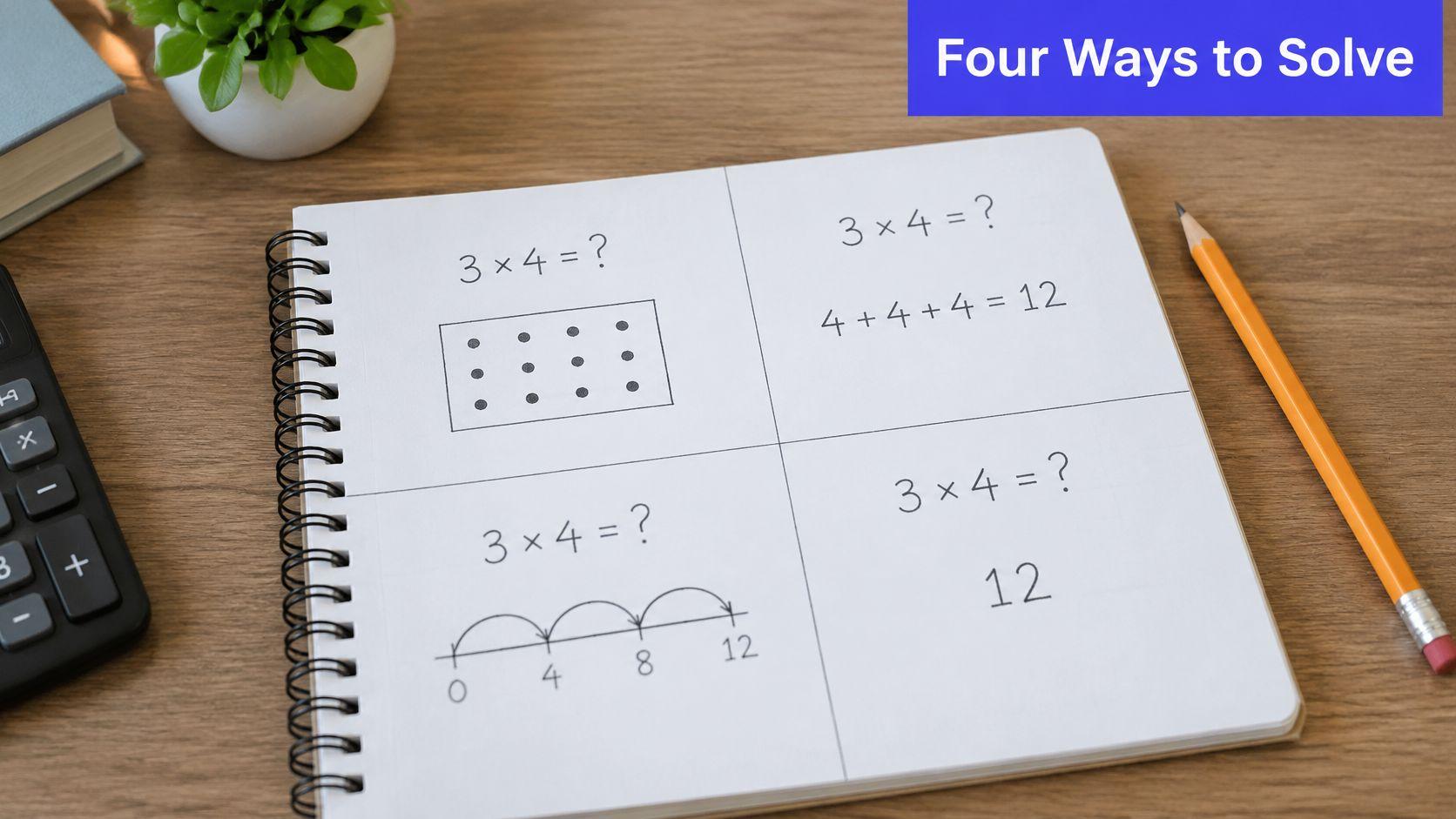
The skipped quadrant points to the stuck moment. A blank model may signal trouble turning the story into a representation; a missing explanation may show that the student can calculate but cannot connect the answer to the question. Rotate which quadrant students complete from the other three to check whether they can transfer between representations rather than copy a worked example. The graphic organizers guide offers more ways to adapt organizer formats across subjects.
Four-square costs time: completing all four parts for every problem can slow practice and frustrate students who already understand the structure. Use it for one carefully chosen problem, then have students solve similar problems with fewer prompts. Kuraplan's worksheet planner can build problem sets for this layout in seconds, so you're not redrawing boxes on Sunday night.
7. Multi-Step Problem Flowchart
Multi-step problems have their own stuck moment. The student does step one correctly, gets a number, and has no idea what it's for. A flowchart fixes that by making the dependency visible, boxes and arrows, each answer feeding the next question.
Say a grade 5 shopping problem needs a discounted price, then tax added, then change from a set amount. Three boxes. Students write the sub-question above each box before they calculate anything. In middle school, the same layout plans rate and unit conversion problems before equations appear.
Planning before calculating also matches the IES problem-solving template, which uses a three-read routine, first for context, then for the question, then for important information, before a visual model is drawn. That pause stops number grabbing.
- Start with three boxes: More than that and the planning tool becomes the hard part.
- Label every arrow: Students write the operation they will use and why that result is needed next.
- Check the last box against the question: Many wrong answers are correct answers to box two.
Flowcharts fall apart when the steps aren't linear, or when a student can't identify the hidden question at all. Then you're back to teacher modeling, which a 2016 Hamline classroom study on high school pre-algebra also pointed to, moving from modeling to guided practice to independent use. Kuraplan can generate multi-step problems in realistic contexts so you can build flowchart practice without inventing ten shopping scenarios yourself.
Seven organizers compared by grade fit, best use, and main limitation
| Item | Typical grade range | Best for | Main limitation |
|---|---|---|---|
| RUDE Strategy (Read, Underline, Draw, Equation, Answer) | Grades 2–6 | A repeatable routine for basic one- and two-step problems | Can become a rote checklist; less suited to complex multi-step planning |
| CUBES Strategy (Circle, Underline, Box, Eliminate, Solve and Check) | Elementary and intervention settings | Identifying relevant information in wordy problems | Students may over-mark or struggle to identify irrelevant details |
| Polya's Four-Step Problem Solving Organizer | Upper elementary through high school | Planning, solving, and reflecting on problems | May feel too involved for younger learners |
| Bar Model (Tape Diagram) | Elementary through early algebra | Visualizing part-whole, comparison, fraction, and ratio relationships | Can take time to master, especially for complex problems |
| Schema Diagrams for Change, Group, and Compare Problems | Early elementary | Recognizing addition and subtraction problem structures | Less direct for multiplication and division contexts |
| Four-Square Problem Solving Organizer | Elementary; adaptable for older learners | Connecting words, visuals, equations, and answers | Limited space for long or multi-step problems |
| Multi-Step Problem Flowchart | Upper elementary through middle school | Breaking complex problems into ordered steps | Overly structured for simple problems; drawing can take time |
Pick One Organizer This Week and Stick With It
Choose the organizer based on where students get stuck. When they struggle to begin reading a problem, RUDE or CUBES gives them a first move. If they start but lose the thread, Polya's steps make the process visible. When the operation is wrong because the relationship is unclear, try a schema diagram or bar model. If students cannot organize the second step, a flowchart can help.
Use one organizer for a single problem type before switching. Model each step aloud, then solve a few problems together with parts of the organizer filled in. When students work independently, check which prompts they skip. An empty Draw box, for example, may mean students need a clearer model of how a drawing represents the quantities.
Reduce the scaffolding as students gain confidence. Shorten prompts, remove sentence starters, and ask students to represent the problem on blank paper. The goal is to keep the reasoning and make the organizer less necessary.
Pictures need a job. A diagram should show a quantity or relationship; decorative art can distract from the problem. For older students preparing for tests, the checking habits in Polya and CUBES can support more independent work. Makon AI's SAT math practice guide offers ideas for that next stage.
With Kuraplan, teachers can turn a lesson into printable or shareable worksheets with multiple-choice questions and images, and create custom diagrams suited to lesson content. That can reduce formatting time, leaving more room to model how students use a representation to solve a problem.