
A student sits in front of the same worksheet as everyone else. You explain the concept, and they can discuss it accurately. Then the default text overwhelms them, the pace moves too quickly, the assignment demands more writing than they can manage, or a behaviour expectation gets in the way of showing what they know.
That situation calls for a careful distinction. Changing access is not automatically the same as lowering the learning goal. Accommodations help a student access instruction or demonstrate knowledge without changing what is taught or measured. Modifications change what the student is taught or expected to learn, as described in Nebraska Department of Education guidance on accommodations and modifications. The National Center on Educational Outcomes similarly describes modifications as changes that lower state-required learning expectations, which makes documentation and team judgment important (NCEO guidance).
The eight approaches below focus on barriers teachers remove every day, including access to instruction, language processing, pace, workload, assessment output, and behaviour regulation. Select supports from the student's documented needs, observe what changes in the work, and adjust. The same solution won't fit every learner.
1. Differentiated Instruction
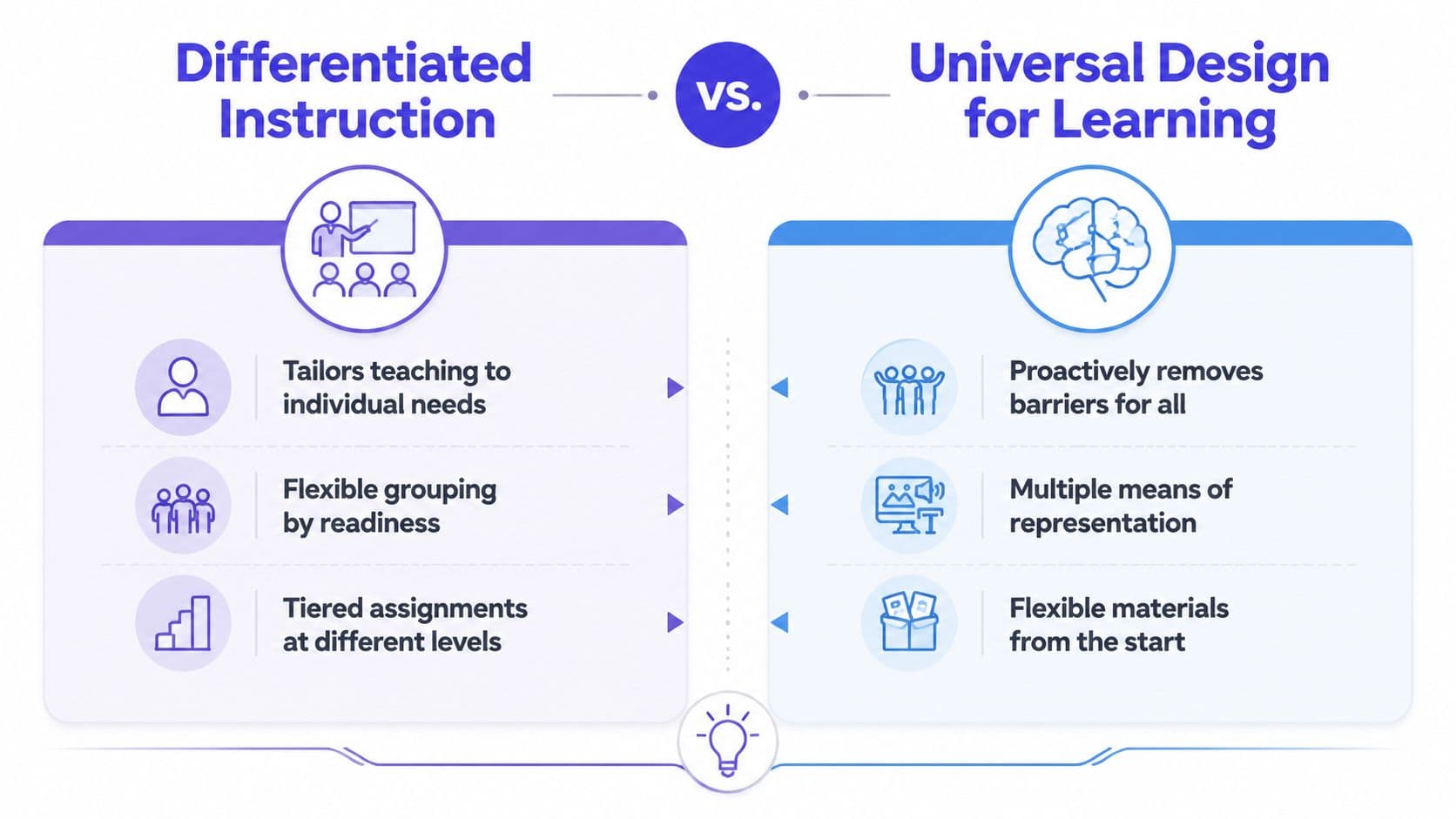
Differentiated instruction gives students different routes into the same meaningful objective. The teacher may vary the content, teaching method, materials, grouping, or assessment pathway according to readiness and need, while keeping the lesson's central purpose visible.
Consider a maths lesson on equivalent fractions. One group uses fraction strips and number lines, another works from visual models, and a third solves increasingly complex word problems. Each group is still reasoning about equivalence. The materials differ because the barriers differ.
A reading teacher might use texts at different reading levels while asking every group to identify the author's main claim and supporting evidence. In science, stations can offer a diagram, a physical model, and a guided investigation. Choice matters, but it needs boundaries. “Choose anything” often creates more uncertainty for students who already struggle with executive functioning.
A manageable classroom sequence
- Identify the target: Write the skill students must demonstrate in observable language.
- Check readiness: Use a short response, conference, or exit ticket to identify the barrier.
- Prepare pathways: Create tiered task cards, varied texts, visuals, manipulatives, or flexible groups.
- Teach the routine: Model how students collect materials, begin, request help, and submit work.
- Review evidence: Compare the student's work to the target, not to another group's worksheet.
Practical rule: Different work should still lead to a clear, shared conversation about the learning goal.
The trade-off is planning time. Creating every version manually can make differentiation unsustainable. Kuraplan can help generate differentiated worksheets and lesson variations, including changes to difficulty and question types, so you can spend more time reviewing student responses and less time reformatting pages. Start with one subject or skill, then expand only when the routine works.
2. Universal Design for Learning
Universal Design for Learning, or UDL, builds flexibility into a lesson before a student encounters a barrier. Instead of waiting until a learner cannot access the textbook, the teacher plans multiple ways to present information, sustain engagement, and let students express what they know.
A history lesson might combine a short reading, an audio version, a video explanation, and an interactive timeline. Students could demonstrate understanding through a written response, recorded explanation, presentation, or infographic, provided the rubric still measures the intended historical thinking. In maths, manipulatives, visual models, and digital representations can sit alongside symbolic notation rather than appearing only after a student fails.
UDL isn't a promise to create every possible format for every learner. It's a design decision to provide useful options without making students publicly request a special version of the lesson.
Build flexibility without creating chaos
Start with one unit. Ask three questions:
- Representation: Can students access the essential information through text, sound, visuals, modelling, or objects?
- Action and expression: Can they show the target skill through writing, speaking, drawing, building, or a digital product?
- Engagement: Can they connect with the topic through appropriate choice, relevance, collaboration, or independent work?
Collect student feedback, but don't treat preference as the only criterion. A student may prefer video while still needing explicit instruction in reading technical text. The monitoring check is whether the chosen route improves access to the target, not whether it feels easier.
For a student who benefits from listening, Kuraplan's audio read-aloud tool can support access to prepared lesson materials. Kuraplan can also help create accessible worksheets, visual diagrams, and lesson versions in formats that reduce design time. This broad approach shares a useful principle with a UK parent's Montessori overview from Grow With, namely that the learning environment should make meaningful participation more reachable.
3. Scaffolding
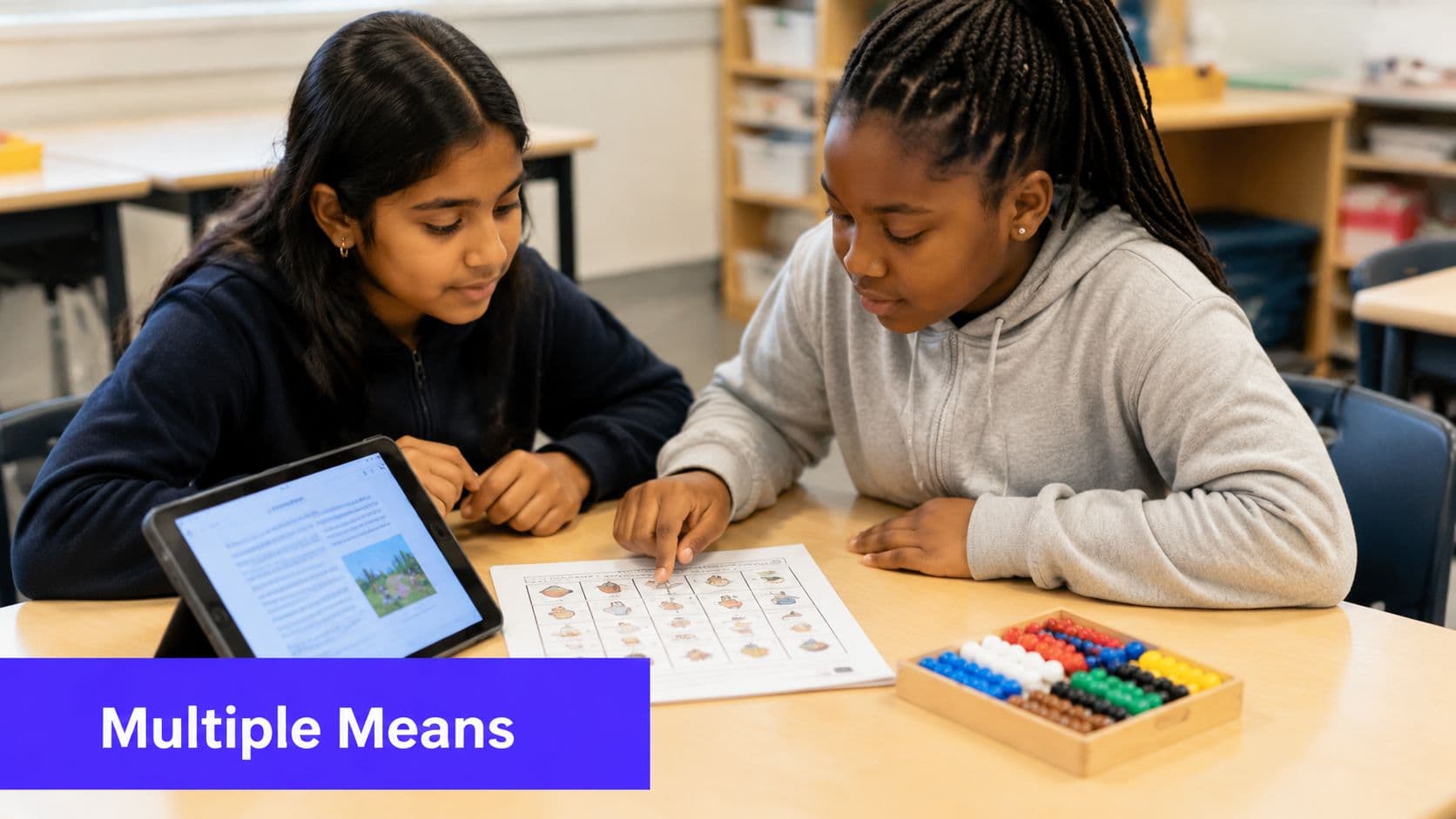
A student may know enough to begin a task but not enough to complete all its steps independently. Scaffolding supplies the missing structure temporarily, then fades as competence grows. It works best when the teacher can name the support, teach the student to use it, and decide what evidence will justify reducing it.
In writing, you might first model a paragraph, then provide a frame with sentence starters, then ask the student to write with a checklist, and finally remove the frame. In maths, a worked example, number line, or operations chart can remain available at the beginning and be covered or withdrawn after the student demonstrates reliable use of the underlying process.
Model, practise, fade
Use the familiar sequence of I do, We do, You do:
- I do: Think aloud while modelling the skill.
- We do: Complete a similar example together and prompt the student to explain each decision.
- You do: Assign a new example while keeping only the support the student still needs.
The classroom scenario matters. During reading comprehension, a teacher may first read a passage with the student, then have partners identify evidence, and later ask for independent responses using a graphic organiser. The organiser isn't automatically a modification. Its effect depends on the student's plan and whether it changes the learning expectation.
A support that stays forever can become a ceiling. Teach students what it does, then check whether they can manage part of the task without it.
Monitor accuracy, independence, prompt frequency, and transfer to a new task. If a student completes a paragraph only after repeated verbal cues, the next step might be a visual checklist rather than immediate removal of all support. Kuraplan can help create related worksheet versions at different complexity levels, which makes gradual release easier to plan. The teacher still decides when the support fades and whether the student can apply the skill in ordinary classwork.
4. Extended Time and Pace Modifications
A student who needs more time isn't necessarily learning less. Processing speed, attention, reading efficiency, motor output, and regulation can all affect how quickly a learner reads, plans, responds, or completes a task. A pace modification changes the time structure around learning, while the team must still clarify what the student is expected to understand.
A student with ADHD may complete a test in a quieter space with planned breaks. A student with dyslexia may complete a large reading assignment in smaller daily sections rather than facing one large deadline. A student with autism may receive an assignment early, with a staggered due date, so planning and transitions don't consume the time needed for the academic work.
Make extra time instructional
More time by itself won't build a missing skill. Pair the extension with explicit teaching, practice, feedback, and a plan for keeping the student connected to current instruction. For a multiplication unit, that might mean additional practice over several lessons before the class moves to more complex operations, rather than allowing unfinished facts work to accumulate.
Break long projects into visible checkpoints:
- Launch: Confirm the task, materials, and first action.
- Checkpoint: Review one chunk and address misconceptions.
- Revision: Give focused feedback before the next chunk.
- Completion: Evaluate the finished work against the stated target.
The monitoring check is progress through the timeline, not just eventual submission. If deadlines keep moving because the student still doesn't know how to begin, add a planning scaffold. If the student finishes accurately with fewer distractions, the environmental change may be doing more work than the extra minutes.
Explain to families that extended time supports access and completion; it doesn't automatically reduce expectations. Kuraplan can help create additional practice materials and alternate worksheet versions so students can reinforce a skill at a manageable pace without waiting for the teacher to build every page from scratch.
5. Simplified Language and Vocabulary Modifications
Complex language can hide a student's knowledge. A learner may understand photosynthesis but lose the task when asked to “synthesize the salient characteristics” without vocabulary support. Clearer language removes the language barrier while preserving the science concept.
Rewrite the direction as, “List the important parts of how plants make food using sunlight.” Pre-teach ecosystem vocabulary with pictures, examples, and non-examples. Provide a graphic organiser with sentence frames when an open-ended prompt demands more language planning than the content task requires. Record directions and provide written steps with visuals so the student can reread or relisten.
This approach can support multilingual learners, students with language-based disabilities, and students with intellectual disabilities. It should not turn an analytical task into a recall task unless the documented plan calls for a change in what the student is expected to learn.
Reduce language load, not thinking
Use shorter sentences with one main idea. Prefer active voice where possible. Define abstract terms in context and show what the word looks like in the subject.
A useful implementation sequence is:
- Find the barrier: Identify whether the student is missing vocabulary, syntax, direction length, or background knowledge.
- Clarify the input: Rewrite directions, add visuals, and pre-teach essential terms.
- Preserve the response target: Keep the reasoning, concept, or skill the student must demonstrate.
- Check transfer: Use the vocabulary in a new example or discussion, not only on the supported worksheet.
Monitor whether the student begins tasks more independently, uses the new terms accurately, and answers the intended question. If performance improves only when every sentence is simplified, gradually return appropriate academic language while retaining a glossary or visual reference.
Kuraplan can help generate clearer worksheets and accessible lesson materials, which is useful when the original resource is sound but linguistically dense. Review every generated version yourself. Simplification should remove unnecessary language complexity, not remove the content that makes the task worthwhile.
6. Reduced Workload or Assignment Modifications
Quantity can become the barrier. A student may understand a maths procedure after a small set of well-chosen problems, then lose accuracy and confidence when required to complete a much longer worksheet. Reducing workload means selecting enough representative work to show the skill while protecting stamina for learning.
For example, a student might complete ten problems instead of twenty, with both sets targeting the same skill and level of reasoning. A student with fine motor difficulties might give fewer written responses while demonstrating the same conceptual understanding orally or through selected responses. Homework can focus on the most important practice rather than requiring every repetitive item.
Choose the evidence, not just the smallest number
Begin by sorting the assignment into essential, useful, and redundant items. Keep problems that reveal different misconceptions or require different applications. Remove repetition that adds fatigue without adding information.
The sequence is straightforward:
- Select: Identify the items that best represent the standard or lesson objective.
- Explain: Tell the student and family why those items were chosen.
- Observe: Check accuracy, independence, and endurance.
- Adjust: Add practice if the smaller set no longer provides enough evidence.
Fewer questions only help when the remaining questions still carry the cognitive load.
The trade-off is that a reduced assignment can conceal a gap if the teacher removes the very item that would expose it. Use exit tickets, brief conferences, and work samples to check whether the student is progressing. If performance falls, the answer may be more explicit instruction, not just more problems.
Kuraplan can generate focused worksheets and lesson materials, allowing you to select essential items from a broader set without manually rewriting the entire assignment. Keep the student's documented needs, stamina, and learning goals at the centre. Reduction should protect meaningful practice, not become an automatic shortcut.
7. Alternative Assessment Methods
The default assessment format can measure writing speed, handwriting, speech production, or test endurance more than subject knowledge. An alternative assessment changes how the student demonstrates learning, so the teacher must separate the academic target from the output barrier.
A student with significant writing difficulty might explain a novel through a structured video presentation instead of an essay. A student with processing difficulties might explain a concept during a one-to-one conference. A portfolio can show learning across drafts, completed tasks, reflections, and teacher feedback. A digital presentation may let a student demonstrate mathematical reasoning when a traditional test format obscures the process.
The format isn't automatically more rigorous. A vague presentation can be easier than a well-designed essay, while a demanding oral defence can reveal deeper understanding. The rubric controls that difference.
Keep the target visible
Create one rubric that defines the required knowledge and reasoning, then identify which parts relate only to the format. Provide an exemplar. Let the student rehearse the response pathway before the assessment, especially if technology or oral explanation is new.
Use this implementation sequence:
- Name the target: State exactly what the assessment must reveal.
- Remove the output barrier: Offer a presentation, interview, demonstration, portfolio, or other suitable route.
- Set equivalent criteria: Score accuracy, evidence, reasoning, and application rather than polish alone.
- Document the evidence: Save the product, notes, recording, or conference record according to school procedures.
Monitor whether the chosen format gives the student a clearer opportunity to demonstrate the target. If the student cannot explain the concept in any format, the issue may be understanding rather than output.
For planning varied pathways, Kuraplan's formative assessment examples can help generate ideas for evidence collection and classroom checks. Kuraplan can also support rubric creation and alternative assignment formats, but the teacher must confirm that the criteria match the documented plan and the intended learning.
8. Behavioral Supports and Positive Reinforcement Systems
Behaviour often communicates a barrier. A student may leave the group because the directions are unclear, refuse work because the demand feels unmanageable, or become dysregulated during an unpredictable transition. A behavioural support should teach a replacement skill and make successful participation more likely. It shouldn't reduce a student to a reward chart.

A visual schedule can show a student with autism what happens next. A student with ADHD may use planned movement breaks and a self-monitoring card. A token system can reinforce beginning work, using a taught help request, or returning to a task after a break. A restorative conversation can replace a purely punitive response after a conflict, provided the student has the regulation needed to participate.
Teach the expected behaviour
Define the behaviour in observable terms. “Be ready” is vague. “Open the notebook, write the date, and complete the first example” gives the student a starting point. Teach the routine when the student is calm, practise it, and reinforce it quickly.
Use a consistent sequence:
- Prevent: Adjust transitions, visual information, seating, sensory load, or task length.
- Teach: Model the replacement behaviour, such as asking for help or requesting a break.
- Reinforce: Deliver a meaningful response when the student uses the skill.
- Review: Track whether participation and regulation improve, then revise the support.
Aim for more positive feedback than correction, with the plan's suggested 4:1 positive-to-corrective feedback ratio treated as a planning target rather than a rigid score. Reinforcement must be individualised. A preferred activity for one student may be irrelevant to another.
Kuraplan can help create visual schedules, behaviour charts, and social stories. Its classroom management strategies can also support planning consistency across staff. Track the student's behaviour, context, replacement skill, and learning participation. If the chart produces compliance only while the reward is present, add explicit regulation instruction and gradually build natural classroom reinforcement.
A short video can also prompt discussion about classroom support planning.
8-Point Comparison: Special Education Modifications
| Item | Implementation Complexity 🔄 | Resources & Time ⚡ | Expected Outcomes 📊 ⭐ | Ideal Use Cases 💡 | Key Advantages ⭐ |
|---|---|---|---|---|---|
| Differentiated Instruction | High, ongoing planning, flexible grouping 🔄🔄🔄 | Moderate–High, varied materials and prep ⚡⚡ | Greater engagement and improved achievement across ability levels 📊 ⭐⭐⭐ | Mixed-ability classrooms; units requiring multiple entry points | Personalized access; closes gaps; promotes student choice ⭐⭐⭐ |
| Universal Design for Learning (UDL) | High, upfront curriculum redesign and training 🔄🔄🔄 | High, diverse materials, accessible tech, training ⚡⚡⚡ | Broad accessibility; fewer retrofit accommodations needed 📊 ⭐⭐⭐ | Whole-class curriculum design; inclusive schools and districts | Proactive accessibility for all learners; reduces stigma ⭐⭐⭐ |
| Scaffolding | Moderate, responsive observation and fading supports 🔄🔄 | Low–Moderate, models, prompts, guided practice ⚡⚡ | Strong skill-building and gradual independence 📊 ⭐⭐⭐ | Teaching new skills; students needing stepwise support 💡 | Structured skill progression; prevents overload while building mastery ⭐⭐⭐ |
| Extended Time & Pace Modifications | Low, scheduling and deadline adjustments 🔄 | Low–Moderate, supervision, flexible timelines ⚡⚡ | Reduced anxiety; higher-quality work for time-affected students 📊 ⭐⭐ | Students with processing speed, ADHD, or attention needs | Equitable access to processing time; preserves rigor when paired with instruction ⭐⭐ |
| Simplified Language & Vocabulary | Low–Moderate, adapt language, pre-teach terms 🔄🔄 | Low–Moderate, rewrite materials, visuals, speech tools ⚡⚡ | Improved comprehension and independence, especially for ELLs 📊 ⭐⭐⭐ | ELLs, language-based disabilities, complex academic texts 💡 | Maintains cognitive demand while clarifying access; scalable ⭐⭐⭐ |
| Reduced Workload / Assignment Modifications | Low, select essential items and monitor impact 🔄 | Low, planning and progress checks ⚡ | Less overwhelm; sustained focus on key skills if monitored 📊 ⭐⭐ | Students with fatigue, executive-function or stamina challenges | Increases engagement and efficiency; focuses practice on essentials ⭐⭐ |
| Alternative Assessment Methods | Moderate–High, design rubrics and varied formats 🔄🔄🔄 | Moderate–High, time-consuming to create/grade; multimedia tools ⚡⚡⚡ | Richer, more authentic evidence of learning; reduced test anxiety 📊 ⭐⭐⭐ | Students with writing/communication challenges; performance tasks 💡 | Showcases strengths; flexible demonstration of mastery; authentic assessment ⭐⭐⭐ |
| Behavioral Supports & Positive Reinforcement | Moderate, consistent implementation and data tracking 🔄🔄 | Moderate, training, behavior systems, visuals ⚡⚡ | Improved behavior, classroom climate, and academic engagement 📊 ⭐⭐⭐ | Students with EBD, ADHD, autism; whole-class behavior needs | Teaches replacement skills; proactive, reduces negative cycles; scalable ⭐⭐⭐ |
Turn One Support Into a Repeatable Classroom System
Effective modifications for special education preserve meaningful learning wherever the student can still work toward the same target with an adjusted route. Clearer language, visual access, flexible pacing, reduced repetition, structured choices, and behavioural supports can remove barriers without turning the lesson into unrelated work. When the student's expected content or performance standard changes, the team needs to document that decision carefully.
The legal and instructional context matters. The Education for All Handicapped Children Act, Public Law 94-142, was signed on November 29, 1975, and later became IDEA in 1990. The U.S. Department of Education describes IDEA as a law created to protect rights, meet individual needs, and improve outcomes for children and youth with disabilities (IDEA history from the Department of Education). That history reflects a broader movement toward individualised access and education alongside non-disabled peers, rather than assuming separate settings are the default.
The scale of the work makes repeatable systems necessary. NCES reported that 7.5 million students ages 3 to 21 received special education or related services under IDEA in 2022 to 2023, representing 15% of public school students (NCES data on students with disabilities). The same source reports growth from 6.4 million students in 2012 to 2013 to 7.5 million in 2022 to 2023, and identifies specific learning disabilities as the largest category at 32%. Teachers need workflows that make thoughtful differentiation possible across ordinary lessons, not heroic one-off adaptations.
Start with one barrier
Choose the barrier you can describe clearly. Is the student unable to access the text, process multi-step language, sustain work across a long assignment, produce written output, or regulate during transitions? Match one support to the documented need, then define what success will look like before you introduce it.
For example, success might mean the student identifies evidence from a grade-level passage using an audio version and a graphic organiser. It might mean completing selected maths problems accurately with planned breaks, or explaining a concept through a recorded presentation using the same content rubric as peers. Review work samples, participation, assessment evidence, and the level of adult prompting. A support is useful when it changes access or performance in a meaningful way, not merely when the student appears quieter.
The IEP must include appropriate accommodations needed to measure academic achievement and functional performance on state and districtwide assessments, along with special education, related services, supplementary aids, and program modifications or supports for school personnel (U.S. Department of Education IEP guidance). Keep classroom materials aligned with that documentation and communicate changes across general education and special education staff.
Combine approaches deliberately. Simplified language pairs naturally with scaffolding. Reduced workload may work alongside an alternative assessment when writing volume, rather than conceptual understanding, is the barrier. UDL can reduce the number of individual retrofits, while differentiated instruction helps you respond when a student still needs a particular route.
Kuraplan can help create differentiated worksheets, visual materials, lesson variations, and rubrics when preparation time is the obstacle. Review and revise every material for accuracy, age-appropriateness, accessibility, and alignment with the student's plan. For broader school support conversations, Friendly ABA Premier's perspective on ABA in schools offers another point of reference, but classroom teams still need to connect any behavioural approach to the individual student and educational context.
Kuraplan helps K–12 teachers create standards-aligned lesson plans, differentiated worksheets, visual materials, and assessment rubrics for varied learners. Visit Kuraplan to build practical lesson versions that remove classroom barriers while keeping student goals visible.