You return a stack of essays, projects, or lab reports with carefully written comments. Students look at the grade first, skim a sentence or two, and put the paper away. When revision time arrives, many still ask, “What exactly should I fix?” The problem often isn't that your feedback lacks detail. It's that students haven't been given a practical way to interpret it, apply it, and judge their own work.
A self assessment rubric changes that relationship. Instead of treating assessment as something a teacher does to a student, it gives learners clear criteria for examining evidence, identifying gaps, and choosing a next step. The strongest rubrics aren't written primarily for grading. They're designed for students to use while learning.
Why Traditional Feedback Often Misses the Mark
A teacher can spend an evening writing comments such as “develop your explanation,” “organize your evidence more clearly,” and “make the conclusion stronger.” Each comment may be accurate. Yet a student may not know what “develop” looks like in the paragraph sitting in front of them, or which sentence should change first.
That's where teacher-centered feedback loses momentum. Students receive a judgment after the work is finished, but they don't always see the connection between the judgment and an action they can take. The feedback becomes a record of what went wrong rather than a tool for improving the next draft.
Practical rule: If a student can't point to evidence in the work and name a specific revision, the rubric is probably describing quality too vaguely.
A student-facing rubric moves the first act of judgment closer to the learner. Before submitting an essay, a student might highlight the sentence that states the claim, underline evidence, and write an explanation of how the evidence supports that claim. The student isn't selecting a box. They're making a claim about the work and backing it with evidence.
Self-assessment is connected to self-regulated learning, which includes planning, monitoring, and revising. A 2019 critical review examined 76 empirical studies and found that self-assessment using scripts or rubrics was generally associated with stronger self-regulated learning than comparison or control conditions. Reported effects ranged from very small to moderate, with η² = 0.06–0.42, and the review emphasized that self-assessment works best when it's formative and supported by training (2019 critical review of student self-assessment literature).
The shift is simple but significant:
- Teacher-only feedback: “Your evidence is weak.”
- Student-facing reflection: “I included evidence, and I explained how it supports my claim.”
- Action after assessment: “I need to add a connection after my second example.”
Students still need your expertise. A rubric doesn't replace instruction, conferencing, or feedback. It gives those interactions a shared language, so a conference begins with the student's reasoning rather than a mysterious score.
What Makes a Self Assessment Rubric Actually Work
A usable rubric answers three questions quickly:
- What quality matters in this task?
- What does that quality look like in my work?
- What should I do next?
A rubric is a scoring guide that names specific criteria and performance levels, not a checklist of every behavior a teacher might notice. Illinois State University's rubric guidance describes this structure clearly. Analytic rubrics commonly place criteria in the left column and performance levels across the top, which helps students compare their work with defined expectations.
The first design choice is criteria. Choose the few dimensions that matter most for the assignment. For a persuasive paragraph, those might be claim, evidence, explanation, and organization. If you include every formatting detail, grammar feature, and process behavior, students may focus on completing boxes instead of improving meaning.
The second choice is language. “Demonstrates metacognitive awareness” may make sense in a professional document, but it doesn't tell a child what to do. “I can explain why I chose this strategy” gives the learner an observable action.
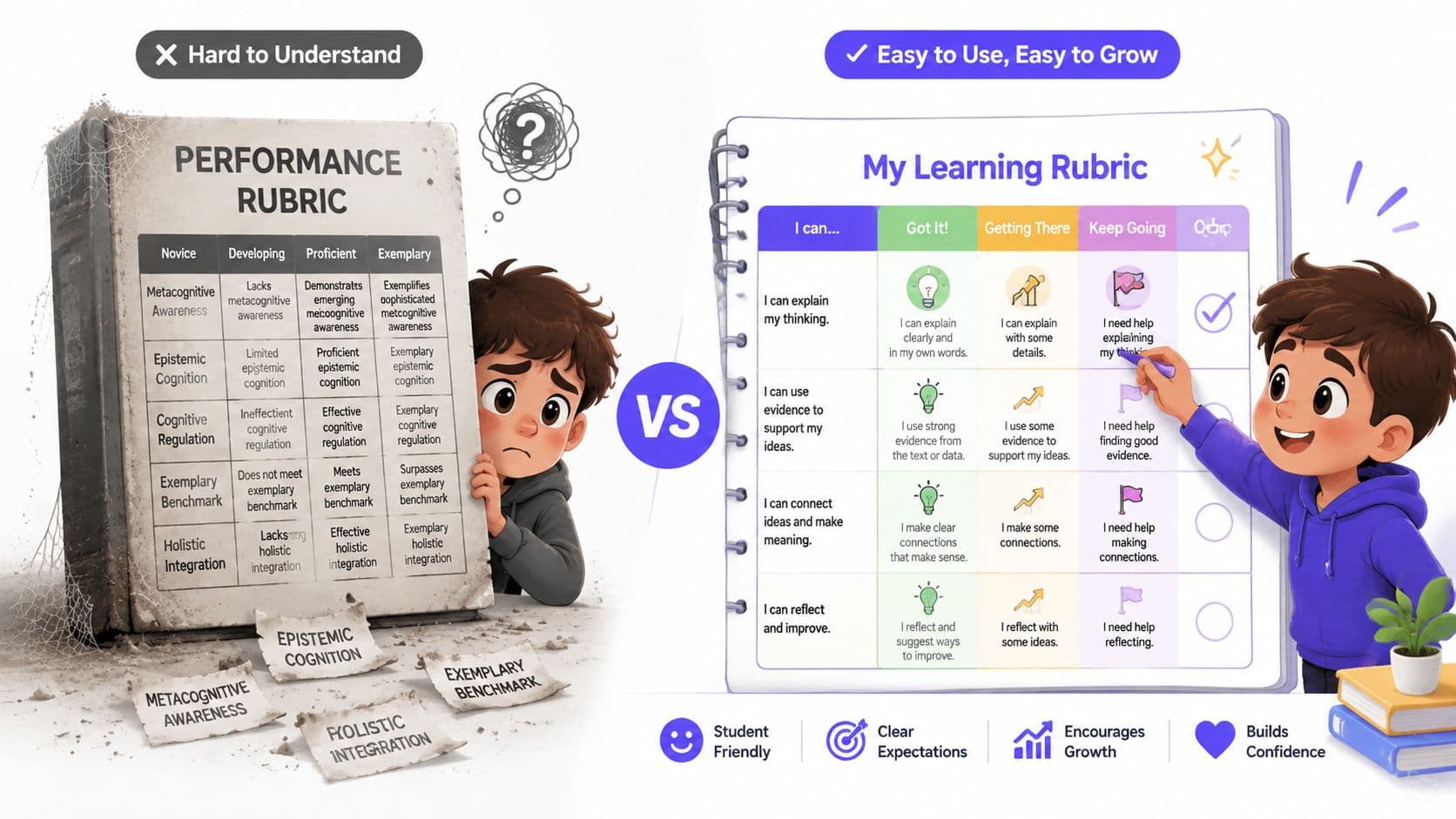
Age and context should shape the wording:
- Elementary: “I included a beginning, middle, and end.”
- Middle school: “My evidence supports my claim, and I explained the connection.”
- High school: “I used relevant evidence and analyzed how it advances my argument.”
A scale should also help students notice growth. Classroom rubrics often use four levels, such as advanced, proficient, approaching, and beginning, as shown in this Responsive Classroom self-assessment handout. For a first self-assessment, however, three levels may be easier: Not Yet, Getting There, and Got It.
The best rubric descriptors distinguish one level from the next. Each higher level should build on the previous one, so students can see which change moves their work forward. The Erasmus+ guidance on distinguishing performance levels supports this practical design rule.
For help connecting criteria to learning intentions, teachers can use learning intentions and success criteria as a planning reference.
Building Your Rubric from the Ground Up
Start with the assignment, not with a template. Write the learning objective in plain language, then ask what students would need to show in order to meet it. A persuasive writing objective might become: “I can make a claim, support it with relevant evidence, and explain why the evidence matters.”
1. Select the essential criteria
Choose three or four criteria that represent the heart of the task. A science abstract might need a clear purpose, accurate method summary, results, and conclusion. A reading response might need a defensible interpretation, textual evidence, explanation, and organization.
Keep separate criteria separate. If “organization and clarity” always receive the same rating, consider whether students need two criteria or one more precise criterion.
2. Describe observable evidence
Avoid descriptors such as “excellent understanding” or “strong analysis.” Students need to know what they can find in their own work.
For example:
- “I explained my thinking” is observable when the student has written reasoning.
- “I used relevant evidence” requires the student to identify evidence and check its relationship to the claim.
- “I revised my work” can be shown through a marked draft, revision note, or before-and-after example.
3. Use first-person language
“I” statements invite students to inspect their work. They also make the rubric sound like a learning tool rather than a report written about them.
| Teacher-Centered Language | Student-Friendly Rewrite |
|---|---|
| Student demonstrates effective organization. | I put my ideas in an order that makes sense. |
| Student provides sufficient textual evidence. | I used evidence from the text to support my answer. |
| Student analyzes the relationship between evidence and claim. | I explained how my evidence proves or develops my claim. |
| Student demonstrates mastery of conventions. | I checked my spelling, punctuation, and sentence structure. |
| Student engages in meaningful revision. | I changed my draft to make my ideas clearer or stronger. |
4. Choose a manageable performance scale
A six-level scale can create distinctions that students can't reliably recognize. A three-level scale often gives beginners a clearer starting point:
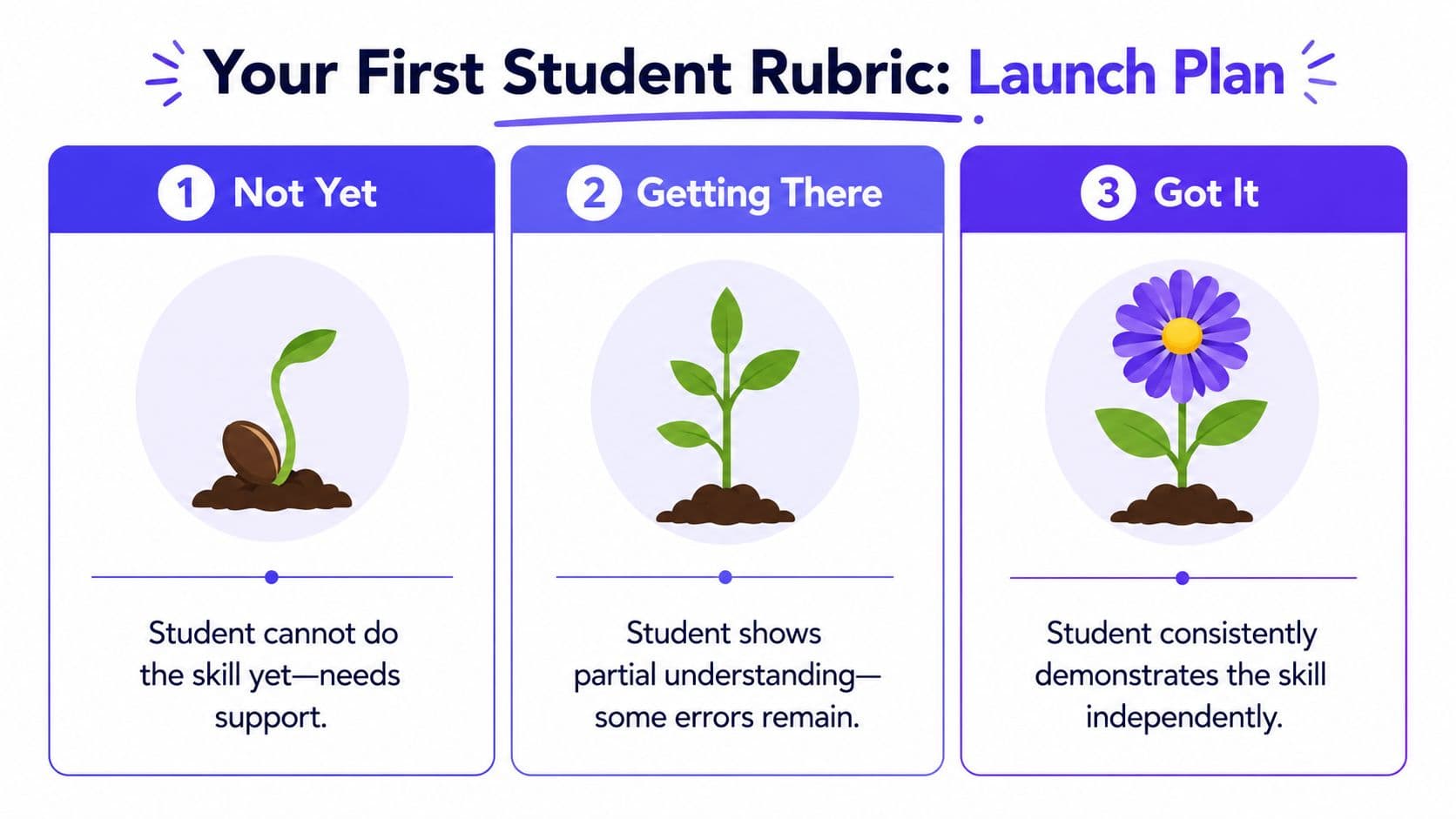
- Not Yet: I haven't shown this skill, or I need direct support.
- Getting There: I've shown part of the skill, but an error or gap remains.
- Got It: I've shown the skill independently and can point to evidence.
A University of Lincoln assessment guide notes that rubrics commonly use three to six performance levels. The important question isn't how many boxes appear. It's whether students can distinguish the expectations and use them while revising.
5. Add an evidence field
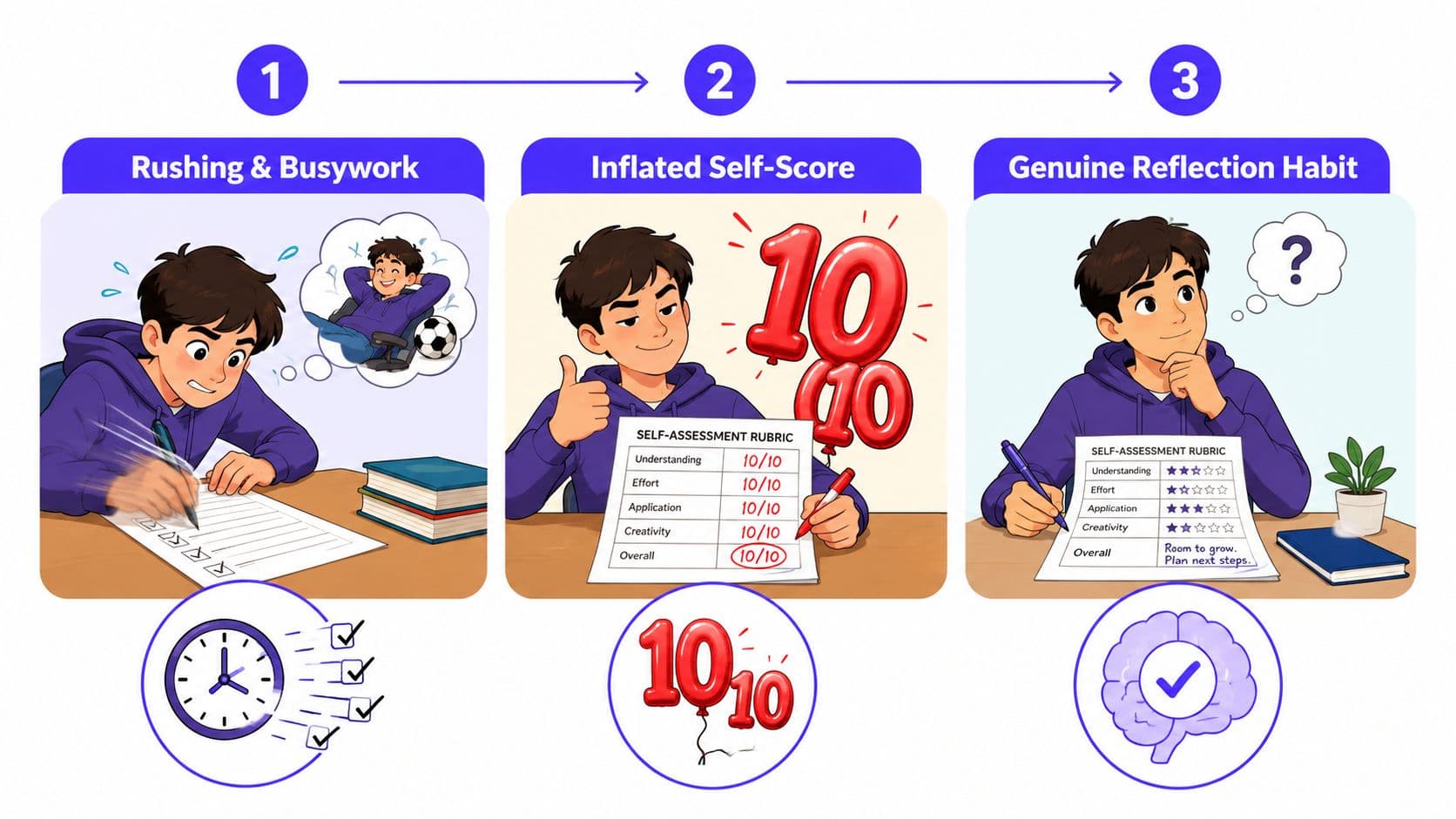
Require students to justify each rating. They might quote a sentence, circle a feature, attach a calculation, or name the section where the evidence appears. This prevents the rubric from becoming a series of optimistic guesses.
6. Test it with real work
Use a sample response and complete the rubric yourself. Then ask a student to read the descriptors aloud and explain what each level means. If the student can't explain the difference between “Getting There” and “Got It,” revise the language before introducing the rubric to the class.
Making Self Assessment a Classroom Habit
A rubric won't create reflection because you print it. Students need to see the thinking process, practice it with examples, and understand that an honest lower rating is useful information rather than a punishment.
Begin with a think-aloud. Display a sample paragraph and say, “I'm checking the evidence criterion. I found an example, but I haven't explained how it supports my claim, so I'm choosing Getting There.” Then write the missing action beside the paragraph. Students need to hear the reasoning, not just watch you circle a level.
Move from imitation to independence
Use a gradual release sequence:
- Compare: You score a sample and explain your evidence. Students compare their judgment with yours.
- Calibrate: Small groups score several samples, discuss disagreements, and point to rubric language.
- Confer: Partners explain their ratings to each other before submission.
- Reflect: Students complete the rubric independently and identify one revision target.
Calibration matters because students often overestimate their performance without feedback. A 2026 meta-analytic systematic review covering 160 studies and 29,352 participants found an overall tendency toward overestimation, with g = 0.206, and only a moderate average correlation between student estimates and expert scores, z = 0.472 (2026 systematic review of self-assessment accuracy). The review also found that feedback, experience with self-assessment, and content knowledge reduce overestimation.
Keep the routine small enough to survive a busy week. On Monday, students can complete a brief self-check against one criterion. During drafting, they can highlight evidence for a selected descriptor. On Friday, they can complete a deeper reflection that names a strength, a gap, and a next action.
A short peer conversation can make the final rating more thoughtful. Ask students to show where the evidence appears, explain why they selected the level, and listen for a question or suggestion. The purpose isn't to let peers assign grades. It's to make quality visible through conversation.
For additional classroom routines, see these formative assessment examples.
A 2023 meta-analysis found that rubric benefits were larger when self-assessment and peer-assessment were combined than when self-assessment was used alone (2023 meta-analysis on rubrics and academic performance). That finding fits ordinary classroom experience. Students often notice a gap more clearly when they must explain their reasoning to someone else.
Using Rubric Data to Guide Your Teaching
Student ratings are not only evidence about student performance. They're evidence about student perception. That distinction gives teachers useful information.
Suppose most students select “Got It” for thesis statements, but their drafts contain broad claims with no clear position. The mismatch doesn't mean the rubric failed or that students were careless. It suggests they have an incomplete mental model of what a thesis does. Your next lesson might compare strong and weak examples, ask students to underline the position in each, and have them revise one claim.
Read the pattern, not just the score
Collect self-assessments by criterion. Look for three kinds of information:
- High confidence with weak evidence: Students may misunderstand the descriptor or the underlying skill.
- Low confidence with solid evidence: Students may need reassurance, exemplars, or clearer success criteria.
- Mixed ratings across one criterion: Students may need targeted practice rather than whole-class reteaching.
A 2024 replication experiment with 93 high-school students found that rubric-based self-assessment of scientific abstracts improved absolute accuracy, reduced bias, and lowered cognitive load. The rubric specified task dimensions, assessment criteria, and performance levels, while expert agreement on reference scoring was strong, with ICC > .85 (2024 replication experiment on rubric-based self-assessment).
| Self-Assessment Pattern | What It Reveals | Instructional Response |
|---|---|---|
| Students choose Got It, but work lacks the feature | The criterion may be unclear or misunderstood | Model the feature with annotated examples |
| Students choose Not Yet and identify the same gap | Students can recognize a genuine need | Form a focused reteaching group |
| Ratings vary widely on one criterion | Students have uneven skill or inconsistent interpretations | Run a calibration activity with contrasting samples |
| Students give a level without evidence | The routine has become a checklist | Require highlighting, quoting, or pointing to proof |
| Students identify a gap you missed | The rubric is revealing useful learner evidence | Address it in a conference or future mini-lesson |
Individual reflections can also guide conferences. A student who writes, “My examples are relevant, but I don't explain them,” has already identified a productive goal. You can respond with one focused prompt instead of covering every possible weakness.
Self-assessment data shouldn't replace your professional judgment. It adds a second view, showing what students believe they understand and where that belief differs from the work in front of you.
Getting Started with Your First Student Rubric
Make the first version deliberately small. Choose one upcoming assignment, such as a paragraph, a lab conclusion, or a short presentation. Select two or three criteria, then use the three-level scale Not Yet, Getting There, and Got It.
A practical launch sequence
- Name the assignment: Choose work students already understand.
- Identify the essentials: Ask what successful work must show.
- Rewrite the criteria: Use “I can” or “I” statements and concrete verbs.
- Add evidence prompts: Include “Where can you show this in your work?”
- Test the rubric: Apply it to a sample response before students see it.
- Model one rating: Think aloud and explain the evidence behind your choice.
- Pilot the routine: Let students self-assess, discuss, revise, and reassess.
- Collect feedback: Ask what was confusing, what helped, and what should change.
The first rubric won't be perfect. You may discover that students interpret “clear explanation” differently, or that one criterion contains two skills. Treat those discoveries as design feedback. Ask students to mark the phrase that confused them and suggest language they would understand more easily.
AI can help you draft initial criteria and descriptors, but you still need to adapt the result to your standards, assignment, learners, and classroom language. Kuraplan's Rubric Generator can create editable rubric language with criteria, performance levels, and descriptors, giving you a starting point to review with students.
Keep the rubric visible during instruction, not only at submission. When students use it to plan, check, discuss, and revise, assessment becomes part of the learning process rather than paperwork at the end.
Kuraplan can help you create editable, standards-aligned rubrics and connect them with lesson plans, worksheets, and assessment activities. Visit Kuraplan to draft a student-facing rubric for your next assignment, then adapt the language with your class and use it to guide reflection and revision.