You're probably sitting with a stack of student work, a progress-monitoring sheet, and that nagging feeling that none of it gives you a clean answer. One student made a strong verbal point but barely wrote anything. Another followed the visual support perfectly, but only with prompting. A third hit the academic target, yet the work sample doesn't show how much support it took to get there.
That's where special education assessment rubrics stop being “one more form” and start doing real work. A good rubric makes expectations visible, scoring more consistent, and instructional decisions easier to defend. A weak rubric does the opposite. It creates fuzzy data, mixed scoring, and hard conversations in IEP meetings when everyone is looking at the same student but interpreting the evidence differently.
The part that gets missed most often is that the best rubrics don't just score performance. They also help teams check for bias and connect student performance to support decisions. If your rubric can't help you answer “Is this a disability-related need, a language difference, a mismatch in instruction, or a support issue?” then it's unfinished.
Why Effective Rubrics Are Your Secret Weapon
Some of the worst grading sessions happen when the student work is complicated in a very normal special ed way. The assignment is technically the same for everyone, but the path each student took was different. One used sentence frames. One dictated. One answered with visuals and oral language. One got there after multiple prompts. If the only choices on your sheet are “met” or “did not meet,” you already know the score won't tell the full story.
That's why I stopped treating rubrics like polished paperwork and started treating them like classroom equipment. A strong rubric doesn't just help you grade. It helps you notice what the student did, what support they needed, and whether the skill showed up consistently enough to matter.
Clarity helps students and adults
The biggest shift happens when the rubric names performance in language people can use. Students know what success looks like. Families can see why a score was assigned. Related service providers and paraprofessionals can collect evidence using the same criteria instead of everyone inventing their own version on the fly.
Practical rule: If two adults can watch the same task and reasonably arrive at the same score, the rubric is doing its job.
There's also solid evidence behind using rubrics as an instructional tool, not just an evaluation tool. Meta-analytic research found a significant positive effect on student academic performance, including an effect size of 0.45 for standardised mean differences, which supports rubric-based assessment as a high-impact strategy rather than a procedural extra (meta-analytic research on rubric implementation).
The real payoff in special education
In special education, that matters because so many decisions depend on defensible data. You need something more useful than “seems better” and more nuanced than a raw percentage on a worksheet. Rubrics help bridge that gap.
A good rubric can help you:
- Track IEP progress more cleanly by breaking broad goals into visible performance markers.
- Improve team consistency because everyone is scoring the same observable thing.
- Support student self-assessment when the language is concrete enough for learners to use.
- Reduce arguments later because the decision rules were set before the work was scored.
When teachers say a rubric “worked,” they usually mean one simple thing. It saved them from guessing.
Laying the Foundation for a Great Rubric
Most bad rubrics don't fail because of formatting. They fail because the thinking behind them was rushed. If the target is muddy, the criteria will be muddy too.
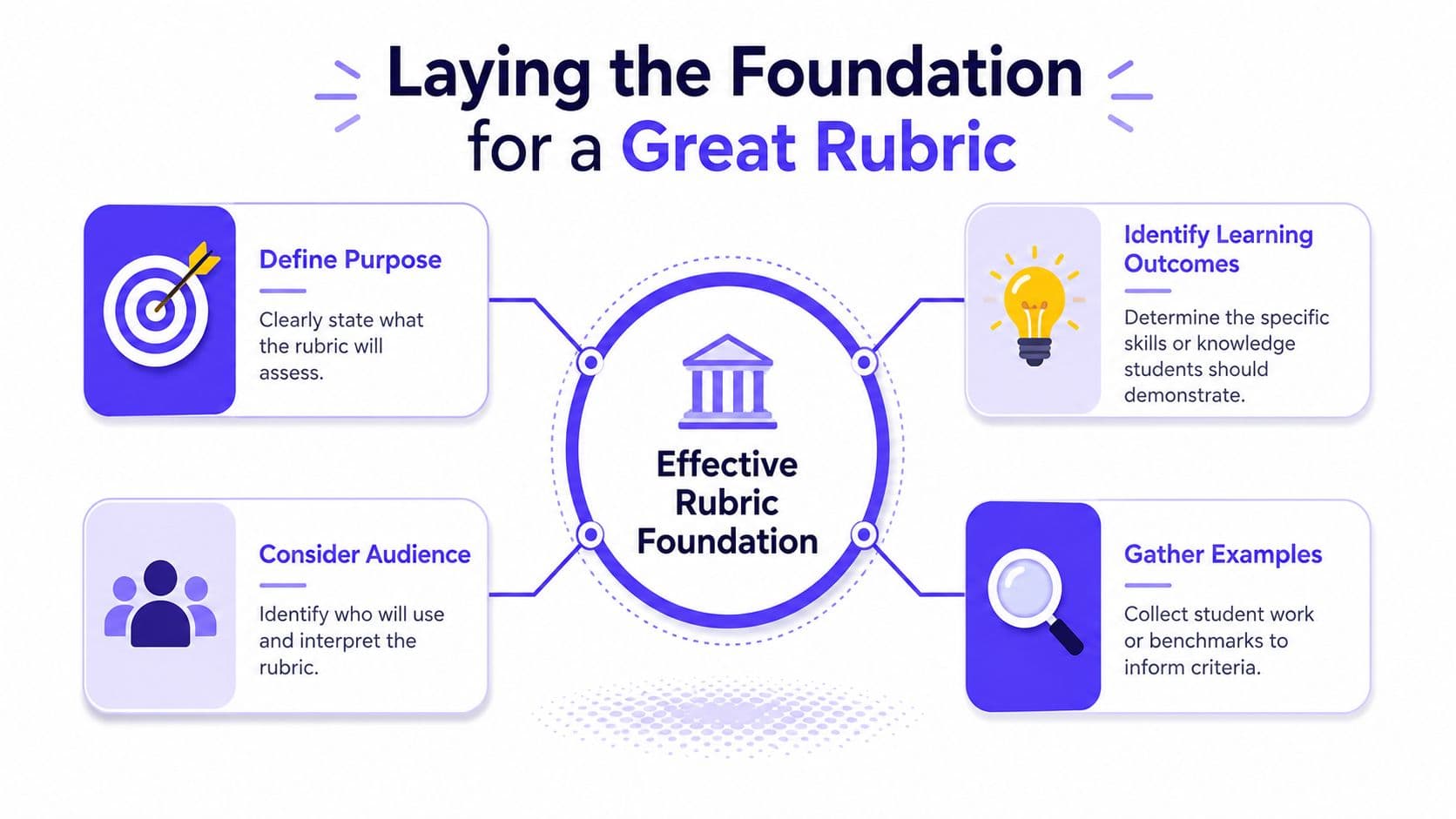
Start before the chart. Decide what the rubric is for, what evidence counts, and what kind of decision the score needs to support.
Start with purpose, not categories
I usually sort rubric planning into four questions:
- What exact skill am I assessing?
- Which part of the IEP goal or standard matters most here?
- What evidence will show that skill clearly?
- Who will use this rubric besides me?
If the answer to the first question is too broad, keep narrowing. “Reading comprehension” is too big. “Identifies the main idea from a grade-level passage using visual supports” is workable. “Explains the main idea and one supporting detail orally or in writing with no more than one prompt” is even better.
Pull apart the goal before you write a row
A lot of IEP goals bundle multiple actions together. That's fine for the document, but it's a mess for scoring unless you unpack it. If a goal includes identifying, explaining, and applying, you may need separate criteria instead of one overloaded line.
I also decide early what does not belong on the rubric. Compliance behaviors, handwriting neatness, and task stamina often sneak in and distort the true score. If I'm measuring written expression, I don't want “sat appropriately” muddying the result unless that behavior is the actual target.
A reliable rubric also needs structure. To ensure consistency, special education assessment rubrics should include five core components: detailed explanations for guiding questions, definitions of key terms, specified sources of evidence for each item, clear scoring decision rules, and explicit definitions of how performance levels progress (five core rubric components for consistency).
Choose evidence before performance levels
Before writing “emerging” or “proficient,” decide what evidence qualifies. In special education, evidence may come from more than one place:
- Student products such as writing samples, math work, or graphic organizers
- Observed behaviors during instruction or independent work
- Language samples from oral response, AAC use, or discussion
- Prompt records showing the level of support required
That choice matters because it changes what your rubric can capture. If your evidence source is only the finished worksheet, you may miss whether the student generated the response independently, copied a model, or answered after repeated cues.
Rubrics get stronger when the evidence source is named up front. That one move cuts down a surprising amount of scoring drift.
Decide how the rubric will travel
Some rubrics are just for teacher scoring. Others need to work across settings. If paraprofessionals, speech-language pathologists, inclusion teachers, or case managers will use it, your wording has to be even tighter.
That's why I keep the planning notes attached to the rubric, at least in my working draft. Definitions, examples, and scoring rules aren't extra. They're what keep the rubric useful once it leaves your desk.
Designing Your Rubric from Scratch
Once the foundation is solid, the writing gets easier. Not easy. Easier. This is the part where vague professional language has to become plain classroom language.

Write criteria people can actually see
The fastest way to wreck a rubric is to fill it with words like “understands,” “shows effort,” or “is engaged.” Those sound professional, but they don't give a scorer anything concrete to look for.
For special education assessment rubrics to produce reliable data, skills need to be defined as observable behaviors. “Student raised hand to ask a question” is scoreable. “Student was engaged” is not. That distinction is critical for inter-rater reliability.
Here's the test I use: can a substitute, a para, and a related service provider all point to the same thing in the same moment? If not, the wording still needs work.
Build performance levels from the middle out
It is common to start with level 1 and then encounter difficulties. I've had better luck starting with the proficient level. Define what successful performance looks like under typical conditions. Then write the level below it by identifying what's missing, and the level above it by identifying what makes the performance stronger, more accurate, or more independent.
A simple comparison helps:
| Weak descriptor | Stronger descriptor |
|---|---|
| Good participation | Contributed one relevant comment during discussion |
| Needs support | Completed task with verbal prompts and visual model |
| Strong writing | Wrote a topic sentence, two related details, and a closing statement |
| Limited understanding | Identified answer choice but could not explain reasoning |
Keep scales simple enough to use on tired days
A rubric that looks beautiful but takes too long to score won't survive October. In practice, I've found that the best scale is the one your team can consistently apply. Some tasks need four levels because growth shows up in small steps. Others are cleaner with three.
A few shortcuts help:
- Use parallel language so each row follows the same pattern.
- Name independence clearly if support level matters.
- Separate accuracy from support when both are important.
- Avoid stacked criteria like “identifies, explains, and compares” in one cell.
If one rubric row needs the word “and” three times, split it. You're probably scoring more than one skill.
Test and tweak before calling it finished
A rubric draft is not a final product. Score a few student samples with it. Ask another adult to score the same samples. Compare where your interpretations diverge.
That's usually where the a-ha moment shows up. You realize one level is too broad, one criterion depends on hidden assumptions, or one score point says more about language production than the actual content skill. Tightening those spots matters far more than adding fancy labels.
Differentiating Rubrics and Embedding Equity
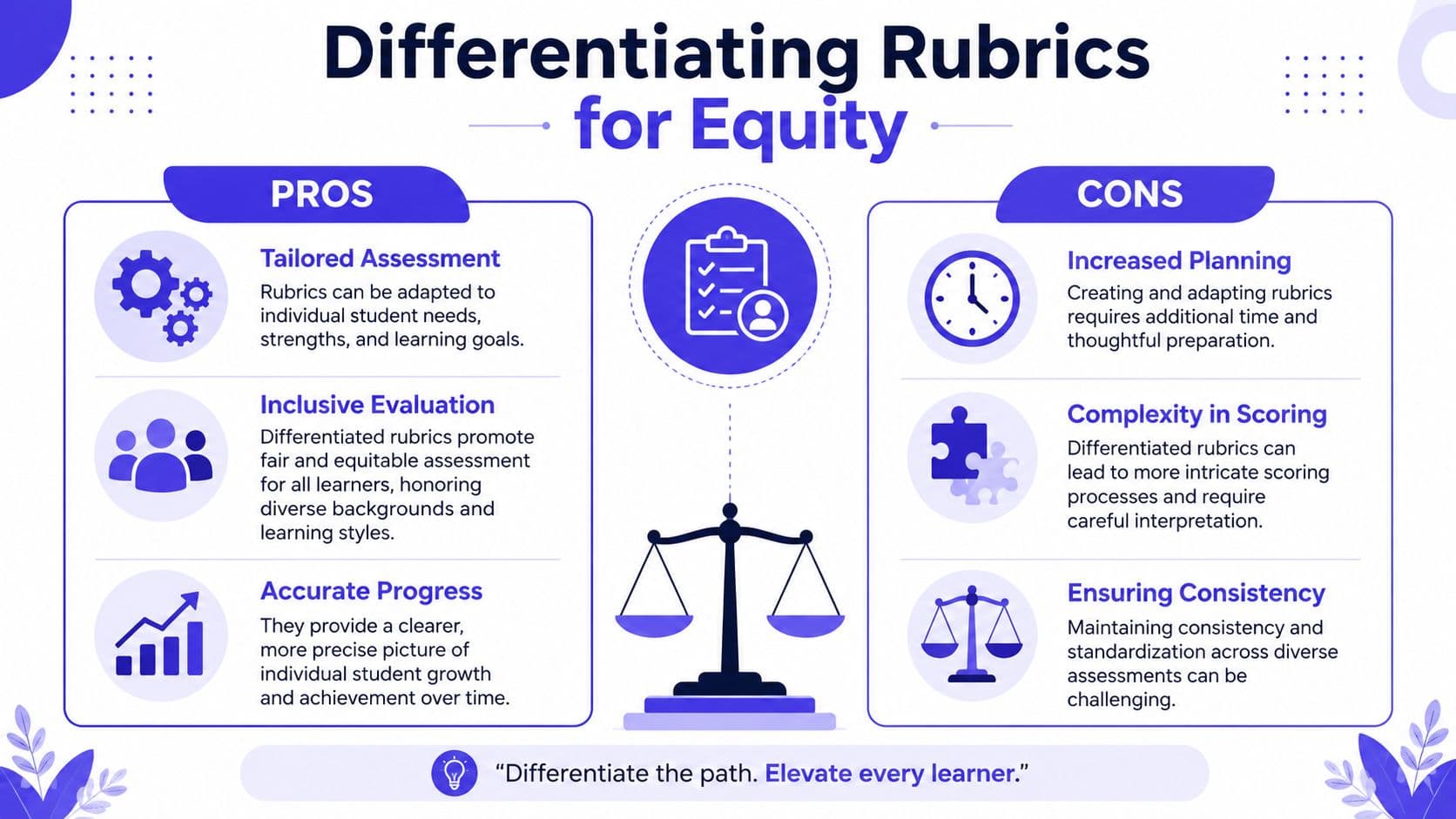
One-size-fits-all rubrics create bad data fast in special education. They often look fair because every student gets the same chart. In reality, they can punish students for how they access the task instead of measuring the skill the task was supposed to assess.
Accommodation and modification are not the same thing
A rubric can stay focused on the same learning target while allowing different ways to show it. That's accommodation. A student might dictate, respond with AAC, use visuals, or receive extended time while being scored on the same core criterion.
Modification changes the target itself. That might mean reducing the number of criteria, adjusting complexity, or scoring a related but different skill. Neither move is automatically wrong. The problem starts when teams blur them and then compare scores as if they mean the same thing.
When I review a rubric, I ask two questions:
- Is the student being measured on the intended skill?
- Did the access support change the skill itself, or just the pathway for showing it?
If the answer is fuzzy, the score will be fuzzy too.
Bias checks belong inside the rubric
This is the part many templates skip. A lot of rubrics assume the “best” response looks a particular way: fast verbal language, standard grammar, culturally familiar examples, or school-shaped behavior patterns. That can skew scoring before anyone realizes it.
A major gap in special education assessment tools is the lack of explicit bias checks. To create non-discriminatory evaluations, educators need to rule out factors like ineffective general education or systemic gaps before attributing needs to disability (guidance on addressing bias in special education evaluation).
That idea should change rubric design, not just evaluation meetings.
A quick equity audit for your rubric
I like using a short bias check before a rubric goes into rotation:
- Language demand check: Does the rubric measure the target skill, or is it secretly measuring English proficiency, vocabulary exposure, or processing speed?
- Cultural knowledge check: Does success depend on background knowledge that may not be shared by all students?
- Behavior expectation check: Are you rewarding one narrow version of participation?
- Instruction check: Has the student had access to effective instruction for this skill?
- Support check: Are accommodations documented clearly enough that raters won't treat supported performance as invalid by default?
For teams working on broader classroom differentiation, this guide to differentiation teaching strategies is a useful companion because rubric quality depends heavily on how instruction was adapted in the first place.
A fair rubric doesn't lower expectations. It removes irrelevant barriers so the score reflects the skill, not the student's distance from a narrow norm.
The practical trade-off is time. Equity checks add planning work. But they prevent a much bigger problem later, when a low score looks objective even though the rubric itself was tilted from the start.
Putting Your Rubric into Practice and Tracking Progress
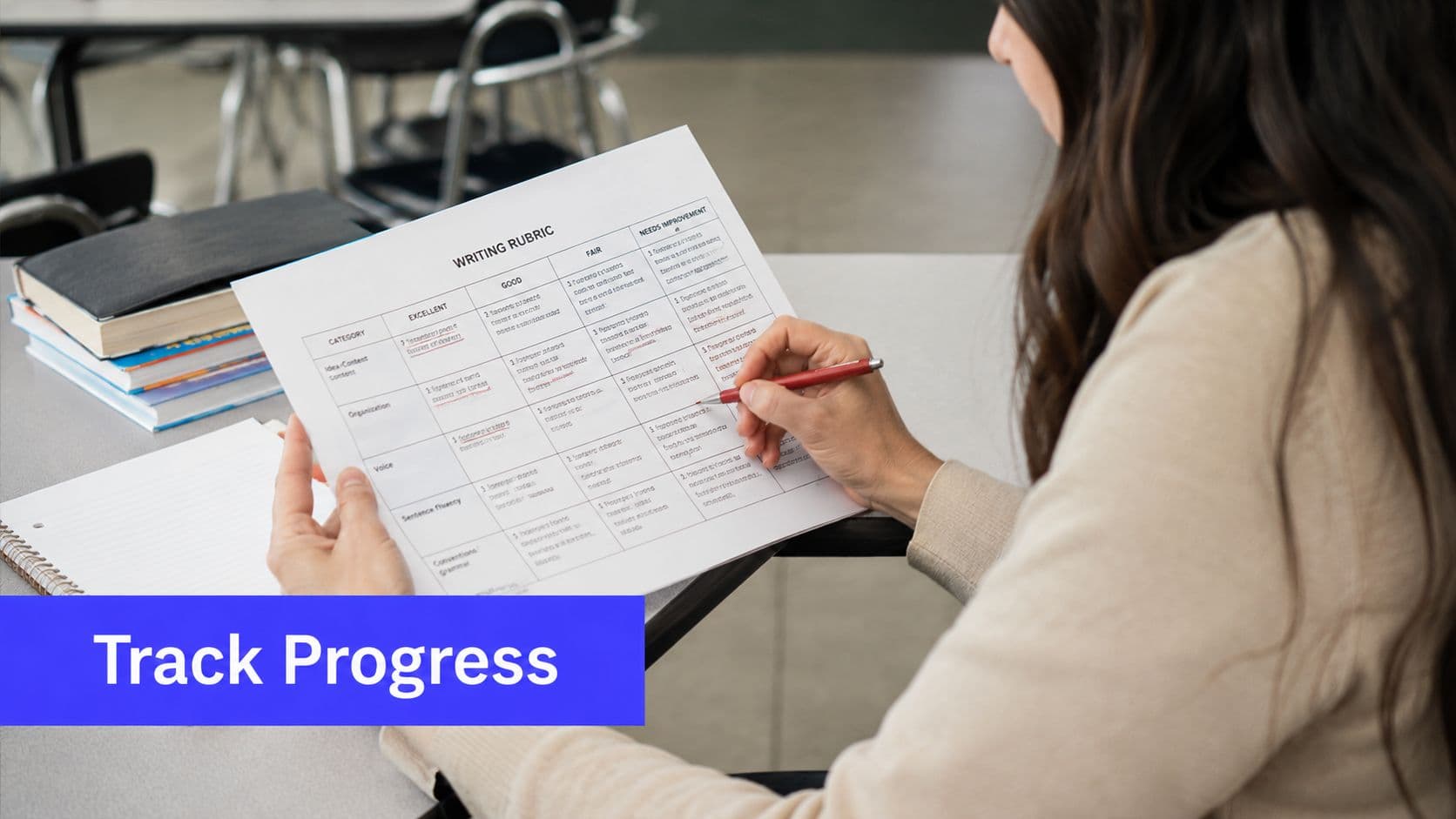
A rubric has almost no value if it only appears during grading. Its best use is ongoing. Students should see it before the task, during the task, and after the task. Staff should use it while support is happening, not just after the evidence is cold.
Teach the rubric before you score with it
Students do better with rubrics when the language is visible and practiced. That doesn't mean reading every row aloud once and hoping it sticks. It means modeling examples, non-examples, and what revision looks like.
The implementation method that works best is a simple two-phase sequence. First, explicitly explain the rubric criteria and why the rubric is being used. Then move through a cycle where students produce work, receive feedback or self-assess, and revise. In the research base summarized earlier, that pattern was tied to positive academic effects when rubrics were used with instruction rather than as stand-alone scoring sheets.
For day-to-day classroom use, I keep it practical:
- Before the task: highlight one or two criteria only
- During the task: stop for a fast self-check
- After the task: have the student identify one strength and one revision target
That's also why examples of formative assessment in classroom practice pair well with rubric use. The rubric shouldn't sit outside instruction. It should shape it.
Turn scores into a progress story
A single rubric score is a snapshot. A series of rubric scores becomes a pattern. That pattern matters in IEP meetings because it answers better questions: Is the student becoming more independent? Is accuracy improving only with prompting? Is generalization happening across settings or adults?
This is a good place to add brief notes beside the score. Not long narratives. Just enough to preserve context:
- independent
- one gestural prompt
- oral response with visuals
- strong content, weak organization
- needed sentence frame
Later, those notes keep you from overinterpreting the number alone.
Here's a useful refresher before teams train on implementation:
Link rubric data to support decisions
This is one of the most overlooked uses of special education assessment rubrics. Teams often collect performance data and staffing data separately, then wonder why support decisions feel subjective.
A frequent disconnect in special education is the failure to link rubric scores to specific paraprofessional support levels. Integrating assessment data with staffing needs is essential for justifying and allocating resources effectively, yet most general rubrics do not provide this quantitative linkage (discussion of rubric data and paraprofessional support levels).
That doesn't mean every rubric needs staffing minutes built into it. It does mean the rubric should capture the kind of information support decisions depend on, such as:
| Rubric feature | Why it matters for support planning |
|---|---|
| Independence level | Shows whether the student can perform without adult proximity |
| Prompt type | Distinguishes visual, verbal, gestural, or physical support |
| Generalization | Shows whether the skill transfers across settings |
| Safety or regulation impact | Flags when support is needed to access instruction reliably |
If your rubric only says whether the answer was correct, it may be fine for grading. It won't be enough for service planning.
Ready-to-Use Rubric Template and Final Tips
Sometimes you don't need a new philosophy. You need a starting draft you can adapt in ten minutes before tomorrow's lesson.
This template works for many writing tasks because it separates core dimensions cleanly. Adjust the descriptors to match the actual target, supports, and evidence source. If you're comparing possible curriculum-based assessments, best practice is to score multiple options with a rubric and adopt the one with the highest rating, or use more than one if needed to capture a fuller profile (curriculum-based assessment rubric guidance).
Adaptable Rubric Template for a Writing Task
| Criteria | 1 - Emerging | 2 - Developing | 3 - Proficient | 4 - Exemplary |
|---|---|---|---|---|
| Ideas | States a topic with limited relevant detail | States a topic and includes at least one related detail | States a clear topic and includes relevant supporting details | Develops a clear topic with well-chosen supporting details |
| Organization | Response is incomplete or hard to follow | Includes some structure but ideas may be out of order | Includes a clear beginning, middle, and ending | Uses clear structure that strengthens meaning |
| Language Use | Uses limited words or unclear sentences | Uses simple sentences that partly communicate ideas | Uses clear language to communicate ideas | Uses precise language that adds clarity and detail |
| Independence or Support | Completes task only with substantial prompting | Completes parts of task with support | Completes task with minimal support | Completes task independently and may revise after feedback |
Final tips that save time later
- Keep one master version with your definitions and scoring rules attached.
- Score a few anchor samples before giving the rubric to a larger team.
- Write for the next scorer. Assume someone else will need to use it during a hectic week.
- Document accommodations directly so supported performance is interpreted correctly.
- Build a bias check into revision rather than treating equity as an afterthought.
If you're refining teacher-made materials more broadly, this piece on unlocking content value with AI tools is worth a read because it highlights how planning tools can help organize instructional content before you ever build the scoring tool. When you want a faster first draft for classroom use, a dedicated rubric generator for teachers can save setup time, especially when you already know the target skill and performance levels you want to refine.
If you want to build standards-aligned rubrics, lesson plans, worksheets, and differentiation supports without starting from a blank page every time, Kuraplan is a practical tool to keep in your planning workflow. It helps K to 12 teachers turn objectives into usable classroom materials quickly, which is a big deal when your rubric, instruction, and progress monitoring all need to line up.