The unit starts Monday. You have a class novel you've taught twice, a folder of handouts named things like "Chapter 3 questions final FINAL", and a vague sense that week three is where the essay happens. What you don't have is one document that says what students will be able to do by lesson ten, how you'll know they got there, and what you'll cut when the assembly eats a period.
That gap is where most English units fail. The individual lessons are often fine. What's missing is the spine connecting the standard, the text, the task and the check.
Drafting tools have changed the shape of this problem. A ten-lesson sequence now takes about ninety seconds to generate, and it looks complete. The core work has moved from writing the plan to auditing it, which is why the audit belongs inside the design rather than bolted on the night before.
The Parts Every English Unit Plan Needs
A finished unit plan english document answers four questions: what students read, what they write, what they discuss, and how you'll know each of them got there. Weak plans usually aren't wrong so much as incomplete. They carry activities but no assessment, or texts but no stated skill, or objectives that never reappear in a task.
Plan inside the timetable you teach. Ten lessons across three weeks is a realistic default for a text-based English unit. Anything longer assumes no assemblies, no testing week and no disruption. Language instruction already competes for a shrinking slice of the day: UNESCO's cross-national study of intended instructional time found official-language instruction averaged 37.0% of total instructional time in Grade 1, dropping to 17.6% by Grade 9, with foreign-language instruction, which usually includes English, running at 12 to 15% across grades (UNESCO). Every period in your unit is contested, so the plan has to sequence rather than list.
Components of an English unit plan
| Component | What it holds | Quick test |
|---|---|---|
| Big question | One question the unit answers, such as why characters in dystopian fiction resist authority | Could a student answer it after the last lesson? |
| Standards and objectives | 2 to 4 standards broken into 3 to 5 measurable objectives | Does each objective name a skill and a text? |
| Texts | One anchor text plus 2 or 3 supporting texts, literary and nonfiction | Is every text read in full by you before it is assigned? |
| Assessments | Baseline, formative checks and a final task | Does every objective appear in at least one assessment? |
| Lesson sequence | 8 to 12 lessons, each with one purpose and one success criterion | Can you state the purpose of lesson 5 in one sentence? |
| Differentiation | Support, extension and named groups | Are groups named, or only described as struggling learners? |
| Timing | Number of lessons and days mapped to your timetable | Does the total fit your calendar with a buffer day? |
Timing gets trickier when your room isn't really a room. If your class meets in a portable while the main building is renovated, the physical layout shapes what small-group work you can run, and the video help setting up temporary offices from Pacific Mobile Structures shows how those spaces get configured. Know your room before you plan the corners of it.
Writing Objectives Students Can Demonstrate
Standards point the unit in a direction. They rarely arrive lesson-ready. In the United States, the Common Core State Standards for English Language Arts, published in 2010, are built on College and Career Readiness Anchor Standards for reading, writing, speaking and listening, and language, with grade-specific standards layered on top (Common Core State Standards). Pick two or three that match your final task, such as one grade-level standard on citing textual evidence and one on writing arguments. Everything else in the unit hangs off that choice.
Then convert each standard into an objective with a fixed shape:
The formula: Students will [skill] in [text] to produce [output].
A worked version reads: "Students will identify the claim in a nonfiction essay and support it with two quoted details in a 500-word response." One skill, one text, one output. Not "students will understand persuasion", which is a topic wearing an objective's coat.
Three to five objectives is the ceiling for a ten-lesson unit. Beyond that you cannot check them properly, and unchecked objectives are decoration. Test each one by asking whether you could write an assessment item for it in under a minute. If you can't, rewrite it until you can. If you want a tighter structure for the student-facing version, this guide to learning intentions and success criteria shows how to phrase the same objective so a thirteen-year-old can tell whether they've met it.
Teachers working under a national curriculum, a state framework or an International Baccalaureate programme can use the identical method. The labels change; the demand for a named skill and a named text does not.
How to Build the Unit Backward From the Final Task
Backward design isn't a philosophy, it's a defence against drift. The order of your decisions matters more than the quality of any single one, because choosing texts first produces a unit about a book rather than a unit about a skill.
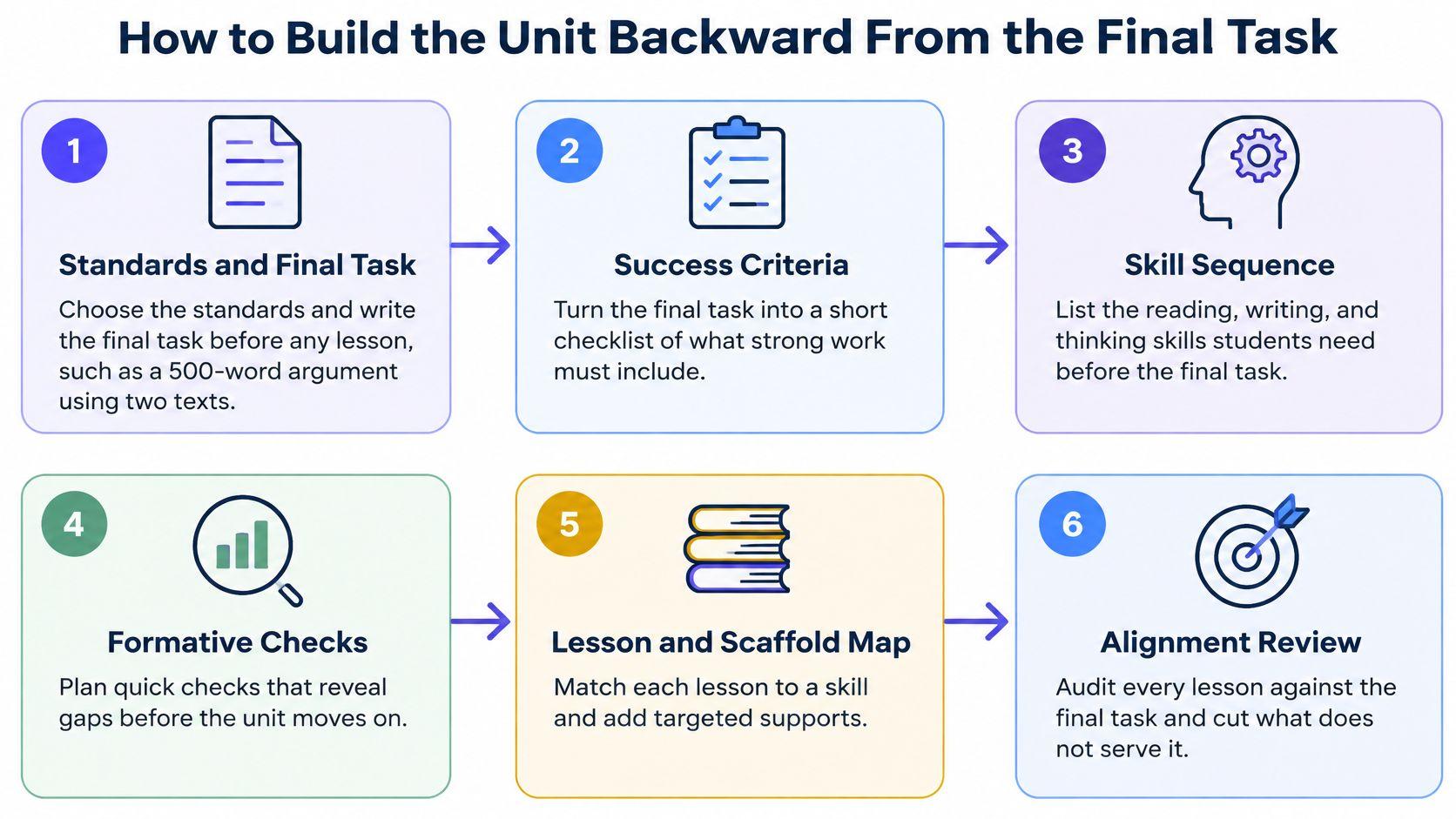
- Standards and final task first. Write the final task before a single lesson: a 500-word argument using two texts, due at lesson 10. If you can't describe the finished product, you can't sequence toward it.
- The rubric immediately after. Four or five dimensions, such as interpretation, evidence, organisation, style and conventions. Writing the rubric later is how vague goals creep in, because you end up scoring whatever the students happened to produce.
- Work backward from the rubric to knowledge and language. Which claims must students recognise, which text structures must they understand, which academic words must they own? This list becomes your vocabulary and your mini-lessons.
- Choose texts to fit that list. Pair the literary anchor with demanding nonfiction so students practise evidence on both. The IES practice guide notes that the standards call for complex literary nonfiction, historical, scientific and technical texts in elementary and middle grades, and treats rich informational text as a platform for vocabulary and structured academic conversation (IES practice guide).
- Sequence modelling, guided practice, independent application. Every skill gets demonstrated by you, attempted with support, then attempted alone. Skipping the middle stage is the most common sequencing error in English units.
- Put a short formative check at the end of each stage and record results by objective, so you know what to reteach while there's still time.
The payoff is measurable. The Education Endowment Foundation reports an average impact of about six additional months of progress over a school year for reading-comprehension strategy instruction, rising to an estimated seven months for secondary pupils, with a high evidence rating (EEF). That return depends on repeated modelling across several texts, not a single annotated extract.
One benchmark holds the whole thing together: one observable success criterion per lesson. If lesson 6's criterion is "students have discussed the poem", you have nothing to observe.
The video below works through the same planning order from standard to final task.
If you're building a unit around a text with a strong reader community behind it, the Lesbian Romance Reads planning guide is a useful model for how readers track theme, character and evidence across a book, and it transfers neatly into a student-facing reading log.
Sequencing Lessons Across a Three-Week Unit
The rhythm that works is modelling in week one, guided discussion with a second text in week two, then writing in week three, with a short check closing each stage. Vocabulary runs underneath all three weeks rather than sitting in a single lesson.
The What Works Clearinghouse recommends teaching academic vocabulary through multiple instructional activities, which can include teacher explanation, contextualised reading, discussion, retrieval and written application (WWC practice guide). That means the same six to eight words appear in the preteach, in the discussion, in the exit ticket and in the final draft. A worksheet on Monday and nothing after is not vocabulary instruction, it's a spelling test with extra steps.
Sample three-week unit sequence
| Week and lessons | Main focus | Formative check |
|---|---|---|
| Week 1, lessons 1–2 | Background knowledge and 6 to 8 preteached words | Students use 3 target words correctly in their own sentences |
| Week 1, lessons 3–4 | Modelling reading strategies on the anchor text | One annotated paragraph with a clearly stated inference |
| Week 2, lessons 5–6 | Guided reading of a second, nonfiction text | Evidence-based discussion turn recorded for each student |
| Week 2, lessons 7–8 | Paragraph skills: claim, evidence, explanation | Baseline and midpoint paragraphs scored on the same criteria |
| Week 3, lesson 9 | Draft, peer feedback, one focus per feedback cycle | Revised evidence paragraph |
| Week 3, lesson 10 | Final task and short reflection | Final draft scored against the full rubric |
Two rows carry more weight than they look. Lessons 1–2 include the baseline paragraph, collected before you teach anything, because the midpoint comparison in lessons 7–8 is meaningless without a starting score. Lessons 7–8 are where units collapse. Teachers who spend all three weeks inside the anchor text arrive at lesson 9 with no time to teach paragraph construction, then grade essays that were never taught.
Timing fix for 45-minute periods: merge lessons 3 and 4 into one double reading block and keep the strategy modelling intact. Cut the reflection, not the modelling.
Fit the sequence to your own calendar rather than forcing ten lessons into nine days. If you lose a period to a fire drill, the buffer day is the thing you spend, not the writing lessons.
Differentiating Texts, Tasks and Support
Differentiation fails when it means "extra worksheets for the fast finishers". In practice there are three levers, and they pull in different directions.
- Text. Offer the same idea at two reading levels, such as a chunked version with an audio track, so a student reading two years below grade can join the same discussion question as everyone else. The question stays constant; the entry point moves.
- Task. Allow a choice of output, such as a paragraph, an annotated diagram or a recorded explanation, while the rubric stays identical. If the rubric changes with the format, you've created two different assessments.
- Support. Build small-group reteaching into the timetable, roughly fifteen minutes twice a week, plus recurring structured partner work.

That partner work has a concrete budget. A federal elementary literacy practice guide specifies approximately 90 minutes per week for structured partner work in which students of different ability levels or English proficiencies collaborate on academic tasks, and federal guidance recommends small-group instructional intervention for students who struggle with literacy or English-language development (WWC practice guide). Ninety minutes sounds like a lot until you realise it replaces whole-class activities rather than adding to them.
For English learners, sentence frames do more work than simplified texts: "The author suggests ___ because ___" gives a student the claim-and-evidence move without giving away the answer. For extension, hand over a counterargument to test or a second nonfiction source that contradicts the first, rather than more of the same.
If a student submits a recorded explanation instead of a paragraph, caption it, and this guide to captioning lectures for deaf students covers the practical side of getting transcripts that are accurate enough to assess against a rubric. For more structures that hold up across a whole unit, this collection of differentiation teaching strategies is worth reading before you write your group names.
A tool like Kuraplan can draft levelled versions of the same worksheet from one unit, and every plan and worksheet is editable, so you can adjust the reading level before anything reaches a student. Check it yourself anyway. A generated text that is shorter is not automatically easier.
Assessments and Rubrics That Track Each Objective
Replace the single end-of-unit essay with three checkpoints, and the unit stops being a guess. Collect a baseline paragraph in lesson 1 and score it on three criteria so you know the starting point. Score a midpoint draft at lesson 8, one dimension at a time, using the rubric you wrote during planning. Compare the final task at lesson 10 against both.
Between those points, exit tickets do the daily work. Two minutes per student, sorted into secure, partly there and not yet. Those three piles decide who joins the small group next lesson, which is how assessment becomes teaching rather than reporting.
Extended writing should be engineered as a staged process, not assigned as a product. The Education Endowment Foundation's secondary-literacy guidance recommends breaking complex writing into planning, monitoring and evaluation, modelling each stage, and combining writing instruction with reading because the two reinforce each other (EEF guidance). The same guidance warns against rubric-only feedback, unmodelled essay prompts, and grading mechanics before ideas and reasoning have developed.
Assessment types matched to objectives
| Assessment | Objective tested | When | Scoring effort |
|---|---|---|---|
| Baseline paragraph | Claim and evidence before instruction | Lesson 1 | About 10 minutes, scored on 3 criteria |
| Exit ticket | One reading strategy or vocabulary term | End of each lesson | About 2 minutes per student, sorted into three piles |
| Annotated text check | Inference and identifying key ideas | Lesson 4 | About 5 minutes per student, spot-check 6 |
| Discussion checklist | Evidence-based talk | Lesson 6 | Tally during discussion |
| Midpoint draft | Evidence and explanation | Lesson 8 | Score one dimension at a time |
| Final task with rubric | All objectives | Lesson 10 | Full rubric, 5 dimensions |
Feedback rule: one focused cycle per draft. Evidence quality first. Explanation and cohesion second. Never both in the same pass.
Before the unit starts, run down the middle column and confirm every objective appears at least once. If an objective has no row, you've found the lesson you'll skip in week three. For more examples of two-minute checks that produce usable information, this set of formative assessment examples is organised by what each one tells you.
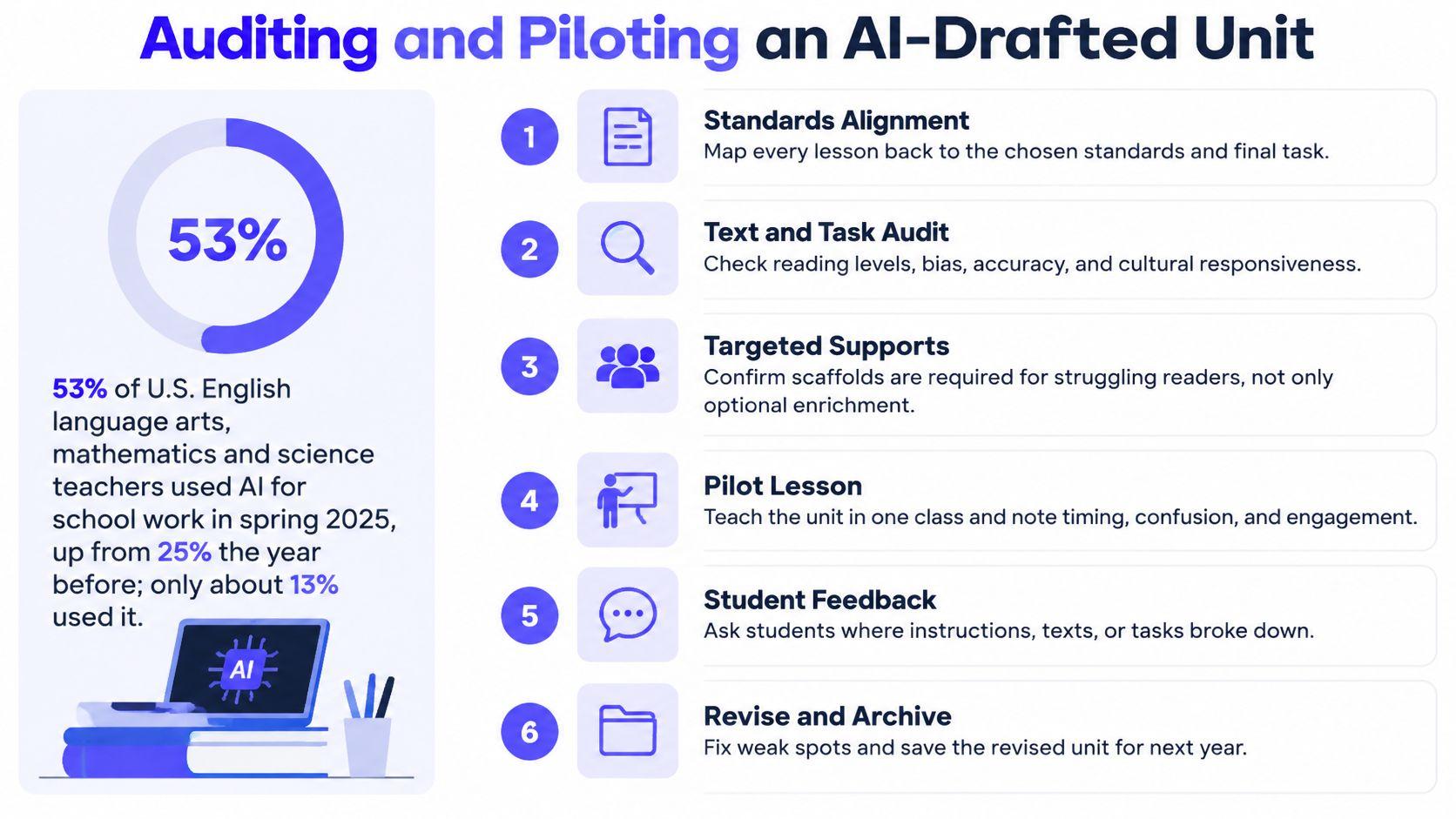
Auditing and Piloting an AI-Drafted Unit
AI drafting is now ordinary practice. 53% of U.S. English language arts, mathematics and science teachers reported using AI for school-related work in spring 2025, up from 25% the year before, though only about 13% used it at least weekly (RAND). Independent testing cited in the same report found that generative AI lesson plans can contain substantive quality problems while appearing complete and polished. That combination, plausible and flawed, is the dangerous one.
So run an eight-point review on any draft, whoever produced it:
- Standards. Check alignment against your own framework, not the one the tool assumed.
- Progression. Trace reading and writing skills across lessons and confirm each builds on the last rather than repeating it.
- Text complexity. Confirm the assigned texts sit in the right grade band, not just the right topic.
- Representation. Review texts and examples for cultural bias and for whose experience is treated as default.
- Facts. Verify every factual claim against a source you trust.
- Assessment validity. Ask whether each exit ticket measures its stated objective or something adjacent to it.
- Accommodations. Confirm the scaffolds are real and specified, not decorative lines about "supporting all learners".
- Student work. Take one past response and check it against the stated objective to see whether the task is answerable as written.
Then run a pre-flight in the final week before teaching. Confirm every objective appears in both a lesson and an assessment. Read each text in full, including the ones you've taught before, because you'll spot something you'd forgotten. Mark the six to eight words you'll preteach. Add lesson timings against your actual timetable with one buffer day reserved for writing. Print the rubric and an annotated exemplar. Write student names into each group instead of leaving the categories abstract.
Finish with a five-minute spoken walkthrough of lesson 1, out loud, alone. You'll hear the resource you haven't made yet.
The contrarian point: faster generation doesn't reduce professional judgement, it relocates it. You draft less and detect more, and detection is the harder skill.
Pilot with one class before the whole department uses it. Note where the timing broke, which instructions confused students and which text lost the room, then revise and archive the fixed version for next year. A unit plan that isn't audited isn't a plan, it's a proposal.
Kuraplan builds unit plans with interconnected lessons, assessments and learning progressions, which gives you the spine before you start cutting activities to fit the calendar. Every plan and worksheet is editable, so when the audit turns up a text that's too hard or an objective nothing assesses, you can fix it in place rather than starting over. Browse the English (ELA) library of 226 lesson plans at Kuraplan and see what survives your own eight-point review.