MathsFreePrintable
Advanced Growing Patterns Stations
A free maths worksheet ready for your classroom. Open in Kuraplan to grab the print-ready PDF, customize it for your students, or generate a fresh version in seconds.
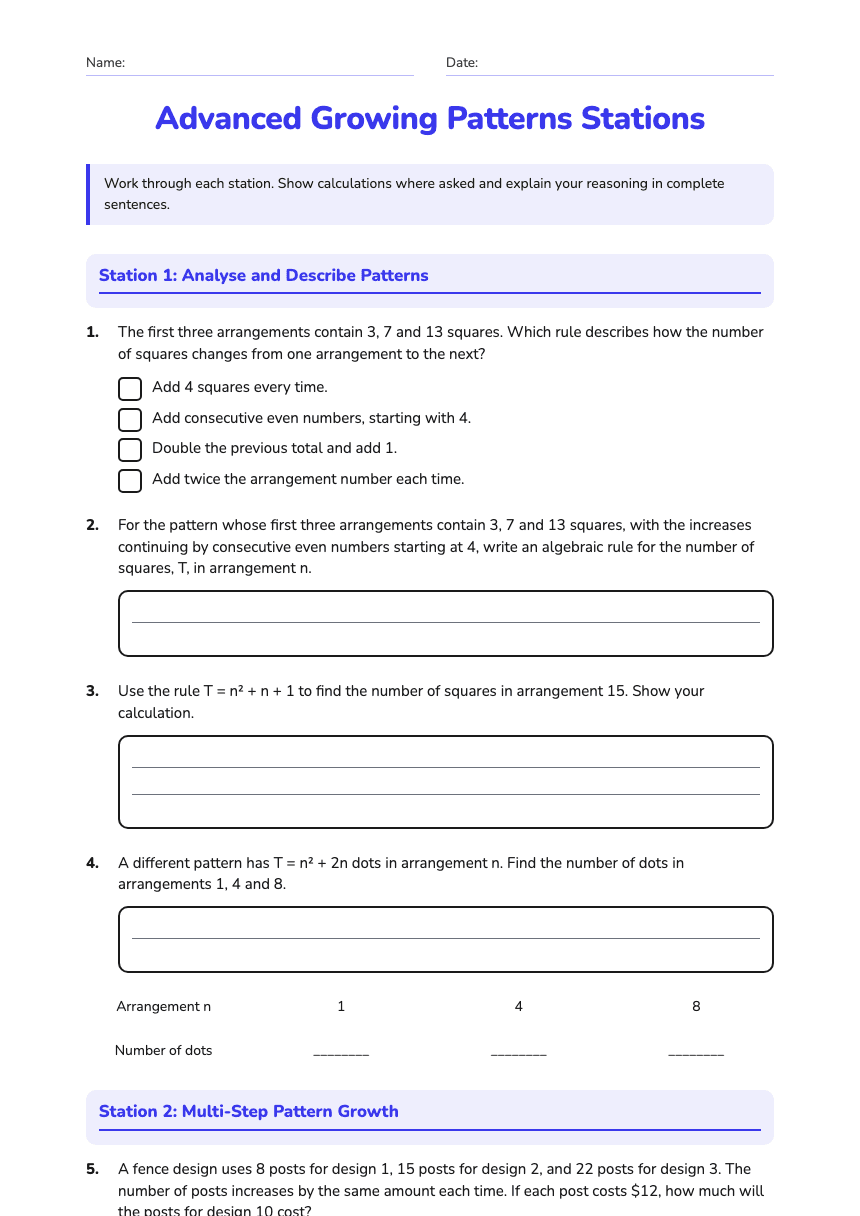
Name:Date:
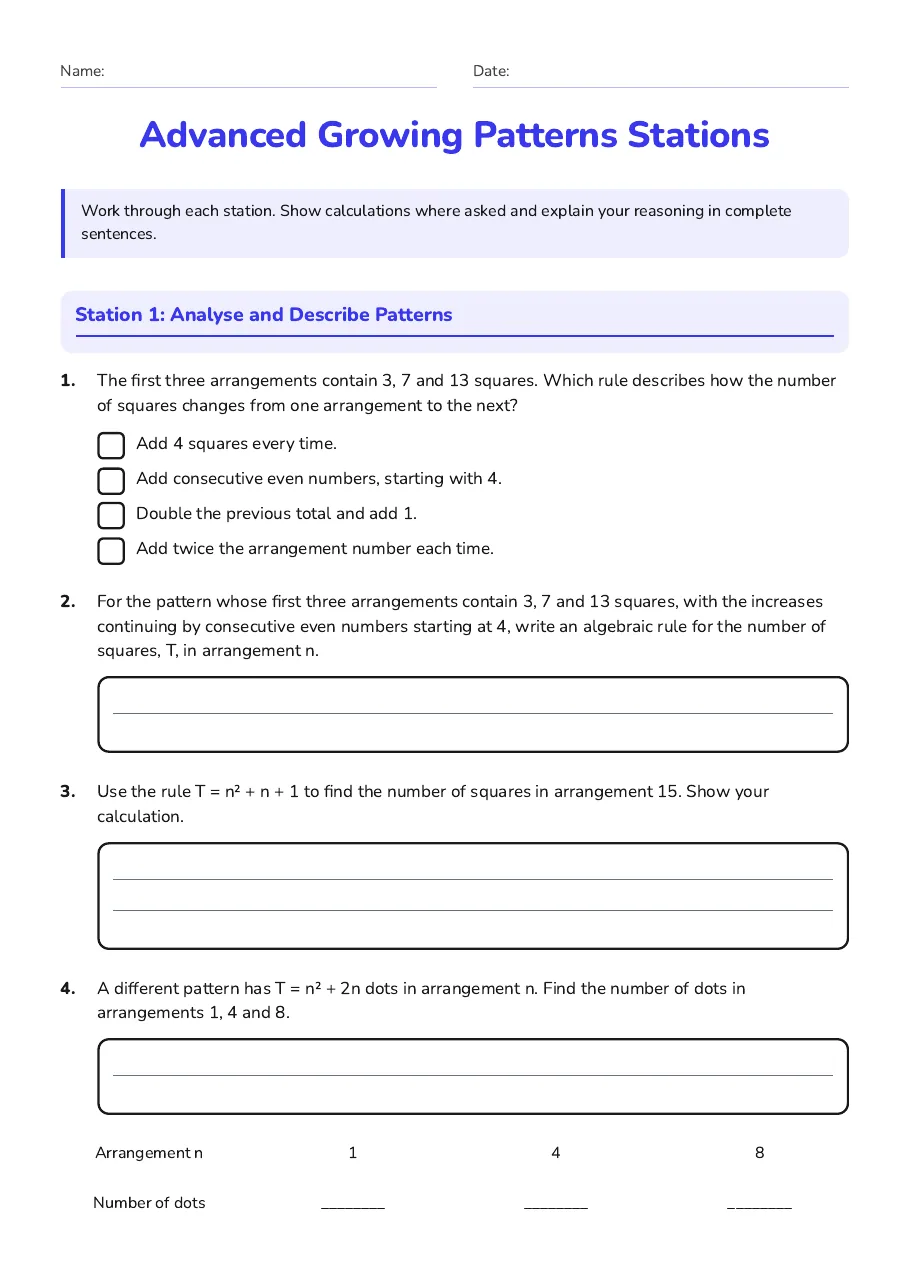
Advanced Growing Patterns Stations
Work through each station. Show calculations where asked and explain your reasoning in complete sentences.
Station 1: Analyse and Describe Patterns
1.The first three arrangements contain 3, 7 and 13 squares. Which rule describes how the number of squares changes from one arrangement to the next?
- Add 4 squares every time.
- Add consecutive even numbers, starting with 4.
- Double the previous total and add 1.
- Add twice the arrangement number each time.
2.For the pattern whose first three arrangements contain 3, 7 and 13 squares, with the increases continuing by consecutive even numbers starting at 4, write an algebraic rule for the number of squares, T, in arrangement n.
3.Use the rule T = n² + n + 1 to find the number of squares in arrangement 15. Show your calculation.
4.A different pattern has T = n² + 2n dots in arrangement n. Find the number of dots in arrangements 1, 4 and 8.
Arrangement n
1
4
8
Number of dots
________
________
________
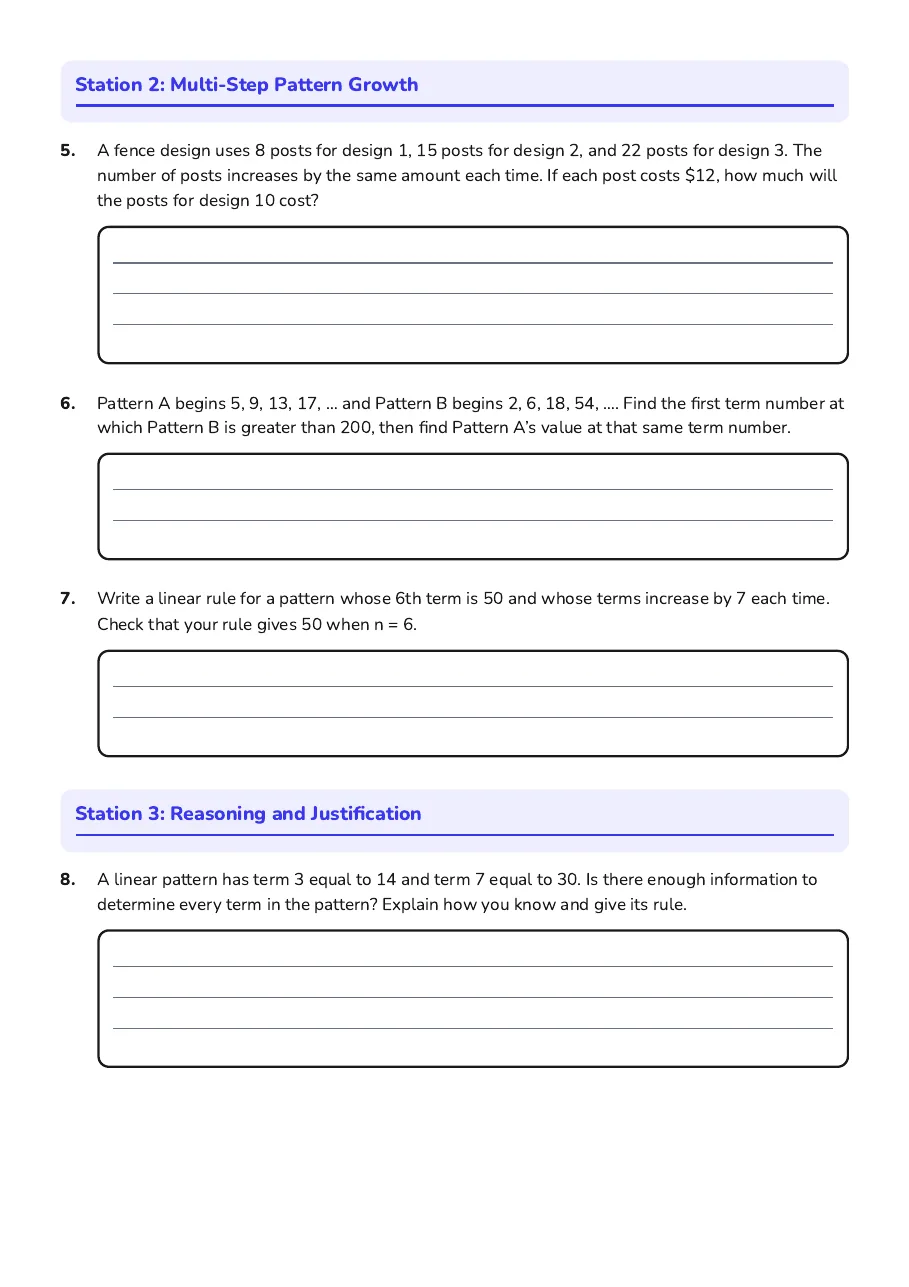
Station 2: Multi-Step Pattern Growth
5.A fence design uses 8 posts for design 1, 15 posts for design 2, and 22 posts for design 3. The number of posts increases by the same amount each time. If each post costs $12, how much will the posts for design 10 cost?
6.Pattern A begins 5, 9, 13, 17, … and Pattern B begins 2, 6, 18, 54, …. Find the first term number at which Pattern B is greater than 200, then find Pattern A’s value at that same term number.
7.Write a linear rule for a pattern whose 6th term is 50 and whose terms increase by 7 each time. Check that your rule gives 50 when n = 6.
Station 3: Reasoning and Justification
8.A linear pattern has term 3 equal to 14 and term 7 equal to 30. Is there enough information to determine every term in the pattern? Explain how you know and give its rule.
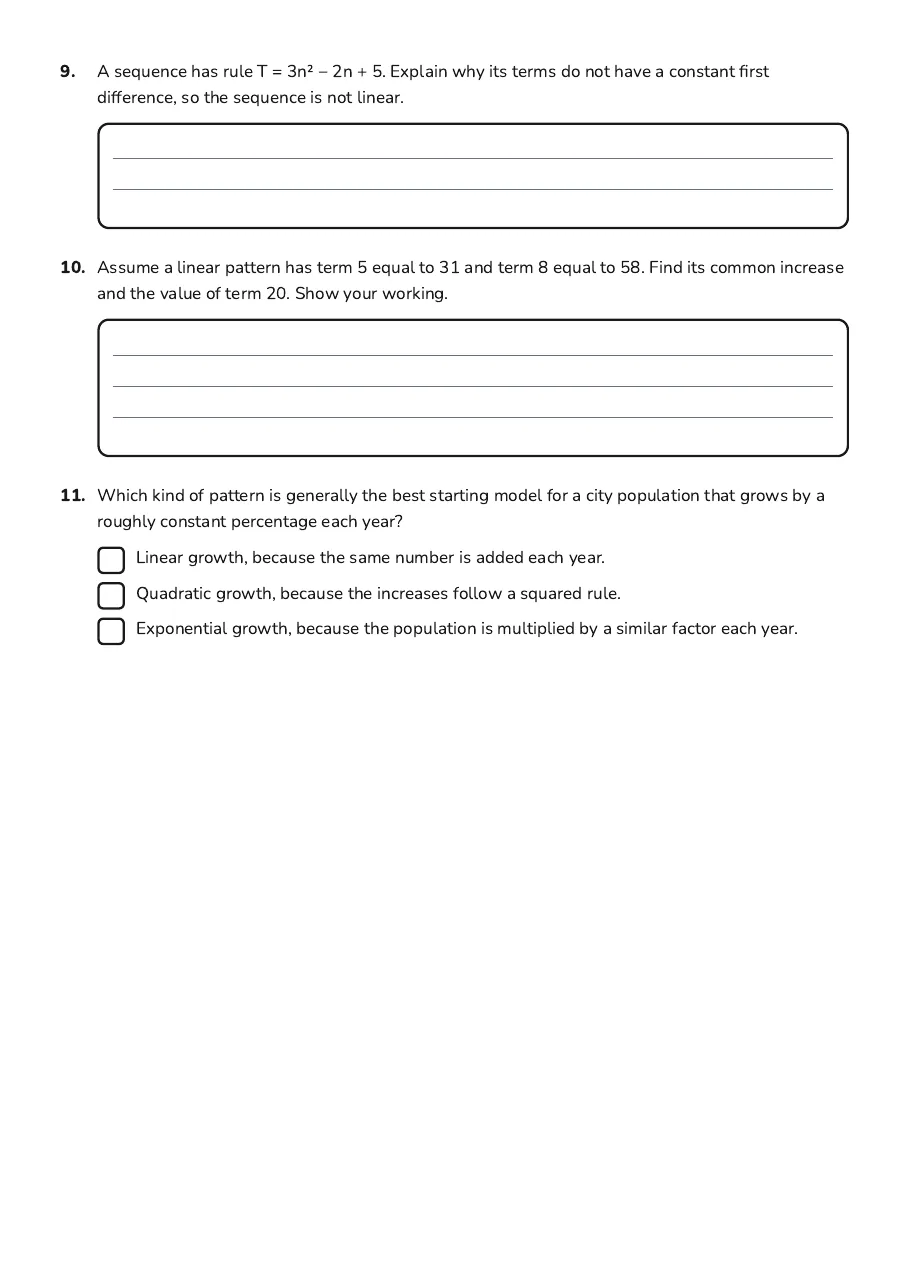
9.A sequence has rule T = 3n² − 2n + 5. Explain why its terms do not have a constant first difference, so the sequence is not linear.
10.Assume a linear pattern has term 5 equal to 31 and term 8 equal to 58. Find its common increase and the value of term 20. Show your working.
11.Which kind of pattern is generally the best starting model for a city population that grows by a roughly constant percentage each year?
- Linear growth, because the same number is added each year.
- Quadratic growth, because the increases follow a squared rule.
- Exponential growth, because the population is multiplied by a similar factor each year.
3 printable pages
Page 1
Page 2
Page 3
About This Worksheet
Free in Kuraplan
Sign up free, grab the PDF, and customize it for your class.
Print-Ready
Formatted for standard paper. Clean layout, easy to read.
AI-Generated
Created with Kuraplan's AI, designed for real classroom use.
For Teachers & Parents
Use in classrooms, for homework, tutoring, or homeschool.
Need a custom version of this worksheet?
Kuraplan's AI generates custom worksheets in seconds — differentiated for every learner, aligned to your curriculum.
Generate Custom Worksheets — Free No credit card Curriculum-aligned Under 60 seconds