HealthFreePrintable

Curated Images, Real Wellbeing

A free health worksheet ready for your classroom. Open in Kuraplan to grab the print-ready PDF, customize it for your students, or generate a fresh version in seconds.
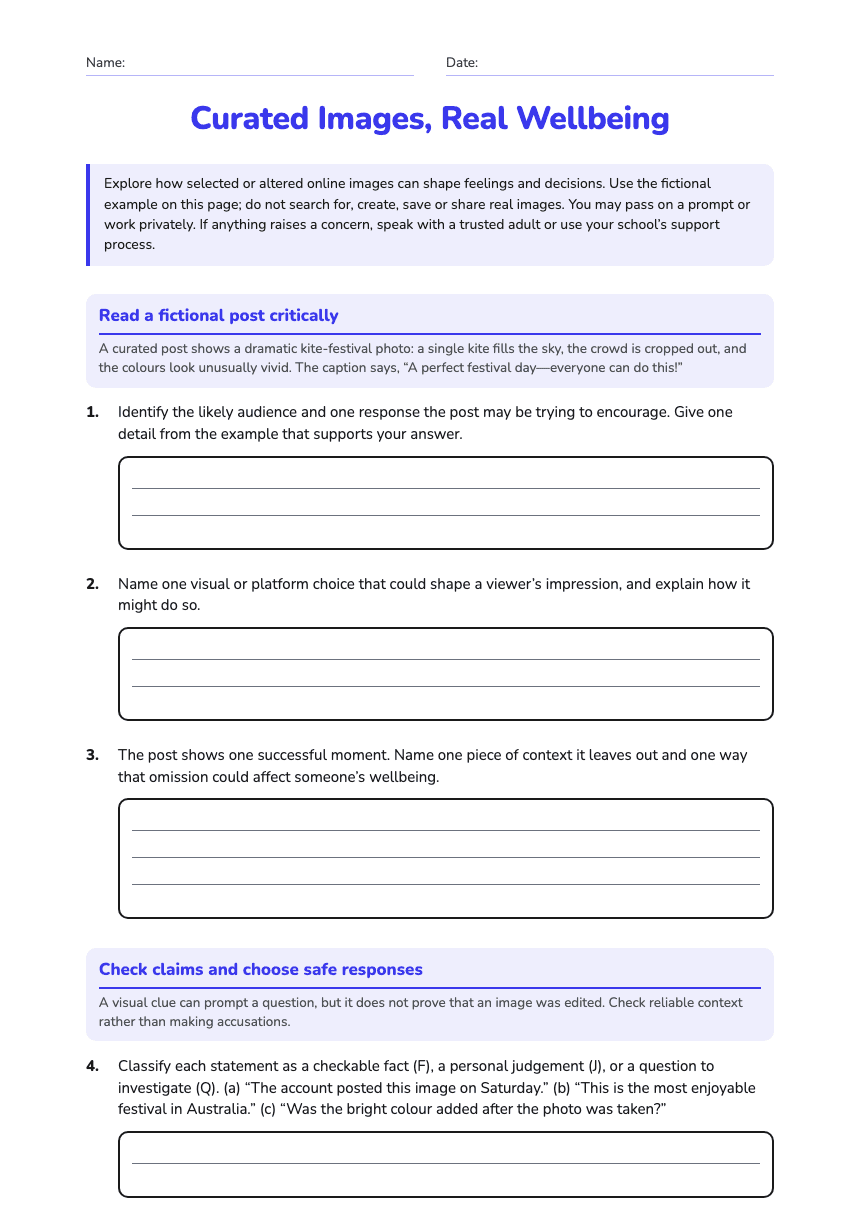
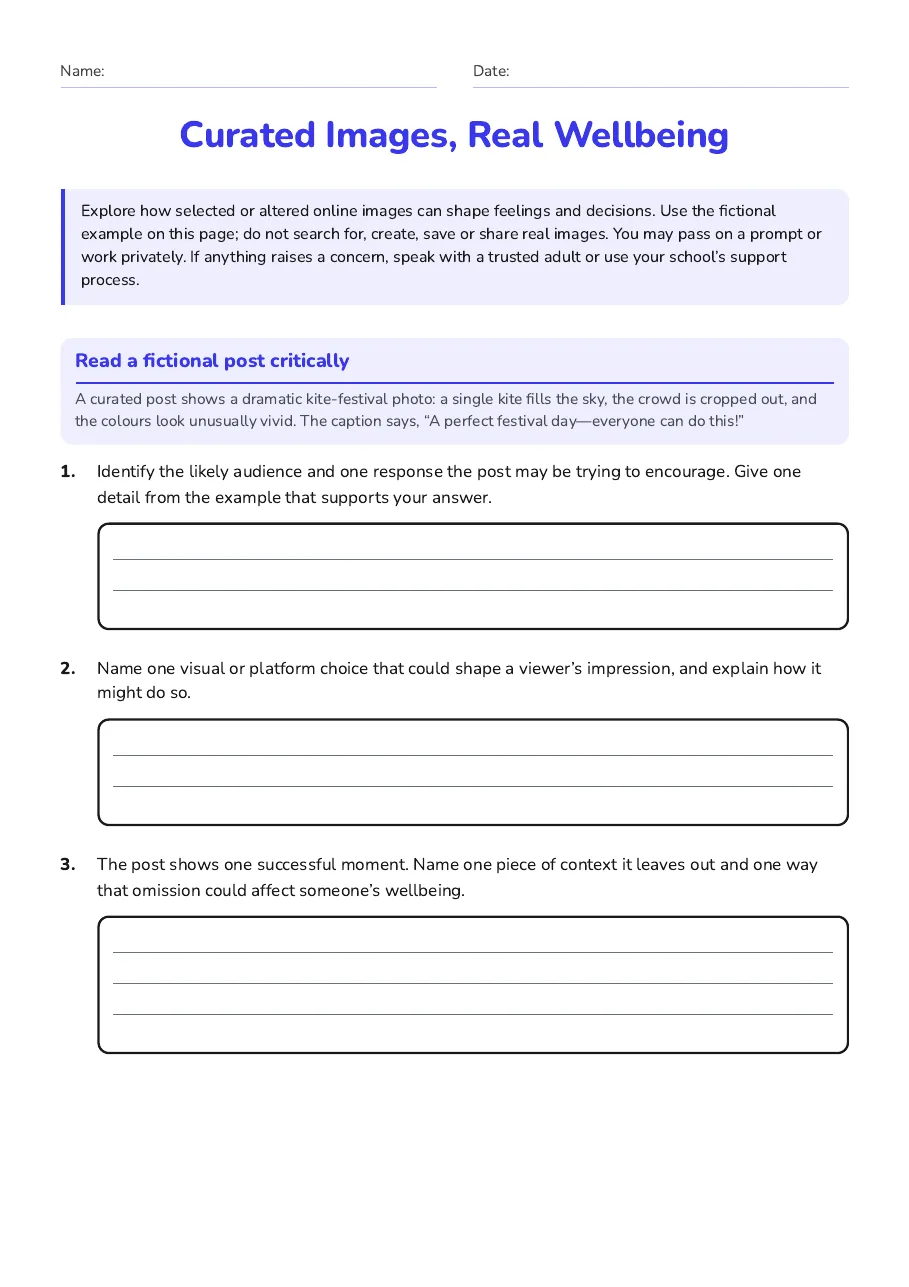
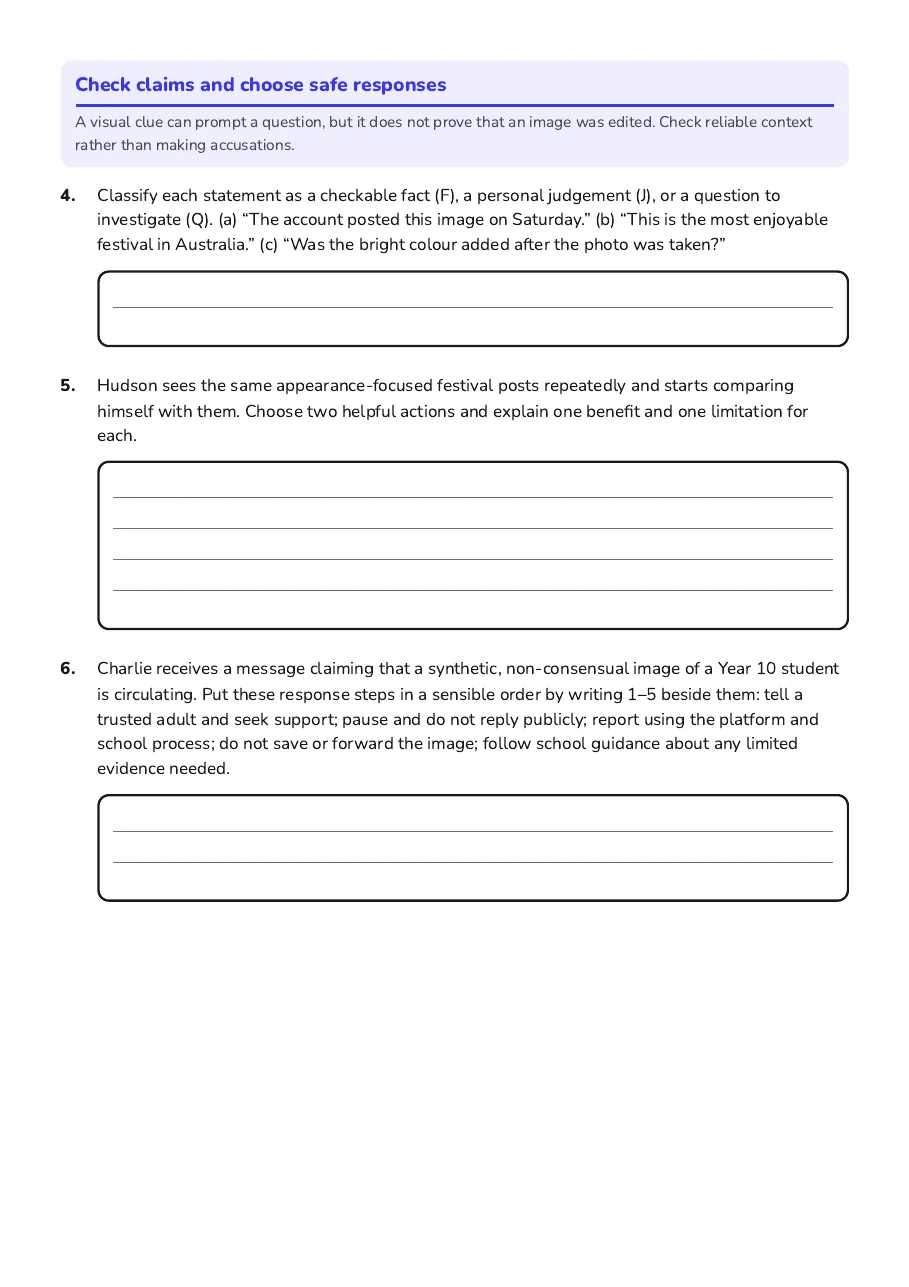
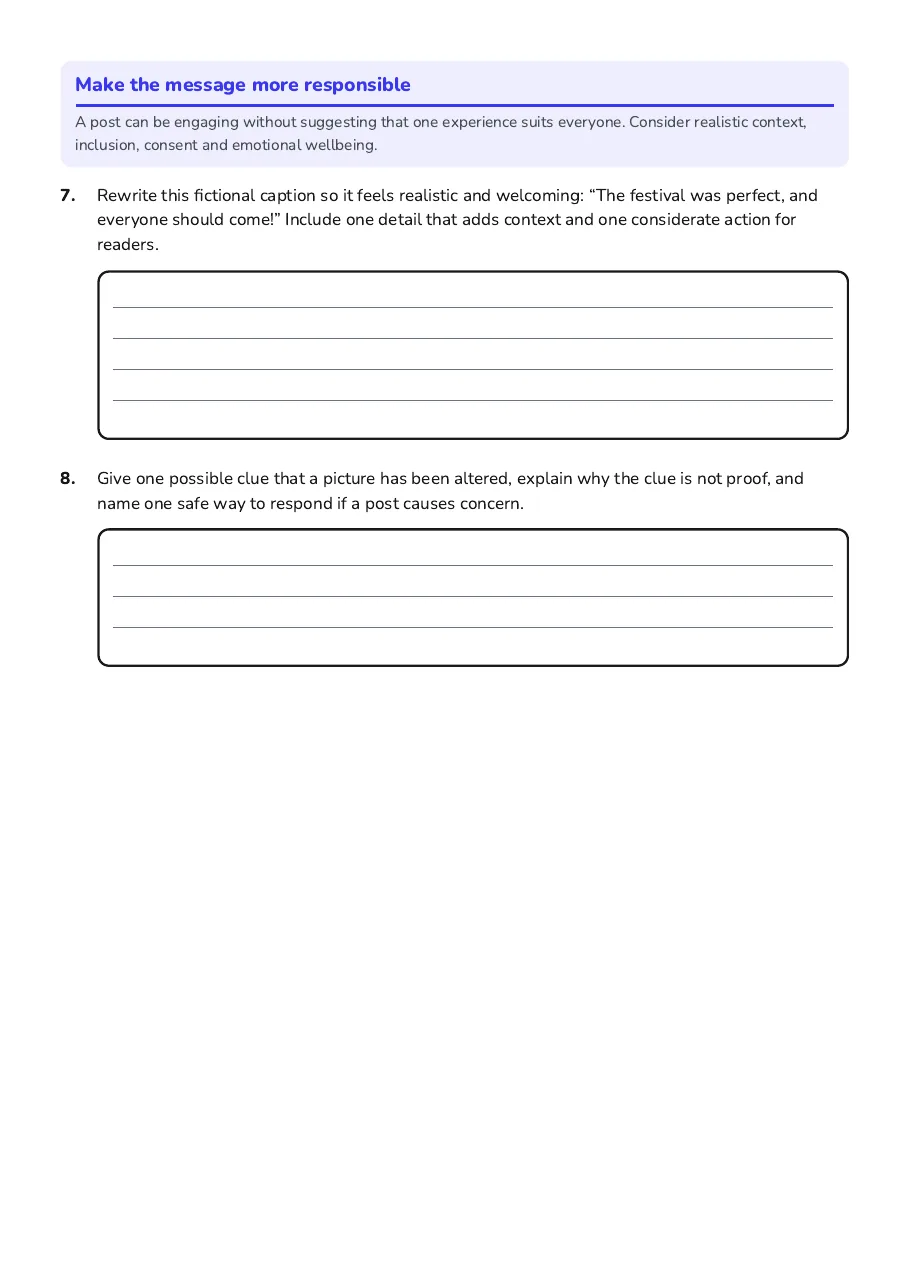
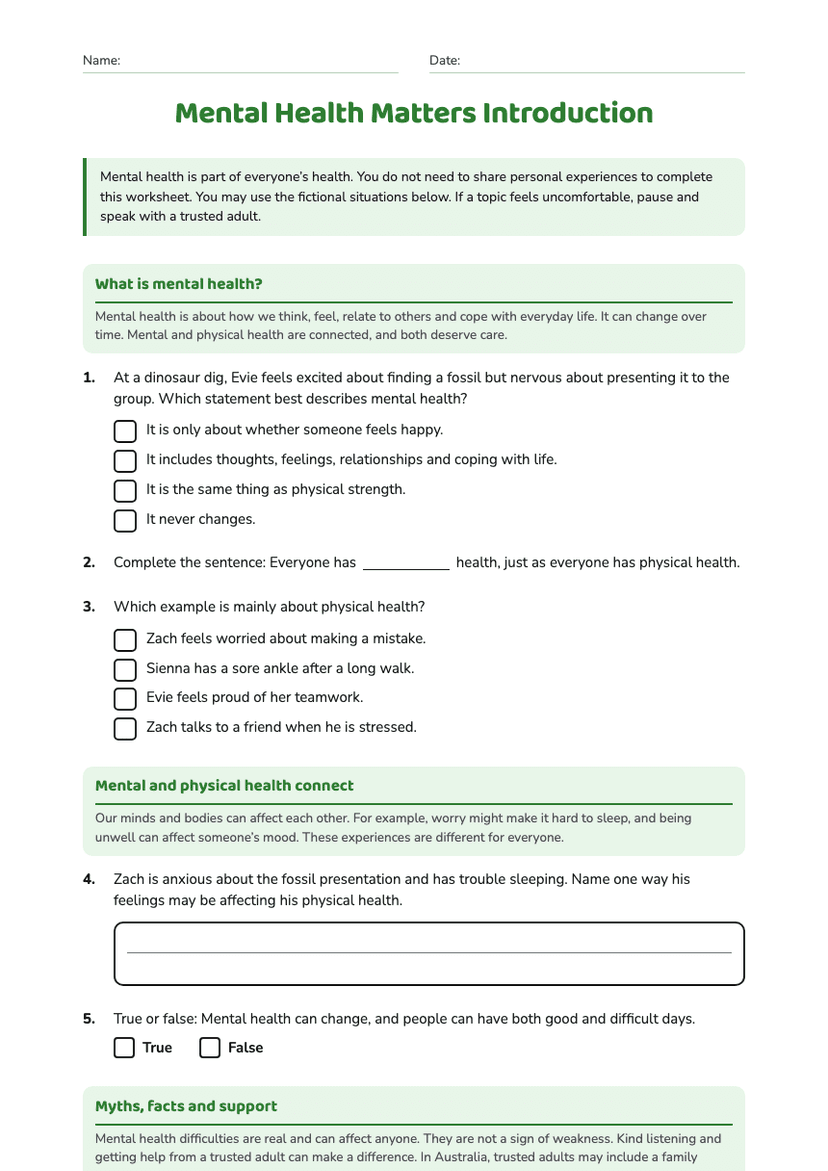
Curated Images, Real Wellbeing worksheet preview

Curated Images, Real Wellbeing

Part 1: Read the message critically

Learning focus: We can question media messages without judging people, bodies or identities. Use fictional or clearly labelled synthetic examples only. You may pass, work privately or choose a different example. Do not upload, download, create or share real images.

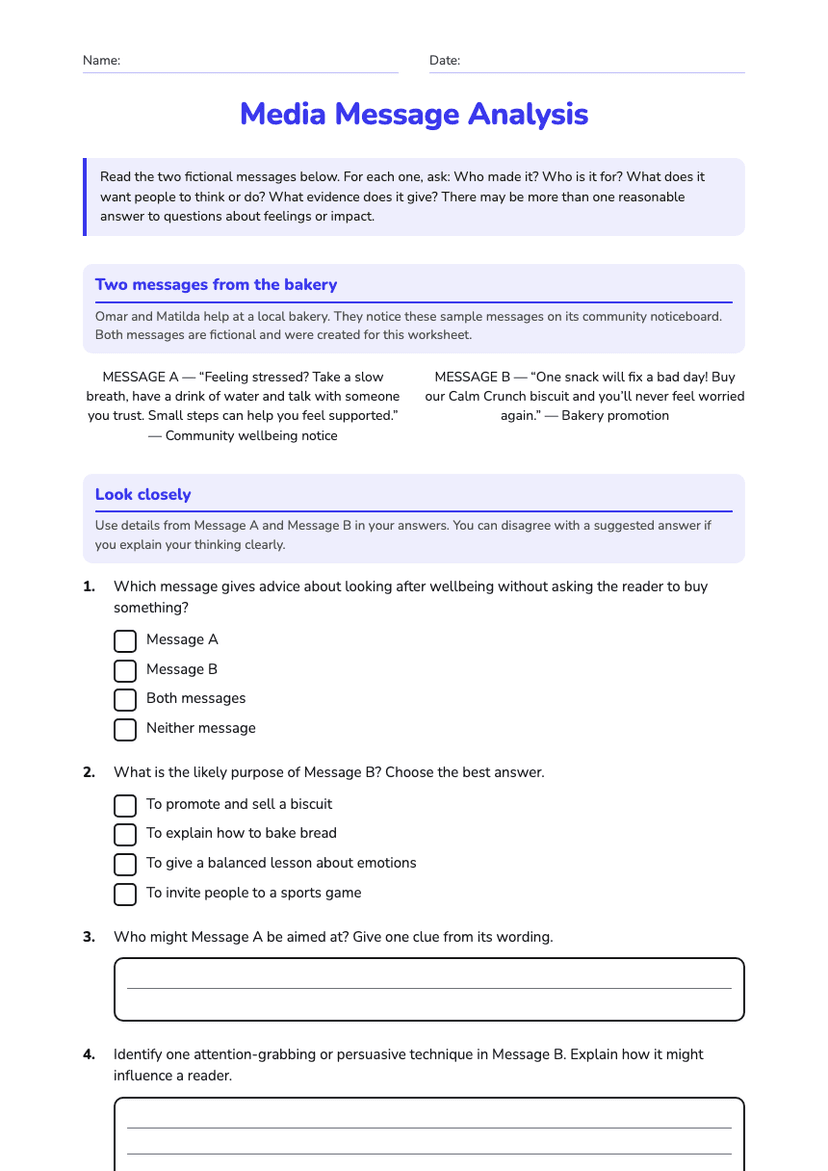
Curated content is selected, edited or repeated to create a particular impression. Filters, algorithms, comments and AI-altered images can influence perceptions, attitudes and behaviours. Visual clues are useful questions to ask, but they are not proof of editing.

1. Media-analysis checklist: For the fictional image or post you are studying, identify what you would check.

Intended audience: Who is this meant to reach?

Purpose: What does it want people to think, feel or do?

Visual techniques: Are there filters, cropping, lighting, posing, editing or AI clues?

Representation: Who is included, and who is missing or stereotyped?

Omissions: What context, effort, cost, failure or information is not shown?

Emotional impact: Could it create comparison, pressure, confidence, concern or other feelings?

Credibility: What is the source, evidence and date? Can the context be checked?

Wellbeing effects: How might it affect safety, participation, relationships or mental wellbeing?

2. Analysis record: Use this structured record for one fictional or labelled synthetic image or post.
Audience and purpose
Who is the audience? What response is encouraged?
Techniques and clues
What visual or platform techniques can you identify?
Representation and omissions
Who or what is included, left out or simplified?
Emotional impact
What feelings or comparisons might the message encourage?
Your notes:
________________________________
Your notes:
________________________________
Your notes:
________________________________
Your notes:
________________________________

Part 2: Evidence, context and safer choices

3. Evidence or opinion? Label each statement E for evidence, O for opinion, or Q for a question. Then explain one choice.

a) “The post was uploaded on 14/08/2025.” _____

b) “This is the best way for everyone to live.” _____

c) “The source and purpose should be checked before trusting the claim.” _____

4. Context check: Identify two factors that could change how this message affects someone. Consider age, culture, identity, past experiences, comments, algorithmic repetition, access to support or the purpose of the account.
5. A clearly labelled fictional synthetic example shows a fake image of a Year 10 student in a group chat. Number these actions from 1 to 6 to show a safer response.

_____ Tell a trusted adult and seek support.

_____ Pause and avoid reacting publicly.

_____ Report through the platform and school process.

_____ Do not download or reshare the image.

_____ Save only limited evidence safely, following school guidance.

_____ Consider consent, privacy, dignity and safety.

Important: Sexualised deepfakes involving young people are abusive and harmful even when fake. Do not view, create, save or circulate them. Follow school safeguarding procedures.

6. Choose two strategies for a fictional student who is seeing repeated appearance-focused posts. Explain one likely benefit and one possible limitation for each.

Pause before comparing.

Check the source, purpose and context.

Mute, unfollow or report harmful content.

Diversify the feed with body- and capability-inclusive content.

Limit notifications and take planned breaks.

Speak with a trusted adult or approved support service.

Part 3: Redesign and reflect

7. Design task: Transform this fictional harmful message into a realistic, inclusive and responsible message. Do not use appearance ratings, dieting or weight language. Focus on participation, capability, wellbeing, consent and realistic context.

Original fictional message: “Change yourself completely in seven days. Everyone should look and live this way.”

Include: a revised message, one context detail the original left out, inclusive representation, and one safe action for the audience.

8. Exit ticket: Complete all three prompts.

a) One possible clue that an image has been edited or AI-altered is ______________________________.

b) This clue is not proof because __________________________________________________________.

c) One safe response or support pathway is _________________________________________________.

Scaffolding prompts: “The post may be trying to…”, “A missing context is…”, “This could affect wellbeing by…”, “I would check…”, “A respectful action is…”. You may use a labelled diagram, type, dictate or plan in another language before writing in English.

Teacher answer guide and concise rubric

Expected understanding: Students should identify audience, purpose, visual techniques, representation, omissions, emotional impact, credibility and possible wellbeing effects. Suitable editing clues may include inconsistent lighting, shadows, reflections, text, hands, jewellery, backgrounds or cropping. Students must state that clues and AI-detection tools are not proof; context and credible checking are required.

Safe-response sequence: Pause; do not download or reshare; preserve only limited evidence safely according to school policy; report through the platform and school; tell a trusted adult; seek appropriate support. Do not investigate publicly or accuse someone.

Evidence and opinion: 3(a) E, 3(b) O, 3(c) Q or evidence-based advice depending on the student’s explanation. Credit reasoning that distinguishes verifiable information from judgement or a request for further checking.

Rubric: 3—Thorough: analyses influence, context, credibility, inclusion and wellbeing; proposes safe, realistic actions with benefits and limitations. 2—Developing: identifies some techniques and effects; includes a mostly safe strategy. 1—Beginning: gives a simple reaction or description with limited evidence, context or safety reasoning.

Respond to distress, bullying, non-consensual image sharing or harmful online contact through normal school safeguarding and wellbeing procedures. Offer a private conversation and the school’s approved support pathways.

About This Worksheet

Free in Kuraplan

Sign up free, grab the PDF, and customize it for your class.

Print-Ready

Formatted for standard paper. Clean layout, easy to read.

AI-Generated

Created with Kuraplan's AI, designed for real classroom use.

For Teachers & Parents

Use in classrooms, for homework, tutoring, or homeschool.

Need a custom version of this worksheet?

Kuraplan's AI generates custom worksheets in seconds — differentiated for every learner, aligned to your curriculum.

Generate Custom Worksheets — Free
No credit card Curriculum-aligned Under 60 seconds