MathsFreePrintable

Financial Problem Solving

A free maths worksheet ready for your classroom. Open in Kuraplan to grab the print-ready PDF, customize it for your students, or generate a fresh version in seconds.
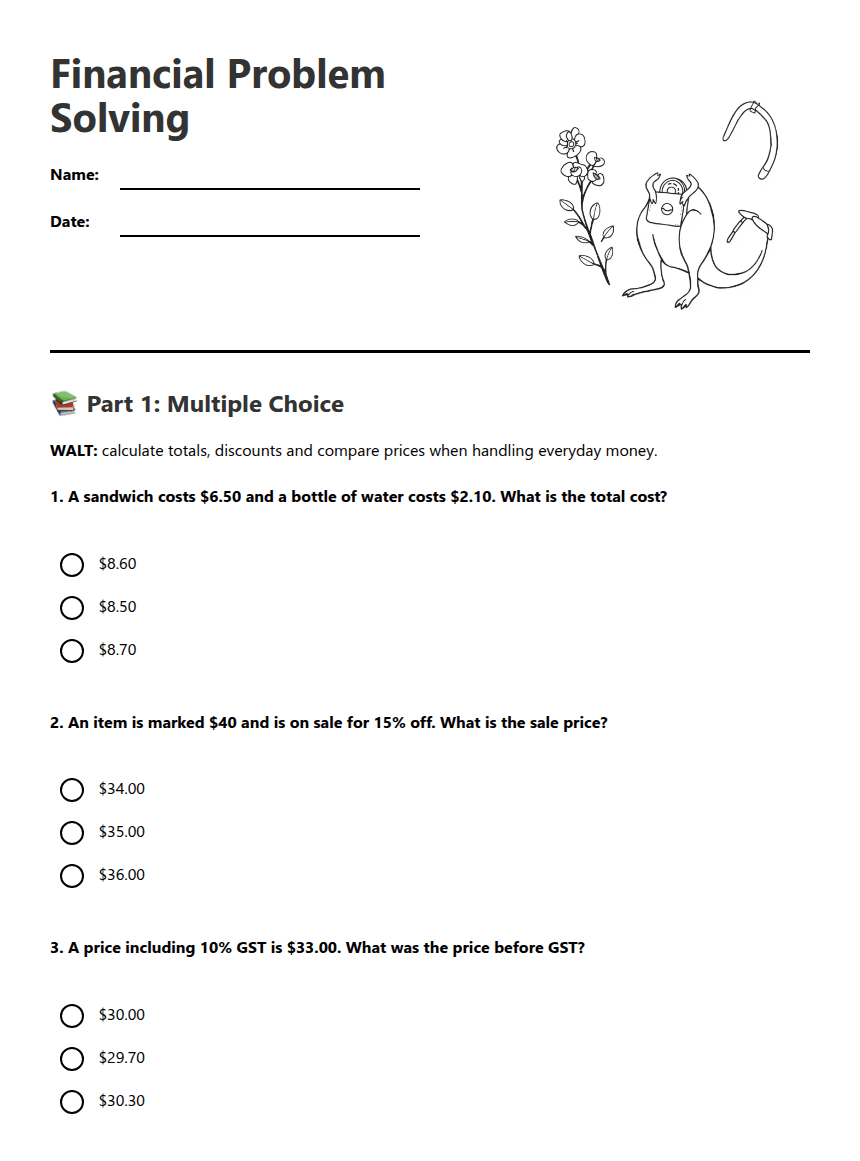
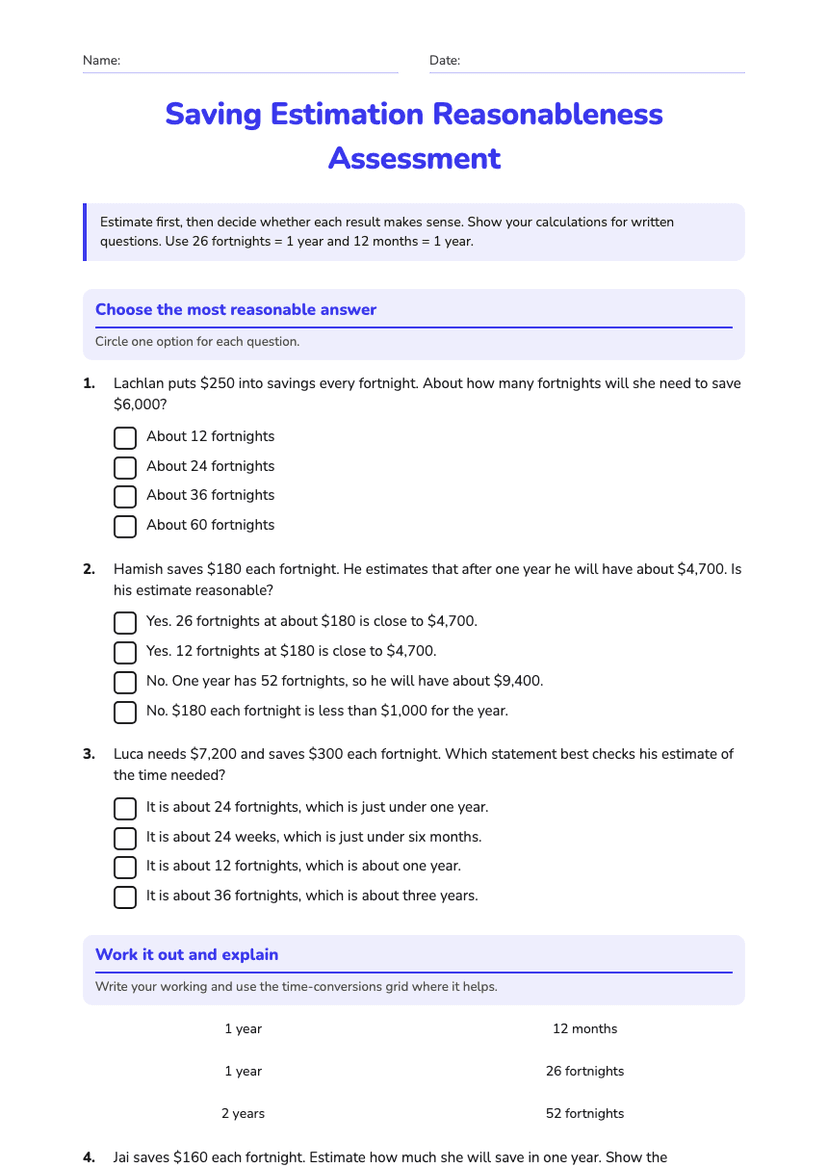
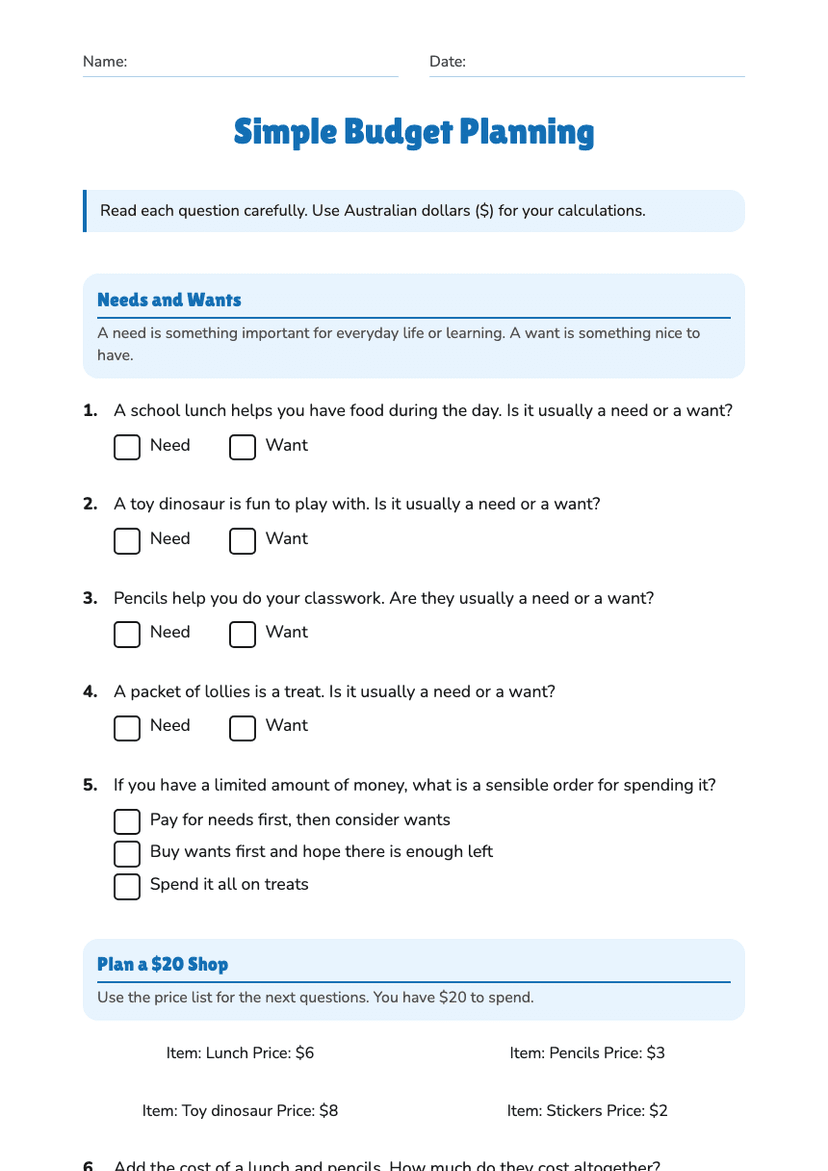
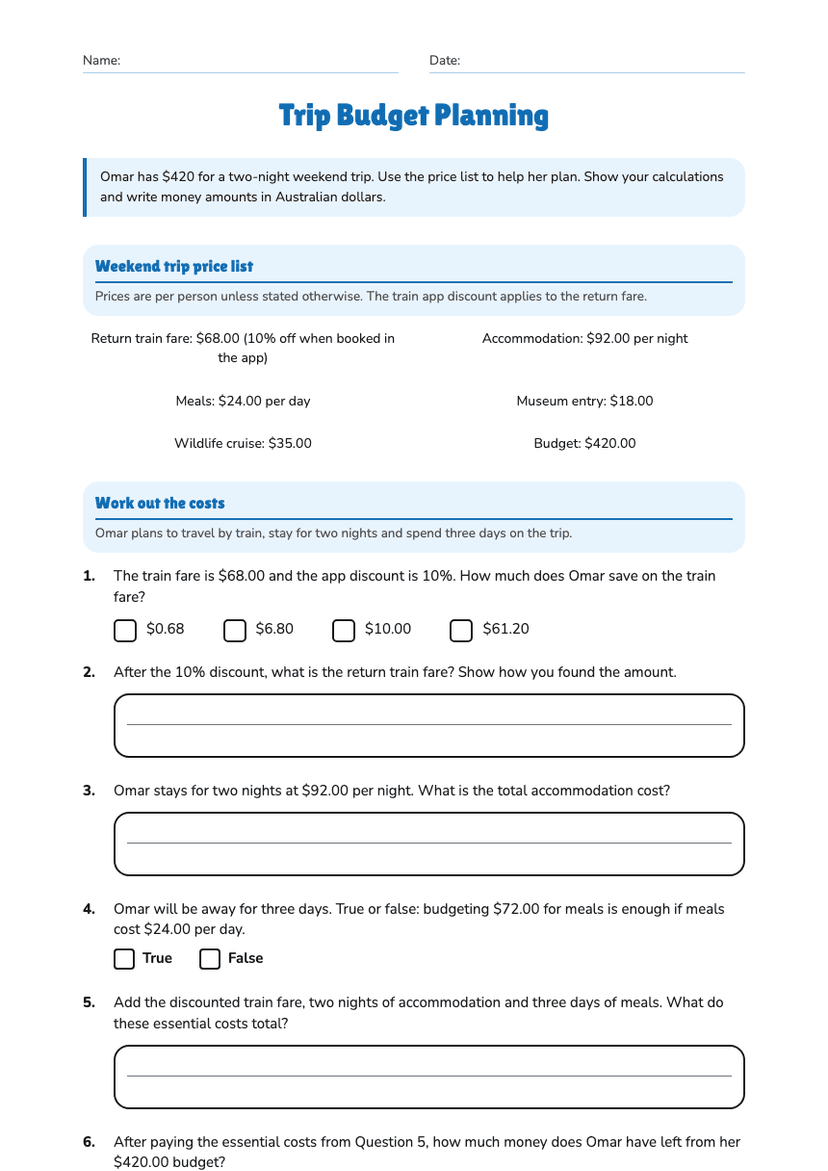
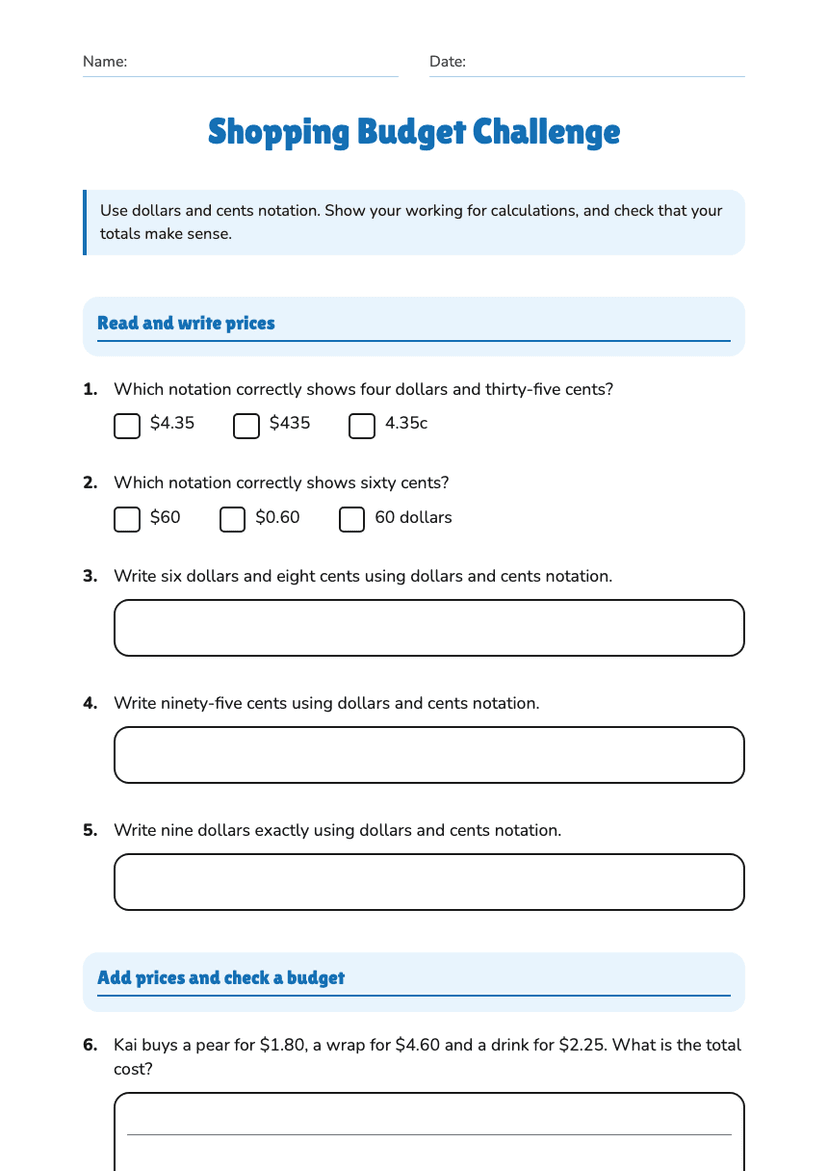
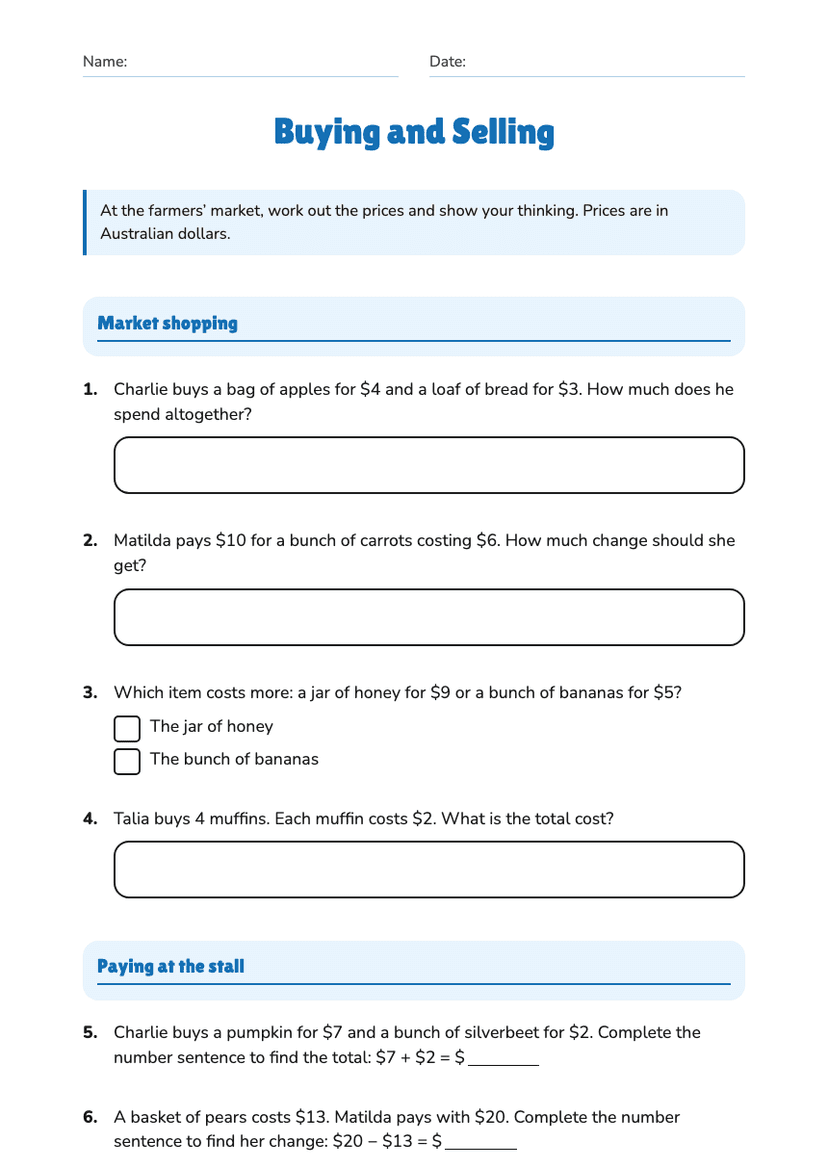
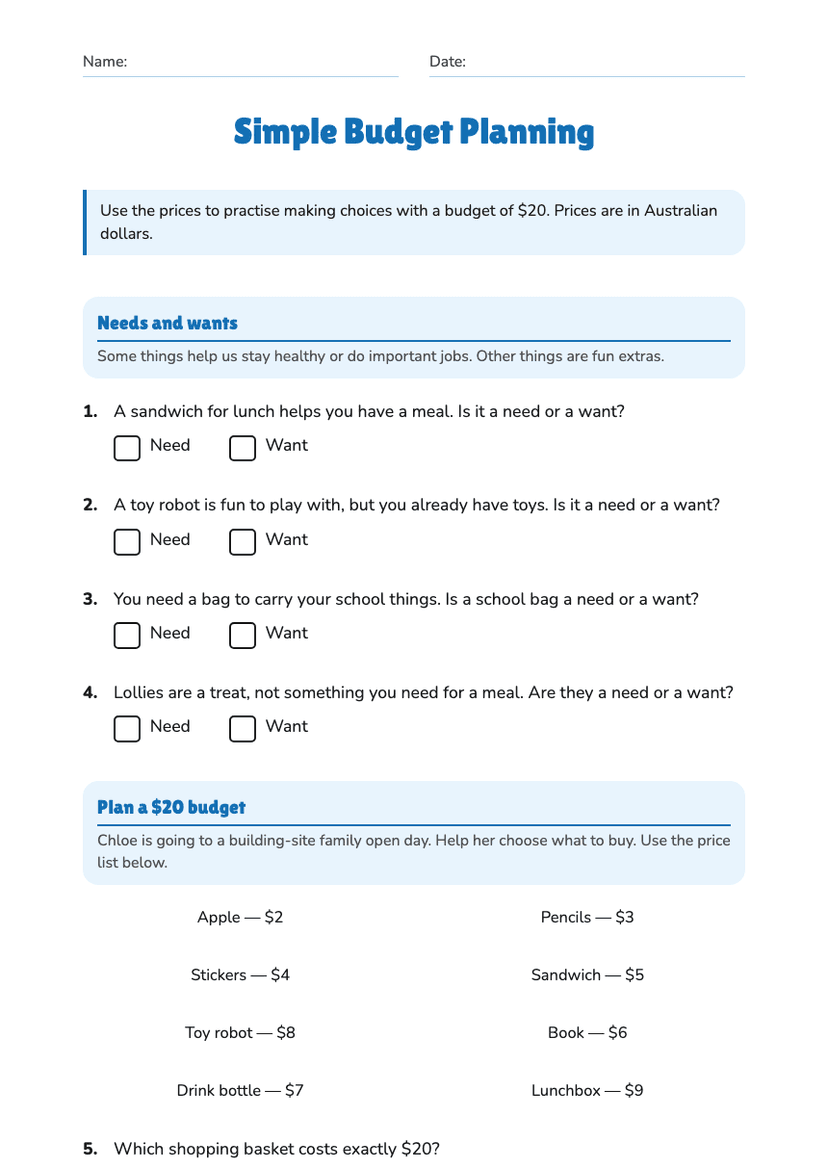
Financial Problem Solving worksheet preview
Financial Problem Solving

Worksheet illustration

📚 Part 1: Multiple Choice

WALT: calculate totals, discounts and compare prices when handling everyday money.

1. A sandwich costs $6.50 and a bottle of water costs $2.10. What is the total cost?

$8.60

$8.50

$8.70

2. An item is marked $40 and is on sale for 15% off. What is the sale price?

$34.00

$35.00

$36.00

3. A price including 10% GST is $33.00. What was the price before GST?

$30.00

$29.70

$30.30

4. Check all that apply: Which items would you include in a weekly household budget?

Groceries

Movie snacks bought once a year

Electricity bill

Birthday present savings

✏️ Part 2: Short Answers & Multi-Step Problems

WALT: solve multi-step money problems and show working clearly.

5. Grocery shopping: Apples are $4.50 per kg. Bananas are $2.80 per kg. You buy 3 kg of apples and 2 kg of bananas. You pay with a $30 note. (a) What is the total cost? (b) How much change should you get?
6. Saving for a trip: Sarah saves $25 each week. She needs $1,500. (a) How many full weeks does she need to save to reach at least $1,500? (b) How much will she have after 40 weeks?
7. Unit pricing: A 6-pack of yoghurt contains 6 × 150 g tubs for $5.40. A single 200 g tub costs $1.80. Which is better value per 100 g? Show calculations.
8. Commuting costs: One single train trip costs $3.40. A weekly pass costs $28. You travel to and from work (2 trips) each weekday for 4 weeks. Which option is cheaper for that 4-week period? Show working.
9. Simple interest: You put $1,000 in an account that pays 3% simple interest per year for 3 years. (a) How much interest will you earn in total? (b) What will be the final balance?

📝 Teacher Notes – Differentiation & Extension

WALT: adapt tasks so all students practise decision-making with money.

Differentiation strategies:

- Support: provide calculators, number lines or worked examples; break problems into smaller steps.

- Core: encourage clear written working and checking of answers (estimation first, then calculation).

- Challenge: ask students to include GST or discounts in multi-step problems and compare monthly vs annual costs.

Extension activities:

- Research: Find two real items online and compare unit prices; prepare a short recommendation.

- Project: Create a simple monthly budget for a teenager starting part-time work (include tax, savings, expenses).

Student self-assessment: How do you feel about today's lesson? Tick one:

I understand and can do these problems independently

I can do most with some help

I need more practice

Quick reflection (one sentence): What is one money skill you will practise this week?

About This Worksheet

Free in Kuraplan

Sign up free, grab the PDF, and customize it for your class.

Print-Ready

Formatted for standard paper. Clean layout, easy to read.

AI-Generated

Created with Kuraplan's AI, designed for real classroom use.

For Teachers & Parents

Use in classrooms, for homework, tutoring, or homeschool.

Need a custom version of this worksheet?

Kuraplan's AI generates custom worksheets in seconds — differentiated for every learner, aligned to your curriculum.

Generate Custom Worksheets — Free
No credit card Curriculum-aligned Under 60 seconds