MathsFreePrintable

Index Laws in Science

A free maths worksheet ready for your classroom. Open in Kuraplan to grab the print-ready PDF, customize it for your students, or generate a fresh version in seconds.
Index Laws in Science worksheet preview
Name:Date:

Index Laws in Science

Use index laws to simplify expressions and solve science-inspired problems. Show your working for calculation questions. Assume all variables are non-zero where needed.

Set up the science data

Index laws help scientists work with quantities that are extremely large or small.

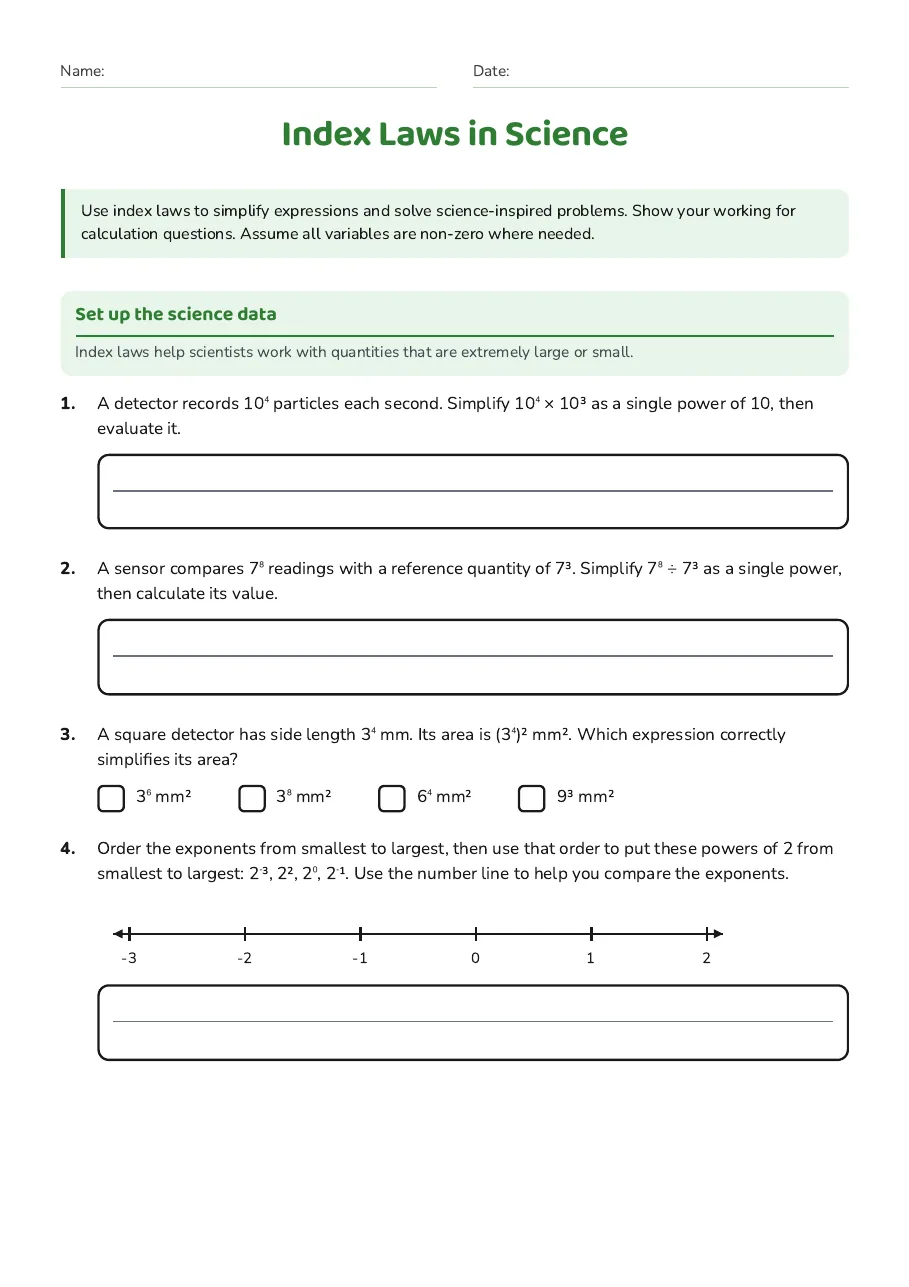
1.A detector records 10⁴ particles each second. Simplify 10⁴ × 10³ as a single power of 10, then evaluate it.
2.A sensor compares 7⁸ readings with a reference quantity of 7³. Simplify 7⁸ ÷ 7³ as a single power, then calculate its value.
3.A square detector has side length 3⁴ mm. Its area is (3⁴)² mm². Which expression correctly simplifies its area?
  • 3⁶ mm²
  • 3⁸ mm²
  • 6⁴ mm²
  • 9³ mm²
4.Order the exponents from smallest to largest, then use that order to put these powers of 2 from smallest to largest: 2⁻³, 2², 2⁰, 2⁻¹. Use the number line to help you compare the exponents.
-3-2-1012

Follow a sample through time

A science team models a harmless tracer that halves in amount every hour.

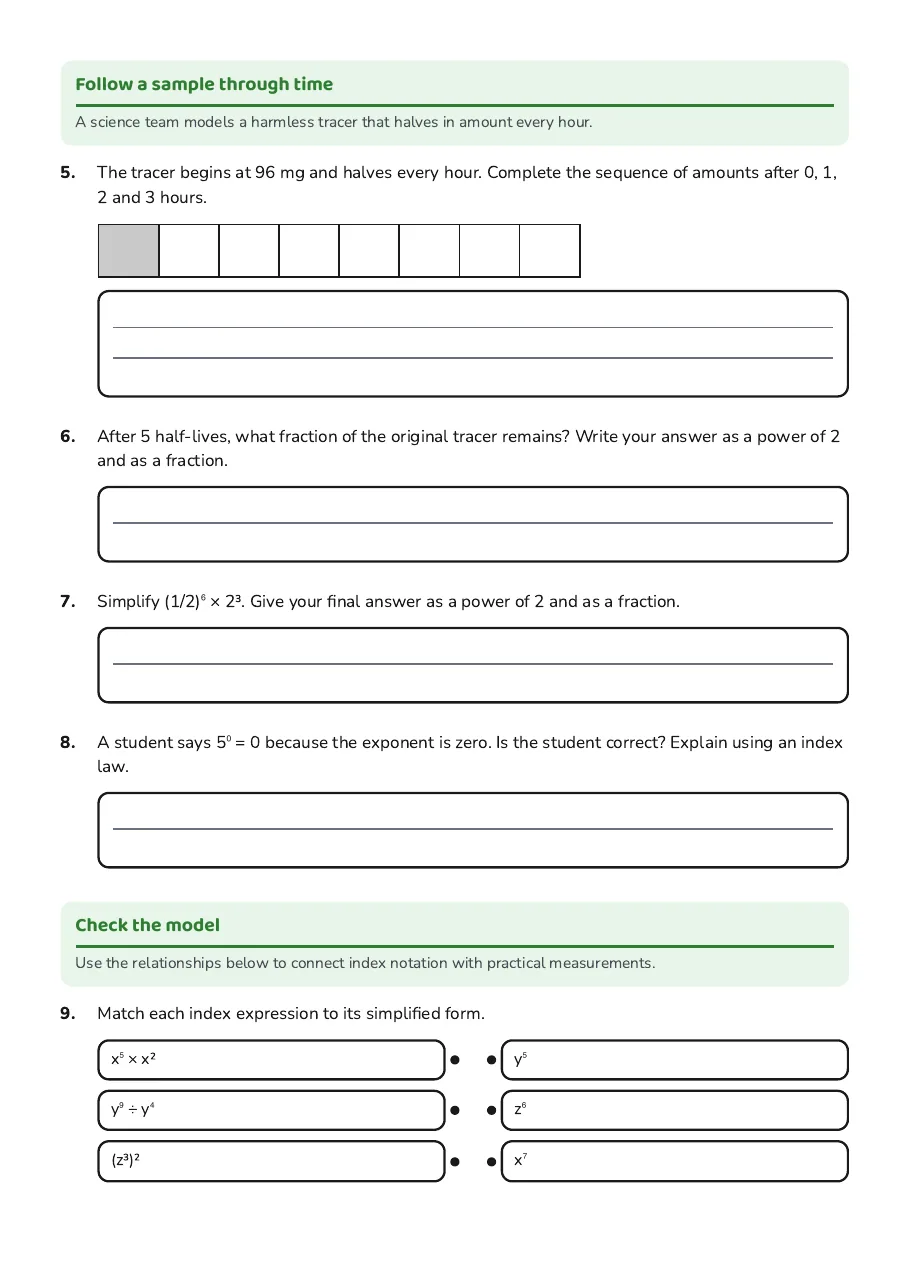
5.The tracer begins at 96 mg and halves every hour. Complete the sequence of amounts after 0, 1, 2 and 3 hours.
6.After 5 half-lives, what fraction of the original tracer remains? Write your answer as a power of 2 and as a fraction.
7.Simplify (1/2)⁶ × 2³. Give your final answer as a power of 2 and as a fraction.
8.A student says 5⁰ = 0 because the exponent is zero. Is the student correct? Explain using an index law.

Check the model

Use the relationships below to connect index notation with practical measurements.

9.Match each index expression to its simplified form.
  • x⁵ × x²
  • y⁹ ÷ y⁴
  • (z³)²
  • y⁵
  • z⁶
  • x⁷
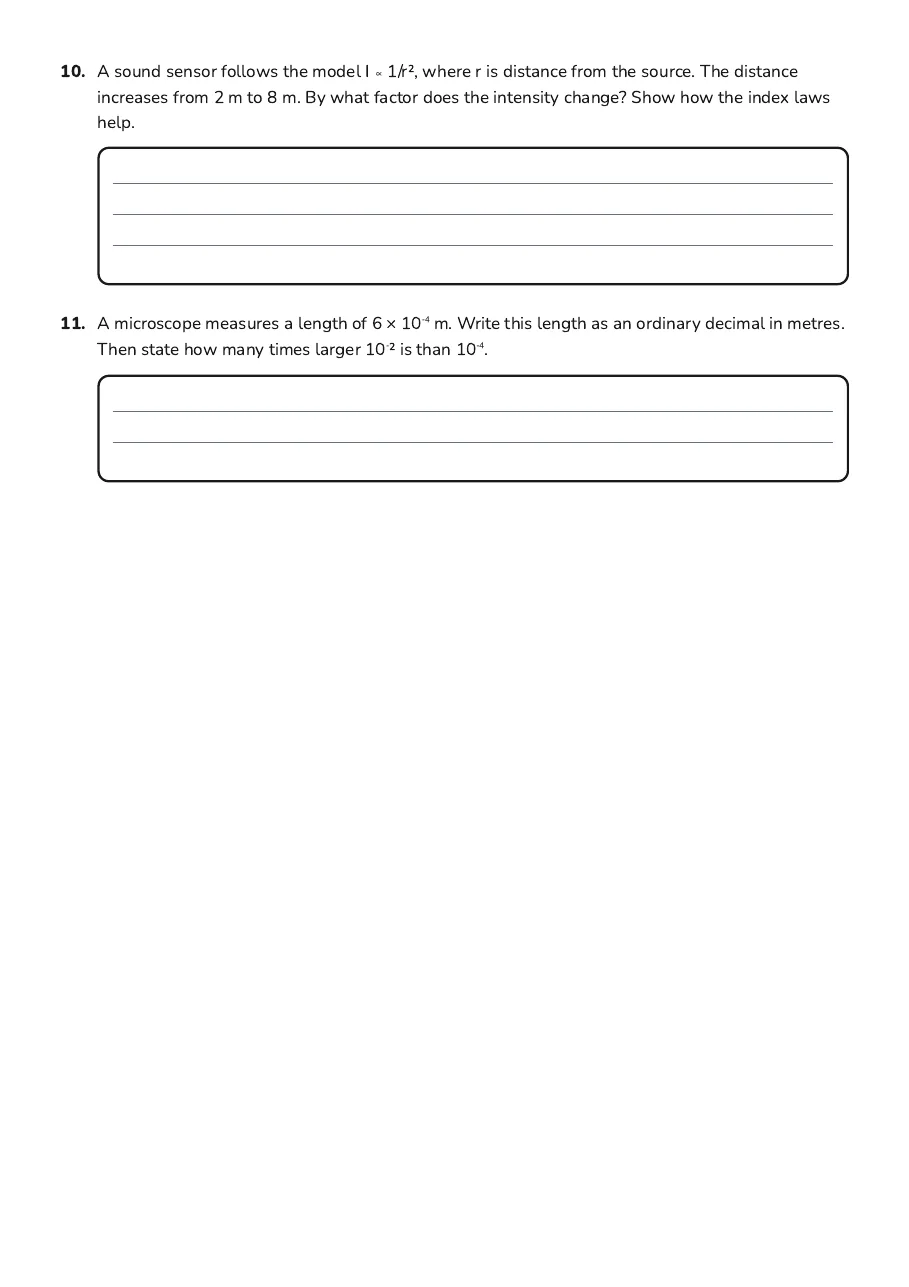
10.A sound sensor follows the model I ∝ 1/r², where r is distance from the source. The distance increases from 2 m to 8 m. By what factor does the intensity change? Show how the index laws help.
11.A microscope measures a length of 6 × 10⁻⁴ m. Write this length as an ordinary decimal in metres. Then state how many times larger 10⁻² is than 10⁻⁴.

3 printable pages

  • Index Laws in Science, page 1 of 3: Set up the science data

    Page 1

  • Index Laws in Science, page 2 of 3: Follow a sample through time, Check the model

    Page 2

  • Index Laws in Science, page 3 of 3: 10. A sound sensor follows the model I ∝ 1/r², where r is distance from the source. The…

    Page 3

About This Worksheet

Free in Kuraplan

Sign up free, grab the PDF, and customize it for your class.

Print-Ready

Formatted for standard paper. Clean layout, easy to read.

AI-Generated

Created with Kuraplan's AI, designed for real classroom use.

For Teachers & Parents

Use in classrooms, for homework, tutoring, or homeschool.

Need a custom version of this worksheet?

Kuraplan's AI generates custom worksheets in seconds — differentiated for every learner, aligned to your curriculum.

Generate Custom Worksheets — Free
No credit card Curriculum-aligned Under 60 seconds