Social SciencesFreePrintable

Resource Allocation Choices

A free social sciences worksheet ready for your classroom. Open in Kuraplan to grab the print-ready PDF, customize it for your students, or generate a fresh version in seconds.
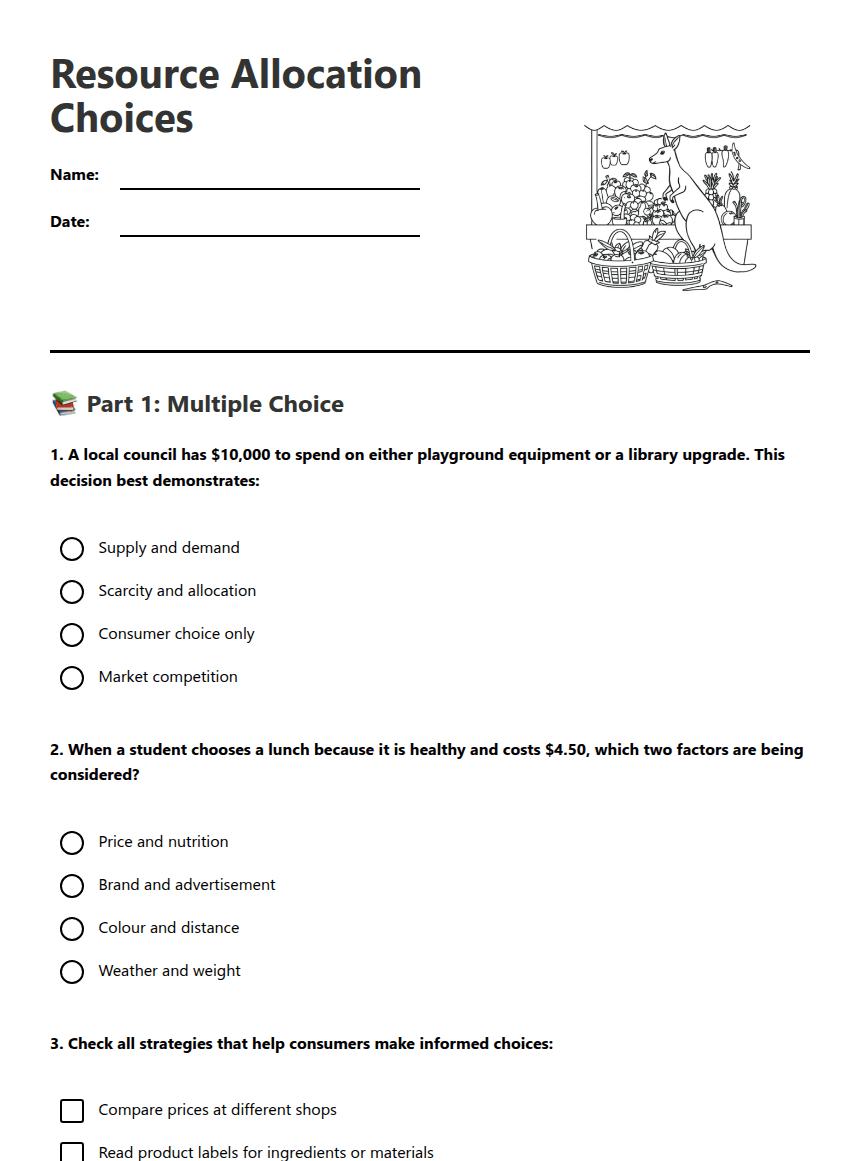
Resource Allocation Choices worksheet preview
Resource Allocation Choices

Worksheet illustration

📚 Part 1: Multiple Choice

1. A local council has $10,000 to spend on either playground equipment or a library upgrade. This decision best demonstrates:

Supply and demand

Scarcity and allocation

Consumer choice only

Market competition

2. When a student chooses a lunch because it is healthy and costs $4.50, which two factors are being considered?

Price and nutrition

Brand and advertisement

Colour and distance

Weather and weight

3. Check all strategies that help consumers make informed choices:

Compare prices at different shops

Read product labels for ingredients or materials

Buy immediately without checking

Look for reviews or ask for recommendations

4. A reusable water bottle costs $15 while a single-use bottle costs $2. The decision to buy the reusable bottle mainly involves:

Short-term price only

Considering both price and environmental impact

Temperature of the product

The distance to the shop

✏️ Part 2: Short Answers & Activities

5. Describe a choice made in your community about how resources were allocated (for example: building a bike path, new playground, or book purchases). What was the choice and why was it made?
6. List three factors that influenced that choice. For each factor, give one piece of evidence (e.g., a price, a quote from a council report, a photo of a sign).
Factor 1 and evidence:
Factor 2 and evidence:
Factor 3 and evidence:
7. Match each factor (left) with an appropriate example of evidence (right).
A. Price
B. Brand reputation
C. Environmental impact
D. Peer influence
1. Photo of a recycling symbol on packaging
2. A friend’s recommendation
3. Price tag showing $29.99
4. A well-known company logo and history
8. Choose two strategies from Question 3 (for example: read labels and compare prices). Explain how these two strategies work together and give one piece of evidence from a real source (label, price tag or review) to support your explanation.

🧑‍🏫 Teacher Notes — Success Criteria & Differentiation

Success criteria (students will):

Identify when choices are needed because resources are limited (scarcity).

Describe at least two factors that influence a consumer choice and cite simple evidence (price, label, review).

Suggest at least two strategies to inform choices and explain how they help.

Differentiation strategies:

Support: Provide sentence starters and labelled examples (e.g., “The council chose X because _______”). Allow oral responses or visuals for students who need it.

Challenge: Ask students to connect resource allocation to a design task: plan materials for constructing a paper prism from nets (consider cost and waste) and explain how face placement affects material use.

Assessment tip: Look for evidence-based answers (students cite a price tag, label, or short extract from a class handout) and the ability to connect two factors to justify a strategy.

About This Worksheet

Free in Kuraplan

Sign up free, grab the PDF, and customize it for your class.

Print-Ready

Formatted for standard paper. Clean layout, easy to read.

AI-Generated

Created with Kuraplan's AI, designed for real classroom use.

For Teachers & Parents

Use in classrooms, for homework, tutoring, or homeschool.

Need a custom version of this worksheet?

Kuraplan's AI generates custom worksheets in seconds — differentiated for every learner, aligned to your curriculum.

Generate Custom Worksheets — Free
No credit card Curriculum-aligned Under 60 seconds