Supermarket Budgeting and Value
A free maths worksheet ready for your classroom. Open in Kuraplan to grab the print-ready PDF, customize it for your students, or generate a fresh version in seconds.
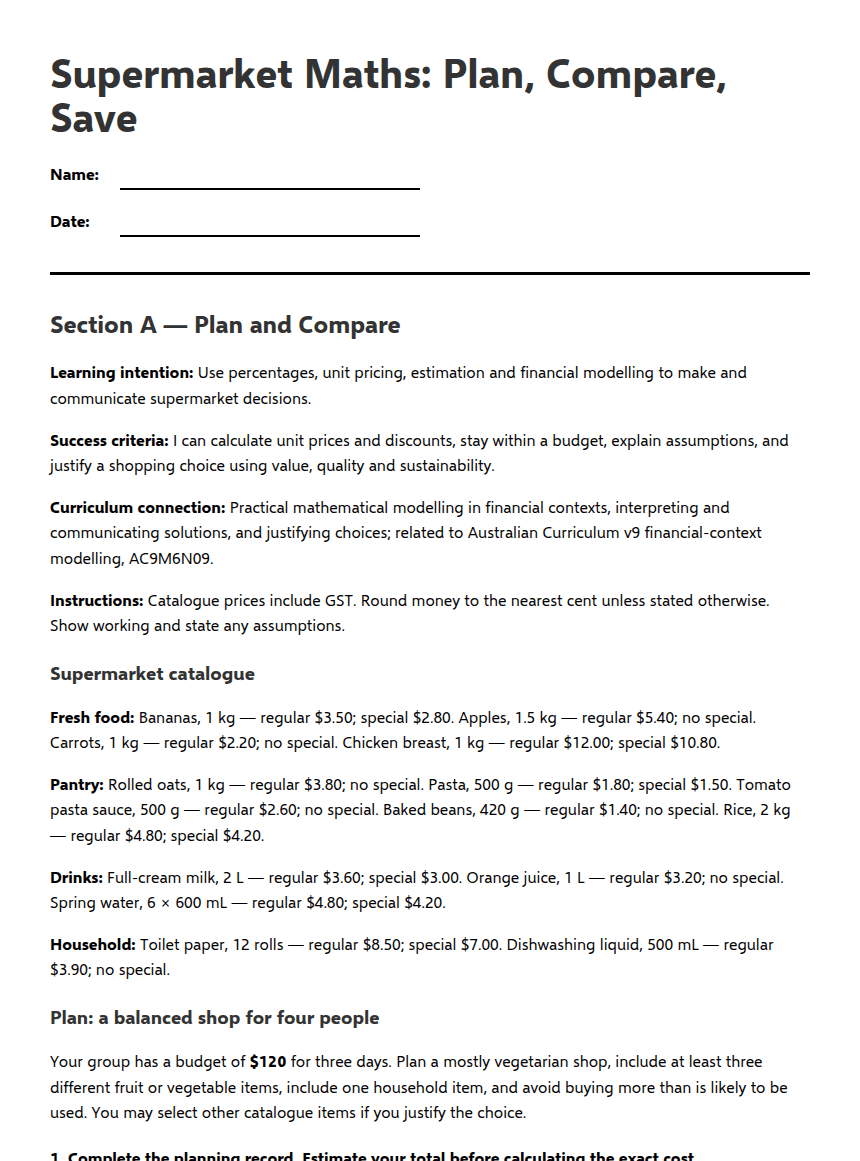
Supermarket Maths: Plan, Compare, Save
Section A — Plan and Compare
Learning intention: Use percentages, unit pricing, estimation and financial modelling to make and communicate supermarket decisions.
Success criteria: I can calculate unit prices and discounts, stay within a budget, explain assumptions, and justify a shopping choice using value, quality and sustainability.
Curriculum connection: Practical mathematical modelling in financial contexts, interpreting and communicating solutions, and justifying choices; related to Australian Curriculum v9 financial-context modelling, AC9M6N09.
Instructions: Catalogue prices include GST. Round money to the nearest cent unless stated otherwise. Show working and state any assumptions.
Supermarket catalogue
Fresh food: Bananas, 1 kg — regular $3.50; special $2.80. Apples, 1.5 kg — regular $5.40; no special. Carrots, 1 kg — regular $2.20; no special. Chicken breast, 1 kg — regular $12.00; special $10.80.
Pantry: Rolled oats, 1 kg — regular $3.80; no special. Pasta, 500 g — regular $1.80; special $1.50. Tomato pasta sauce, 500 g — regular $2.60; no special. Baked beans, 420 g — regular $1.40; no special. Rice, 2 kg — regular $4.80; special $4.20.
Drinks: Full-cream milk, 2 L — regular $3.60; special $3.00. Orange juice, 1 L — regular $3.20; no special. Spring water, 6 × 600 mL — regular $4.80; special $4.20.
Household: Toilet paper, 12 rolls — regular $8.50; special $7.00. Dishwashing liquid, 500 mL — regular $3.90; no special.
Plan: a balanced shop for four people
Your group has a budget of $120 for three days. Plan a mostly vegetarian shop, include at least three different fruit or vegetable items, include one household item, and avoid buying more than is likely to be used. You may select other catalogue items if you justify the choice.
Item | Quantity | Chosen product | Cost | Reason
1. ____________________________________________________________________________________
2. ____________________________________________________________________________________
3. ____________________________________________________________________________________
4. ____________________________________________________________________________________
5. ____________________________________________________________________________________
6. ____________________________________________________________________________________
Estimated total: $__________ Exact total: $__________ Money remaining: $__________
Compare value
Section B — Save and Decide
Save: the $75 challenge
You have $75 and must buy: 1 kg carrots, 1.5 kg apples, 1 kg oats, 2 kg rice, 2 L milk, 1 kg chicken breast, 1 packet pasta and 1 household item. You may choose specials, change a product size, or make a reasonable substitution, but explain your decision.
Final cost: $__________ Total saving: $__________ Percentage saved: __________%
Decide and explain
Extension: compare supermarket baskets
Basket A contains 2 kg rice at $4.20, 2 L milk at $3.00, bananas at $2.80 and pasta at $1.50. Basket B contains 1 kg rice at $2.70, 2 L milk at $3.60, bananas at $3.50 and two packets of pasta at $1.80 each.
Compact Answer Key
1. Answers will vary. A valid plan must include a mostly vegetarian selection, at least three different fruit or vegetable items, one household item, a sensible quantity for four people over three days, and a total of $120 or less. The estimate should be reasonably close to the exact total.
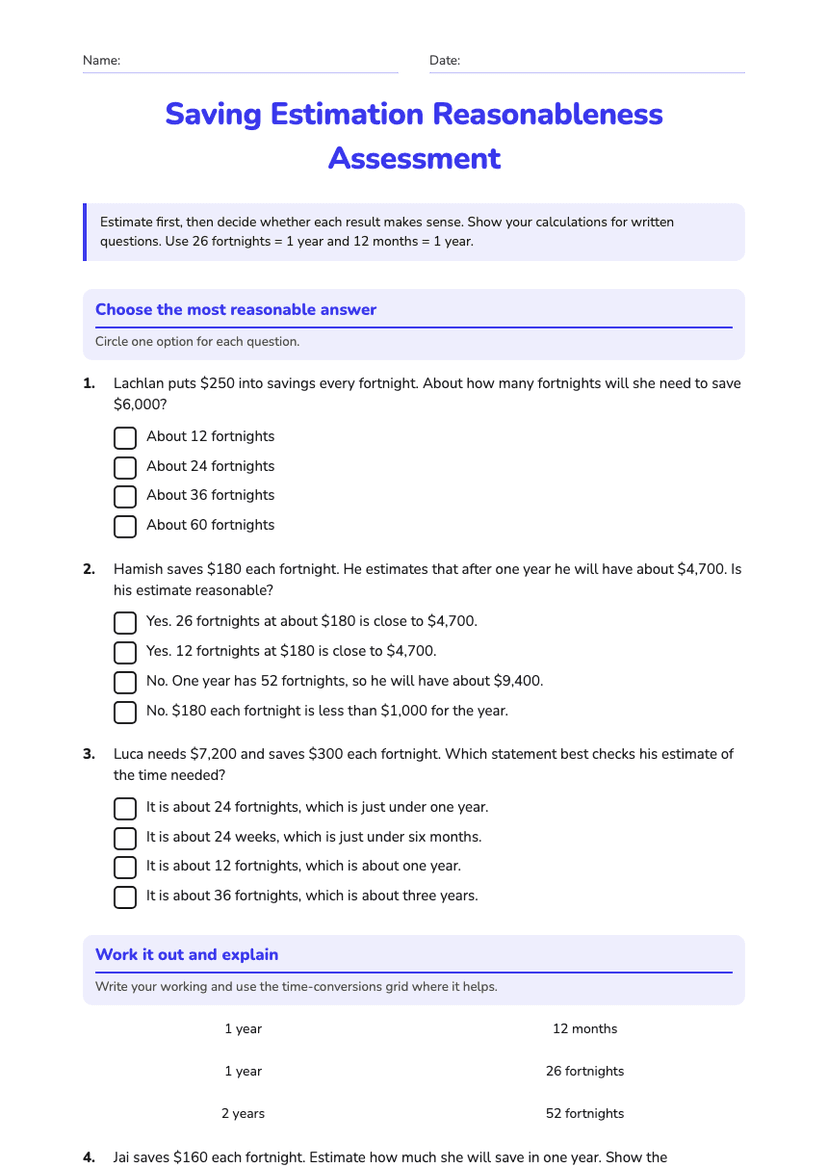
2. Regular rice: $4.80 ÷ 2 = $2.40 per kg. Special rice: $4.20 ÷ 2 = $2.10 per kg. Saving: $0.30 per kg.
3. Saving = $3.50 − $2.80 = $0.70. Percentage discount = $0.70 ÷ $3.50 × 100 = 20%.
4. Pasta: $1.80 ÷ 5 = $0.36 per 100 g. Sauce: $2.60 ÷ 5 = $0.52 per 100 g. Pasta is cheaper by $0.16 per 100 g.
5. Ten per cent of $10.80 is $1.08. After loyalty discount: $9.72. After coupon: $7.72. Total saving from $12.00: $4.28.
6. Answers will vary. At regular prices, the required products cost $12.00 + $5.40 + $3.80 + $4.80 + $3.60 + $12.00 + $1.80 + $8.50 = $51.90, before any chosen substitutions or additional items. Students should show a final cost of $75 or less, two valid saving strategies, and calculate percentage saved as saving ÷ regular comparison cost × 100.
7–9. Indicative points: identifies a realistic method; uses relevant calculations or assumptions; considers quantity, quality, nutrition, packaging or sustainability; explains consequences clearly; and communicates a justified decision.
10. Basket A: $4.20 + $3.00 + $2.80 + $1.50 = $11.50. Basket B: $2.70 + $3.60 + $3.50 + $3.60 = $13.40. Basket A is cheaper by $1.90. Percentage difference using Basket B as reference: $1.90 ÷ $13.40 × 100 = 14.18%. Break-even delivery fee for Basket A: $1.90.
About This Worksheet
Free in Kuraplan
Sign up free, grab the PDF, and customize it for your class.
Print-Ready
Formatted for standard paper. Clean layout, easy to read.
AI-Generated
Created with Kuraplan's AI, designed for real classroom use.
For Teachers & Parents
Use in classrooms, for homework, tutoring, or homeschool.
Need a custom version of this worksheet?
Kuraplan's AI generates custom worksheets in seconds — differentiated for every learner, aligned to your curriculum.
Generate Custom Worksheets — Free