
The best 2nd grade lesson plans find that sweet spot between a solid structure and the flexibility to follow your students' curiosity. It's about having a master blueprint that maps out your subjects, sets up reliable routines, and paces the curriculum so you can actually breathe. This approach will save you tons of time and—most importantly—prevent that all-too-common teacher burnout.
Building Your Stress-Free Planning Framework
Let's be real. Planning for second graders can feel like you're constantly juggling different reading levels, new math concepts, and messy science experiments. The pressure is on to hit every standard while keeping a room full of seven- and eight-year-olds excited about learning.
What if you could ditch the Sunday night planning stress for a clear, repeatable system?
A planning framework that actually works is often grounded in solid pedagogy, like the constructivist learning theory, which champions active, hands-on learning. Instead of facing a blank planner every week, you start with a blueprint. This isn't about scripting your day down to the minute; it's about creating a reliable structure that empowers students and frees up your own mental energy for what matters most—teaching.
This simple three-part process helps you move from big-picture goals to the practical, day-to-day steps that bring your lessons to life. It makes the whole thing feel so much more manageable.
Establishing Your Weekly Rhythm
First things first, you need to map out your non-negotiables. Take a look at your daily schedule and block out dedicated time for your core subjects. This weekly blueprint is the foundation for all your 2nd grade lesson plans.
- Morning Meeting (15 min): Kick off the day on a positive note with greetings, sharing, and a quick group activity.
- Reading & ELA Block (60-90 min): This is usually the biggest chunk of your day. I like to break it into a whole-group mini-lesson, guided reading centers, and time for independent practice.
- Math Block (60 min): You can structure this similarly with a quick warm-up, a lesson on the core concept, and hands-on activities or centers.
- Science/Social Studies (30 min): To go deeper, you can alternate these subjects daily or focus on one per week, which really opens the door for cool, project-based learning.
The real goal here is to create a predictable flow that students can rely on. When they know what’s coming next, you'll spend way less time on transitions and more time on learning. That's a huge win for classroom management.
Here's a sample of what that weekly pacing could look like at a glance.
Sample 2nd Grade Weekly Pacing Overview
This table offers a bird's-eye view of how core subjects can be structured across a typical week to ensure balanced coverage of key standards.
| Day | Reading/ELA Focus (45-60 min) | Math Focus (45-60 min) | Science/Social Studies Focus (30 min) |
|---|---|---|---|
| Monday | Introduce new phonics skill & high-frequency words. | Introduce weekly math concept (e.g., place value). | Science: Kick off unit on plant life cycles. |
| Tuesday | Guided reading groups; focus on decoding strategies. | Practice with manipulatives & partner games. | Science: Observe seeds and predict growth. |
| Wednesday | Whole-group read-aloud focusing on main idea. | Independent practice & problem-solving. | Social Studies: Introduce community helpers. |
| Thursday | Writing workshop: Brainstorming for personal narratives. | Math centers: Reinforce place value concepts. | Social Studies: Guest speaker (virtual or in-person). |
| Friday | Phonics & high-frequency word assessment. | Quick concept check or math game review. | Free choice exploration of science/social studies topics. |
Remember, this is just a starting point! The real magic happens when you adapt this rhythm to fit the unique needs of your own classroom.
Pacing and Long-Term Vision
Once you've got your weekly blueprint, it's time to zoom out. Look at the entire school year and start mapping out your units. How many weeks do you need for narrative writing? For two-digit subtraction? Pacing isn't about rushing through material; it’s about giving students enough time for true mastery.
Having a good digital planner can be a total game-changer for this. It makes it so much easier to adjust your pacing guide when life inevitably happens. If you're looking to get organized, check out our guide on finding the perfect digital teacher planner for your needs.
When you have a solid framework in place, your weekly planning becomes a breeze. You’re no longer reinventing the wheel every Sunday night. Instead, you're just plugging in the specific skills, activities, and standards for the week ahead. Trust me, this approach saves hours and ensures you’re always moving forward with purpose.
Creating Reading Lessons That Spark Curiosity
Second grade is such a magical year for reading. It’s that sweet spot where kids shift from just decoding words to really getting the story. But let’s be real, juggling the needs of a whole classroom—from students still sounding out CVC words to those already diving into chapter books—is one of the toughest parts of the job. To create great 2nd grade lesson plans for reading, you need a mix of whole-group fun and laser-focused small-group work.
The secret is to make lessons feel more like a discovery than a chore. Second graders are naturally wired for curiosity, and our reading block should tap directly into that. Instead of skill-and-drill, we can frame our lessons around big questions and hands-on activities that make comprehension feel like cracking a code.
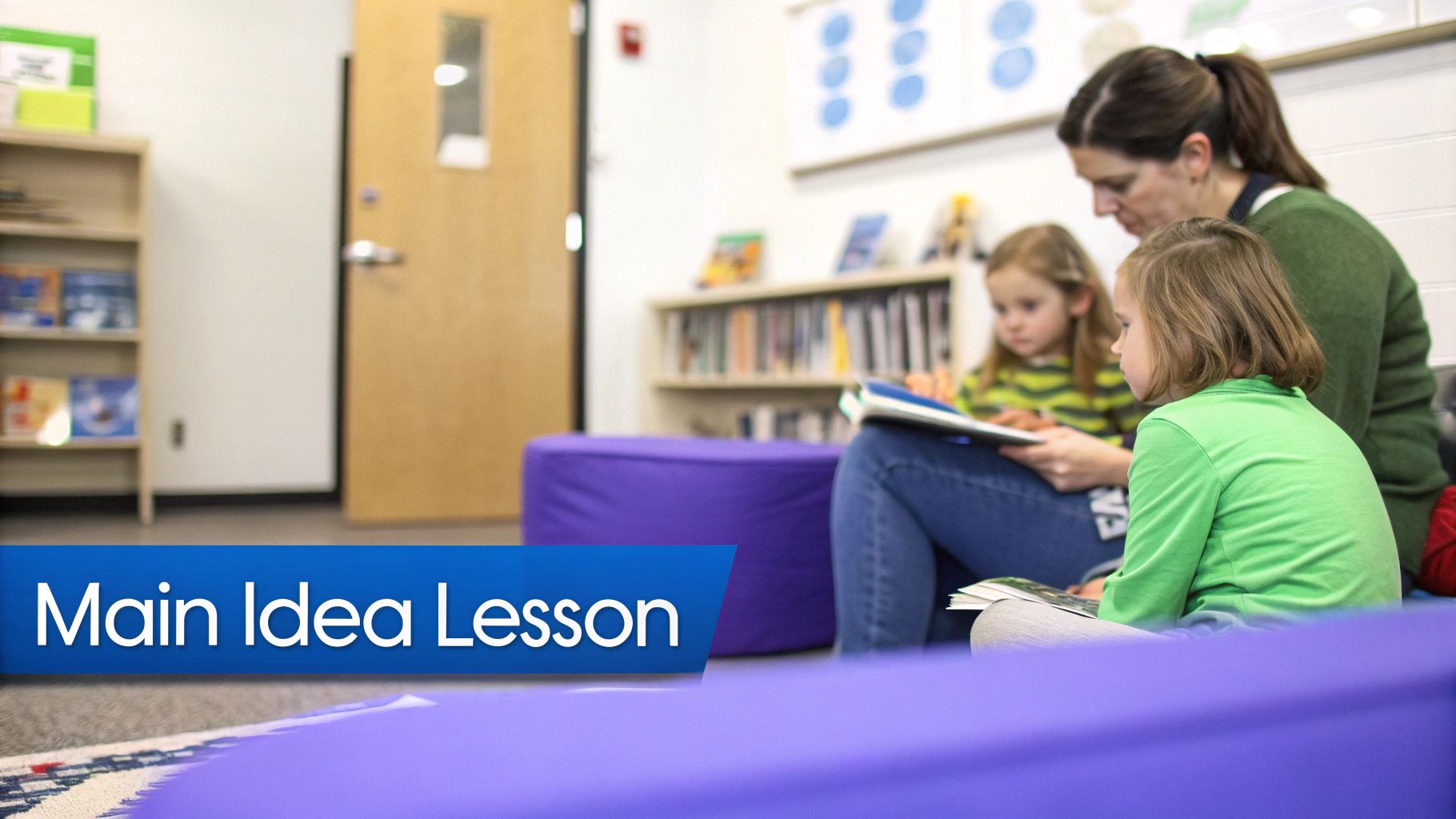
Anatomy of an Engaging Main Idea Lesson
Identifying the main idea and key details is a core second-grade standard, but it can be a really abstract concept for seven-year-olds. A solid lesson hooks them right away and then provides just the right amount of support as they build their skills.
Here’s a classroom-tested structure I’ve had a ton of success with:
- The Hook (5-10 minutes): I always start with something they can touch and see. My favorite is the "mystery bag." I'll fill it with related items—a dog leash, a chew toy, a bag of treats, and a photo of a puppy. As I pull each item out, I ask, "What do you think all these 'details' are about?" Within seconds, they're all shouting, "It's about a dog!" Boom. That's our main idea.
- Model with a Read-Aloud (15 minutes): Next, grab a high-interest picture book with a super clear main idea. As you read, think aloud. Point out key details and ask the class, "What is this page mostly about?" We’ll fill out a graphic organizer together on the whiteboard—a simple web or a two-column chart works perfectly to sort the main idea from its supporting details.
- Guided Practice (20 minutes): This is where the real magic of differentiation happens. I break the class into small groups based on where they are as readers. Each group gets a short, level-appropriate text and their own graphic organizer to tackle together. This is my chance to float, listen in on their conversations, and offer targeted help right where it’s needed.
Differentiating for Every Reader
Small-group instruction is the heart and soul of a good reading block. It's our best shot at giving every kid the focused attention they need to grow.
- For My Struggling Readers: I work with this group directly. We use shorter passages with very obvious details. We might start by just talking about the vocabulary, and I’ll have them physically highlight or underline the sentences that point straight to the main idea.
- For My On-Level Readers: These students get slightly more complex texts. Their job is to find the main idea and then back it up with at least two specific details from the story.
- For My High-Flyers: I challenge this group with texts where the main idea is implied, not stated outright. I'll push them with extension questions like, "What message do you think the author is trying to send?" or "How do the illustrations help you figure out the main idea?"
The goal of differentiation isn't to give kids different things to do; it's to give them different ways to get to the same learning goal. Everyone is practicing the same skill, just with the right amount of support.
Connecting Reading to Writing
The reading-writing connection is just too powerful to ignore. After a few days of practicing finding the main idea, I have my students apply the skill by writing their own personal narratives. This really helps bridge the gap between understanding a concept and actually using it.
A simple rubric makes grading clear for everyone—me and the kids.
| Skill | Beginning (1) | Developing (2) | Proficient (3) |
|---|---|---|---|
| Main Idea | The story lacks a clear focus or topic. | The story has a main idea, but it may be unclear. | The story has a clear and consistent main idea. |
| Key Details | Few details are included to support the topic. | Some details are included that relate to the topic. | At least 3 strong details are included to support the main idea. |
| Organization | Events are not in a logical order. | Events are mostly in order, with some confusion. | Events are in a clear sequence (beginning, middle, end). |
This kind of project helps their understanding stick in a much more meaningful way. If you’re looking for more inspiration, this comprehensive unit plan on building strong readers lays out a fantastic sequence of lessons.
Let’s be honest, finding the perfect, differentiated reading passages for every single group can take up hours of planning time. This is where AI tools can be a lifesaver. A platform like Kuraplan can generate multiple versions of a reading passage on the same topic, each tweaked for a different reading level and complete with comprehension questions. It gives you back your prep periods while making sure every student gets exactly what they need to succeed.
Making Math Click with Hands-On Activities
Let's be honest, endless math drills aren't anyone's idea of a good time—especially not for a second grader. Abstract concepts like place value or telling time can feel overwhelming to a seven-year-old. But when we bring in hands-on activities, those intimidating ideas suddenly become tangible, playful, and so much easier to understand.
The goal here is to move beyond just memorizing facts. We want to build confident little mathematicians who see numbers as tools for solving real problems, not just answers on a worksheet.
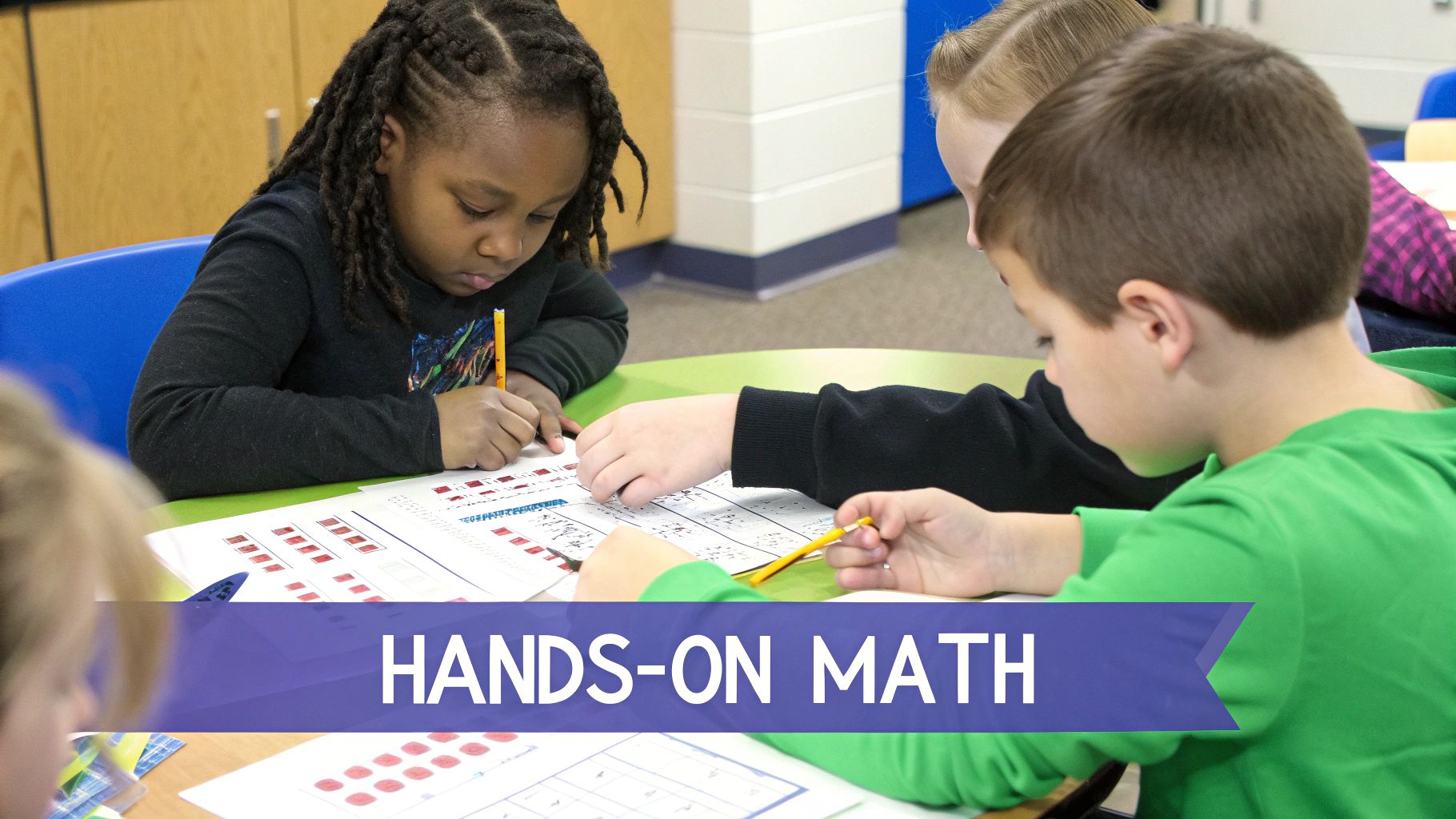
A Favorite Lesson: Data and Graphing
One of my absolute favorite math units for this age group is data and graphing. It’s naturally interactive and gets kids moving, talking, and thinking like tiny researchers. It's a perfect fit for the growing focus on data literacy in elementary classrooms.
In fact, standards for second grade make data collection a key skill. Over 90% of curricula expect students to gather, organize, and display data in picture and bar graphs. It's not just about charts, either; these activities can boost mental math skills by 25-30% as kids practice skip-counting by 5s and 10s with tally marks.
Here’s a quick look at how a lesson on graphing might unfold in my classroom:
- We start with a fun question. Something simple and relevant, like "What is our class's favorite type of pet?" or "What's the best activity to play at recess?"
- Time to be researchers! I hand out clipboards (this simple trick makes them feel so official), and they survey five classmates, using tally marks to record the answers. It’s controlled chaos, but the engagement is fantastic.
- Let's build the graph. Back at their desks, they use their tally data to create their own bar graph. We talk about labeling the axes and giving our graph a title so everyone knows what it's about.
Navigating Those Common Sticking Points
As with any lesson, a few common roadblocks always seem to pop up. It's best to address them head-on.
- Tally Mark Trouble: Some students always forget that diagonal slash for the fifth tally. To help, we practice as a group, chanting, "One, two, three, four, number five shuts the door!"
- Wobbly Bars: Students might color their bars unevenly, making the data hard to read. I model using a ruler to draw straight lines first before they start coloring.
- Describing vs. Analyzing: When I ask, "What does the graph tell us?" many will just list the numbers: "Four people like dogs." I gently push them further with questions like, "Which pet got the most votes? How many more votes did it get than the pet with the least votes?"
It's that final step—analyzing the data—that elevates this from a coloring activity to a real math lesson. The graph isn't the end product; it's the tool we use to answer bigger questions.
More Hands-On Math Wins
This hands-on approach works wonders for other tricky second-grade math topics, too.
- Two-Digit Addition with Regrouping: Get out the place value blocks! When students can physically trade ten "ones" for one "ten" rod, the concept of regrouping finally clicks in a way a worksheet never could.
- Telling Time: Give each student a small analog clock with movable hands. As you call out different times, they can move the hands on their own clock. It's so much more effective than just looking at a static image.
- Counting Money: Manipulatives are fantastic for this, and if you're looking for a good starting point, our lesson plan for counting to twenty provides a great foundation for money concepts.
Creating all the visuals and word problems for these activities can eat up your prep time. To supplement your hands-on work, you can find a great collection of essential math problems for 2nd graders that provide targeted practice. This is also where an AI tool like Kuraplan can be a true game-changer. You can ask it to generate real-world word problems about your class's favorite pets or create a custom-labeled graph template in seconds, all perfectly aligned to your standards. It handles the tedious prep work so you can focus on the fun, hands-on teaching.
Bringing Science and Social Studies to Life
Let’s be honest, science and social studies can sometimes get pushed to the back burner when reading and math demand so much time. But these subjects are where we get to see our second graders' eyes light up with pure curiosity. They offer the perfect opportunity to get hands-on, ask big questions, and make learning an unforgettable adventure.
Forget dry textbook chapters. The best 2nd grade lesson plans for science and social studies are all about doing, exploring, and connecting concepts to the world our students actually live in.
A Stellar Science Lesson on Stars
Second graders are naturally fascinated by the night sky. A lesson on observing the attributes of stars taps right into that wonder while hitting key earth science standards.
Here’s a simple but powerful activity I love to do:
- Kick it off with wonder. I start by showing some stunning images of constellations and asking, "What do you notice about the stars? Are they all the same?" This opens the door to discussions about color, size, and brightness.
- Become star detectives. I give students "star attribute cards"—just simple index cards with different colored dots of various sizes. In small groups, their mission is to sort them based on different attributes (e.g., all the small blue stars, all the big yellow stars).
- Create your own constellation. Finally, they use their cards to create their own unique constellation on black construction paper, giving it a name and a backstory. It’s part science, part art, and 100% engaging.
This type of hands-on approach is incredibly effective. For instance, STEM lesson plans like ORISE's 'Stars and their Attributes' are used by over 10,000 teachers a year to help students model complex concepts. Research even shows these integrated plans can improve student retention by 18%. To see how this kind of lesson can be structured, you can explore more teacher resources on stars and their attributes.
The goal isn’t to have them memorize facts about astronomy. It’s to teach them the foundational scientific skill of observation and classification using a topic they already find magical.
Making Social Studies Local
Social studies becomes so much more meaningful when kids can see it in their own community. A great way to blend geography, math, and civics is by comparing different communities using real-world data.
Instead of just talking about "urban" versus "rural," I make it concrete. We might start by looking at a simple population map of our own state. I’ll ask questions like, "Which city has the most people? How does it compare to our town?" This seamlessly connects back to our graphing lessons from math.
The Power of Integrated Units
The real magic happens when you weave a single theme across multiple subjects. An integrated unit plan makes learning feel cohesive and helps students make deeper connections.
Here’s an example of an integrated unit I've used:
- Theme: Our Community
- Reading: We read stories about different types of communities and the people who live in them.
- Math: We use local population data to create bar graphs and solve comparison word problems.
- Social Studies: We map out important places in our town and learn about community helpers.
- Writing: Students write a personal narrative about their favorite place in their own neighborhood.
Pulling together all the visuals for a unit like this used to take me an entire weekend. I’d be searching for the right maps, diagrams of city layouts, and illustrations of community helpers. Now, AI tools are a massive help here. A platform like Kuraplan is a lifesaver because it can generate custom diagrams and kid-friendly illustrations to reinforce these concepts in just a few minutes, giving you back precious time.
Differentiating Instruction Without the Headache
Let's be real—meeting the needs of every single second grader can feel like the toughest part of the job. You’ve got a room full of different reading levels, math skills, and attention spans. The secret isn't to burn yourself out creating a dozen different lesson plans. It's about building smart, simple differentiation into the lessons you're already teaching.
Think of it as offering different paths to the same destination. This way, every student feels both challenged and successful, no matter where they're starting from.
Using Flexible Grouping Effectively
Flexible grouping is my absolute go-to for both reading and math centers. The key word here is flexible. These groups aren't set in stone; they should change based on the specific skill we're working on that day or week. A student who needs a little extra help with phonics might be the one leading the charge in a group focused on story sequencing.
Here’s what that looks like in my classroom:
- Reading Centers: After our whole-group mini-lesson, students head to their centers. One of those centers is always a small group with me for targeted, direct instruction. The others might be working on independent reading, word work on their own, or listening activities.
- Math Centers: It's a similar setup. We might have a station with hands-on manipulatives, a technology station for practicing a specific skill, and a problem-solving group working through challenges with me.
The real magic of flexible grouping is that it lets you provide focused support right when and where it's needed most. You get to listen in on their thinking and fix misconceptions on the spot, which is so much more effective than reteaching the whole class later.
Creating Tiered Assignments That Work
Tiered assignments are a fantastic way to have all your students tackle the same core concept, just at different levels of complexity. It’s not about giving some kids more work, but about adjusting the challenge of the work.
For example, during a math lesson on two-digit addition, a tiered assignment could be structured like this:
- Tier 1 (Needs Support): These students might use place value blocks to solve problems without regrouping. The focus is on the physical act of combining tens and ones to build that foundational understanding.
- Tier 2 (On Grade Level): This group is ready to tackle problems that include regrouping, maybe using a graphic organizer to help guide their steps and keep their work organized.
- Tier 3 (Extension): These students are ready for a bigger challenge. They could solve multi-step word problems involving regrouping or even create their own word problems for a partner to solve.
Accommodations and Extensions Made Easy
Sometimes, the simplest adjustments make the biggest difference for students with specific needs. At the same time, having engaging extension activities ready to go is crucial for keeping your early finishers from getting bored (and disruptive!).
- Simple Accommodations: This could be as easy as providing sentence starters for a writing assignment, offering visual aids and anchor charts, or letting a student use a highlighter to track the text as they read.
- Engaging Extensions: I love using a "Choice Board" for this. It might have activities like writing a different ending to a story, designing a new book cover, or creating a math puzzle based on the day's lesson.
Trying to plan for all these layers of differentiation from scratch for every single lesson is, frankly, exhausting. This is where having a smart tool in your corner can be a huge help. A platform like Kuraplan is a lifesaver because it can build differentiation right into the 2nd grade lesson plans it generates for you. It automatically creates tiered activities and varied worksheets to support every learner, giving you back your evenings and weekends.
Your Questions on 2nd Grade Lesson Plans Answered
Even with the perfect framework and a stack of great activities, questions always pop up. We all face the same hurdles, from trying to quiet down a chatty group during centers to figuring out how to actually use all the tech our schools hand us.
Let's dig into some of the most common, in-the-trenches questions I hear from fellow teachers about making 2nd grade lesson plans work in the real world.
How Do I Manage Classroom Behavior During Group Work?
This is the big one, isn't it? You plan these amazing, collaborative centers, and five minutes in, the volume is through the roof and half the groups are completely off-task. The solution isn't a magic wand; it's all about proactively teaching what group work is supposed to look and sound like.
Before I ever launch centers, we practice. A lot. I like to use a fishbowl activity where one group models the task in the middle of our circle while the rest of us observe. Then, we build an anchor chart together with two columns: "Looks Like" and "Sounds Like."
- Looks Like: Leaning in together, sharing materials, taking turns, eyes on your work.
- Sounds Like: Quiet, "spy" voices, asking each other for help, giving compliments.
We also use a visual "noise meter" on the board. When things start getting too loud, I can just point to the meter instead of stopping the entire class. It takes some time to set up at the beginning of the year, but the payoff in smooth, productive group work is huge.
What's the Best Way to Integrate Technology?
Tech can either be a massive help or a massive headache. The trick is to use it as a tool, not just a flashy distraction. Ask yourself: what can this app or website do that a simple worksheet can't?
I love using tech for quick, engaging practice on foundational skills. Digital flashcards for sight words or a math game that targets addition fluency are perfect for a 10-minute station. It gives students immediate feedback and frees me up to pull a small group.
The best tech integration solves a problem for you or your students. If it's just a digital version of a worksheet, it might not be worth the login hassle. The goal is to make learning more efficient or more engaging.
One of the biggest shifts for me has been in the planning process itself. Instead of spending ages creating my own visuals, I now lean on AI. For a lesson on data, for example, I might need a specific bar graph. Instead of wrestling with a program to build it myself, I can use a tool like Kuraplan to generate a perfectly formatted, kid-friendly graph in seconds. This is where tech becomes a true partner in my planning.
How Can I Assess Students Without Drowning in Paperwork?
Grading every single thing is a fast track to burnout. For daily work and center activities, I've learned to focus more on observation and quick checks for understanding instead of formal grading.
Here are a few strategies that have saved my sanity:
- Exit Tickets: A single, focused question at the end of a lesson gives me an instant snapshot of who got it and who needs more support tomorrow.
- Observation Checklists: While students are working, I'll walk around with a clipboard and a simple checklist for the skill we're targeting. I just make a quick note or a checkmark next to the names of students I observe.
- Peer-to-Peer Feedback: For writing or projects, I teach students how to give kind and helpful feedback. Using a simple "Two Stars and a Wish" format works wonders and gives them ownership of their learning.
One area where assessment and planning come together beautifully is in math, especially with data analysis. Data graphing lesson plans for 2nd graders have become incredibly popular—some resources are downloaded by over 50,000 educators a year. Experts even say that early exposure to graphing can lead to 20% higher statistical reasoning scores by middle school. Kuraplan makes this so much easier by generating sequential unit plans with integrated visuals and differentiated worksheets that align perfectly with standards like CCSS 2.MD.D.10. You can check out some popular data and graphing resources for second grade to see what’s working in other classrooms.
Ultimately, the goal is to gather the info you need to inform your teaching, not to create a mountain of paperwork.
Planning for second grade is a challenging but incredibly rewarding puzzle. With the right strategies and tools, you can create engaging, effective lessons without giving up your evenings and weekends. Kuraplan is designed to be your partner in this, helping you build standards-aligned lessons, differentiate for every student, and create all the materials you need in minutes, not hours.
Start creating your 2nd grade lesson plans with Kuraplan today!