Creating a solid lesson plan is all about knowing your destination, mapping the route to get there, and being ready for every kind of student traveler you’ll have in your classroom.
Your Guide to Practical Lesson Planning That Works

Let’s be real. Too often, lesson planning feels like a soul-crushing chore. You're buried in templates, trying to build something that checks all the administrative boxes but doesn’t always connect with what actually happens in the classroom.
This guide is different. It’s built by a teacher, for teachers. My goal is to help you create lesson plans that are flexible, engaging, and genuinely useful—the kind that feel like a trusty roadmap, not a rigid script.
We’re ditching the dense academic jargon and focusing on a simple framework that saves time and actually boosts student learning.
Why Structured Planning Matters More Than Ever
You already know planning is important, but its true impact is even bigger than you might think. This isn't just about being organized for the day; it's a proven driver of student achievement. For another great perspective on this, check out this guide to making a lesson plan that works.
In fact, research shows that structured, thoughtful plans are one of the most cost-effective ways to improve learning outcomes.
A 2023 analysis by the Global Education Evidence Advisory Panel (GEEAP) called structured lesson planning a top 'Smart Buy' for education. Their research found that giving teachers detailed plans boosts learning by an average of 0.22 standard deviations. To put that in perspective, that’s like giving a student an extra four months of progress in a single school year.
This data just confirms what so many experienced teachers already know in their gut: a great lesson rarely happens by accident. It's the product of careful preparation that anticipates what students will need and connects every single activity back to a clear, meaningful purpose.
Our goal here is to make that preparation process less of a headache and a lot more powerful.
Start With Your Destination, Not Just an Activity
Before you fall down the Pinterest rabbit hole searching for a cute activity, let's pause for a second. The most important question isn't, "What are we going to do today?" It should always be, "What will my students know or be able to do by the end of this lesson?"
This simple mental shift is the foundation of purposeful teaching. It’s the core of a powerful planning method you might have heard of called backwards design. If you want to dive deeper, you can explore our guide on how backwards design transforms lesson planning. It's all about starting with the end in mind.
Everything else—the videos, the worksheets, the group discussions—is just a vehicle. If you don't know your destination, any road will get you there, but it probably won't be where your students truly need to go.
From Vague Goals to Actionable Objectives
The first real step is translating those dense curriculum standards into clear, student-friendly learning objectives. Think of an objective as your lesson's North Star; it ensures every single element has a specific purpose.
Let’s look at the difference this makes:
- Vague Goal: Students will learn about photosynthesis.
- Actionable Objective: Students will be able to diagram the process of photosynthesis, labeling the key inputs (sunlight, water, carbon dioxide) and outputs (glucose, oxygen).
See the power of that action verb? "Diagram" gives you a crystal-clear target. You know exactly what students need to produce to show they've mastered the concept. Other strong verbs include "explain," "compare," "solve," "analyze," or "create."
When you create a lesson plan with a clear objective, you're not just organizing your time; you're maximizing it. Prioritizing clear objectives is a hallmark of high-performing education systems and has a direct impact on how much learning happens in the classroom.
The reality is that poor planning directly eats into teaching time. UNESCO's 2024/5 Global Education Monitoring Report highlights that in some classrooms, educators spend just 58% of their time on actual teaching due to a lack of structure. Prioritizing clear objectives has been linked to 15% higher PISA scores in systems that value structured unit planning. You can read more about these global education insights from UNESCO.
Connecting Objectives to Standards Without Losing Your Mind
Now for the part that makes us all groan: connecting those objectives to district, state, or national standards. This is where so many of us get bogged down, spending hours cross-referencing documents just to tick a box. It's essential work, but it doesn't have to be a soul-crushing manual chore.
This is a perfect example of where a smart assistant can be a lifesaver. Instead of flipping through binders or endless PDFs, you can use a tool to handle the grunt work.
Modern AI tools built for teachers are fantastic for this. For example, a platform like Kuraplan can take your lesson idea—say, a lesson on the American Revolution—and instantly map it to the correct Social Studies standards for your grade level. It suggests measurable objectives and ensures you’re on the right track from the very start.
This frees you up to focus on the creative side of planning, not the administrative drudgery.
Design the Learning Journey With Purpose
Okay, you've got your destination—that clear, actionable objective. Now it's time to map out the actual journey your students will take.
A great lesson has a natural rhythm, a flow that guides kids from "I don't get it" to "Aha!" It doesn’t just happen by accident; it's designed with real intention. Think of it like telling a good story: you need a hook, a rising action, and a climax where the hero (your student!) gets to show what they've learned. This narrative arc is what keeps a lesson from feeling like just a random pile of activities.
The Power of I Do, We Do, You Do
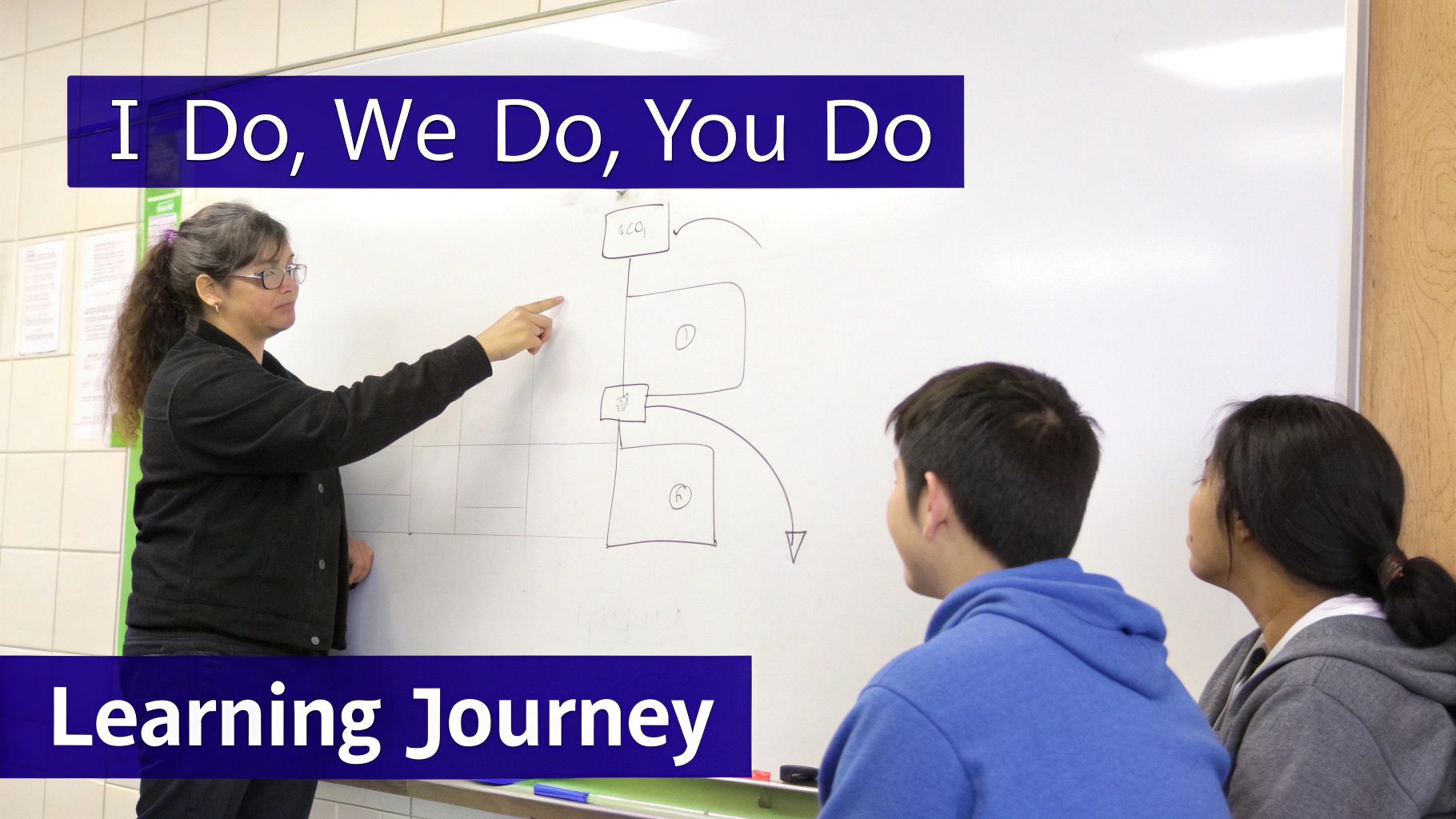
One of the most dependable frameworks out there is the gradual release of responsibility model. In the teacher lounge, we just call it "I Do, We Do, You Do." It’s a classic for a reason: it works. It’s the perfect way to make sure you aren't just tossing students into the deep end and hoping they can swim.
Here’s how this simple but powerful flow plays out in the classroom:
- I Do (Direct Instruction): This is your moment. You introduce the new concept or skill, modeling your thinking process out loud. Keep it short and focused—this isn't a 45-minute lecture. You’re showing them exactly what success looks like.
- We Do (Guided Practice): Now, you pull the students into the process. You work through problems together. This is the messy, collaborative heart of the lesson, where you can catch misunderstandings in real-time and build up their confidence.
- You Do (Independent Practice): Finally, it’s time to step back. Students get to apply the new skill on their own, proving they’ve got it. This is their chance to show you they’ve truly mastered the objective.
This structure provides a predictable and supportive scaffold that helps every learner in the room move toward independence.
Moving Beyond the Lecture
Direct instruction has its place, but the "We Do" and "You Do" phases are where the real learning magic happens. This is your chance to get students thinking, moving, and collaborating instead of just passively listening.
If your lessons are feeling a bit stale, try swapping out a standard lecture for something more dynamic.
Don’t be afraid to break the routine. The goal is active engagement, not quiet compliance. A little bit of organized chaos is often a sign that real, deep learning is taking place.
Here are a few alternatives to get kids actively involved:
- Gallery Walks: Post questions or images around the room. Students move in small groups, discussing and adding their thoughts on chart paper at each stop.
- Socratic Seminars: Instead of you asking all the questions, students lead a discussion based on a text, building on each other's ideas to reach a deeper understanding.
- Hands-on Labs or Simulations: Whether it's a science experiment or a historical role-play, letting students experience a concept makes it stick.
Choosing the right activity always comes back to one question: "Does this activity directly help my students nail the objective?" If you're struggling with that first step, our post on how to write objectives for lesson plans will help you build that solid foundation.
Choosing and Creating Your Materials
Once you've picked your activities, you need the right stuff to make them happen. This could be anything from primary source documents and lab equipment to interactive websites and graphic organizers. The key is to find resources that genuinely support the learning, not just busywork to fill the time.
We’ve all been there—spending hours formatting a worksheet or hunting for the perfect diagram. Sourcing and creating quality materials can easily eat up your entire evening.
This is another spot where modern tools can be a lifesaver. An AI lesson planner like Kuraplan is built for exactly this. It can generate custom worksheets, clear diagrams, and even detailed rubrics tailored to your specific topic and grade level. Instead of wrestling with text boxes and clipart, you can get back to focusing on what you do best: teaching.
Plan for Every Student in Your Classroom
Step into any classroom, and you'll see a wild mix of learners. You have the kid who gets it in a flash, the one who needs to chew on an idea for a bit, the English Language Learner juggling new words, and the student with an IEP who needs specific support. A one-size-fits-all lesson plan just doesn't work. It never has.
This is where the real magic of teaching happens, but it doesn't have to be a logistical nightmare. When you build differentiation and assessment into your lesson plan from the ground up, you transform a good lesson into a great one. It’s all about creating a flexible plan with different entry points and extensions for every single student.
Simple Ways to Differentiate Instruction
Let's be clear: differentiation does not mean creating 30 unique lesson plans. It’s about making small, smart tweaks to what you teach (content), how you teach it (process), or how students show you what they know (product).
It’s like having a toolkit ready to go. For a student struggling with a dense text, you might offer a version with key vocabulary highlighted or a simple graphic organizer. For the student who zips through the assignment and is ready for a challenge, you can have an extension task that pushes them to apply the concept in a new way.
Here are a few practical strategies you can weave right into your plans:
- Provide Scaffolds: Think of these as temporary training wheels. Offer sentence starters for writing prompts, use visual aids like charts and diagrams, or create a word bank for key terms to support your English learners.
- Offer Choices: Let students have a say in how they show their learning. Maybe they can write a paragraph, draw a comic strip, or record a quick video to explain the same idea. This gives them ownership and lets them lean into their strengths.
- Use Flexible Grouping: Sometimes, students need to work with peers at a similar level. Other times, mixed-ability groups are perfect for collaboration and peer teaching. Shaking up your grouping strategies is a powerful way to meet everyone's needs.
- Create Tiered Activities: This just means designing the same core task at different levels of complexity. In a math lesson, for instance, one group might be working with whole numbers, another with decimals, and a third with fractions—all while practicing the same addition skill.
We all know the headache of manually creating three versions of the same worksheet. It’s a huge time-suck. This is where a tool like Kuraplan can be a total game-changer. It's designed to do exactly this—with just a few clicks, it can generate multiple versions of an activity for different readiness levels. True differentiation becomes achievable without giving up your entire weekend.
Weaving in Assessment That Actually Helps
So, how do you know if your differentiation is actually working? Assessment isn’t just about the final test. The most effective assessment is baked right into your lesson, giving you a constant pulse on who’s getting it and who’s hitting a wall.
This means planning for both quick checks and bigger-picture evaluations.
Your lesson plan should be a living document. The formative assessment data you collect during a lesson is what helps you decide whether to speed up, slow down, or pull a small group for reteaching the next day.
Think of it like this: formative assessments are the check-ups, and summative assessments are the final diagnosis. You absolutely need both.
Here’s a quick-reference table to keep these ideas straight. It breaks down simple, practical ways to differentiate your lessons to meet your students where they are.
| Practical Differentiation Strategies at a Glance | | :--- | :--- | :--- | | Differentiation Type | What It Means | Classroom Example | | Content | Adjusting what students learn. | Providing a text at a different reading level or using a video to explain a concept for visual learners. | | Process | Changing how students learn. | Allowing students to work in pairs, independently, or in a small group with you to complete a task. | | Product | Varying how students show mastery. | Letting students choose between writing an essay, creating a poster, or giving an oral presentation. |
Ultimately, it’s the small, informal checks that make the biggest difference for in-the-moment teaching.
A simple thumbs-up/thumbs-down can tell you if the class is ready to move on. An exit ticket—just one quick question students answer before they leave—can give you incredibly valuable intel on who needs a little extra help tomorrow.
These quick checks are low-stakes for your students but incredibly high-value for you. They guide your next moves and ensure your planning stays connected to what’s really happening in the classroom.
See How It All Comes Together
Okay, let's shift from theory to practice. Sometimes, seeing a fully fleshed-out lesson plan is what makes all the abstract pieces finally click.
Below, we'll walk through a completed example for a 7th-grade science lesson. Think of it as looking over a colleague's shoulder to see how they map everything out. We’ll break down the plan piece by piece so you can see the thinking behind each choice and how every activity is hardwired to the main learning objective.
A 7th-Grade Science Lesson Example
Let’s imagine our standard is for students to "analyze and interpret data to provide evidence for the effects of resource availability on organisms and populations of organisms in an ecosystem." It's a bit of a mouthful, but it gives us a clear target.
Here’s how we can build a lesson around it:
- Objective: Students will be able to analyze a data set showing predator-prey population changes over time and write a paragraph explaining how resource availability (the prey) impacts the predator population.
- Hook (5 mins): Kick things off with a quick "Think-Pair-Share." I’d show a short, dramatic video clip of a lion hunting a gazelle and ask: "What do you think would happen to the lion population if all the gazelles disappeared?"
- I Do - Modeling (10 mins): Next, I'll introduce a simple graph showing rabbit and fox populations over 50 years. I’ll model how to read it, pointing out the peaks and valleys and thinking aloud: "I notice that when the rabbit population goes up, the fox population seems to follow it a little later. Why would that be?"
- We Do - Guided Practice (15 mins): Now it's their turn, with support. In small groups, students get a new data set (e.g., lynx and snowshoe hare) and a worksheet with guided questions to help them identify patterns and discuss the cause-and-effect relationship.
- You Do - Independent Work (10 mins): Each student receives a final, different data set. Their task is to write a short paragraph summarizing the relationship, using specific data points from the graph as evidence. This is our key formative assessment.
- Closing (5 mins): To wrap up, I'll use an exit ticket: "On a sticky note, write down one cause-and-effect relationship you observed in today's data."
Notice how every single step, from the video clip to the exit ticket, serves that core objective. There are no wasted minutes or disconnected activities. It all flows.
Building in Differentiation
A solid plan anticipates that you'll have a classroom full of different learners. For the lesson above, differentiation isn't an afterthought—it's woven right into the fabric of the plan.
This infographic shows a simple, three-tiered framework for thinking about differentiation: providing foundational support, targeting the main objective, and offering opportunities to extend the learning.
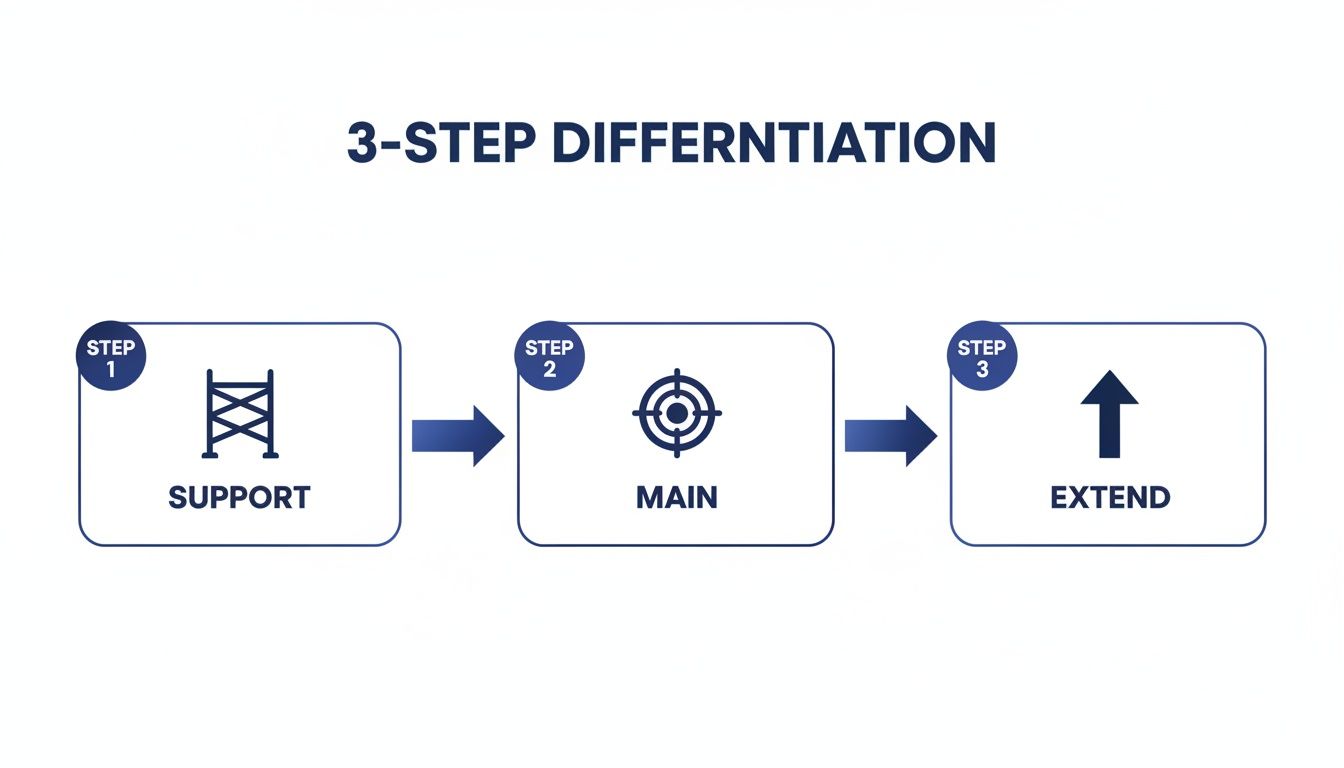
This process helps you meet every student where they are by planning scaffolds and challenges right from the start.
For our science lesson, this could look like:
- Support: Provide a version of the worksheet with sentence starters ("When the hare population increases, the lynx population...") or a graph with key points already circled.
- Extend: Challenge early finishers or advanced students to predict what the graph would look like over the next 20 years. You could even introduce a third variable, like a drought, and ask them to hypothesize its impact.
Manual vs. AI-Assisted Planning
Creating this lesson manually is totally doable, but it takes time. You have to find the right data sets, create three versions of the worksheet, and maybe even design the graphs yourself. This is where AI assistants can be a massive help.
With a tool like Kuraplan, you could input your objective and get a complete, structured lesson draft in seconds. It can generate differentiated worksheets, find relevant data, and even suggest the exit ticket question, saving you an incredible amount of prep time. You can explore more options by checking out our guide on finding a simple lesson plan template that fits your needs.
The real value of using a tool isn't just speed; it's alignment. An AI assistant ensures every activity, worksheet, and assessment is laser-focused on your objective and standards, creating a more coherent and powerful learning experience for your students.
This coherence is especially powerful when lessons connect to the real world. Research from The Statistics Teacher journal found that lesson plans incorporating real-world data can improve student engagement by 35%. A lesson that uses global life expectancy data to teach mean and median makes abstract concepts tangible and relevant for kids.
Avoid Common Pitfalls and Reclaim Your Time
We’ve all been there. You spend hours crafting a beautiful, detailed lesson plan, only to watch it go completely off the rails five minutes into class. That perfectly timed activity takes twice as long, a key question falls flat, and suddenly you’re just winging it.
Real-world teaching is messy. Learning to anticipate the bumps in the road is what separates a good plan from a great one. This is about sidestepping the classic mistakes that cost us our precious time and sanity.
Sidestep These Common Planning Traps
Some of the most common pitfalls are surprisingly easy to dodge once you know what to look for. One of the biggest? Over-scheduling every single minute. A plan that’s packed too tightly leaves zero room for the spontaneous questions or teachable moments that often lead to the deepest learning.
Another classic mistake is forgetting to plan for transitions. The two minutes it takes for students to put away lab materials and get out their notebooks can quickly spiral into five minutes of chaos if you haven’t thought it through.
Here are a few other traps to watch for:
- Choosing "Fun" Over Function: An activity might seem super engaging, but if it doesn't directly help students master the learning objective, it's just educational fluff.
- Assuming Prior Knowledge: Never assume students remember a concept from last year or even last week. A quick warm-up can reveal critical gaps before they derail your entire lesson.
- Planning in Isolation: Don't try to reinvent the wheel for every single lesson. Great teachers borrow, adapt, and build on the success of their colleagues.
The goal of a lesson plan isn't to create a perfect script; it's to build a flexible roadmap. The best plans guide your teaching but are loose enough to adapt the moment your students need you to pivot.
Time-Saving Tips From the Trenches
After a few years in the classroom, you learn that efficiency is the key to survival. One of the best insider tips is to plan thematically by the week, not just day-by-day. This helps you see the bigger picture and create a more cohesive journey for your students.
Another game-changer is building a personal library of your go-to activities, templates, and assessments that you can quickly pull from and adapt. This is where leaning on smart tools becomes an absolute lifeline.
For teachers who spend over 10 hours a week on planning, AI assistants like Kuraplan are invaluable.
By automating the most tedious parts—mapping lessons to standards, generating differentiated materials, and creating visuals—these tools can honestly cut your planning time by more than half. This gives you back your evenings and lets you focus on what really matters: the art of teaching.
FAQs About Lesson Planning
We get a lot of questions about the nuts and bolts of lesson planning. Here are some of the most common ones we hear from teachers in the trenches.
How Detailed Should My Lesson Plan Be?
Your lesson plan is a tool for you, not a script you’re performing for an administrator. For a typical daily lesson, one or two pages covering your objective, main activities, materials, and how you’ll check for understanding is usually perfect.
The real test is usability. Does it help you stay on track and teach effectively? If so, it’s detailed enough. Don’t get bogged down adding extra fluff just to check a box.
What Is the Most Important Part of a Lesson Plan?
The learning objective. Hands down. A clear, measurable objective is the North Star for your entire lesson.
Every single activity, every question you ask, and every assessment you give should point directly back to that goal. Without a strong objective, lessons tend to drift, and it's tough to know if students actually learned anything meaningful.
How Can I Make My Lessons More Engaging?
Engagement boils down to two things: relevance and active participation. You have to find a way to connect the material to your students' lives, their interests, or what’s happening in the world around them.
Then, get them doing something. Move past the lecture and bring in activities that make them think, talk, create, and solve problems. Simple strategies like a quick Think-Pair-Share, a group challenge, or using a bit of tech can completely change the energy in the room.
Can AI Really Help Me Create Good Lesson Plans?
Absolutely, but think of it as the world’s best teaching assistant, not a replacement for your professional judgment. AI tools are fantastic at handling the tedious, time-sucking tasks that we all dread.
For instance, an AI tool like Kuraplan can instantly map your lesson to curriculum standards, generate differentiated worksheets, or create custom rubrics in seconds. This frees you up to focus on what only a human can do: connect with your students, adapt on the fly, and spark that genuine love of learning.
Ready to slash your planning time and build truly dynamic, standards-aligned lessons? See how Kuraplan can become your most trusted co-pilot in the classroom. Start planning smarter, not harder, today.