Lesson planning is our roadmap. It’s how we define what students need to learn, design activities that actually work, and make sure everything lines up with curriculum standards. At its best, it's the blueprint for a classroom experience that’s effective, engaging, and meets the needs of every single student.
The Reality of Modern Lesson Planning
But let’s be real for a second. More often than not, lesson planning feels like a mountain we have to climb every single night. We didn’t become teachers to spend our evenings buried in spreadsheets and curriculum documents, but that's the reality for so many of us. It's a constant juggle between what the administration needs and what we know our students need to get excited about learning.
And it's not just a feeling—it's a fact. Across the globe, teachers spend up to 50% of their workweek on tasks outside of teaching, like planning lessons and creating materials. This heavy administrative load is a huge reason for burnout, with one in five new teachers thinking about leaving the profession within their first five years.
Navigating the Daily Demands
The real challenge isn't just the sheer amount of time; it's how complex the task has become. Every lesson plan we create is a balancing act. We have to:
- Align with Standards: Every activity needs to be tied to specific, and often dense, state or national standards.
- Differentiate for All Learners: Our classrooms are beautifully diverse. A single lesson has to work for students who need extra support, those who are right on track, and those who are ready to be pushed further.
- Integrate Engaging Activities: We’re always on the hunt for resources that grab students' attention and lead to genuine understanding, not just quiet compliance.
- Plan for Assessment: How will we know if they really learned it? We have to build in quick checks and formal assessments right from the start.
Trying to manage this with traditional, manual methods is what leads to that "staring at a blank page" feeling after a long day. It’s not just daunting; it's inefficient. It drains the creative energy that brought us into teaching in the first place.
The goal isn't just to survive the planning process. It’s to find a smarter way to work that prioritizes our students' growth without sacrificing our own well-being.
To really see the difference, let’s compare the old way with a more modern approach.
Traditional Planning vs Smarter Planning
| Planning Aspect | The Old Grind | The Smarter Approach |
|---|---|---|
| Standards Alignment | Manually searching through dense curriculum documents. | AI automatically finds and integrates the right standards. |
| Resource Creation | Hours spent making worksheets and activities from scratch. | Instantly generate custom materials with a single click. |
| Differentiation | Creating multiple versions of one lesson, taking up a whole evening. | Easily adjust activities and content for different learning levels in minutes. |
| Time Investment | 5-10 hours per week (or more!) on planning alone. | Cut planning time by over 80%, reclaiming hours for other tasks. |
This table makes it clear: sticking to the old methods means we’re working harder, not necessarily smarter. The "smarter approach" isn't about cutting corners; it's about being strategic.
Shifting Toward Smarter Planning
Recognizing these challenges isn't about complaining—it's about being honest so we can find real solutions. The good news is, we live in a time where we have tools that can do a lot of the heavy lifting for us. For a deeper look at structuring educational content effectively, this a guide to course instructional design is an excellent resource.
Making the shift from "I have to do it all myself" to "I can plan with smart support" is the first step. This mindset opens the door to a new way of working, one where technology handles the tedious parts like standards alignment and resource creation. It’s about getting our time back so we can focus on what we love: connecting with our students and bringing learning to life.
Starting with Your Destination in Mind
Before you even think about a fun Kahoot game or a cool project, you need to know where you're going. Solid lesson planning isn't about the activities first; it's about the destination. Think of it like a road trip—you wouldn’t just start driving without plugging an address into your GPS. Your learning objectives are that destination.
Everything else, from the bell ringer to the exit ticket, is just a turn-by-turn direction to get your students there. This "backwards design" approach can feel a little strange at first, but it's the secret to making sure every single minute of class time has a purpose. It stops you from just filling time and helps you create activities that are both engaging and meaningful.
This flowchart shows the shift from the old grind to a smarter, more destination-focused approach.
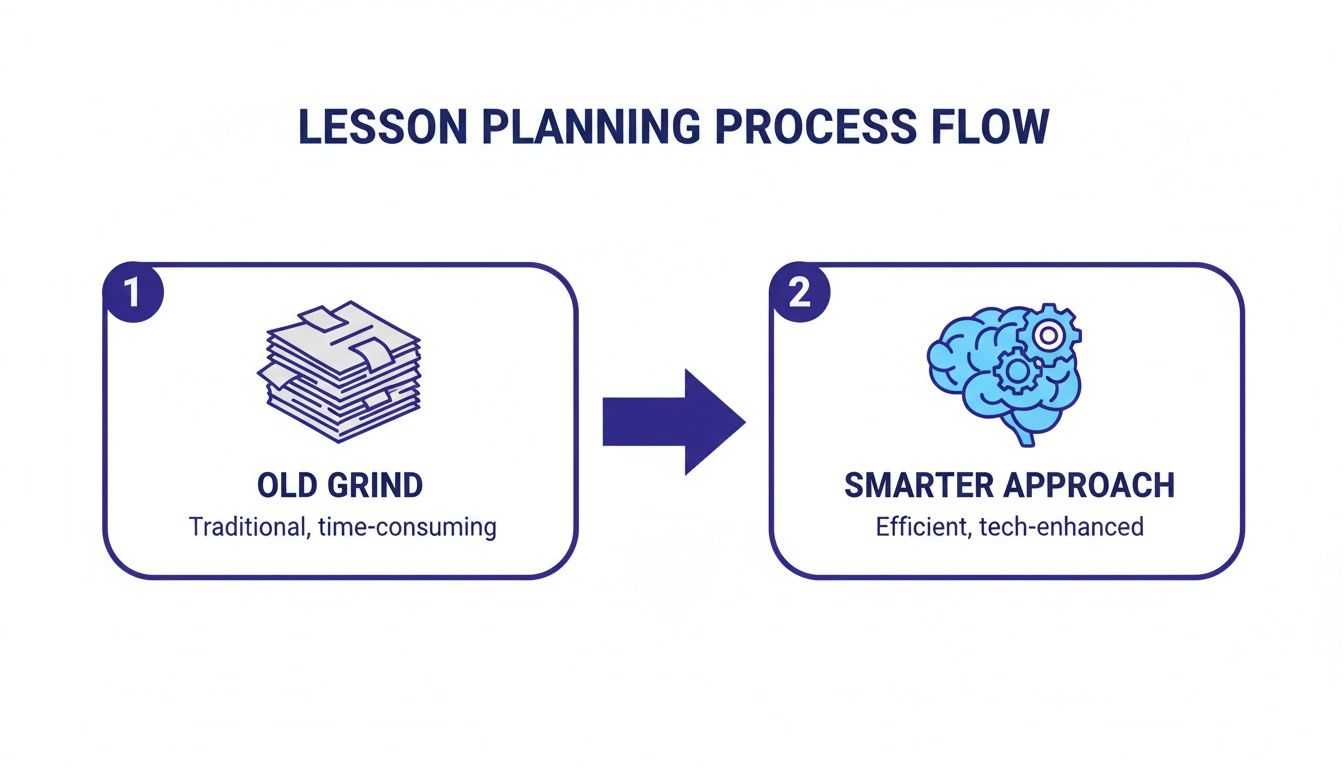
By starting with the end in mind, we move from a reactive, time-consuming cycle to a proactive, purpose-driven one.
From Dense Standards to Clear Objectives
Let's be honest, curriculum standards can be a nightmare. They’re often written in dense, academic jargon that doesn't exactly scream "classroom-friendly." Your first job is to be a translator, breaking down that complex language into something clear and actionable for your students.
This is where "I can" statements become your best friend. They reframe the standard from the student's perspective, making the learning goal feel personal and achievable.
For example, a standard like this one:
- CCSS.ELA-LITERACY.RI.5.2: "Determine two or more main ideas of a text and explain how they are supported by key details; summarize the text."
Can be translated into a much clearer objective:
- "I can find the main ideas in an article and use specific details from the text to explain them."
That small shift is huge. It gives students ownership over their learning and provides you with a clear target for your instruction.
A well-written objective is more than just a box for your admin to check. It’s a promise to your students about what they will be able to do by the end of the lesson. It’s the foundation of all great teaching.
Making Standards Alignment Less of a Chore
Manually digging through curriculum documents to find the right standard for every lesson is one of the most tedious parts of planning. It’s the kind of admin work that drains your energy and pulls you away from the creative side of teaching. This is exactly where technology can give you back your time.
Modern lesson planning tools are built to handle this heavy lifting. For instance, a platform like Kuraplan can automatically map your lesson ideas to the correct state or national standards as you type. You can start with a simple idea—like "a lesson on the water cycle for third graders"—and the tool will suggest relevant standards and objectives.
This doesn't just save time; it ensures your lessons are built on a solid, standards-aligned foundation from the get-go. Instead of spending an hour hunting for codes, you can spend that time thinking about how to make the content come alive for your students.
Of course, writing clear objectives is a skill in itself. For a more detailed walkthrough, you can learn more about how to write objectives for lesson plans in our dedicated guide.
By setting a clear destination with student-friendly objectives and using tools to simplify standards alignment, you create a powerful roadmap. Every activity, every worksheet, and every discussion has a clear "why" behind it, leading to more focused teaching and deeper student learning.
Designing Activities That Truly Engage Students
Now for the fun part—crafting the actual learning experience. A learning objective is just words on a page until your students get to roll up their sleeves and do something. This is where we move beyond the lecture-and-worksheet routine to spark genuine curiosity and create those "aha!" moments.
The goal is to design activities that feel less like a chore and more like an adventure. It’s our chance to get creative, connecting our objectives to hands-on tasks, collaborative challenges, and real-world problems.

Crafting the Flow of a Lesson
A great lesson has a natural rhythm, almost like a story. It needs a beginning to hook students, a middle where they wrestle with the new material, and an end where they can show what they’ve learned. I’ve always found the I Do, We Do, You Do model to be an absolute lifesaver here.
It’s a simple but incredibly effective structure:
- I Do (Direct Instruction): This is your moment to shine. You introduce the new concept with a short, focused explanation or demonstration. You’re modeling the exact skill you want students to learn.
- We Do (Guided Practice): Now, you bring the students into the action. You work through problems or tasks together, either as a whole class or in small groups. This is the perfect time to spot-check for understanding and clear up misconceptions on the fly.
- You Do (Independent Practice): Finally, you set them loose. This is their chance to apply the new skill on their own, whether it’s through a worksheet, a quick-write, or a short project.
This gradual release of responsibility gives students the scaffolding they need to build confidence. It takes them from watching you, to trying with support, to finally mastering it themselves.
Think of yourself as a coach. You show the team the play, run drills together, and then let them execute it in the game. Each step is essential for success.
Matching the Activity to the Objective
The most engaging activity in the world is useless if it doesn't actually hit your learning objective. If your goal is for students to analyze a character's motivation, having them complete a word search with character names just won't cut it. Alignment is everything.
You can also explore powerful reading comprehension strategies for teachers that boost engagement beyond simple recall.
Here's a simple way to think about it:
| If Your Objective Involves... | Try an Activity Like... |
|---|---|
| Understanding a process | A sequencing task, creating a flow chart, or a hands-on simulation. |
| Analyzing different perspectives | A structured debate, a role-playing scenario, or a gallery walk with different primary sources. |
| Applying a mathematical concept | A real-world problem-solving task, a budgeting activity, or designing something to scale. |
| Summarizing key information | A "one-sentence summary" challenge, creating an infographic, or a think-pair-share. |
This deliberate matching ensures the "fun stuff" is also the "learning stuff." There are tons of ways to get students moving and thinking, and you can find even more ideas with these active learning strategies for students.
Saving Time on Creating Materials
Let's be real: creating the perfect worksheet or visual aid can burn through an entire planning period. You know exactly what you need—a specific diagram of the water cycle for third graders or a Venn diagram comparing two historical figures—but the online scavenger hunt to find it is exhausting.
This is another area where modern tools are a huge help. Instead of spending 30 minutes scrolling through stock photo sites for the right image, a tool like Kuraplan can generate a tailored, age-appropriate visual for your lesson in seconds.
Being able to create custom resources on the fly is a game-changer. It means you can produce high-quality, relevant materials that perfectly match your activity without sacrificing your evenings. Whether it's a unique graphic organizer or a specific visual, getting it instantly means you can spend more time focusing on what really matters—interacting with your students.
Using Assessment to Inform Your Next Move
How do you know if they really got it? It's the question that keeps us up at night as teachers.
Assessment often gets a bad rap, bringing to mind stressful final exams and essays covered in red ink. But what if we thought about it differently? Instead of a final judgment, think of assessment as an ongoing conversation you're having with your students.
This conversation tells you everything you need to know: when to speed up, when to slow down and reteach a concept, and when a particular student just needs a little extra one-on-one help. It’s the feedback that makes your planning truly responsive and effective.
The Essential Assessment Trio
To get a full picture of where your students are, you really need a mix of approaches. I like to think of them as an essential trio that works together throughout a unit. Each one answers a different, crucial question.
- Diagnostic Assessment: This is your "what do they already know?" check before you even start teaching. It can be something as simple as a K-W-L chart or a quick pre-quiz. The goal isn’t to grade anyone; it's to find their starting line so you can plan a better route for them.
- Formative Assessment: These are the frequent, low-stakes check-ins you do during the learning process. They’re the heartbeat of your lesson, giving you a real-time pulse on student understanding.
- Summative Assessment: This is the "what did they learn?" evaluation at the end of a unit or project. It’s your final look back at the journey, measuring how well students mastered the objectives you set from the very beginning.
Using all three creates a complete feedback loop that informs your instruction every single step of the way.
The Power of Real-Time Formative Checks
Forget waiting for the big unit test to find out who’s falling behind. Formative assessments are your secret weapon for nimble, on-the-fly teaching.
These quick, often ungraded, activities give you immediate feedback you can act on tomorrow—or even in the next five minutes. This is where the real magic happens. You can spot misconceptions as they're forming and gently correct course before they become ingrained habits.
Formative assessment data is gold. It’s not about collecting grades; it's about collecting insights that make your next lesson more powerful than the last.
Ready to move beyond just asking "any questions?" here are a few simple but incredibly effective techniques:
- Exit Tickets: Before the bell rings, ask students to answer one quick question on a sticky note. Something like, "What was the most confusing part of today's lesson?" or "Summarize today's main idea in one sentence."
- Quick Polls: Use a quick show of hands, personal whiteboards, or a simple digital tool to ask a multiple-choice question. You’ll see at a glance what percentage of the class is on the right track.
- Think-Pair-Share: Pose a challenging question, give students a quiet moment to think, have them discuss it with a partner, and then ask a few pairs to share out. It’s a low-pressure way to hear multiple student voices and check for understanding.
These small moments provide incredibly valuable data. If you're looking for more ways to check for understanding, there are dozens of great formative assessment examples you can adapt for any subject.
Designing Meaningful Summative Assessments
When it's time for that final project or unit test, clarity is your best friend. A great summative assessment isn't about tricking students; it’s about giving them a clear opportunity to show you what they’ve learned. The key to this is a solid rubric.
A well-designed rubric makes grading faster, fairer, and far more transparent for everyone. Students know exactly what success looks like before they even start, which empowers them to produce much better work. The only problem? Creating them from scratch can be a major time sink.
This is where planning tools can really help. Many AI-powered platforms, including Kuraplan, can suggest relevant assessment questions and even generate detailed rubrics that are directly aligned with your learning objectives. This ensures your final evaluation is just as thoughtfully planned as your activities, saving you hours of work while providing clear, consistent feedback for your students.
Making Differentiation and Scaffolding Manageable
Let’s be real. Every classroom is a beautiful, chaotic mix of learners. You’ve got students ready to soar, some who need a gentle nudge, and others who are just figuring out which way is up. A one-size-fits-all lesson plan? It just doesn't cut it.
This is where differentiation and scaffolding come in. But the thought of creating three different versions of every single lesson is enough to make any teacher want to hide under their desk.
Good news: it doesn’t have to be that monumental. The secret is to build these supports directly into your lesson plan from the very beginning, instead of tacking them on as an afterthought. It's about making small, smart adjustments that meet students exactly where they are.
Simple Ways to Adjust Your Instruction
Differentiation isn't about rewriting your entire curriculum. It’s about being flexible and offering different paths for students to reach the same destination: your learning objective.
You can make tiny tweaks in three key areas:
- Content (What they learn): This just means adjusting the material's complexity. For a reading assignment, maybe you provide a version of the text with a lower reading level or a summary with key vocabulary highlighted for students who need that extra boost.
- Process (How they learn): This is all about changing up the activity itself. Some students might fly with independent research, but others might need a structured graphic organizer or the chance to work with a partner to really process the information.
- Product (How they show what they know): Give students options to show you what they’ve learned. Instead of just a written essay, could a student create a podcast, draw a comic strip, or build a model? Offering choice here can unlock some seriously incredible creativity.
Thinking in these three categories makes the whole idea feel much more doable. You don't have to change all three for every lesson—even one thoughtful adjustment can make a world of difference.
Practical Scaffolding Strategies
Scaffolding is simply about providing temporary support to help students reach a higher level of understanding than they could on their own. Think of it like the scaffolds on a building—they come down once the student is ready to stand on their own.
Scaffolding isn't about lowering the bar; it's about building a ladder so every student can reach it. It’s the art of providing just enough help, just in time.
Here are a few of my go-to strategies that are easy to weave into your daily planning:
- Sentence Starters: For kids who stare at a blank page, providing starters like "The main character's motivation was..." or "I believe this is true because the text states..." can be the small push they need to get going.
- Visual Aids: Never underestimate the power of a simple anchor chart, a diagram on the board, or a checklist for a multi-step problem. These provide a constant reference point for students who need it.
- Think-Alouds: Modeling your own thought process out loud is one of the most powerful scaffolds there is. When you say, "Okay, the first thing I'm going to do is reread the question to make sure I understand it," you're giving students a direct peek into the metacognitive skills they need to build.
These aren't complicated moves. They're small, intentional supports that create entry points for all your learners.
Let Technology Do the Heavy Lifting
The pressure to differentiate effectively is huge, especially with what's happening in education globally. The worldwide teacher shortage is projected to hit 44 million by 2030, which puts an incredible strain on planning quality.
According to PISA 2022 data, the percentage of schools in OECD countries held back by teacher shortages jumped from 26% to 47%. This often leads to rushed and inadequate planning. You can read more about it in the UNESCO report on tackling the global teacher shortage.
This is where AI-powered tools can be a total game-changer. Instead of spending hours creating tiered worksheets or hunting for leveled reading passages, modern platforms can do it for you in minutes.
A tool like Kuraplan, for example, can look at your learning objective and automatically suggest differentiated activities. Need three versions of a worksheet with different levels of support? It can generate them instantly. This shifts differentiation from a time-sucking chore to a seamless part of your workflow. It's not about replacing your professional judgment; it's about giving you the tools to act on it quickly and effectively, so every kid gets the support they deserve.
Common Questions About Lesson Planning
Even with a solid workflow, questions always pop up. Lesson planning is a practice that evolves with us, and it's totally normal to wonder if you're on the right track. Here are some of the most common questions I hear from fellow educators, with straightforward answers to help you refine your process.
How Far in Advance Should I Plan My Lessons
There's no single "right" answer here, but a great strategy is to plan from macro to micro. I always start by mapping out the entire semester by units—the big picture. This gives me a clear sense of pacing and ensures I cover all my required standards.
A few weeks before a new unit begins, I flesh out the key lessons and assessments for that block of time. For the daily, micro-level plans, I aim to be at least a week ahead. That buffer is an absolute lifesaver when assemblies, fire drills, or those unexpected "teachable moments" throw off your schedule.
Trying to plan every single daily lesson in August for the entire year just doesn't work. You need the flexibility to respond to your students' needs, and what you thought would take one day might stretch into three. Using a digital planner can be a huge help here, as you can easily shift lessons and adjust your unit map without starting from scratch.
What Is the Difference Between a Lesson Plan and a Unit Plan
Think of it like planning a road trip. The unit plan is your overall map from one city to another. It outlines the final destination (the major learning goals), identifies the key landmarks you'll visit (the core concepts and skills), and estimates how long the whole trip will take.
A lesson plan, on the other hand, is the turn-by-turn GPS navigation for a single day of that trip. It details the specific activities, the materials you'll need, and the quick stops (formative assessments) you'll make along the way to ensure you're still on course.
A strong unit plan makes writing daily lesson plans infinitely easier because you already know where you're heading.
Your unit plan provides the 'what' and 'why,' while your daily lesson plan details the 'how.' Both are essential for a smooth and purposeful journey.
How Can I Make My Lesson Plans More Flexible
The fear of a lesson plan being too rigid is real. We've all been there—a lesson is going great, but you have to cut off an amazing discussion to stick to the plan. Flexibility is key, and the best way to get it is to build it in from the start.
I love thinking in terms of "must-do" and "may-do."
- Must-Do: Identify the one core activity or concept that is non-negotiable for that lesson. This is the heart of your objective.
- May-Do: Prepare a short list of related extension activities. These could be challenge questions, a related short video, or a quick creative task.
If your core lesson runs short, you have a meaningful "may-do" activity ready to go. If that amazing discussion takes longer than expected, you can drop the "may-do" activities without sacrificing the essential learning. This simple framework keeps you from rushing through material or, worse, running out of things to do with ten minutes left before the bell.
Can AI Tools Genuinely Help with Lesson Planning
Absolutely, and they've come a long way. The key is to see them as a co-pilot, not an autopilot. The right AI tools are designed to slash the administrative burden that leads to burnout, freeing you up to focus on the human side of teaching.
Platforms like Kuraplan, for instance, are built by educators for educators. They can help you brainstorm creative activity ideas, generate standards-aligned objectives, and even create differentiated worksheets in minutes.
The real power is in letting the AI handle the time-consuming tasks. It can generate a rubric, find the right standard, or create a custom visual. This gives you back hours that you can then reinvest in what truly matters: connecting with your students and bringing your lessons to life.
Ready to cut your planning time and create more dynamic, engaging lessons? Kuraplan is the AI-powered co-pilot designed to handle the heavy lifting of lesson planning for teachers. From aligning with standards to generating differentiated worksheets, see how thousands of educators are reclaiming their evenings and focusing on what they love. Get started with Kuraplan today.