At its core, summative assessment is the evaluation that happens at the end of a learning period to gauge what students have truly mastered. Think of it as the final score in a championship game—it summarizes the team's performance after all the practices and scrimmages are over.
Understanding Summative Assessment in Your Classroom
So, what does summative assessment look like in a real classroom? It’s what we often call an "assessment of learning." It gives you, your students, and their families a clear snapshot of what was learned over a unit, a semester, or an entire school year.
This is your final exam, your end-of-unit project, or that formal essay that serves as a final checkpoint. Unlike the quick daily check-ins or exit tickets, these assessments are typically higher-stakes and are designed to measure cumulative knowledge. They provide the conclusive data needed for grading, reporting, and even evaluating how effective your instruction was.
A summative assessment is less like a coaching session during practice and more like the official tally of points on the scoreboard after the final buzzer. Its primary job is to evaluate, not to guide ongoing instruction.
This focus on final evaluation is a big deal in education. The global market for school assessment tools was valued at around USD 2.5 billion in 2023 and is projected to hit USD 5.8 billion by 2032. That growth highlights just how critical these evaluations have become for measuring student skills and knowledge. You can find more insights about the school assessment tools market in recent industry reports.
To give you a better sense of what these assessments are all about, here is a quick summary.
Summative Assessment at a Glance
| Characteristic | Description |
|---|---|
| Timing | Administered after instruction is complete (e.g., end of a unit, semester, or year). |
| Purpose | To evaluate student mastery against learning standards and assign a grade or score. |
| Stakes | Typically high-stakes, as results often contribute to final grades or accountability measures. |
| Feedback | Provides a final summary of performance, not ongoing instructional guidance. |
| Analogy | The final exam, not the pop quiz. The driver's test, not the practice sessions. |
This table shows how summative assessments serve as the definitive checkpoints in a student's learning journey.
Key Ingredients of Summative Assessment
To really get a practical handle on it, let’s break down its three core components:
- Timing: Summative assessments are always given after instruction is complete. This could be at the end of a chapter, a nine-week grading period, or an entire semester.
- Purpose: The main goal is to evaluate student mastery against a set of standards or learning objectives. It definitively answers the question, "Did the students learn what I intended for them to learn?"
- Impact: These evaluations often carry significant weight. The results are frequently used for final grades, student placement, and accountability reports, which is why they are often called "high-stakes" assessments for both students and educators.
Formative vs Summative Assessment Explained
It’s easy to get formative and summative assessments mixed up, but telling them apart is a total game-changer for your classroom. Here’s a simple analogy I’ve always found helpful: formative assessment is like the daily practice or team scrimmage, while summative assessment is the big championship game.
One checks for understanding along the way, while the other measures the final outcome. In short, formative assessment is an assessment for learning, and summative assessment is an assessment of learning.
This diagram breaks down the key parts of a summative assessment—its timing, purpose, and impact—to help you visualize exactly where it fits in.
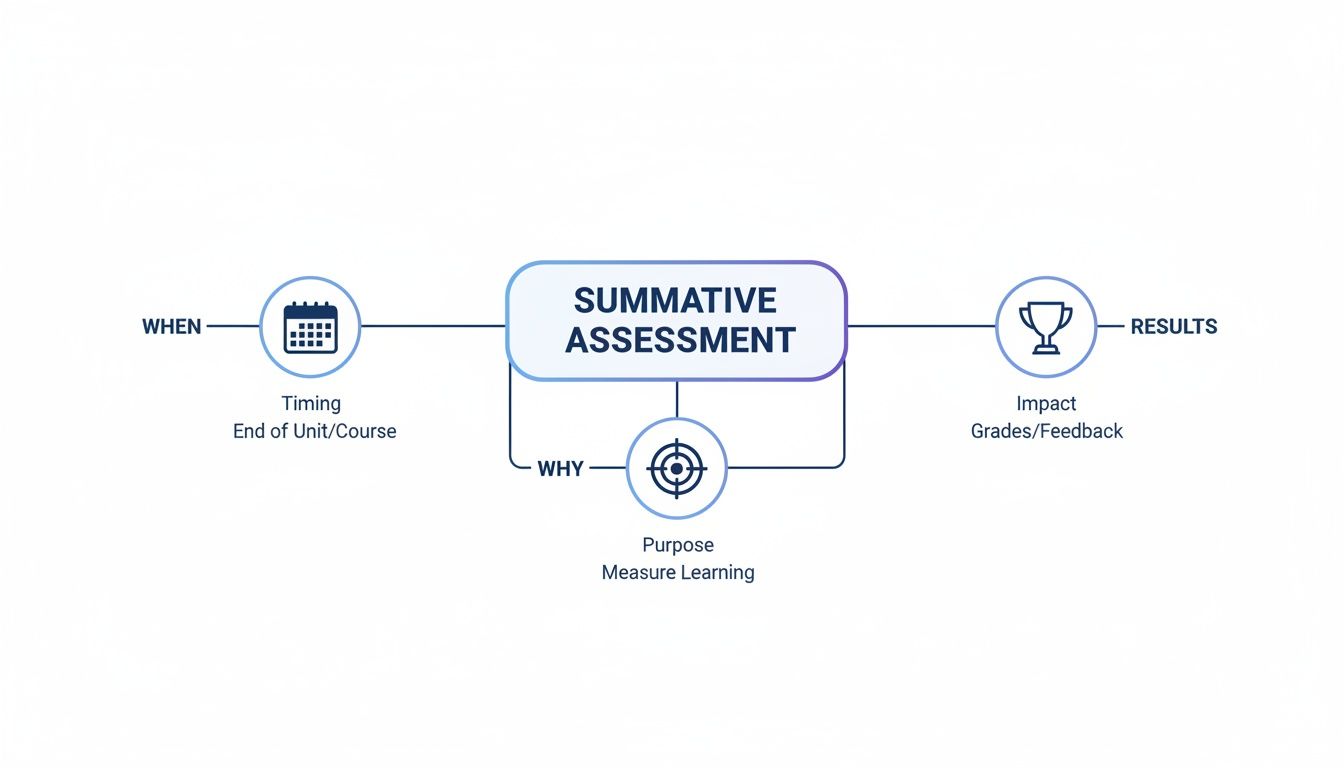
As you can see, summative assessments are intentionally designed to evaluate what students have learned at the very end of an instructional period. This naturally makes them higher-stakes than your quick, daily checks for understanding.
Practice vs. Game Day
Formative assessments are all those crucial, low-stakes training sessions. Think of exit tickets, think-pair-share activities, or even a quick thumbs-up/thumbs-down check. These moments give you immediate feedback you can use to adjust your teaching on the fly. You might realize half the class didn't quite get a concept and decide to reteach it differently tomorrow.
Summative assessments, on the other hand, are the final performance. They happen after the learning is supposed to be complete—things like an end-of-unit exam, a final research paper, or a big capstone project. They aren’t designed to guide your immediate next steps in instruction but to evaluate a student's overall mastery.
A great way to think about it is this: when the chef tastes the soup while cooking, that's formative. When the customer tastes the soup, that's summative. You can't change the recipe once it's already served.
This distinction is so important because you need both types of assessment to work together. All those consistent formative checks are what prepare students for success on their summative evaluations. Every exit ticket and peer review session builds the skills and knowledge needed to ace that final exam. For a deeper look into this, it’s worth understanding the nuances between formative and summative feedback.
Formative vs Summative Assessment Key Differences for the Classroom
Let's break down the practical differences you'll see in your classroom every day. This isn't just theory; it directly impacts how you plan, teach, and grade. The table below lays it all out.
| Aspect | Formative Assessment (Practice) | Summative Assessment (Game Day) |
|---|---|---|
| Purpose | To monitor and improve learning in real-time. | To evaluate and grade student mastery at the end of a unit. |
| Timing | Ongoing and frequent (daily or weekly). | At the end of a unit, semester, or year. |
| Stakes | Low-stakes; often ungraded or for participation. | High-stakes; usually contributes significantly to a final grade. |
| Feedback | Immediate and specific, aimed at guiding next steps. | Delayed and general, summarizing overall performance. |
While both are necessary, finding the right balance is everything. Without all that formative practice, a summative test can feel like an ambush for students. But without a final summative evaluation, it’s hard to know if they truly mastered the standards you worked so hard to teach. Getting this balance right is at the heart of effective instruction.
Common Types of Summative Assessments
When you hear "summative assessment," your mind probably jumps straight to a final exam—rows of desks, No. 2 pencils, the whole scene. While traditional tests definitely have their place, the world of summative assessment is so much broader and more creative than that.
Going beyond a single, high-stakes test gives you a much richer picture of what your students truly know and can do. The key is to pick the right tool for the job, one that actually lines up with the skills you taught.
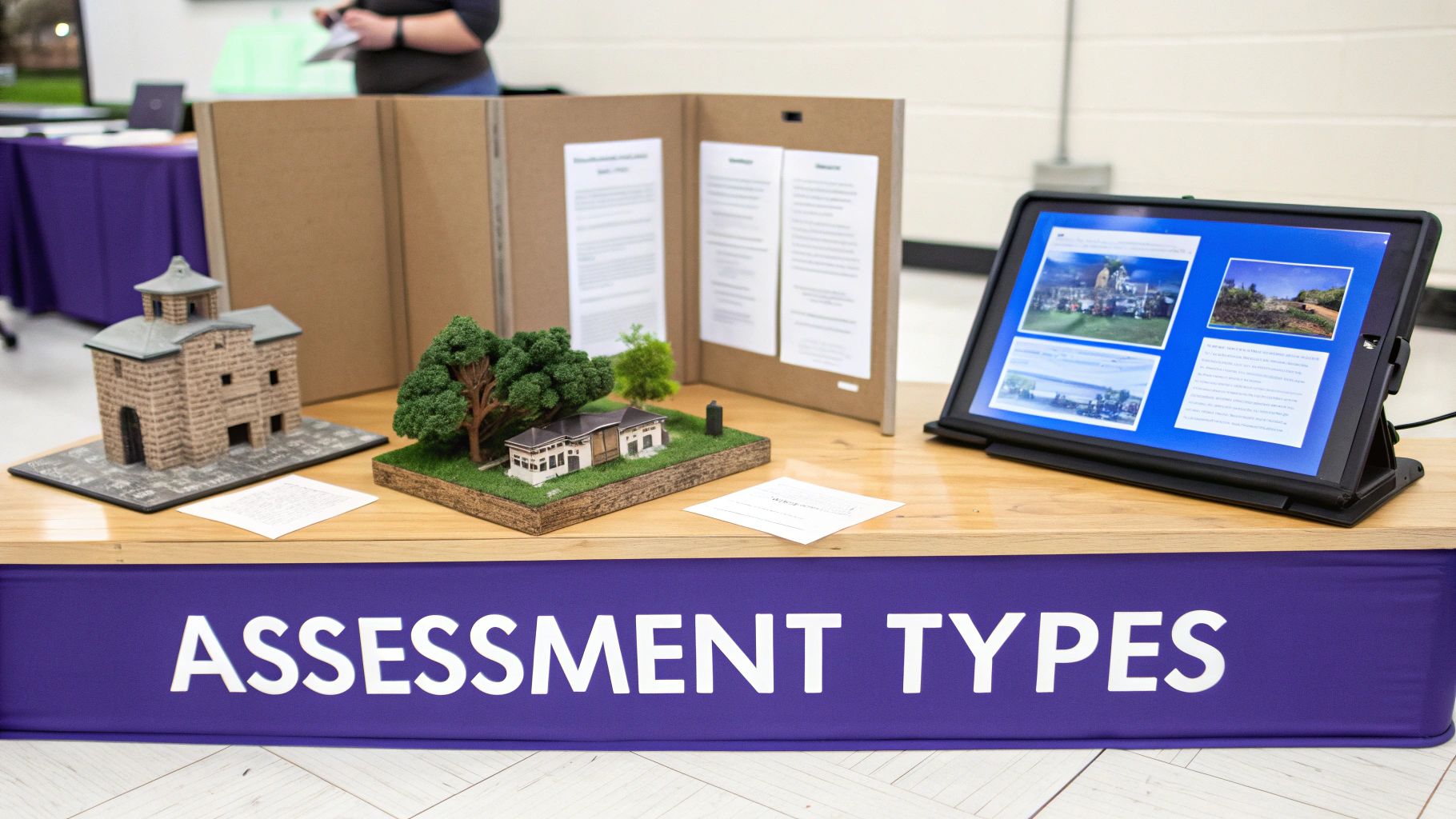
Think of this section as your toolkit. It's packed with practical ideas you can adapt for your own classroom, no matter the grade or subject.
Traditional and Standardized Assessments
Let’s start with the classics. These are often the most efficient way to check for a wide range of content knowledge.
- Final Exams: These big-picture tests cover everything from an entire semester or year, making them great for evaluating cumulative knowledge.
- End-of-Unit Tests: More focused than a final, these check for mastery of a specific chapter or unit. They usually mix multiple-choice, short-answer, and maybe an essay question.
- Standardized Tests: These are the large-scale state or national tests designed to measure how students are doing against a consistent set of standards.
Performance-Based Assessments
This is where things get fun. Performance tasks ask students to do something with their knowledge—to apply it by creating a product or completing a complex task.
For example, instead of a multiple-choice test on the American Revolution, a 5th-grade class could create a short documentary. An 8th-grade science class might design and run an experiment to test a hypothesis, turning in a final lab report. These tasks show you what students can do, not just what they can memorize.
Performance-based assessments shift the focus from recalling information to applying it in a meaningful context. This is where you see learning in action.
Project-Based and Portfolio Assessments
These types of summative assessments are perfect for seeing growth and skills develop over a longer stretch of time.
- Capstone Projects: A multi-faceted project serving as a final academic experience, especially for high schoolers. Think of a senior research paper, a community service initiative, or an engineering design challenge.
- Portfolios: This is a collection of a student's work that shows their progress and best efforts over time. A writing portfolio, for instance, might showcase their best persuasive essay, a narrative story, and poetry from the semester.
- Presentations and Oral Reports: Having students present their findings to the class is a fantastic way to assess both their content knowledge and their communication skills.
Ultimately, choosing the right type of assessment comes down to your learning objectives. A persuasive essay is a perfect summative task for an ELA unit on rhetoric, while a final lab report is the ideal fit for a chemistry unit on chemical reactions. The goal is to match the assessment to the learning so every student gets a chance to show you what they’ve truly mastered.
How to Design Effective Summative Assessments
This is where the art and science of teaching really click into place. Knowing what a summative assessment is? That's the easy part. Building one that actually measures what students have learned—without causing a meltdown for them or you—is a whole different ballgame.
Let's walk through how to get it right.
Start with Clear Learning Objectives
This is the golden rule, no exceptions. Before you even think about writing a question, you have to be crystal clear on what you're trying to measure. Your assessment questions must be a direct reflection of your learning objectives and standards.
If your objective was for students to "analyze the causes of the Civil War," a test packed with simple date-matching questions just isn't going to cut it. Your objectives are the blueprint; every single part of the test should trace right back to them.
Need a refresher? Our guide on how to write objectives for lesson plans can help.
Choose the Right Assessment Format
Once you know your destination (the objectives), you can pick the right vehicle to get there. Different skills demand different kinds of evaluation. You wouldn’t ask a student to write an essay to prove they can solve a quadratic equation, right? It just doesn’t fit.
Think about the best match for your goal:
- For checking factual recall: Multiple-choice, matching, or fill-in-the-blank questions are your friends.
- For gauging critical thinking: Go with essay questions, document-based questions (DBQs), or case studies.
- For demonstrating practical skills: Nothing beats performance tasks, lab reports, or presentations.
- For tracking long-term growth: Portfolios or capstone projects give you that comprehensive view.
Write Clear Instructions and Questions
Ambiguity is the enemy of a fair test. Your instructions should be so simple that there’s absolutely no room for misinterpretation. Be explicit: define the task, specify how to answer, and state the point value for each section.
When it comes to the questions themselves, avoid tricky phrasing or "gotcha" formats. The goal is to see what your students know, not to test their ability to decode your questions.
The best-designed summative assessment allows every student to demonstrate what they know without being hindered by confusing language or unclear expectations. Clarity is fairness.
Design a Transparent Rubric
For anything that isn't a simple multiple-choice question, a rubric isn't just nice to have—it's essential. A solid rubric makes grading objective, consistent, and completely transparent for students. It clearly breaks down what "success" looks like at different levels of performance.
Let's be honest, though: building a detailed, standards-aligned rubric from scratch can take forever. This is where a tool like Kuraplan comes in clutch. Its AI-powered features can help you generate rubrics tied directly to your learning standards in just a few clicks, making your grading fair and fast.
Ensure Fairness and Accessibility
Finally, a truly great summative assessment is one that every student can access. This means providing the necessary accommodations—like extended time, a quieter space, or text-to-speech tools—without lowering the academic bar.
It's all about removing barriers to showing what they know, not removing the challenge itself. Stick to these core principles, and you'll be creating summative assessments that are genuinely effective.
Using Assessment Data to Improve Your Teaching
The real power of a summative assessment isn't just in the final grade—it's in the story the data tells you. When the scores are in, it’s easy to focus on the student side of things. But the most effective teachers I know shift their thinking from, "What did my students get?" to, "What is this data telling me about my teaching?"
Viewing summative results as feedback on your instruction is a game-changer. It transforms the assessment from a final verdict on student learning into a powerful tool for your own professional growth.
Turning Data Into Actionable Insights
Once you have the results, the first step is to look for patterns. Don't just calculate the class average and move on; you have to dig deeper to find the story behind the numbers. A simple item analysis, where you track how many students got each question right or wrong, can be incredibly revealing.
Maybe you discover that 80% of your class struggled with questions related to a specific learning standard. That’s not a student failure—that’s a huge, flashing sign pointing to a potential gap in your curriculum or a lesson that needs a different approach next year.
Summative data is your instructional mirror. It reflects back the strengths and weaknesses of a unit, showing you exactly where your teaching landed and where it might need a tune-up for the next cohort of students.
This process helps you pinpoint common misconceptions that might have slipped past your formative checks during the unit. When you identify these specific hurdles, you can build targeted review activities or even entirely new lessons to address them proactively in the next school year.
Using Data for Reflection and Collaboration
This data-driven reflection isn't a solo activity. Bringing your findings to your Professional Learning Community (PLC) or department meeting can lead to powerful collaboration. When you share that your students stumbled on a particular skill, a colleague might have a strategy or resource that worked wonders in their classroom.
This is also where organized planning becomes critical. Keeping detailed notes on these insights within your lesson plans ensures you don't forget them when you're planning for next semester. For teachers looking to stay organized, a great digital teacher planner can be the perfect place to log these reflections and link them directly to future lessons.
Ultimately, using summative data this way creates a cycle of continuous improvement:
- Analyze: Spot the patterns in student performance.
- Reflect: Ask what these patterns reveal about your instructional methods.
- Collaborate: Share insights with colleagues to find new solutions.
- Refine: Adjust your lesson plans and teaching strategies for the next group of students.
By treating summative assessment data as a diagnostic tool for your own practice, you ensure that every evaluation makes you a more effective and responsive educator.
Common Questions About Summative Assessment
Even with a solid handle on summative assessment, practical questions always come up. Let's tackle some of the most common ones I hear in the staff room with clear, straightforward answers you can use right away.
Can I Use a Summative Assessment Formatively?
You absolutely can. The real difference isn’t the test itself—it’s what you do with the results.
When you analyze an end-of-unit exam to spot concepts the whole class bombed and then circle back to reteach those ideas, you’re using a summative tool for a formative purpose. The focus shifts from just giving a final grade to gathering intel for your next instructional move.
Think of it this way: you're using the "final exam" to scout out weak spots in your curriculum's defense. The goal is no longer just to grade, but to figure out how to strengthen your teaching for the next group of students.
This is a powerful way to refine your practice year after year.
How Many Summative Assessments Should I Give?
There's no magic number here. The right frequency really depends on your subject, grade level, and curriculum map. A good rule of thumb is to have one at the end of each major instructional unit—a logical stopping point in the learning journey.
Here’s what that might look like in practice:
- A history teacher might have one after each historical era covered.
- A math teacher could plan one after each key concept, like fractions or geometry.
- An ELA teacher might design one after each major novel study or writing unit.
The goal is to measure mastery at logical checkpoints without burning students out with test fatigue. For educators navigating big curriculum updates, like those in New Zealand, understanding what the new NCEA changes mean can also shape how you schedule these tasks.
What Is the Best Way to Prepare Students for a Test?
The best prep isn't a last-minute cram session. It's the consistent, high-quality formative assessment you weave throughout the entire unit.
Those small, daily checks for understanding—like exit tickets, quick quizzes, and class discussions—are what build a solid foundation. They let you catch misunderstandings early, before they snowball into major learning gaps.
Also, always give students a clear study guide and share the rubric ahead of time. When students know exactly what’s expected and how they’ll be evaluated, their anxiety goes down, and their performance almost always goes up. It’s about building confidence, not just knowledge.
Ready to design standards-aligned summative assessments without spending hours on paperwork? Kuraplan is an AI-powered platform that helps you create lesson plans, rubrics, and engaging activities in minutes, so you can focus on what matters most—your students. Explore how it works at https://kuraplan.com.