You assign a book report, and the room tells you exactly how everyone feels. Students groan because they think it means retelling the whole story. Teachers groan because they picture weak summaries, copied blurbs, and a weekend spent writing the same comment over and over.
I still use book reports in 5th grade because, when the format is tight, they become one of the clearest ways to see whether a student can read closely, organize thinking, and write with purpose. A strong report asks for more than plot recall. It asks students to explain what mattered, why it mattered, and whether the book is worth someone else's time.
That shift changes everything. The assignment stops being “tell me what happened” and becomes “show me how you understood the book.”
Reimagining the 5th Grade Book Report
The old version of the book report fails for a simple reason. It's too loose. If students only hear “write a report about your book,” many of them either summarize every chapter or jump straight to “I liked it because it was good.” Neither response shows much thinking.
A better 5th grade book report format gives students boundaries. Those boundaries don't limit good writing. They rescue it. When students know what belongs in each part, they spend less energy guessing and more energy analyzing character choices, theme, and the author's message.
I've seen the difference in conference notes and rough drafts. The student who usually rambles often does better with a predictable structure. The student who writes very little usually does better when each paragraph has one clear job. Even strong readers benefit, because the assignment pushes them past surface-level reactions.
A book report works best when it measures reading comprehension and writing decisions at the same time.
That's why I treat it like a capstone literacy task. It pulls together several things 5th graders should already be practicing:
- Reading for meaning: noticing theme, setting, character change, and key plot events
- Summarizing with control: choosing what matters and leaving out what doesn't
- Writing in paragraphs: keeping one main idea in each paragraph
- Supporting opinions: explaining reactions instead of tossing in a quick “I liked it”
Students also need to know that a book report isn't a book commercial and it isn't a chapter-by-chapter recap. It sits in the middle. It gives enough information for the reader to understand the book, then moves into analysis and judgment.
When teachers frame it that way, the assignment becomes easier to teach and much easier to grade fairly.
The Anatomy of a Perfect 5th Grade Book Report
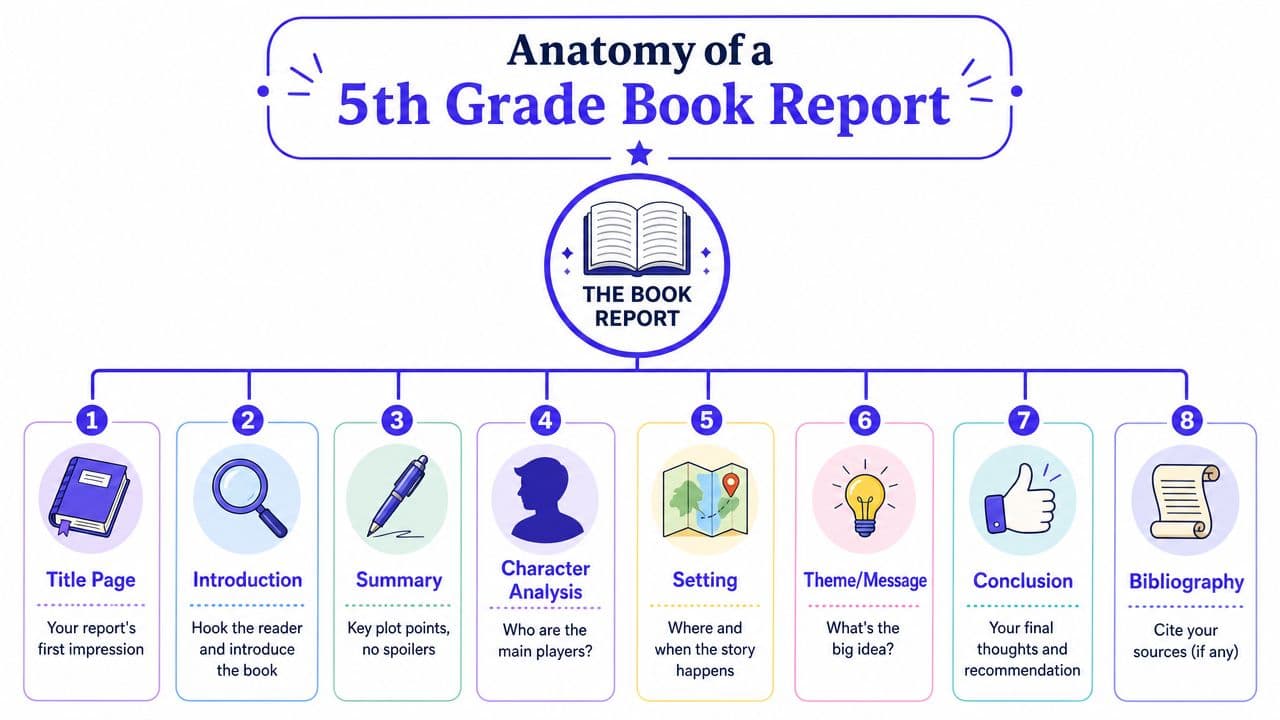
The fastest way to improve book reports is to make the format mandatory. Students often write better when they don't have to invent the structure themselves. According to the Selwyn School summer reading format for grades 5 and 6, the main body should contain exactly three to four paragraphs, each focused on one distinct idea, with an introduction of two to three sentences and a conclusion of exactly two sentences.
Start with the cover page
Many teachers skip this step, but it helps students practice academic presentation. In the Selwyn format, the cover page includes title, author, genre, publisher, copyright year, date, and the student's name. That small routine teaches students that writing assignments have formal parts.
If the report is typed, the same source calls for 12-point font, examples like Calibri, Arial, or Times New Roman, and double spacing. I like clear formatting rules because they remove arguments about what “looks done.”
Keep the introduction short
A 5th grader's introduction doesn't need a dramatic hook and three layers of context. It needs a clean start. Two to three sentences is enough to name the book, author, and overall focus.
A useful formula is simple:
- Sentence 1: State the title and author.
- Sentence 2: Name the genre or basic setup.
- Sentence 3: Give the report's focus or overall reaction, if needed.
Students who write better with sentence frames often succeed with that pattern.
Build the body with one idea per paragraph
This is the heart of the 5th grade book report format. The body should not be one giant summary block. It should be divided so each paragraph has a clear purpose.
Here's a structure that works well in class:
| Paragraph | Job | What to watch for |
|---|---|---|
| Body 1 | Summary of the book | Only major events, no side trails |
| Body 2 | Character or setting analysis | Stay focused on one main idea |
| Body 3 | Theme or message | Explain, don't just name it |
| Body 4 | Opinion and recommendation | Give reasons, not just a rating |
Some students only need three body paragraphs. Stronger writers can handle four without wandering.
Practical rule: If a student can't tell you the paragraph's job in one sentence, the paragraph is probably doing too much.
End with a tight conclusion
Students love to keep writing long after the useful part is over. A strict ending solves that. In the Selwyn model, the conclusion is exactly two sentences. That forces students to summarize their final judgment and state whether they recommend the book.
This is one of those cases where a hard limit helps.
Teach structure as a writing support
The format is not busywork. It's scaffolding. If you already teach short response writing, the RACE writing strategy guide from Kuraplan pairs nicely with book reports because it helps students state ideas clearly and support them with details from the text.
The students who struggle most are usually not short on opinions. They're short on organization. A strong format fixes that first.
Guiding Students Through Each Written Section
Once students have the skeleton, they need help filling it with real thinking. At this stage, many assignments fall apart. “Write a summary” sounds clear to an adult, but to a 10-year-old it can mean anything from one sentence to the whole plot.
The FHG Anchor 5th grade book report guidelines make the expectation much clearer. The summary must include theme, setting, characters, and plot, and students should not reveal the ending.
Teach the summary paragraph with a checklist
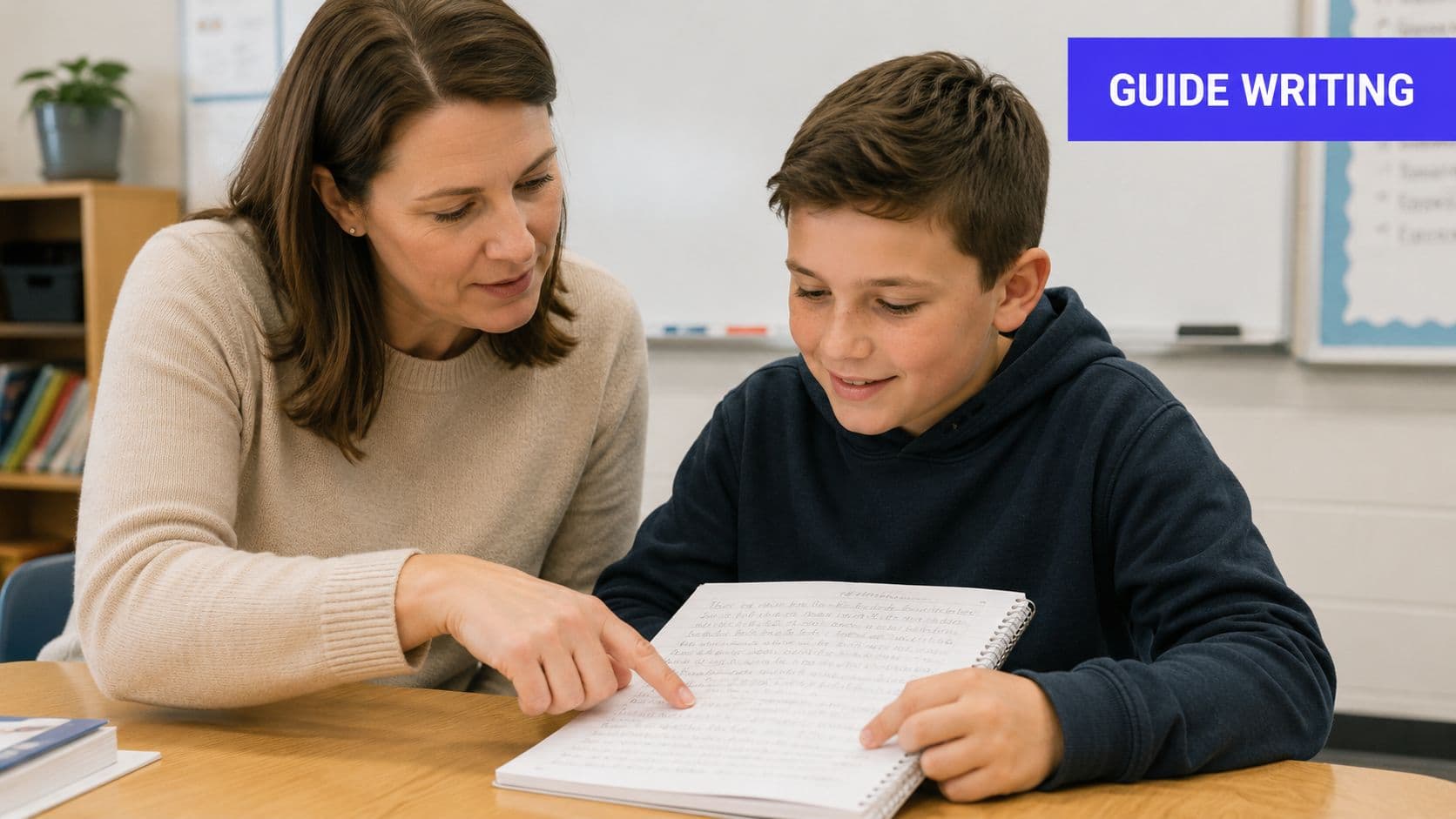
I don't ask students to “summarize the book.” I ask them to prove they included four things. That changes the quality fast.
Use a checklist like this:
- Theme: What big idea is the story exploring?
- Setting: Where and when does the story happen?
- Characters: Who matters most in the story?
- Plot: What major events move the story forward?
Then add the rule that saves many reports: stop before the ending.
Students need direct language here. I tell them, “Your job is to explain the story so a reader understands it, not ruin the final surprise.” That rule also helps them choose only the most important plot points.
Move from listing to explaining
A common 5th grade draft sounds like this: “The setting is a farm. The characters are Wilbur and Charlotte. The theme is friendship.” That's technically correct, but it isn't much writing.
Push students one step further with sentence stems:
- The story takes place in ___, which matters because ___.
- The main character changes when ___.
- One important theme is ___ because the author shows this through ___.
- A major problem in the story is ___, and it leads to ___.
Those stems work especially well in mini-lessons and small groups.
Students don't need fancier words first. They need clearer thinking first.
Use a paragraph-by-paragraph teaching routine
For many classes, the easiest method is to model one paragraph at a time across several days.
Introduction day
Model how to state the title, author, and a quick overview. Keep it short on purpose.Summary day
Build a class paragraph from notes. Stop and ask, “Did we include setting? Did we include theme? Did we spoil the ending?”Analysis day
Choose one idea only. Character motivation works well. Theme works well too. Students often improve when they answer one focused question instead of five loose ones.Opinion day
Require a judgment with reasons. “I recommend this book” is incomplete. “I recommend this book to readers who enjoy survival stories because the suspense stays strong and the characters feel real” is usable.
That pacing also supports classroom habits around revision and reflection. If you're already working on fostering goal setting in children, book reports are a natural place to let students set a writing target such as “I will explain my theme clearly” or “I will avoid retelling every chapter.”
Give students tools they can actually use
Not every student needs a full graphic organizer, but many do. I've had good results with simple boxes labeled:
- introduction
- summary
- character or setting
- theme
- recommendation
- conclusion
If a student struggles with getting started, a guided worksheet helps. A printable set like Kuraplan's 5th grade writing worksheets can be useful because the prompts break writing into manageable chunks instead of handing students a blank page.
The key is not to over-scaffold. If every sentence is prewritten for them, you won't see their thinking. If nothing is scaffolded, you'll spend the whole week reteaching organization.
A Sample Report and Your Printable Template
Students write better when they can see what “finished” looks like. I don't mean a perfect polished essay that sounds like an adult wrote it. I mean a realistic student-friendly model that follows the format and makes sensible choices.
Here's a brief sample built on a familiar upper-elementary title.
A model students can understand
Introduction
Because of Winn-Dixie by Kate DiCamillo is a realistic fiction book about a girl named Opal who finds friendship in a new town. The story shows how people can connect even when they feel lonely.
Body paragraph 1
The story takes place in Naomi, Florida. Opal meets a stray dog named Winn-Dixie, and the dog helps her meet new people in the community. As the story continues, Opal learns more about others and begins to understand her father better.
Body paragraph 2
Opal is an interesting character because she is open-hearted and curious. She asks questions, notices what other people need, and keeps trying to make connections even when life feels hard.
Body paragraph 3
One important theme is friendship. The author shows that friendship can grow in unexpected places and can help people feel less alone.
Body paragraph 4
I recommend this book because the characters are memorable and the story feels warm without being boring. Readers who like realistic stories with strong emotions would probably enjoy it.
Conclusion
This book is thoughtful and easy to care about. I would recommend it to students who enjoy character-centered stories.
A short model like that does two things well. It shows restraint, and it shows structure. Students can see that they don't need to retell every scene to write a complete report.
A quick video model can help too, especially for students who need another format before drafting.
A printable template you can hand out tomorrow
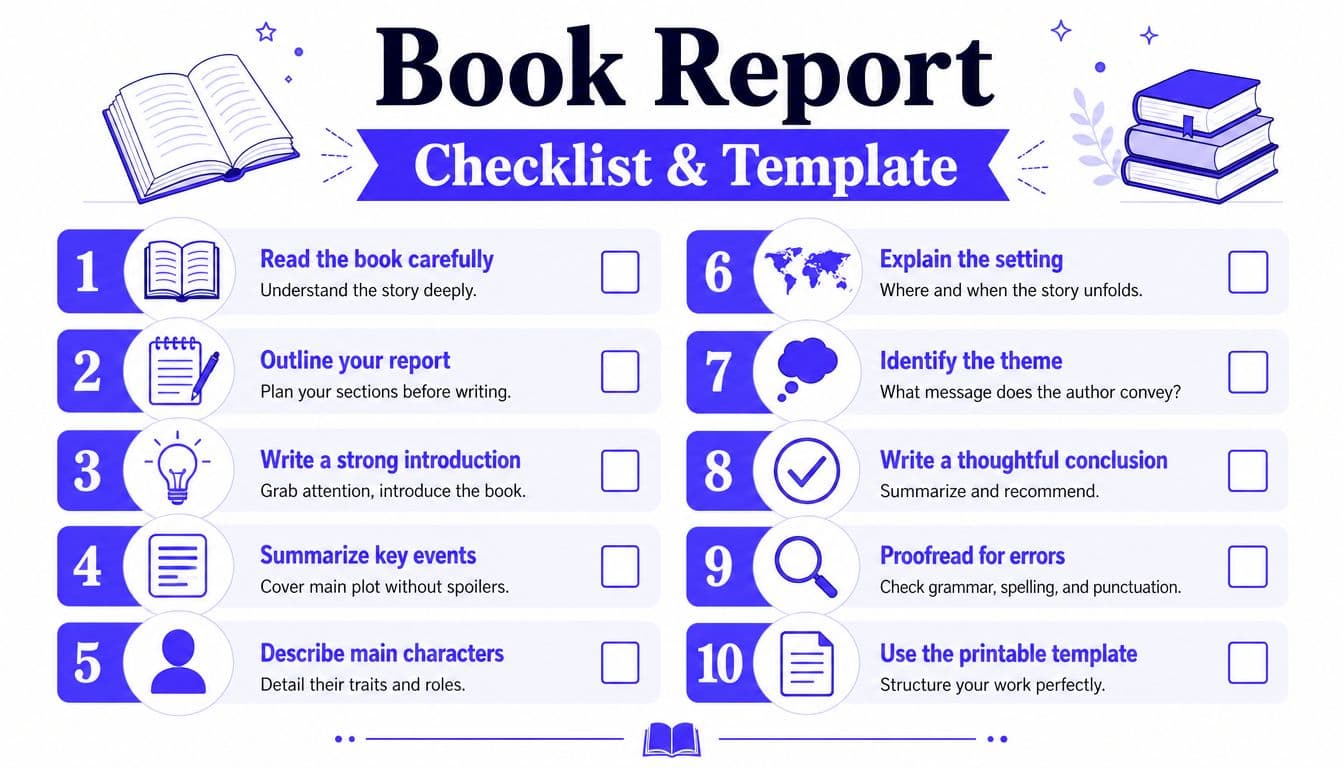
You can copy this directly into a doc or learning platform:
| Section | Student prompt |
|---|---|
| Cover Page | Title, author, genre, publisher, copyright year, date, your name |
| Introduction | Write two to three sentences. Name the book and author. Introduce the story. |
| Summary Paragraph | Explain the setting, characters, plot, and theme. Do not tell the ending. |
| Analysis Paragraph | Choose one part to explain more deeply, such as a character, the setting, or a conflict. |
| Theme Paragraph | What is the big message of the book? How does the author show it? |
| Opinion Paragraph | Do you recommend this book? Why or why not? Give real reasons. |
| Conclusion | Write exactly two sentences. Summarize your opinion and recommendation. |
Keep the sample visible while students draft. A model on the board prevents half your “What do I do next?” questions.
Grading with Clarity and Differentiating for All Learners
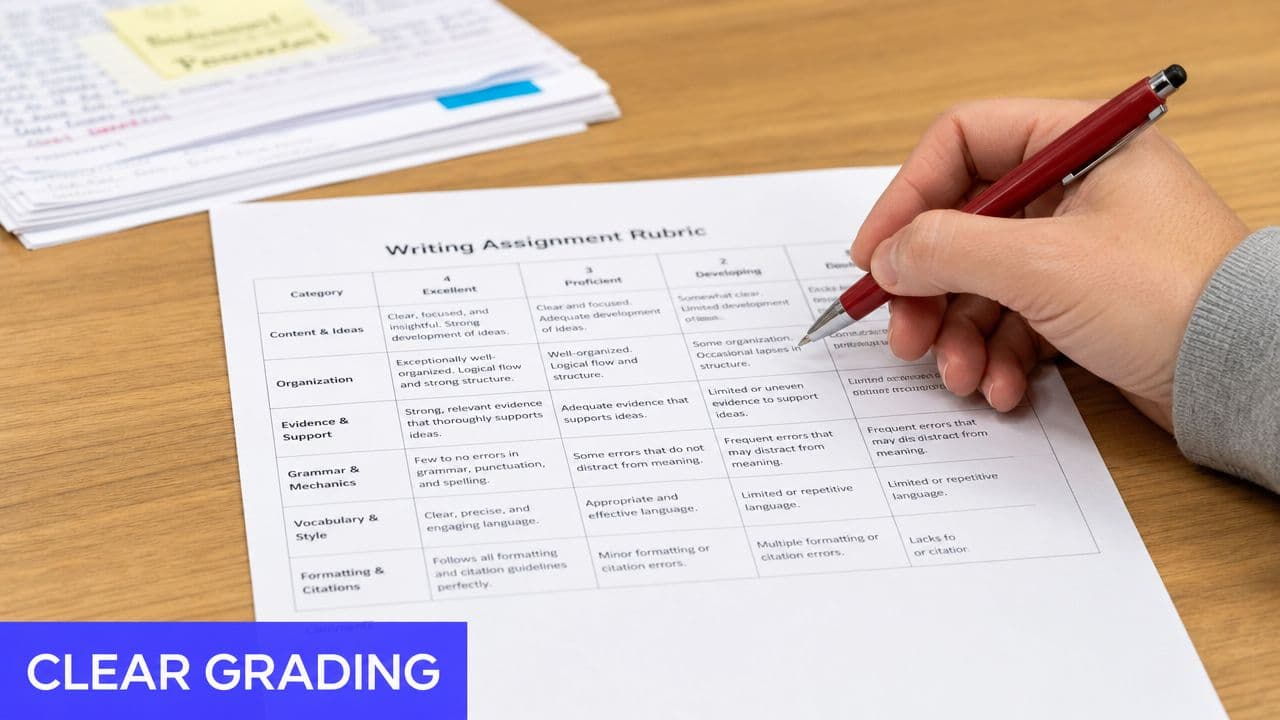
If the directions are clear but the rubric is fuzzy, students still feel like they're guessing. A good rubric doesn't just speed up grading. It tells students what counts before they write.
That matters even more with book reports because this assignment pulls together multiple skills. Students are reading, summarizing, analyzing, organizing, and editing at the same time. If those pieces aren't separated in your rubric, feedback becomes too vague to be useful.
What a practical rubric should measure
I prefer a rubric with a small number of categories students can understand quickly. Something like this works well:
- Format and completeness: Did the student include all required sections and follow the assigned structure?
- Summary quality: Did the student explain the important parts of the book clearly?
- Analysis and thinking: Did the student move beyond retelling and explain ideas like theme or character change?
- Opinion and support: Did the student give reasons for the recommendation?
- Conventions: Is the writing readable, edited, and properly organized?
That's enough to grade with consistency, and it gives students a clear revision target.
If you want language for traits like organization, ideas, and voice, resources built to elevate your writing can be helpful when you're refining rubric wording for older elementary writers.
Fiction and nonfiction should not use the same lens
This is one of the biggest mistakes I see. Teachers use one generic format for every book, then wonder why nonfiction reports feel awkward. The Raise the Bar Reading guide on nonfiction book reports points out that nonfiction needs a different approach, including text structure, author's point of view, and evidence-based summarization.
That's exactly right. A student reading a biography or science text should not be pushed into pretending the book has a plot arc like a novel.
For nonfiction, I adjust the categories:
| If the student read fiction | If the student read nonfiction |
|---|---|
| Character | Main idea |
| Setting | Text features |
| Plot | Key facts or sections |
| Theme | Author's purpose or point of view |
| Recommendation | What the reader learned and who would benefit from reading it |
This small change saves a lot of confusion.
A fair assignment doesn't make every student produce the same paper. It gives each student a matched path to show understanding.
Differentiation is not optional
Some students can handle the full formal report with no support. Others need sentence frames, oral rehearsal, a graphic organizer, or a reduced writing load to show what they know accurately. That isn't lowering expectations. It's removing barriers that have nothing to do with reading comprehension.
Helpful adjustments include:
- For ELL students: word banks, model paragraphs, and oral planning before drafting
- For students with ADHD or executive function needs: chunked deadlines, checklists, and one paragraph at a time
- For students with dyslexia or writing challenges: speech-to-text, teacher scribing during planning, or an audio response paired with short written sections
- For reluctant writers: a guided template with prompts instead of a blank page
When I want to build a rubric quickly without losing clarity, a tool like Kuraplan's rubric generator can save planning time, especially if you're trying to create different versions for fiction, nonfiction, and supported writing formats.
The point is simple. If students are doing different kinds of reading and have different access needs, the assignment should reflect that.
Bringing the Book Report to Life in Your Classroom
The strongest book report units don't begin with drafting. They begin with thinking made visible. A step-by-step methodology described by Studybay outlines four phases: creating a visual story map, drafting an outline, writing the rough draft, and proofreading with peer review. That structured process is linked there to a 40% increase in A-grade attainment compared with unstructured attempts.
That sequence lines up with what many teachers already know from experience. Students write better when they sort their ideas before drafting, and they revise better when another reader reacts before the final copy is due.
Here's how I'd use that workflow in class:
- Story map first: Students sketch the author, characters, major events, and central ideas before they write a sentence.
- Outline next: They sort notes into the report structure so each paragraph has a job.
- Rough draft after that: They write without worrying about perfection on the first pass.
- Peer review last: A partner checks for missing parts, spoilers, and weak explanations.
Once that routine is in place, the final paper doesn't have to be the only product. Students can use the same analysis to create a book talk, a movie poster with a short critic's review, a character interview, or a visual display centered on theme. Those options keep the academic core intact while giving the project more energy.
That's the version of the book report worth keeping. It's structured, teachable, and flexible enough to work for the students sitting in front of you.
If you want to cut planning time and build cleaner book report lessons, Kuraplan is worth a look. It helps teachers generate standards-aligned lessons, differentiated worksheets, visuals, and rubrics quickly, which makes it easier to turn a solid 5th grade book report format into a full classroom-ready unit.