An arts-integrated lesson can produce measurable academic gains, but only when the connection between the art form and the subject is deliberate. A Wallace Foundation evidence review synthesized 27 studies and found that arts integration moved the average student from the 50th to the 54th percentile, an average gain of four percentile points, with stronger results often appearing in reading, English language arts, science, and social studies than in math (Wallace Foundation review). The evidence supports arts integration, but it also points to a planning truth: an effective lesson isn't two unrelated activities placed side by side.
The strongest arts integration lesson plans use an artistic process to make a disciplinary concept more visible, memorable, or discussable. Rhythm can make fractions concrete. Movement can give historical change a physical shape. Drama can turn literary subtext into an observable choice.
The eight classroom-ready models below move from early literacy and observation to fractions, history, geometry, performance, and physics. Each one identifies the cross-curricular connection, implementation sequence, preparation, differentiation choices, standards-alignment points, and assessment evidence a teacher needs before adapting the lesson. Kuraplan can help map objectives to standards, generate differentiated resources, build rubrics, and turn a promising concept into a usable sequence.
1. Elementary Music and Math Rhythm Patterns and Fractions
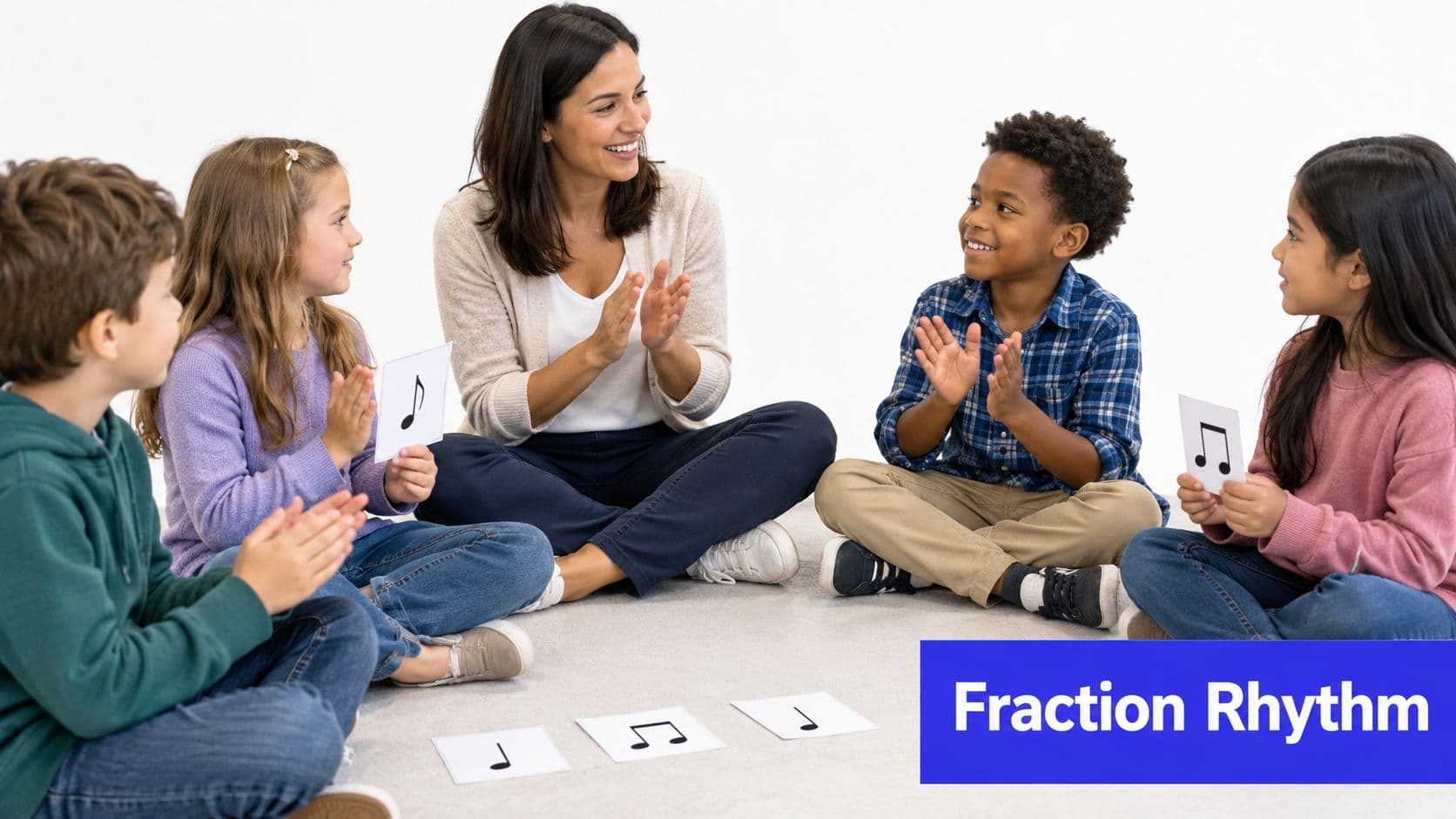
Third graders can hear and feel fractions before they're ready to explain every symbol abstractly. In this lesson, whole, half, quarter, and eighth notes become fractional parts of a measure. Students manipulate rhythm cards, compare values, and compose a pattern that adds up correctly.
The mathematical objective is to represent and compare fractional values. The music objective is to read, create, and perform a simple rhythmic pattern. Verify the exact math and music standards for your local curriculum, then make the success criteria visible: students should show the fraction equivalence, perform the rhythm accurately, and explain how the two systems connect.
Plan for 50 to 60 minutes. Begin by activating prior knowledge about fractions, then introduce a visual chart pairing notation with fraction values. Students manipulate rhythm cards, clap combinations, compose, rehearse, perform, and reflect. Use chart paper, pencils, rhythm cards, and optional percussion instruments.
Practical rule: Start with body percussion. Clapping and snapping keep attention on duration before instruments add a second technical challenge.
A tiered task works well. Some students can build patterns from preselected cards, while others can compose freely within a whole-note constraint. Keep an anchor chart visible, and let students record their rhythms on video as a portfolio artifact and visual support.
Assess fraction accuracy, rhythmic accuracy, explanation, and collaboration separately. A student who performs confidently but can't justify the fractional total hasn't yet met the math objective. Kuraplan can generate aligned fraction worksheets, notation practice, differentiated composition prompts, and a performance rubric. Teachers can also pair the lesson with this complete guide to meter in music and use the third-grade fractions worksheet to prepare independent practice.
2. Middle School Visual Art and Social Studies Identity Portraits
A strong identity portrait asks students to defend its meaning. Sixth graders examine artists who address identity, culture, and representation, then research a social studies question before creating mixed-media portraits with symbols, text, and images. The artwork becomes evidence of thinking, not only a display piece.
Set the objectives before materials are distributed. In visual arts, students communicate through composition, media, and symbolism. In social studies, they examine perspective, representation, bias, and diversity through respectful, evidence-based discussion. Check local standards, particularly those connected to cultural understanding and interpreting evidence.
Plan for two to three class periods. Begin with exemplar analysis and focused artist research. Students then sketch, produce the portrait, participate in a gallery discussion, and write or record a reflection explaining how specific choices communicate meaning. Prepare portrait references, paper, drawing tools, collage materials, paint or digital alternatives, and a research template. Kuraplan can streamline the research organizer, prompt sequence, and differentiated reflection tasks.
Cultural care shapes the assignment from the start. Do not ask students to imitate or claim an identity that is not their own. Establish discussion norms, offer artists from multiple continents and time periods, and frame cultural study as inquiry rather than performance. A student might represent personal identity, a researched idea, or a broad theme such as belonging.
Build choice into the process:
- Subject: Personal identity, researched ideas, or shared themes.
- Response: Sentence starters, private reflection, oral explanation, or written critique.
- Medium: Drawing, collage, paint, or digital composition.
Assess research, symbolism, craftsmanship, explanation, and respectful discussion as separate evidence. The California Arts Framework emphasizes assessing learning in both the arts and the connected content area. Kuraplan can also prepare culturally responsive prompts, critique questions at different reading levels, and a rubric aligned with both domains. Adjust the research load or offer audio responses when language, processing, or fine-motor needs would otherwise obscure students' understanding.
3. High School English and Performance Shakespeare Scenes
Shakespeare becomes more accessible when students have to make an interpretation visible. In a ninth- or tenth-grade classroom, small groups select a scene, annotate character motivation and subtext, choose a staging approach, rehearse, perform, and defend their decisions with textual evidence.
The English objectives are close reading, character analysis, evidence-based interpretation, collaboration, and oral presentation. Check the standards for the selected play and jurisdiction, then require students to mark the exact words, pauses, gestures, and spatial choices that support their reading.
A two- to three-class sequence is practical. Students annotate first, plan blocking second, rehearse before performing, receive peer feedback, and write a reflection afterward. Scripts, annotation tools, a character-analysis organizer, simple props, and recording equipment are enough. Expensive costumes often distract from the literary work.
Use role choice as a differentiation tool. A student may perform, direct, narrate, operate a recording, or co-perform. Recorded video can replace live performance, and scaffolded excerpts can preserve the analytical demand without overwhelming students with an entire scene.
The performance is evidence of interpretation, not a contest in theatrical confidence.
A strong rubric keeps the domains distinct. Score textual evidence, interpretive choices, delivery, collaboration, and reflection separately. Have students submit annotated scripts so a polished performance doesn't conceal weak analysis. Kuraplan can generate close-reading guides, character worksheets, performance prompts, and text-specific rubrics. For a ready-made starting point, adapt the scene script draft worksheet.
Teachers using performance-based units often report stronger engagement from reluctant readers because the performance gives complex reading a concrete purpose. That observation matters, but the assessment must still reward what students understand about the text, not just how confidently they perform.
4. Primary Science and Visual Art Nature Observation Journals
Nature journals work because young children have something real to observe, name, draw, and revisit. First and second graders can track a plant, weather pattern, insect, or outdoor space across several weeks, combining scientific sketches, labels, simple sentences, and watercolor illustrations.
This should be a multi-session sequence, not a one-day craft. The objectives include observing detail, using scientific vocabulary, labeling parts, constructing sentences, representing visual information, and revising ideas over time. Verify the relevant early science, language arts, and visual arts standards before selecting the observation subject.
Schedule 20 to 30 minute observation sessions repeatedly across several weeks. Model how to look closely, write only what can be observed, and distinguish an observation from a guess. Students need journals, pencils, clipboards, watercolor supplies, and weather-appropriate alternatives such as indoor specimens, photographs, or classroom plants.
Young writers need structure without losing ownership. Use sentence frames, vocabulary banks, and prompts such as “Count how many legs you see,” “Describe the texture,” and “What colors did you notice?” Students who can't yet write independently can dictate to a partner, record an oral response, or label a drawing while the teacher captures language.
- Journal checkpoints: Review detail, labels, vocabulary, and changes from one entry to the next.
- Simple rubric: Assess observable detail, scientific language, labeling, and revision over time.
- Flexible format: Keep the page structure consistent, but allow students to choose drawing, watercolor, collage, or oral explanation.
Kuraplan can generate seasonal observation prompts, sentence frames, vocabulary lists, and printable pages adapted to a local ecosystem and grade-level standards. The repeated format also gives teachers a practical record of growth. Students aren't only producing attractive pages. They're learning how scientists document change.
5. Upper Elementary Social Studies and Dance Movement Through History
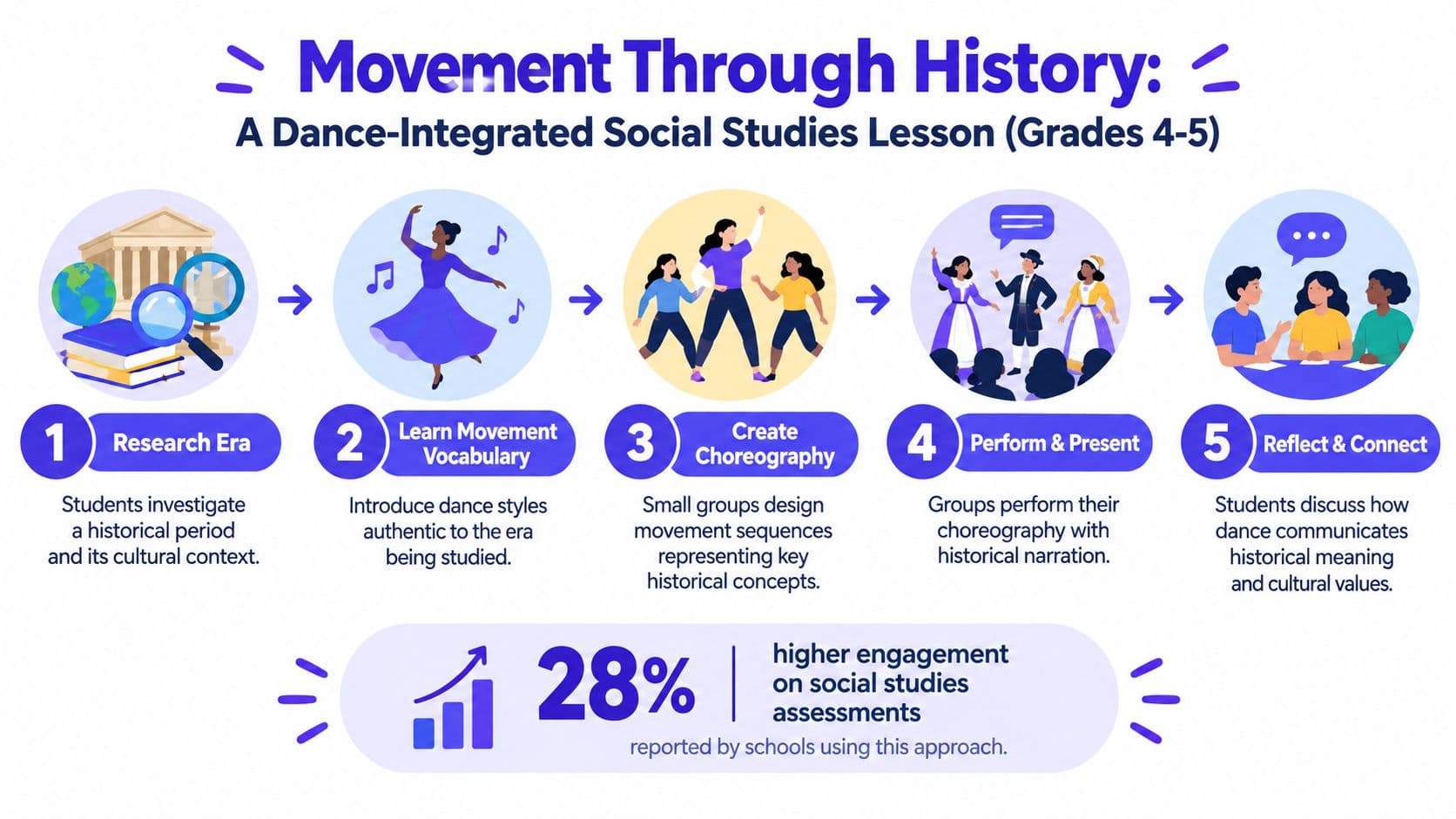
Historical movement can make chronology and cultural expression more tangible, but it must be handled with accuracy and care. Fourth and fifth graders research an era or event, study movement vocabulary connected to the context, and create group choreography that communicates selected historical moments.
The academic objectives are research, chronology, interpretation, and explanation. The arts objectives are movement composition, spatial awareness, collaboration, and communication. Confirm the local standards, and distinguish authentic cultural forms from a student-created response inspired by historical ideas. Students shouldn't reduce a living tradition to a costume or a few borrowed gestures.
Use two to three class periods. Begin with source analysis and movement exploration, move to individual experimentation, then form groups for choreography, rehearsal, contextual presentation, and reflection. Prepare research sources, movement-vocabulary charts, an open space, appropriate music, and storyboard or simple notation sheets.
A student who can't or doesn't want to perform still needs a meaningful role. Offer researcher, narrator, choreographer, music selector, storyboard artist, or accessibility coordinator positions. Seated movement and gesture-based compositions can meet the same communication objective.
Assessment should reward historical explanation and artistic communication, not performance polish alone.
Require each group to explain which source supports each movement choice and which part of the sequence represents chronology, conflict, change, or continuity. Kuraplan can streamline research guides, vocabulary lists, choreography-planning sheets, and integrated rubrics. Video examples of authentic dance forms can support analysis, but preview them carefully and give students historical context rather than presenting them as interchangeable samples.
The lesson works best when movement is treated as an interpretive language. It doesn't replace reading or writing about history. It gives students another way to test whether they understand the evidence.
6. Middle School Mathematics and Visual Art Geometry Through Islamic Pattern Design
Islamic geometric patterns offer a demanding mathematics context because students must see structure beneath visual complexity. Seventh and eighth graders analyze symmetry, tessellation, angles, and rotations in authentic pattern references, then design and annotate an original pattern.
The lesson has two equally important products: the design and the mathematical rationale. Students should classify symmetry, calculate angles and rotations, explain tessellation, and justify design decisions. Verify local geometry and visual arts standards, especially those addressing transformations, construction, and cultural study.
Plan for two to three class periods. Students analyze exemplars, annotate mathematical features, experiment on grid paper or with digital tools, construct a pattern, and explain the mathematics. Provide high-resolution references, grid paper, rulers, protractors, colored pencils, and optional tools such as GeoGebra or Spirograph applications.
Rote copying is the main risk. Require an annotated design rationale and ask students to identify where a shape repeats, how a rotation operates, and why the pattern can continue. Scaffolded templates help students who need a lower entry point, while extension tasks can ask others to compare transformation strategies or create a more complex tessellation.
- Accuracy: Check angle calculations, symmetry, repetition, and construction.
- Reasoning: Require written or recorded explanations for mathematical choices.
- Communication: Assess how clearly the design and annotations convey the underlying geometry.
Kuraplan can generate angle problems, pattern-analysis worksheets, differentiated geometry tasks, and a combined math-and-art rubric. Use cultural context respectfully, focusing on close observation and mathematical analysis rather than treating Islamic design as decorative material detached from its traditions.
A visually striking final product isn't enough. If students can't explain the transformations that produced it, the lesson has assessed craft more than geometry.
7. High School Science and Music Sound Waves Through Instrument Building
Instrument building turns sound into a design problem. Tenth and eleventh graders investigate frequency, pitch, resonance, and acoustics while constructing string, wind, or percussion instruments from reclaimed materials. They then test how design changes affect sound and communicate evidence through a demonstration or performance.
The science objectives are to model sound, form hypotheses, iterate designs, collect data, interpret measurements, and communicate evidence. Engineering objectives include defining constraints, prototyping, testing, and revising. Confirm the local physics and engineering standards, and make safety guidance explicit before students handle tools or construction materials.
Allow three to five class periods for the full sequence: introduce a sound phenomenon, issue a design brief, build a prototype, test, revise, analyze data, and present. Prepare reclaimed materials, safe tools, design templates, measurement equipment or frequency-analysis applications, data tables, and lab-report supports.
Sound quality should not dominate the evaluation. A quiet instrument may still demonstrate strong scientific reasoning if students explain its limitations, test conditions, and revisions.
- Design constraints: Offer choices involving material, size, instrument family, or construction method.
- Team roles: Assign builder, safety lead, data manager, tester, and presenter roles, with rotation where practical.
- Data access: Provide tables, sample graphs, alternative measurement methods, and an option to present through a report, video, or demonstration.
Require a hypothesis before building and measurements after testing. Free spectral-analysis apps can help students ground observations in frequency data, but the app should support reasoning rather than become the lesson. Kuraplan can generate experimental design templates, data-collection sheets, lab-report scaffolds, engineering prompts, and integrated assessment rubrics.
Assess scientific reasoning, design iteration, data quality, explanation, and collaboration. A successful arts integration lesson here doesn't ask students to decorate a science project. It asks them to use musical design to investigate a physical system.
8. Primary Language Arts and Visual Art Digital Storytelling With Illustration
A child's own story creates a powerful reason to reread. Kindergarten and first-grade students dictate or write a simple narrative, illustrate it with drawing or collage, assemble the pages into a digital or printable book, and share it with classmates or families.
The language objectives include oral language, narrative sequencing, vocabulary, emergent writing, and repeated reading. The visual arts objective is to create images that add meaning to the text. Check the local early-literacy framework, then define evidence beyond handwriting. A student who dictates a coherent story and creates a purposeful illustration is demonstrating important literacy learning.
Use two to three class periods. Students orally rehearse, dictate or draft, illustrate, sequence pages, assemble the book, share, and reread. Prepare story-planning sheets, drawing or collage supplies, recording tools, and a simple digital or printable book template.
Record dictation verbatim rather than correcting grammar in the moment. That preserves the child's voice and makes the finished book genuinely theirs. Students can use invented spelling, speech-to-text, picture sequencing, sentence frames, partner storytelling, or a classroom role focused on digital assembly.
The illustration should add information, emotion, setting, or action. It shouldn't be treated as a reward placed beside the writing.
Assess story structure, message clarity, vocabulary, illustration-to-text connection, and participation. Repeated reading with a self-created book gives students an authentic audience and a reason to notice words they want to recognize again. Kuraplan can generate vocabulary lists, story maps, phonics extensions, sentence frames, and practice materials connected to the student-created books. The worksheet illustration generator can help prepare supporting visual materials without making digital assembly the center of the lesson.
Keep the technology simple. Book Creator or Canva may work well, but a printed class anthology meets the same instructional purpose when devices, access, or setup time are limited.
8-Project Comparison: Arts-Integrated Lesson Plans
| Lesson (Grade) | Implementation Complexity 🔄 | Resources & Time ⚡ | Expected Outcomes 📊⭐ | Ideal Use Cases 💡 | Key Advantages ⭐ |
|---|---|---|---|---|---|
| Elementary Music & Math: Rhythm Patterns and Fractions (Grade 3) | Moderate 🔄, needs basic music prep and fraction alignment | Low–Moderate ⚡, rhythm cards, chart paper, optional percussion; 50–60 minutes | Concrete fraction understanding; increased engagement (example: 18% improvement) 📊⭐⭐ | Introducing fractions with kinesthetic learners; cross-curricular starter lessons 💡 | Makes fractions concrete, natural differentiation, memorable connections ⭐ |
| Middle School Visual Art & Social Studies: Identity Portraits (Grade 6) | Moderate–High 🔄, research, cultural sensitivity, mixed-media facilitation | Moderate ⚡, collage/paint supplies, research templates; 2–3 class sequence | Improved cultural competency and representation understanding 📊⭐⭐ | Units on identity, bias, empathy-building; arts-integrated inquiry 💡 | Builds empathy, produces meaningful artifacts, choice-based differentiation ⭐ |
| High School English & Performance: Shakespeare Scenes (Grades 9–10) | Moderate 🔄, close-reading scaffolds and staging coordination | Moderate ⚡, scripts, rehearsal space, recording tools; 2–3 classes | Stronger text comprehension and oral skills (example: 22% improvement) 📊⭐⭐ | Complex texts requiring embodied interpretation; performance assessments 💡 | Deepens textual analysis, boosts engagement, supports reluctant readers ⭐ |
| Primary Science & Visual Art: Nature Observation Journals (Grades 1–2) | Low–Moderate 🔄, recurring sessions and teacher modeling | Low ⚡, journals, clipboards, watercolor; repeated 20–30 min observations over weeks | Better observation skills and vocabulary retention (example: 31% improvement) 📊⭐⭐ | Early inquiry-based science, portfolio development, outdoor learning 💡 | Strengthens observation, fine motor control, family-sharable artifacts ⭐ |
| Upper Elementary Social Studies & Dance: Movement Through History (Grades 4–5) | Moderate 🔄, choreography facilitation and historical accuracy checks | Moderate ⚡, open space, music, movement charts; 2–3 class progression | Increased engagement and integration of history with movement (28% reported) 📊⭐⭐ | Kinesthetic history units, cultural expression lessons, collaborative projects 💡 | Embodies historical concepts, builds community, memorable learning experiences ⭐ |
| Middle School Mathematics & Visual Art: Islamic Geometry (Grades 7–8) | Moderate–High 🔄, precision math-art tasks and cultural framing | Moderate ⚡, rulers, protractors, grid/digital tools; 2–3 classes | Improved geometric reasoning and symmetry understanding (24% reported) 📊⭐⭐ | Teaching symmetry, tessellation, culturally sustaining math lessons 💡 | Visualizes abstract geometry, honors non-Western math traditions, gallery-worthy outcomes ⭐ |
| High School Science & Music: Instrument Building (Grades 10–11) | High 🔄, engineering design, safety supervision, iterative testing | High ⚡, reclaimed materials, tools, measurement apps; 3–5 class project | Strong physics and engineering skills; measurable gains in acoustics (31% reported) 📊⭐⭐⭐ | Project-based STEM, makerspaces, engineering-integrated music units 💡 | Hands-on physics, iterative design practice, real-world application ⭐⭐⭐ |
| Primary Language Arts & Visual Art: Digital Storytelling (Grades K–1) | Low–Moderate 🔄, storytelling scaffolds plus digital assembly | Low–Moderate ⚡, drawing supplies, recording tools, simple app/template; 2–3 classes | Faster sight-word acquisition and fluency (29% reported); stronger narrative skills 📊⭐⭐ | Emergent literacy, family-sharing artifacts, early narrative development 💡 | Validates emergent writers, highly motivating, adaptable differentiation ⭐ |
Turn One Strong Idea Into a Repeatable Planning System
The strongest arts integration lesson plans share a planning pattern even when the classroom activities look completely different. Start with a genuine connection between an artistic process and a disciplinary objective. Rhythm should clarify fractional equivalence. Performance should clarify character motivation. Pattern design should reveal transformations. Illustration should extend narrative meaning.
Then define the evidence before choosing materials. Ask what students will say, make, perform, label, calculate, annotate, or revise. The California Arts Framework states that students in integrated instruction should learn and be assessed in the arts and the integrated content area, so a single broad participation grade isn't enough (California Arts Framework guidance). Build separate criteria for each domain, then add collaboration or reflection where those skills matter.
Standards alignment should also be operational. Select the most important strands and standards first, list their identifiers, and build a success-criteria checklist around them, as recommended in this arts integration planning handbook. Don't start with an attractive activity and search for a standard afterward. That approach often produces busy work with weak evidence.
Use this adaptation checklist before teaching:
- Grade level: Adjust vocabulary, independence, motor demands, reading load, and abstraction.
- Standards: Verify both arts and non-arts standards in your local curriculum.
- Materials: List what students need, what can be reused, and what can be replaced.
- Time: Break the creative process into launch, practice, production, feedback, revision, and reflection.
- Student choice: Offer meaningful choices in subject, role, medium, or response.
- Access alternatives: Plan options for students who can't perform, use technology, work outdoors, or handle particular materials.
- Assessment: Use a rubric that evaluates the arts objective and the disciplinary objective separately.
Planning time remains a practical barrier. Reviews of arts integration identify the time needed to plan, prepare, and implement lessons, along with the lack of clear curricular frameworks and models, as ongoing challenges (arts integration planning framework). That's where a planning platform can reduce friction, provided the teacher remains responsible for judgment, cultural context, and classroom fit.
Start with one strong idea rather than attempting a full interdisciplinary unit immediately. Use Kuraplan to map objectives, generate differentiated worksheets and visuals, create a standards-aligned rubric, and sequence the lesson into teachable stages. Once students have completed and reflected on the first lesson, expand the concept into a coherent unit with repeated practice and increasingly independent work.
The evidence supports a measured conclusion. A review of arts integration studies aligned to ESSA evidence standards found an average gain of about four percentile points, while other evidence shows that outcomes vary by subject, design, and implementation (ESSA evidence synthesis). Arts integration isn't automatically effective because students enjoy making, moving, performing, or designing. It works when the artistic process makes the learning clearer and when the teacher can see what students understand.
Kuraplan helps K–12 teachers create standards-aligned arts integration lesson plans, differentiated worksheets, educational visuals, and rubrics for both arts and academic objectives. Use it to turn one classroom concept into a practical sequence, then visit Kuraplan to build materials that keep the arts focused on learning rather than decoration.