You've started a lesson on explaining the water cycle. One student can name the stages but needs help connecting them, another is ready to explain the process independently, and another wants to investigate why evaporation changes with temperature. They're working toward the same understanding, but giving them identical work won't necessarily give them equally useful practice.
Differentiation starts with better decisions, not just different worksheets. Assigning several versions of a task can help, but only when the differences address something you have noticed. A student who needs vocabulary support doesn't automatically need easier science, and a student who finishes quickly doesn't automatically need more questions.
The best practices for differentiated instruction follow a deliberate cycle: identify readiness, remove a specific barrier, adjust access or support, and check what students learned. If you're also considering what is personalized learning in 2026, keep the immediate classroom question concrete: what does this student need to move toward today's learning target?
Choose a strategy because it solves an instructional problem, not because it makes the lesson look differentiated.
The practices below work together. You don't need to attempt all of them in every lesson, and you don't need a separate plan for every child. Start with a meaningful shared goal, use a short formative check, and make the smallest adjustment that gives students appropriately challenging work.
1. Tiered Assignments
Tiered assignments keep the essential learning target steady while changing the support or complexity. They're useful when students understand different amounts of the prerequisite content, but still need to engage with the same central idea.
For a water-cycle lesson, students might explain the process using a labeled diagram and word bank, an independently written explanation, or an investigation of temperature and evaporation. Check the alignment carefully: naming stages alone isn't equivalent to explaining how those stages connect. Every version should require students to show that essential relationship.

Change the Challenge, Not Just the Workload
In middle school mathematics, offer visual models, tables, or multi-step contexts for proportional reasoning. All students should explain the proportional relationship, rather than leaving the supported group with calculation alone.
An ASCD review of differentiated learning describes Tieso's mathematics study involving 31 teachers and 645 students, in which high-ability students receiving a differentiated curriculum with performance-based grouping achieved significantly higher post-test results than comparable students receiving textbook-based whole-class instruction. That supports purposeful changes to curriculum and grouping, not a blanket promise that any leveled worksheet will improve learning.
- Preserve the thinking. Give a biology student a lab-report template without supplying the conclusion they're supposed to reach.
- Use neutral labels. Identify materials by task name or color, and allow students to move when their work shows readiness.
- Check every version. Apply common success criteria before assigning the tasks.
Kuraplan can draft scaffolded, on-level, and stretch worksheets from a core lesson. Use its drafts alongside these differentiation teaching strategies, then inspect whether each version still requires meaningful reasoning.
2. Flexible Grouping
A student may need help multiplying fractions today and lead a discussion about historical evidence tomorrow. Group membership should describe a current instructional need, not a student's identity.
Flexible grouping means bringing students together for a specific purpose and changing the arrangement when that purpose or the evidence changes. In reading, a teacher might use recent running records to form a decoding group, then regroup for inference work. In history, students might collaborate around economics, politics, or social life because their inquiry questions overlap.
A systematic review of 61 K–12 studies found that ability grouping was the most common form of differentiated instruction, but effectiveness varied with instructional method, learner differences, subject, assessment approach, and implementation conditions. The practical implication is that grouping alone isn't an intervention. What students do, what feedback they receive, and whether they retain access to challenging content matter.
Regrouping rule: Give each group a purpose, an evidence source, and a condition for changing its membership.
Make Movement Normal
Tell students why a group exists: “We're working on explaining the denominator's role,” rather than announcing a low mathematics group. Set a predictable review point, but move students sooner when their work justifies it.
Watch participation as closely as accuracy. A quiet multilingual learner may need rehearsal time or language support, not placement in a group with less demanding content.
- Use recent evidence. Group around a particular misconception, not an overall grade.
- Vary the arrangement. Alternate targeted instruction with mixed-readiness collaboration and individual work.
- Notice access. Check whether the same students repeatedly miss rich discussions while receiving remediation.
Kuraplan can help connect a group's learning target with a focused activity and follow-up check. Keep membership decisions with the teacher, grounded in student work rather than generated labels.
3. Learning Stations (Work Stations)
Stations are worth the setup when they protect focused teaching time. They're less useful when students rotate through attractive activities that don't address a clear learning need.
In a mathematics lesson, students could work with word-problem cards, a fluency game, an explanation task, and a teacher-led group. A science lesson on states of matter might combine hands-on observation, written reflection, and guided inquiry. Not every student needs every station if the evidence shows that some practice would be redundant.
The demonstration below can provide a starting point for thinking about station organization.
Teach Independence Before Rotation
Launch the routines before introducing several unfamiliar tasks. Students need to know how to begin, where to record thinking, how to check work, and what to do when they're stuck.
An ERIC-indexed study of third- and fourth-grade teachers found that teachers generally understood differentiation but struggled to find enough time to use formative information for flexible grouping. Stations don't remove that interpretation work. They can, however, give you a workable setting for acting on the decisions you've already made.
- Make directions usable. Put materials, steps, and completion expectations on a visible task card.
- Provide a help routine. Students can consult an example or partner before interrupting the teacher-led group.
- Plan worthwhile extensions. Ask early finishers to compare strategies or explain an error rather than complete extra drill.
Use a rotation chart and visible timer, with transition space built into the schedule. Kuraplan can help prepare printable station cards and differentiated practice, but rehearse the routine yourself: if students need constant clarification, simplify the station before adding more content.
4. Choice Boards
A beautifully illustrated poster can hide weak understanding. A plain spoken explanation can reveal excellent reasoning. Choice boards work when students choose the format, not whether to meet the learning target.
For a Civil Rights Movement lesson, students might create a timeline, write a historically grounded letter, design a museum panel, or record an interview. Each option should require accurate historical evidence and an explanation of significance. A letter also needs clear boundaries between documented information and imagined dialogue.

Assess the Learning Across Formats
In a novel unit, character analysis, a theme poster, an alternate ending, and a character dialogue can all reveal understanding. They won't do so automatically. Require students to explain how their choices connect to the text, especially when the product is creative.
A guide on student choice for K-12 staff offers a related planning resource. Before adopting any board, inspect every option against your own objective and assessment criteria.
- Use a shared rubric. Assess evidence, accuracy, and reasoning across all products.
- Protect essential practice. Include a required component when everyone needs to demonstrate a particular skill.
- Check practical access. Don't make success depend on home technology, expensive materials, or extensive adult help.
The trade-off is assessment complexity. Limit the initial menu to formats you can evaluate consistently, and show students what a strong response looks like.
Kuraplan's worksheet and visual generation can help create printable boards with relevant images and prompts. Review the tasks for equivalent demand before handing them out. A visually appealing option shouldn't become an easy route around the learning.
5. Curriculum Compacting
When a student can already demonstrate the learning, repeated practice needs a reason. Curriculum compacting replaces mastered work with purposeful enrichment or acceleration, while preserving the outcomes the student still needs to meet.
Begin with a pre-assessment that asks for explanation and application, not just familiar answers. A primary student who demonstrates multiplication understanding might replace routine practice with a budgeting project that requires choosing operations and defending decisions. An older student who understands linear equations might investigate a situation involving systems of equations, provided the necessary prerequisites are secure.
The important distinction is between mastery and speed. Finishing first doesn't prove that a student understands the concept, and a single error doesn't necessarily mean they need the entire practice sequence.
Compacting safeguard: Replace work only when you have evidence of mastery, and make the replacement worth the student's time.
Agree on the Replacement Work
Write a short plan naming the content being compacted, the evidence supporting that decision, the replacement task, and a review point. This makes expectations visible without turning independent work into a separate curriculum you must manage constantly.
- Confirm transfer. Ask the student to apply the skill in an unfamiliar context before removing practice.
- Keep a final check. Revisit the compacted content to confirm that understanding holds.
- Offer depth. Use investigation, comparison, justification, or design rather than a longer version of the original worksheet.
Compacting can stall when enrichment is vague. “Research something interesting” leaves the student without a clear intellectual task or a way to judge progress.
Kuraplan can help draft extension activities and assessment criteria linked to the original objective. Select the task yourself, and make sure the student can work meaningfully without being left alone whenever classmates receive instruction.
6. Scaffolding
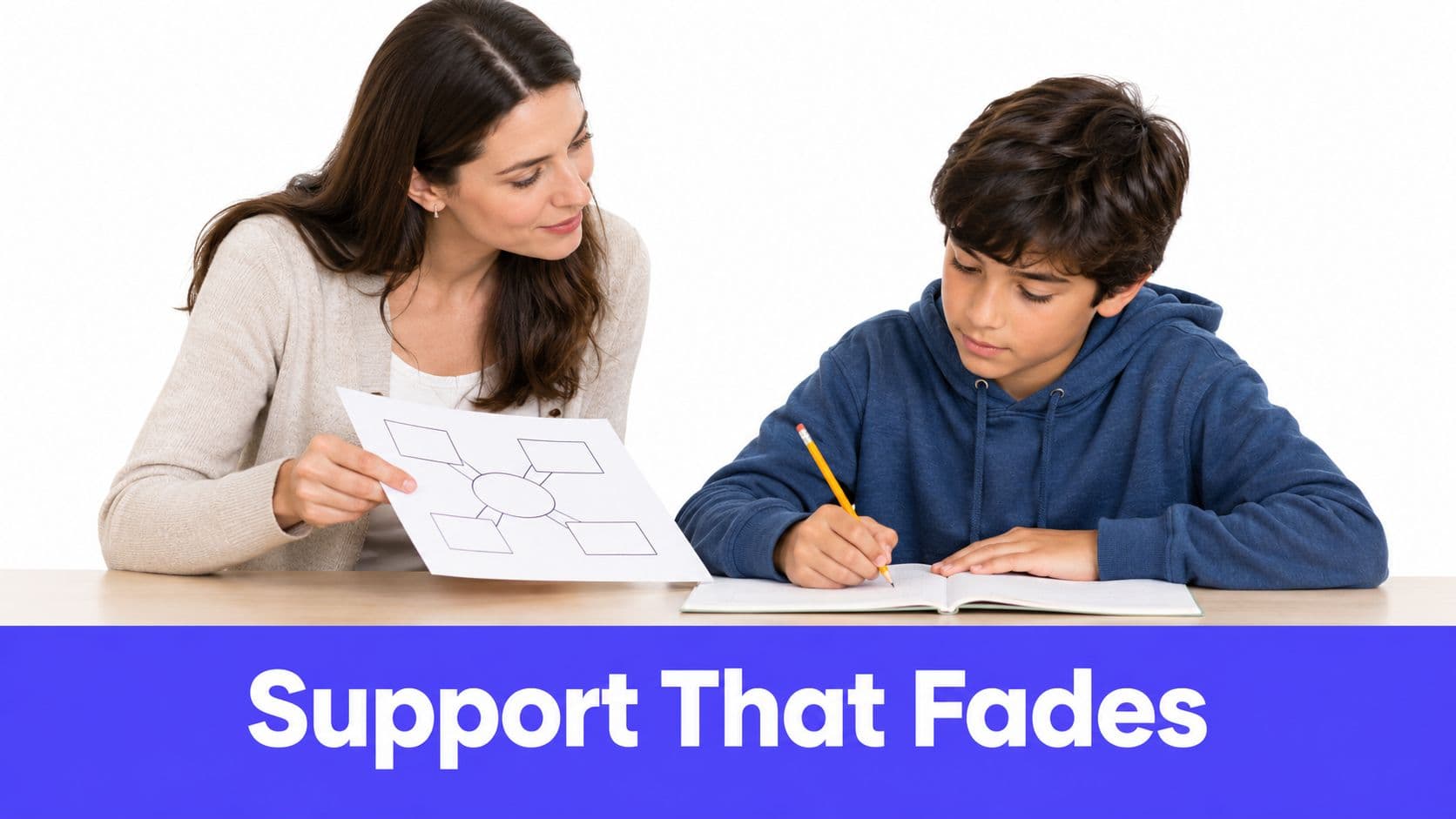
A scaffold should help a student do the thinking, not do the thinking for them. Sentence frames, graphic organizers, modeled think-alouds, and guided questions are useful when they address a specific obstacle and lead toward greater independence.
For poetry annotation, model how you notice a word choice and connect it to meaning. Then provide an annotation template, followed by a lighter checklist when students can make those connections themselves. In science, a claim-and-evidence frame can support writing without supplying the scientific claim.
Plan How Support Will Fade
Decide what independent performance would look like before introducing a scaffold. These classroom approaches to scaffolding in education can help you match a support to the task rather than distribute the same organizer to everyone.
Ask students which support helped and which they no longer need. Remove temporary instructional assistance in response to evidence, while maintaining accessibility supports and required accommodations.
Kuraplan's AI assistant can suggest frames, organizers, and guided questions, but generated support needs review. A 2025 Michigan Virtual survey of more than 500 educators found that 43.9% of teachers reported classroom AI use, while limited time, insufficient training, and unclear policies remained barriers.
- Check correctness. Verify scientific explanations, worked mathematics, and answer keys.
- Inspect assumptions. Review cultural references, language demands, and accessibility.
- Preserve productive struggle. Remove hints that reveal the reasoning students must develop.
Don't include identifiable student information when requesting suggestions. Describe the objective and barrier instead. Preparation help is useful only if the resulting scaffold is accurate, appropriate, and still leaves meaningful work for the learner.
7. Universal Design for Learning (UDL)
Before making individual adaptations, inspect the lesson itself. Is an unnecessary barrier built into the way students receive information or demonstrate understanding?
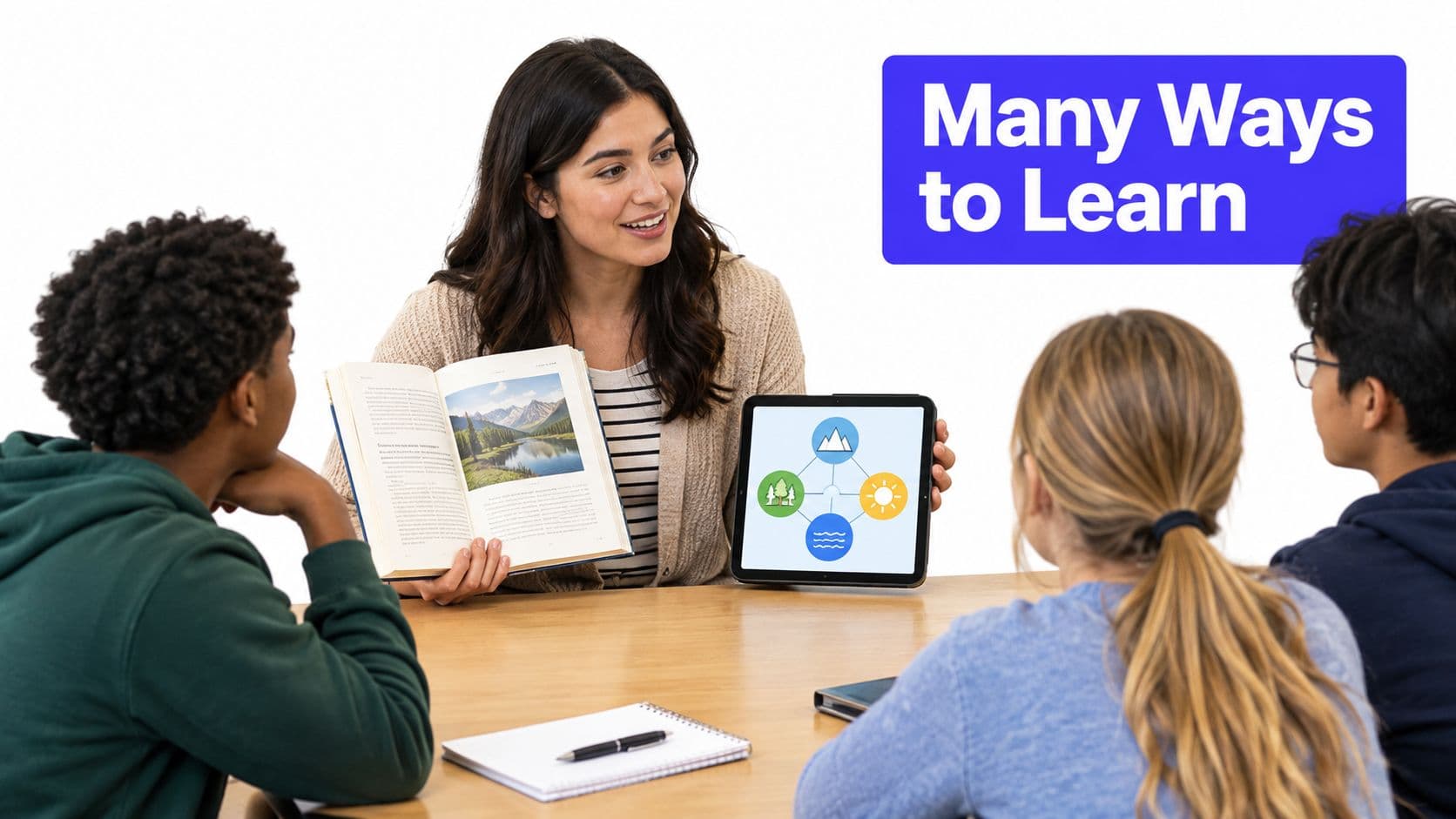
The federal TEAL Center's Universal Design for Learning guidance identifies three planning routes: multiple means of representation, action and expression, and engagement. It recommends practices such as giving directions orally and in writing, using graphics and charts, and allowing visual or oral presentations rather than relying only on written work.
This isn't a reason to assign students fixed learning-style labels. It's a way to make deliberate choices about access, participation, and assessment.
Remove Barriers Without Changing the Target
For an Industrial Revolution lesson, offer a captioned video, a primary-source extract with a glossary, and opportunities to discuss or create an infographic. If the objective is explaining historical change, those formats can offer different routes to the same evidence.
If the objective is writing an evidence-based paragraph, an oral response alone won't demonstrate the full target. Students may rehearse orally or use accessible writing tools, but the assessment still needs to capture the intended writing skill.
- Audit access. Check reading load, directions, visual clarity, timing, and required output.
- Start narrowly. Add another representation of a difficult concept rather than redesigning everything.
- Keep options coherent. Too many formats can create navigation work that distracts from learning.
Kuraplan can generate diagrams and illustrations to accompany explanations. Check labels, relationships, and visual clarity, especially in scientific or mathematical images.
UDL doesn't replace targeted instruction. A lesson can offer broad access and still require a focused decoding group, an extension task, or an individual conference.
8. Formative Assessment-Driven Differentiation
An exit ticket only helps if you change something because of it. Formative assessment drives differentiation when evidence leads to a different next step, not another entry in the gradebook.
Vanderbilt University's IRIS Center guidance on differentiated instruction identifies ongoing assessment and flexible grouping as core principles and recommends checking both student outcomes and fidelity of implementation. That means asking whether students learned and whether you delivered the planned support.
In a mathematics lesson, inspect an exit ticket for the reasoning behind incorrect answers. Students who misunderstood the relationship need a different response from students who understood it but made a calculation error.
Decide What Each Response Means
Prepare the decision rules alongside the questions. That keeps you from collecting more evidence than you can realistically use.
- Understanding is secure. Offer application or extension rather than repeated practice.
- A misconception is shared. Bring students together for a targeted explanation and another attempt.
- Evidence is unclear. Confer briefly or use a different response format before making a placement decision.
A primary teacher can use whiteboard responses during phonics to decide who needs further letter-sound practice. When students receive special education services, connect daily observations with their individual goals; special ed progress tracking with Guiding Growth is a related resource for organizing that monitoring.
Kuraplan's AI assistant can brainstorm follow-up tasks from a description of a misconception. Keep the distinction between formative and summative assessment clear: a check intended to guide instruction should create room for another attempt.
Finally, look beyond completion. Can students explain the concept without the scaffold, apply it elsewhere, and participate meaningfully? Those observations help you decide whether to maintain, revise, or fade the support.
8 Differentiated Instruction Strategies: Best Practices Comparison
| Strategy | 🔄 Implementation Complexity & Resources | ⚡ Efficiency | 📊 Expected Outcomes | 💡 Ideal Use Case & Key Advantage |
|---|---|---|---|---|
| Tiered Assignments | High planning effort; requires readiness data and multiple task versions | Moderate; versions can be reused | ⭐ Same learning goal with appropriately varied challenge | Mixed-readiness classes; maintains shared standards while adjusting support and complexity |
| Flexible Grouping | Moderate; needs recent assessment data and regular regrouping | Moderate; recurring routines ease transitions | 📊 Responsive instruction and temporary, purposeful groups | Changing skill needs or shared interests; avoids fixed ability labels |
| Learning Stations | High setup effort; requires materials, clear directions, and routines | ⚡ Efficient once established; enables simultaneous activities | 📊 Varied practice and targeted small-group teaching | Lessons needing hands-on, independent, and teacher-led work |
| Choice Boards | Moderate; requires aligned options and a common rubric | Moderate; reusable boards save planning time | ⭐ Greater student choice and engagement while targeting shared goals | Practice or assessment with varied formats; supports learner autonomy |
| Curriculum Compacting | High; requires pre-assessment and planned enrichment | ⚡ Saves time by reducing already-mastered practice | 📊 More time for extension and deeper learning | Students who demonstrate prior mastery; reduces repetitive work |
| Scaffolding | Moderate; requires observation and planned support removal | Moderate; reusable supports can simplify task access | ⭐ Builds access to challenging work and increasing independence | Students learning a complex task; provides temporary, fading support |
| Universal Design for Learning (UDL) | High initial planning; benefits from flexible materials and collaboration | Moderate; proactive design can reduce later adaptations | 📊 Fewer barriers and multiple ways to access and show learning | Whole-class lesson design for diverse learners; builds flexibility in from the start |
| Formative Assessment-Driven Differentiation | Moderate to high; requires frequent checks, analysis, and follow-up | ⚡ Quick checks support timely adjustments | 📊 Reveals misconceptions and guides next instructional steps | Ongoing lessons where needs may shift; grounds differentiation in evidence |
Build Differentiation Into Your Next Lesson
Choose an upcoming lesson that currently feels too easy for some students and difficult for others. Don't redesign the entire unit. Improve the decision points in that lesson, then use what you learn to plan the next one.
Start by writing a meaningful target in language students can understand. “Explain how evidence supports a claim” gives you something to assess; “complete the worksheet” doesn't. Separate the essential learning from the format you've traditionally used to teach it.
Use a Small, Complete Instructional Cycle
- Choose the target. Identify the understanding or skill everyone needs to develop, while honoring individual learning goals where applicable.
- Check readiness. Use a three-to-five-question task as a manageable planning choice, including a prompt that reveals reasoning rather than recall alone.
- Identify the barrier. Distinguish missing knowledge from language demands, unclear directions, inaccessible materials, or insufficient challenge.
- Match the response. Select one or two strategies that address the barrier, such as a temporary group with a scaffold or a compacted task with an extension.
- Keep expectations visible. Provide common rubric criteria for the shared learning target, even when students use different materials or formats.
Build the follow-up check before the lesson begins. If you introduce a word bank, decide how you'll find out whether students understand the relationships as well as the terminology. If you offer a stretch task, make sure you can assess the deeper reasoning it asks students to demonstrate.
You can use Kuraplan to connect the objective with activities, worksheets, visuals, and a rubric. Treat the generated plan as a draft to inspect, not a substitute for knowing your students. Verify content, check the demand across versions, and remove options that add preparation without addressing a real need.
After teaching, record what changed in student responses, who still needs support, and which temporary supports should fade next.
Keep that reflection brief enough to use. Note whether students gave more accurate explanations, contributed more independently, or applied their learning in a new context. If a group completed the task but still needed constant prompting, don't confuse completion with independence.
Effective differentiated instruction isn't about giving every student something different. It's about removing specific barriers, responding to evidence, and helping students move toward meaningful learning. A focused adjustment, followed by an honest check of its effect, is more useful than an elaborate lesson you can't sustain.
Kuraplan helps you create standards-aligned lesson plans, differentiated worksheets, educational visuals, and assessment rubrics. Visit Kuraplan to draft an upcoming lesson around a shared learning target, then review the supports and follow-up checks before using it with your class.