Ever ask a strong question and get a room full of blank faces back? Or teach a concept well, then watch students freeze when the problem changes slightly? That gap between recall and transfer is where a lot of us live every day.
Critical thinking usually isn't missing because students don't care. It's missing because they need repeated practice with analysis, evidence, comparison, and judgment inside normal lessons, not as a once-a-quarter enrichment activity. A major REBOOT Foundation survey found teachers were almost evenly split on whether students should practice critical thinking while learning basic facts or after learning them, with 41% choosing simultaneous practice and 42% preferring it after facts are learned. To me, that says something important. Teachers already see thinking as part of everyday instruction, not a bonus task for the fast finishers.
That matters even more now, when students are sorting through misinformation, AI-generated content, and persuasive half-truths online. If media literacy is on your radar, this classroom-friendly guide to deepfake awareness for educators pairs well with the strategies below.
These critical thinking activities are the ones I come back to because they work across subjects and grade bands. Each one includes a mini-plan you can readily use: how to run it, how to differentiate it, what to watch out for, and how to assess whether students did more than just participate. If you want to save planning time, Kuraplan can also help generate discussion prompts, rubrics, printables, and visuals so you aren't building every piece from scratch the night before.
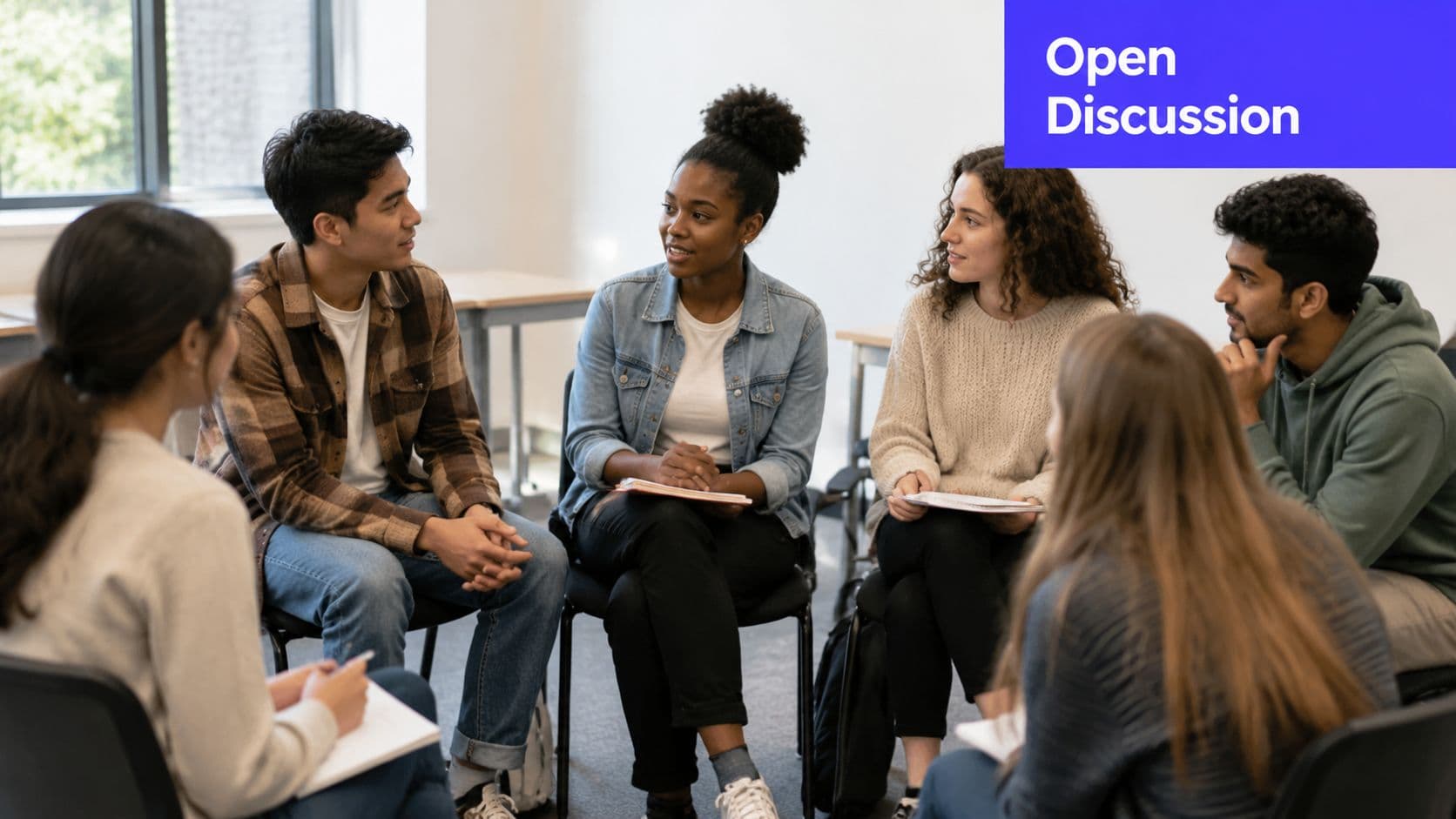
1. Socratic Seminar
A Socratic seminar works when the text or problem is rich enough to hold more than one reasonable interpretation. It falls flat when the prompt has one obvious answer or when students haven't had time to prepare.
In high school English, that might look like discussing whether Atticus Finch acts courageously or cautiously in To Kill a Mockingbird. In middle school history, it could be a seminar on a set of primary sources from the Civil Rights era. In elementary science, I've seen it work surprisingly well around a simple question like, "What can we infer from what we observed on our nature walk?"
How to run it well
Prepare a sequence of open-ended questions that starts concrete and becomes more interpretive. Students need an accessible on-ramp first. Ask what they notice, then what they infer, then what they would defend.
A simple flow looks like this:
- Start with evidence: Ask students to identify a specific line, detail, image, or data point.
- Move to interpretation: Ask what that detail suggests and what assumptions might be behind that reading.
- Push for evaluation: Ask which interpretation is strongest and what evidence makes it stronger than the alternatives.
Wait time matters more than teachers think. If you ask and then rescue the silence too fast, students learn that persistence isn't necessary.
Practical rule: If the room is quiet, let it be quiet for a few more seconds. Real thinking often looks slow at first.
Differentiation and assessment
For students who need more support, give sentence stems such as "I agree because..." or "That changes my thinking because...." For students ready for more challenge, assign them to track assumptions, contradictions, or missing evidence during the discussion.
The biggest mistake is grading only participation. A student can talk a lot and still reason poorly. Use a quick rubric with three criteria: quality of evidence, response to peers, and depth of reasoning. End with a short written reflection asking students what idea shifted, what they still question, and which claim they can support best.
If you use Kuraplan, this is an easy place to generate seminar questions at different difficulty levels plus a one-page discussion tracker for observers.
2. Case Study Analysis
Case studies are one of the best critical thinking activities for moving students out of textbook mode. Students stop asking, "What's the right answer?" and start asking, "What information matters here, and what trade-off am I willing to make?"
That shift is the whole point.
A good case gives students enough context to reason, but not so much that the answer is predetermined. In health, students can examine a treatment dilemma. In environmental science, they can analyze a pollution issue affecting a local community. In social studies, they can study a historical turning point and argue which decision-makers had the strongest options.
A mini-plan that actually works
Give students a short case packet with background, stakeholder perspectives, and a few documents or data displays. Then ask them to identify the central problem before they suggest any solution. That order matters. Weak case study work usually happens because students jump straight to opinions.
For a ready-made example, a medical ethics case study worksheet can give students a concrete scenario where competing values need to be weighed, not merely identified.
Try this sequence:
- Read for facts: What happened, who is involved, and what constraints are present?
- Read for perspectives: Who benefits, who is harmed, and whose voice is missing?
- Read for decision quality: What options exist, what evidence supports each one, and what consequences might follow?
What works and what doesn't
What works is narrowing the task. Ask for the strongest recommendation and the reasoning behind it. What doesn't work is telling students to "discuss the case" with no framework. That usually rewards confident talkers and punishes careful thinkers.
AACSB describes a critical thinking assessment design that uses a standardized rubric with six subcriteria, combines auto-scored multiple-choice items with faculty-scored open-ended items, and randomizes case-study scenarios so each learner gets a unique form. That assessment design for benchmarking higher-order thinking is a useful reminder for classroom teachers too. If you want to know whether case work improved thinking, score the reasoning, not just the final recommendation.
Kuraplan is useful here for generating stakeholder cards, short source sets, and a rubric aligned to your standards.
3. Think-Pair-Share
Think-pair-share is simple, but it's one of the most misused routines in school. The problem usually isn't the strategy. It's the question.
If the prompt can be answered in one sentence, students won't need to think. If the prompt asks for explanation, comparison, or prediction, the structure starts doing real work. In math, ask which strategy is most efficient and why. In science, ask students to predict an outcome and justify it. In ELA, ask which character choice changed the conflict most.
Make the "think" part real
The silent think time can't be optional. Students need a note, sketch, or claim written down before they talk to a partner. Otherwise, many of them borrow someone else's thinking and never build their own.
I like prompts that force a choice:
- Best explanation: Which answer is strongest, and what evidence supports it?
- Best method: Which strategy would you use first, and why?
- Best interpretation: Which detail matters most to your conclusion?
Once students pair up, require both partners to speak. A quick way to do that is to assign roles such as Partner A explains first, Partner B paraphrases, then adds or challenges.
Easy differentiation
This routine scales well. For students who need support, provide sentence starters and a visual timer. For stronger groups, ask each pair to reach consensus and prepare one lingering question for the class.
Participation isn't the same as reasoning. The share-out should synthesize ideas, not become a parade of repeated answers.
One practical tweak makes a big difference. During the whole-group share, don't ask, "What did you talk about?" Ask, "Which pair changed its mind, and why?" That question surfaces revision, evidence, and intellectual flexibility.
If you use Kuraplan, it can quickly produce tiered prompts, partner discussion stems, and exit tickets. That's especially helpful when you want the same routine to work differently in grade 3 science than in grade 9 literature.
4. Debate and Structured Argumentation
Debate can sharpen thinking fast, but only if students understand that evidence beats volume. Without that norm, debate turns into performance.
The most useful classroom debates don't require students to defend what they personally believe. In fact, assigning positions often improves the quality of thinking because students have to examine a side they might otherwise dismiss. That matters in history, science, civics, and media literacy.
A strong topic invites real disagreement. "Should social media platforms face tighter regulation?" works. "Is bullying bad?" doesn't.
A classroom version that stays manageable
Keep the structure tighter than you think you need. Give students a claim, research time, evidence requirements, and a short rebuttal window. In a history class, students might debate whether the use of atomic weapons was justified. In science, they might debate whether a specific energy transition policy is realistic.
A simple format:
- Opening claim: State the position and the main line of reasoning.
- Evidence round: Present the best supporting facts, examples, or source-based details.
- Rebuttal: Identify the weakest point in the opposing case.
- Reflection: Decide which side argued more effectively and why.
For a planning shortcut, this debate worksheet from Kuraplan shows the kind of structure that helps students organize claims, evidence, and counterarguments before speaking.
What to assess
Don't grade students mainly on confidence or style. Grade claim clarity, evidence use, treatment of counterarguments, and responsiveness. Those are the parts of debate that transfer to writing and discussion later.
A useful debrief question is, "What argument sounded strong at first but weakened under scrutiny?" Students learn a lot from seeing the difference between persuasive language and solid reasoning.
This is also a good place to connect media literacy and source evaluation. Students need to ask not just whether a source supports them, but whether it is credible, relevant, and interpreted fairly.
5. Problem-Based Learning
Problem-based learning asks students to work through a messy problem that doesn't come with a clean answer key. That's why it can be powerful, and that's also why it can become chaos if the problem is too big or the supports are too light.
Students do best when the problem feels real and local. "How can we reduce food waste in our cafeteria?" is easier to own than a giant abstract challenge about the global food system. "How could our school improve playground accessibility?" lands better than a vague prompt about inclusive design.
What good PBL looks like
Start with a driving question tied to a real need. Then break the process into checkpoints so students don't drift. In a science or engineering class, students might design a simple water filtration solution. In social studies, they might propose a response to a community issue and justify it using stakeholder needs.
Use these checkpoints:
- Define the problem: What exactly needs to be solved?
- Research constraints: What limits, costs, needs, or rules shape the solution?
- Generate options: What are several possible responses?
- Defend one plan: Why is this option the strongest based on evidence?
Common pitfalls
The biggest mistake is treating PBL like "group work with a poster at the end." If you only grade the final product, you miss the thinking that happened or didn't happen during the process.
Students also need explicit support in research and evidence evaluation. Statistics has long been tied to critical thinking because it helps learners evaluate evidence, identify patterns, and make decisions from data. The Royal Statistical Society notes this connection in its hands-on statistics guidance for educators, which points to classroom experiences like estimating population size, creating box plots, and analyzing logistic growth as ways students practice inference and decision-making. That same habit of reasoning from evidence strengthens PBL.
Kuraplan can help you build checkpoints, group role sheets, and rubrics that score process, not just presentation quality.
6. Concept Mapping and Visual Thinking
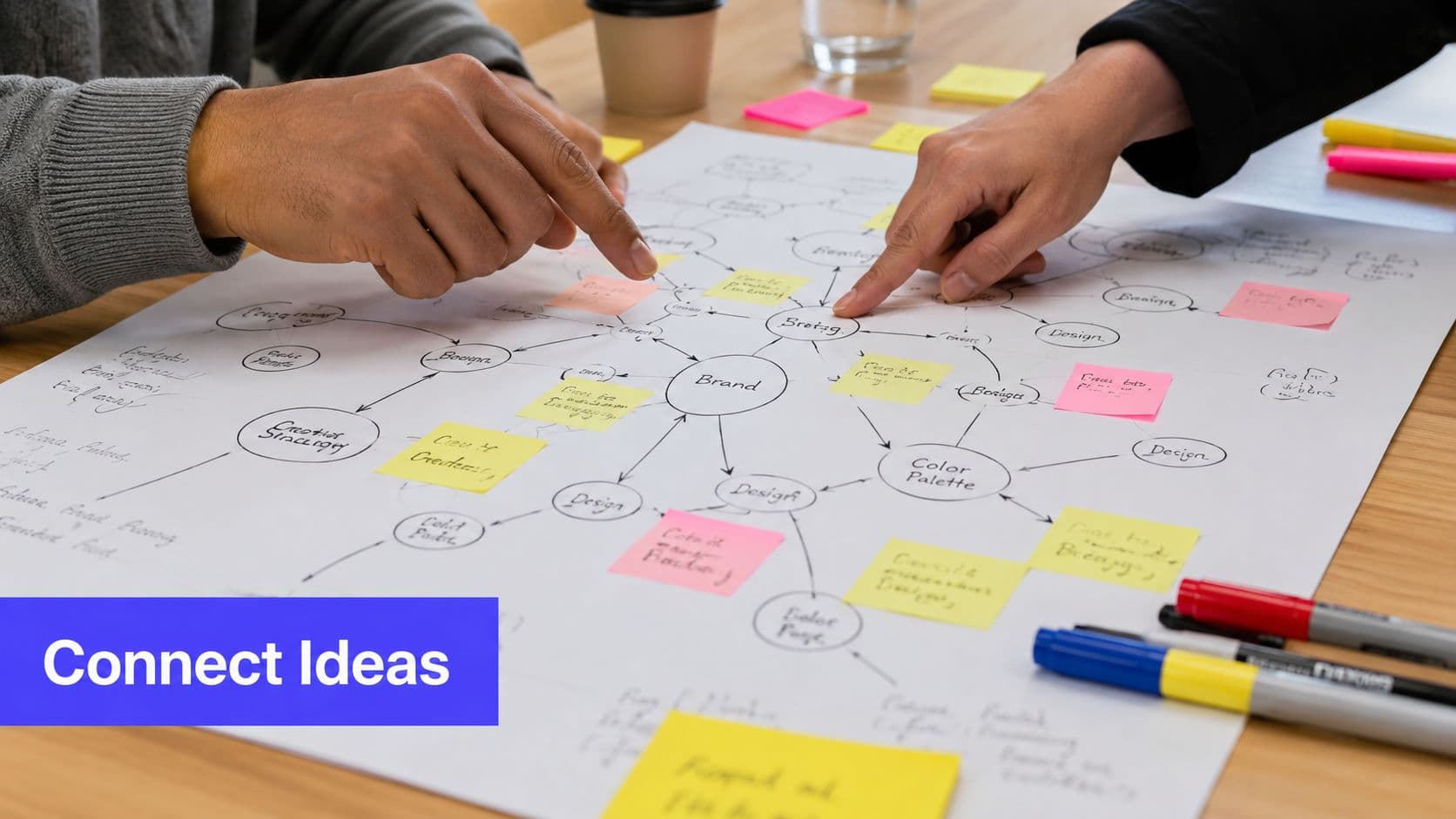
Some students don't know what they think until they can see it. That's where concept maps, mind maps, cause-and-effect chains, and comparison diagrams become more than decoration.
A concept map is especially useful when students are learning ideas that connect across a unit. In science, students can map relationships among energy transfer, ecosystems, and food webs. In ELA, they can map how conflict, character decisions, and theme influence one another. In history, they can build causal chains around an event rather than memorizing isolated dates.
How to make it rigorous
Model one first. Students need to hear your thinking about why two concepts connect, not just watch you draw boxes and arrows. Then give them partially completed maps before expecting completely independent work.
Three strong prompts:
- Show relationships: How do these ideas influence each other?
- Show hierarchy: Which idea is broadest, and which details belong under it?
- Show causation: What leads to what, and where are the feedback loops or exceptions?
Have students explain their map orally or in writing. That's where misconceptions become visible. A polished visual can hide weak reasoning unless students can justify each connection.
Assessment without overcomplicating it
I wouldn't score artistic neatness. I would score accuracy of connections, clarity of labels, and ability to explain the map. If two students produce very different structures but both can defend their reasoning, that's often a sign the task is doing its job.
This is one of the easiest critical thinking activities to differentiate. Some students can work from a word bank and starter nodes. Others can build a map from scratch and add missing concepts the class didn't name.
Kuraplan can generate blank templates, labeled versions for support, and visual exemplars that save a lot of prep time.
7. Fishbowl Discussion
Fishbowl discussions solve a common classroom problem. In a whole-class discussion, a few students carry the conversation while everyone else disappears. In a fishbowl, students can't hide as easily because the outer circle has a job too.
The inner circle discusses. The outer circle observes for something specific, then the roles switch. In literature, observers can track how often speakers use text evidence. In science, they can note when students make claims without support. In social studies, they can look for respectful disagreement and whether students address counterarguments.
Why this format works
Students learn a lot by watching discussion quality, not just by participating in discussion. That observer role trains them to notice the moves that make reasoning stronger.
Give the outer circle a focused observation tool. Don't tell them to "take notes." Tell them exactly what to listen for.
For example:
- Evidence tracking: Where did the speaker support a claim well?
- Reasoning quality: Did the speaker explain how the evidence connects to the point?
- Collaboration moves: Who invited another voice in or built on a peer's idea?
Students often improve faster when they can name the discussion move they need to strengthen.
Measuring more than engagement
Many popular activity lists celebrate participation but stop there. One underserved need in this area is assessment. The challenge isn't only getting students talking. It's determining whether a discussion improved their reasoning, evidence use, or ability to transfer thinking to a new task. This gap is highlighted in guidance on creative activities that build critical thinking skills, which points out how often teachers get formats without practical scoring criteria.
A quick fix is to pair the fishbowl with a short post-task write-up. Ask students to respond to a new but related question using one idea they heard and one piece of evidence they selected themselves. That's where you see whether the discussion moved thinking forward.
8. Jigsaw Cooperative Learning
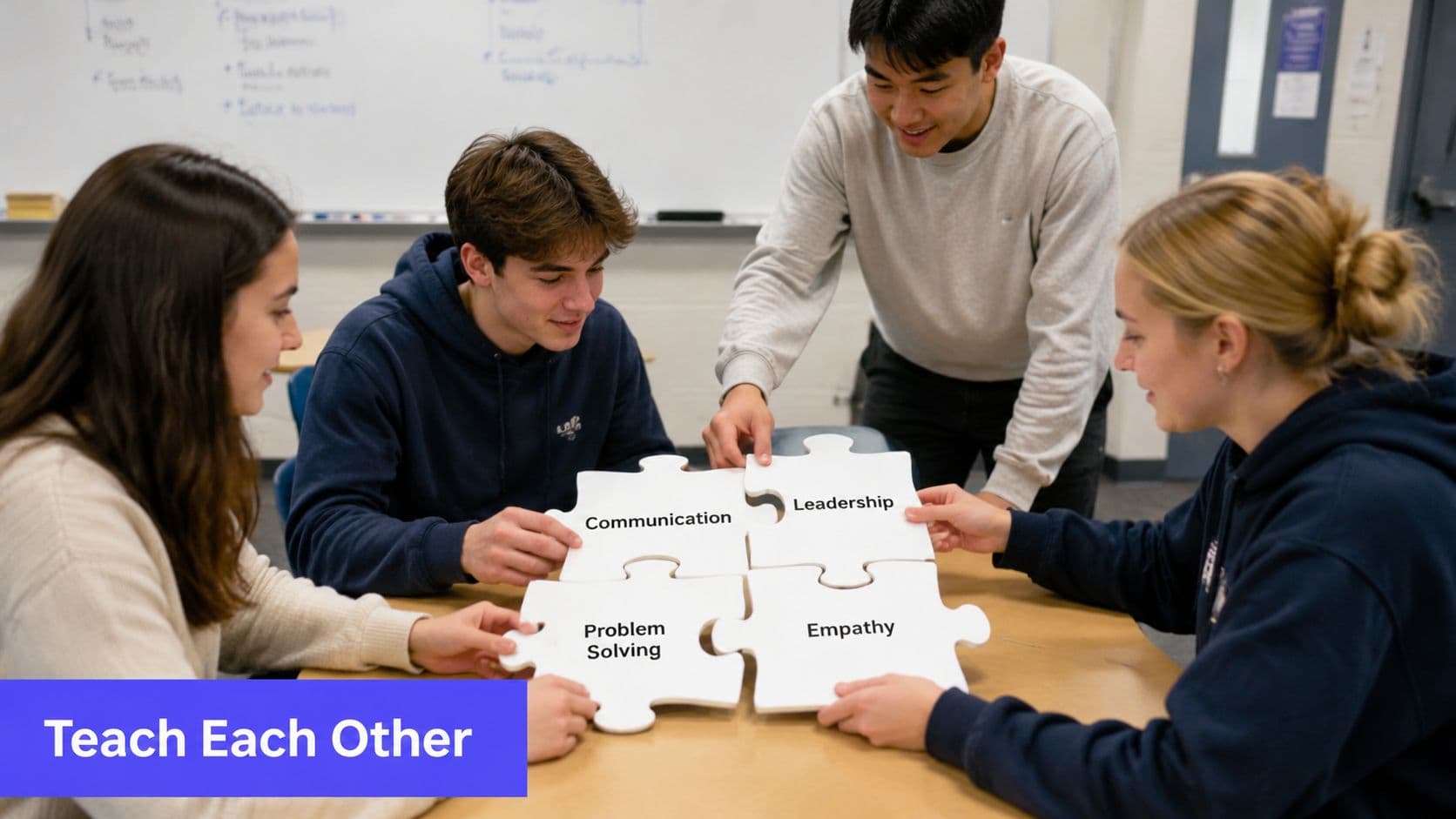
Jigsaw works best when the content naturally breaks into distinct parts and each part matters. If one section is clearly easier or less important, students figure that out immediately and the structure weakens.
Good jigsaw topics are built from pieces that need one another. In science, different roles in an ecosystem work well. In government, the branches of government fit naturally. In literature, groups can study author background, historical context, symbolism, and narrative structure, then teach one another.
The structure that keeps it from drifting
Students first meet in expert groups to learn one subtopic thoroughly. Then they return to home groups and teach it. The catch is that peer teaching needs support. Many students know something before they can explain it clearly.
Set them up with a simple teaching scaffold:
- Key idea: What must your group understand?
- Supporting evidence or examples: What proves or illustrates it?
- Connection: How does your piece fit the whole topic?
- Check for understanding: What question will you ask your group?
Trade-offs and fixes
The strength of jigsaw is interdependence. The weakness is uneven expertise. If one expert group leaves confused, the confusion spreads.
So build in a quick teacher check before students return to home groups. Ask each expert group to produce one visual, one key explanation, and one question for peers. That tiny checkpoint prevents a lot of shaky reteaching.
This also works well as one of your lower-stakes critical thinking activities because students practice selecting essentials, explaining relationships, and comparing perspectives. Kuraplan can help by generating differentiated expert sheets and short comprehension checks for each subtopic.
9. Scaffolded Inquiry and Discovery Learning
Inquiry sounds great in theory. In practice, it can become frustrating fast if students are expected to discover everything with no structure.
The sweet spot is guided discovery. Students explore a phenomenon, test ideas, and revise their thinking while the teacher carefully shapes the path with questions, prompts, and materials. In early grades, that might mean investigating which objects sink or float and why. In upper elementary or middle school, it might involve exploring plant growth variables, sound, density, or number patterns.
Start with something worth noticing
Begin with a concrete observation. A strange result, a surprising object, a pattern, or a discrepancy gives students a reason to ask questions. Then collect their initial thinking before any explanation begins.
Useful prompts include:
- What do you notice?
- What do you wonder?
- What do you think is happening, and why?
A 2026 education adoption study reports that students' intention to use AI tools is linked to their engagement in critical-thinking activities, suggesting schools should pay attention not only to tool usage but also to whether those tools increase analytic behaviors like evaluating evidence and comparing alternatives. That study on AI tool adoption and critical-thinking engagement is especially relevant here. Inquiry works best when tools support analysis rather than shortcut it.
Keep the scaffold visible
Record student ideas publicly. Use sentence stems. Offer tools like measuring materials, observation sheets, diagrams, or partially structured recording forms. The support shouldn't do the thinking for students, but it should make the thinking possible.
One caution from experience: don't rush to the official explanation. If students haven't had time to test and revise their ideas, inquiry becomes a guessing game followed by teacher correction. The productive part is the revision.
Kuraplan can help generate observation sheets, prediction prompts, and reflection pages that fit the age group you're teaching.
10. Critique and Revision Cycles with Peer Feedback
If you want students to think more carefully, ask them to improve something instead of just finish it. Revision forces judgment. Students have to decide what is weak, what feedback matters, and how to make the work stronger.
This works in writing, lab reports, design challenges, math explanations, artwork, and presentations. In ELA, students can revise a narrative or argument after peer review. In science, they can revise a conclusion after feedback on evidence use. In math, they can revise a written explanation of their reasoning.
Make feedback concrete
Peer feedback fails when directions are vague. "Give suggestions" usually produces either empty praise or unhelpful nitpicking.
Set success criteria before students begin, then teach the language of useful critique. A resource like this narrative peer review worksheet helps by giving students specific prompts instead of expecting them to invent review criteria on the spot.
Use feedback stems such as:
- I noticed: Point out something effective or specific.
- I wondered: Identify a place where the reasoning or clarity breaks down.
- You might try: Suggest one revision tied to the criteria.
What strong revision looks like
Require students to respond to feedback, not just receive it. They should decide what to revise and explain why. That metacognitive step is where a lot of the critical thinking happens.
Good revision isn't adding more. It's making choices with a clear reason behind them.
I also prefer manageable revision targets. Asking students to improve three specific things usually leads to better work than asking them to "revise everything." Kuraplan can support this process by producing rubrics, peer feedback forms, and exemplar comparisons that show what stronger reasoning looks like at different levels.
Critical Thinking Activities: 10-Item Comparison
| Method | 🔄 Implementation complexity | ⚡ Resource & time requirements | 📊 Expected outcomes (⭐) | Ideal use cases | 💡 Key advantages / Tips |
|---|---|---|---|---|---|
| Socratic Seminar | Moderate–High: needs skilled facilitation and question sequencing | Low materials, moderate class time (20–50 min) | Deep comprehension, perspective-taking ⭐⭐⭐⭐ | Literature, ethics, close-text analysis, humanities | Prepare 5–7 sequenced questions; use wait time; assign observers |
| Case Study Analysis | High: design realistic, multi-layered cases and scaffolds | High: prep time, possible external data/resources | Complex problem-solving, application of theory ⭐⭐⭐⭐ | Business, medicine, environmental science, applied social studies | Align cases to objectives; provide sources and guiding questions |
| Think-Pair-Share | Low: simple, repeatable three-step routine | Minimal materials, very time-efficient (1–3 min phases) | Increased participation and rapid formative insight ⭐⭐⭐ | Quick checks for understanding across all subjects | Use timers; provide sentence starters; vary pairings |
| Debate & Structured Argumentation | High: requires research, format management, and norms | High: prep/research time, possible judges/evaluation rubrics | Persuasive reasoning, evidence evaluation, public speaking ⭐⭐⭐⭐ | Civics, policy, ethics, advanced social studies | Teach claim-evidence structure; use rubrics; assign positions |
| Problem-Based Learning (PBL) | Very high: teacher facilitation, long-term project management | High: materials, sustained time, teacher training | Authentic problem-solving, self-directed learning ⭐⭐⭐⭐ | STEM projects, community challenges, interdisciplinary units | Frame driving question; build checkpoints and roles |
| Concept Mapping & Visual Thinking | Moderate: requires modeling and mapping conventions | Low–Moderate: paper or digital tools; time to create maps | Improved organization of ideas; reveals misconceptions ⭐⭐⭐ | Planning essays, science concepts, review and assessment | Model maps first; use color-coding and revision cycles |
| Fishbowl Discussion | Moderate: requires role management and physical space | Moderate: prep for observers and rotating roles; extra class time | Metacognitive awareness of discussion quality ⭐⭐⭐ | Literature circles, peer feedback, focused debates | Provide observation templates; rotate roles; debrief |
| Jigsaw Cooperative Learning | High: complex grouping and content division | Moderate–High: prep for expert materials and multiple sessions | Deep mastery through peer teaching; interdependence ⭐⭐⭐⭐ | Covering large content sets efficiently (history, science) | Equal-value subtopics; teach peer-teaching skills; use quizzes |
| Scaffolded Inquiry & Discovery | High: careful scaffolding and formative checks | Moderate–High: materials, space, teacher comfort with pacing | Scientific thinking, investigation skills, conceptual understanding ⭐⭐⭐⭐ | Science investigations, math discovery, phenomena-based lessons | Use driving phenomena; provide tools and question sequences |
| Critique & Revision Cycles | Moderate–High: needs rubrics, feedback routines, multiple iterations | Moderate: time across several drafts, peer/trainer support | Improved final quality, growth mindset, metacognition ⭐⭐⭐⭐ | Writing workshops, design projects, research reports | Establish rubrics upfront; teach feedback language; require revision log |
Making Critical Thinking an Everyday Habit
The main win with critical thinking activities isn't that students have one good discussion or one strong project. It's that they start expecting to explain themselves. They learn that answers need reasons, claims need evidence, and first thoughts can be revised.
That's a culture shift more than a lesson format.
You don't need to launch all ten of these at once. Pick one that fits how you already teach. If your class is discussion-heavy, start with a fishbowl or Socratic seminar. If your students need more structure before speaking, think-pair-share is the easier entry point. If you're trying to move beyond recall in science or social studies, case study analysis and problem-based learning usually create stronger transfer.
What matters is consistency. Students get better at thinking when the classroom keeps asking them to compare, justify, question, and revise. That habit forms through repetition. It's the same reason routines matter in every other part of teaching. If you're working on consistency in your own practice too, these Pretty Progress consistency tips offer a useful reminder that small repeated actions beat occasional bursts of effort.
One thing I'd strongly encourage is assessing the thinking, not just the activity. A lively debate isn't automatically a strong one. A colorful concept map isn't automatically accurate. A busy group project isn't automatically analytical. If you want students to value reasoning, your rubrics and feedback have to value it too. Even a short scoring guide that looks at evidence, explanation, and responsiveness to other ideas will tell you more than a participation grade ever will.
This is also where planning load can sneak up on teachers. The activity itself might be simple, but building the prompts, scaffolds, reflection sheets, and rubrics takes time. That's one reason tools like Kuraplan can be helpful in day-to-day practice. It can generate standards-aligned materials, worksheets, visuals, and assessment rubrics that match the kind of thinking you want students to do, which makes it easier to use these strategies without spending your whole evening formatting documents.
And don't overlook small moments. Critical thinking doesn't only happen in formal seminars or long projects. It happens when a student explains why one math strategy is more efficient. It happens when a reader changes an interpretation after hearing new evidence. It happens when a lab group realizes its conclusion doesn't match the data and decides to fix it instead of forcing the answer.
Those moments add up.
Start with one routine next week. Teach it clearly. Use it more than once. Tighten the assessment after you've seen where students struggle. Before long, you'll notice fewer blank stares and more students willing to say, "I think this because..." That's when you know the classroom is moving beyond memorization and becoming a place where thinking is normal.
If you want a faster way to turn these ideas into ready-to-use classroom materials, Kuraplan can help you build lesson plans, worksheets, visuals, and rubrics for critical thinking activities without starting from a blank page every time.