You're halfway through a whole-class lesson when the competing demands become impossible to ignore. One student needs the directions read aloud, another needs a reduced writing load, a third is working toward an IEP goal that doesn't appear anywhere in the grade-level worksheet, and the rest of the class still needs meaningful practice. The familiar temptation is to create separate materials for everyone, then spend the evening trying to make the system hold together.
Differentiated instruction for students with disabilities works better when it's treated as classroom architecture, not a collection of emergency fixes. The practical question isn't how to produce an entirely different lesson for every learner. It's how to design strong core instruction, add disability-sensitive supports, and use efficient tools so students can access the same learning community while receiving the instruction their plans require.
The Reality of Inclusive Classrooms
A general education classroom can contain one shared objective and several very different routes toward it. During a reading lesson, one student may discuss the main idea confidently but struggle to record an answer, while another needs explicit instruction in vocabulary before the text becomes accessible. A student with significant communication needs may understand the content yet require a device, picture symbols, or dictated responses to demonstrate that understanding.
That tension doesn't mean the lesson has failed. It means access, participation, and progress are separate design problems. A student may need an accommodation to participate in today's task, specially designed instruction to build a missing skill, and a way to show learning that doesn't depend on handwriting speed.
Why flexibility became central to inclusion
The move toward adaptable instruction has a legal and historical foundation. The U.S. Education for All Handicapped Children Act of 1974, later renamed the Individuals with Disabilities Education Act, established the right to a free appropriate public education and helped drive individualized instruction for students with disabilities (historical overview of differentiated instruction). Differentiated instruction later became associated with Carol Ann Tomlinson's fully developed model in 1995, centered on varying readiness, interests, and learning profiles, as described in the same source.
That history reflects a broader shift away from segregated schooling and toward classroom-based flexibility. In practice, inclusion isn't achieved just by placing a student in the general education room. The teacher must adjust content, process, product, and environment while preserving a meaningful connection to the class's learning.
A productive learning environment supports that work because routines, expectations, and physical access reduce avoidable barriers. For ideas about organizing classroom conditions for varied learners, the Magna Education learning environment resource offers useful planning context, particularly around structure and engagement.
The scale of the access problem
The need is substantial. UNESCO and the World Bank estimate that roughly 240 million children ages 0–17 live with disabilities, while some World Bank summaries report 291.2 million children and adolescents living with a disability worldwide (World Bank inclusive education overview). The World Bank also reports that children with disabilities are 2.5 times more likely to never attend school than their peers, and UNESCO found that children, adolescents, and youth with disabilities represented 15% of the out-of-school population across 14 countries studied, according to that same World Bank resource.
These figures aren't an argument for lowering expectations. They're an argument for designing instruction that doesn't make disability an automatic barrier to attendance, participation, or achievement.
Practical rule: If a support helps a student enter the task, it belongs in the lesson design. If the student needs explicit teaching to develop a missing skill, it belongs in the instructional plan and IEP implementation.
Accommodations Versus Modifications in Practice
The distinction between an accommodation and a modification changes what you plan, what you assess, and what you document. An accommodation changes how a student learns or demonstrates knowledge without changing the learning expectation. A modification changes what the student is expected to learn and may lower grade-level expectations, according to the Texas special education field user guide.
That difference can disappear during a busy morning. A teacher may shorten a worksheet because the student is overwhelmed, but shortening the task doesn't automatically make it an accommodation. The key question is whether the student is still working toward the same expectation.
Use the standard as the checkpoint
Suppose the reading standard requires students to identify a theme and support it with evidence. Reading the passage aloud, previewing vocabulary, providing a high-contrast copy, allowing speech-to-text, or accepting an oral response can preserve that expectation. The student still identifies the theme and supports it with evidence. The access route changes.
A modification would look different. The student might work on identifying a character or matching a picture to a basic event while classmates analyze theme. That may be appropriate when the IEP calls for it, but it isn't the same standard and should be planned with care.
Math creates the same test. A student solving grade-level problems may use graph paper, manipulatives, a multiplication chart, worked examples, or additional time. Those supports change the route, not necessarily the mathematical expectation. If the assignment shifts from solving multi-step problems to identifying single-digit numbers, the learning target has changed.
| Adjustment Type | Example in Reading | Example in Math | Impact on Expectations |
|---|---|---|---|
| Accommodation | Audio text and an oral response for a grade-level comprehension question | Extra time and graph paper for solving grade-level problems | The expectation stays the same |
| Modification | A simpler passage with an expectation to identify a basic event instead of analyzing theme | Fewer or less complex problems targeting an earlier skill | The expected learning changes |
Audit every support before the lesson
Use a quick three-question check:
- What is the grade-level learning target? Write it in student-friendly language.
- What barrier is interfering? Is it decoding, language processing, motor output, attention, memory, or something else?
- Does the support remove the barrier or replace the target? If it removes the barrier, it may be an accommodation. If it replaces the target, confirm that the modification is intentional and documented.
The distinction protects both access and expectations. A student shouldn't be handed a simpler task merely because the original format is inconvenient, but a student also shouldn't be denied a legitimate modification because the teacher is trying to preserve a standard the IEP has already addressed differently.
Implementing Universal Design for Learning
Universal Design for Learning makes differentiation less reactive. Instead of waiting for a student to fail with one format, plan multiple ways to engage with the lesson, access information, and demonstrate understanding from the beginning.
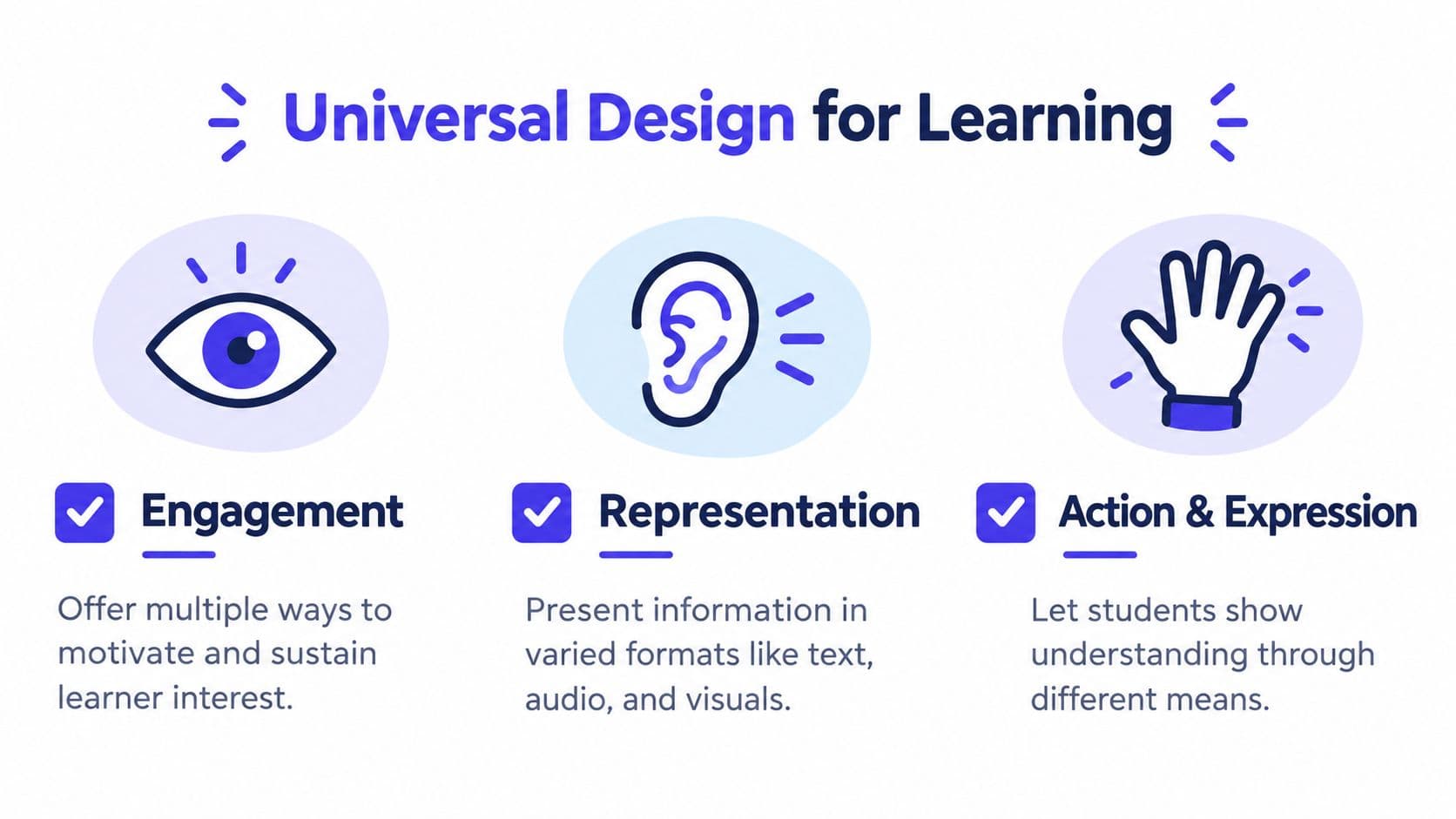
The three UDL principles are engagement, representation, and action and expression. Engagement addresses how students sustain interest and regulate effort. Representation addresses how information is presented. Action and expression address how students respond, create, and show what they know.
Build the lesson before you build the exceptions
Start with the essential learning target. Then plan one option under each principle:
- Engagement: Offer a choice of topic, partner, quiet workspace, or task sequence where the choice doesn't undermine the objective.
- Representation: Pair teacher explanation with visuals, explicit modeling, accessible text, audio, concrete materials, or a worked example.
- Action and expression: Accept a written response, oral explanation, dictated answer, labeled diagram, demonstration, or supported digital product when each option measures the target.
For a science lesson on classifying materials, students might handle physical examples, view labeled images, hear the explanation, and sort objects digitally or on a table. A student with limited speech could use a communication device or point to symbols. A student with dysgraphia could explain the classification orally while the teacher or technology records the response.
The framework only helps when teachers apply it with consistency. A study of UDL implementation found that high-fidelity applications covering engagement, representation, and action and expression produced 37.4% average overall performance gains and 42.3% gains for identified students with disabilities, while low-fidelity implementations produced 6.8% and 12.1% gains respectively (UDL implementation study). The same study reported a 34% reduction in the achievement gap for marginalized learners, with outcomes dropping sharply when implementation fidelity weakened.
Implementation matters more than the label. Three attractive options on a lesson plan won't help if students don't know how to use them, materials aren't ready, or the response choices measure different skills.
A daily UDL check
Before class, ask whether students can:
- understand the objective through more than one format,
- begin the task without relying on a single communication or motor skill,
- receive feedback during practice,
- demonstrate the target through an appropriate response mode,
- use supports that are available consistently, not only after frustration appears.
A short video can help a team visualize the principles in practice:
UDL doesn't replace individualized instruction. It reduces the number of barriers that teachers must retrofit after the lesson has already begun.
Streamlining Prep Work with AI Tools
The workload is real. Preparing a core lesson, an accessible text, visual supports, alternate response formats, and progress-monitoring materials can consume the planning period before you've even checked the IEP accommodations. The answer isn't to let software make instructional decisions independently. It's to use AI for repetitive production while the teacher retains responsibility for standards, disability-related needs, and final review.

Start with a controlled input
Give the tool the information that should constrain its output:
- grade and subject,
- standard or lesson objective,
- essential vocabulary,
- student barrier,
- accommodation or modification,
- expected response mode,
- reading or task complexity,
- what evidence you need for progress monitoring.
A vague request such as “make this easier” produces unreliable work. A stronger request specifies, “Create a grade-level main-idea task with an audio-friendly passage, highlighted vocabulary, sentence starters, and an oral response option. Keep the comprehension target unchanged.”
Kuraplan can generate standards-aligned lesson materials, differentiated worksheets, educational visuals, and assessment formats from a core lesson. Its workflow is most useful when the teacher supplies the instructional boundaries and then checks whether the generated material matches the student's plan.
For text adaptation, the Kuraplan differentiate text tool can support the first draft of varied reading versions. Treat that draft as preparation, not as an automatic decision about a student's reading level or IEP service.
Use AI for production, not judgment
The Asian Development Bank identifies practical classroom adjustments including extra time, small-group or one-to-one settings, varied materials such as Braille, audio, books, videos, and games, reduced task difficulty or scope with added support, and alternative responses such as oral or dictated answers (inclusive education guidance from the Asian Development Bank).
AI can help prepare these formats quickly:
- turn a passage into an audio-ready script,
- create a vocabulary picture bank,
- draft a reduced-scope practice set,
- produce task cards for flexible groups,
- generate oral-response prompts,
- create a visual sequence for a multi-step routine,
- convert a written assessment into a teacher-administered interview format.
The teacher still needs to inspect factual accuracy, reading accessibility, cultural relevance, visual clarity, and alignment with the IEP. Don't paste identifiable student information into a tool, and don't allow generated materials to introduce a modification when the plan calls for an accommodation.
A reliable workflow is simple: define the target, describe the barrier, generate options, review every item, pilot the material, and save the version that worked. That process preserves professional judgment while removing much of the formatting and drafting burden.
Aligning Daily Instruction with IEP Goals
An IEP goal becomes useful in the general education classroom when it changes what someone does during an actual lesson. If the goal targets written expression, the team should be able to identify the prompt, scaffold, response mode, and evidence collected during writing time. If the goal targets task completion or communication, those needs should appear in routines, not just in a document stored elsewhere.
The U.S. Department of Education's inclusive-practices guidance calls for access to high-quality core instruction and extra instructional time each day for students with academic needs, making scheduling part of implementation rather than a vague aspiration (inclusive-practices guidance from the U.S. Department of Education).
Translate the goal into lesson evidence
Take a measurable goal and create a daily evidence line:
IEP goal: The student will identify the main idea and provide supporting details.
Daily lesson evidence: After reading a short section, the student selects the main idea from choices, points to two supporting details, and explains one choice orally or through an augmentative communication system.
That evidence can be collected during guided practice instead of waiting for a long written test. Record the level of prompting, the response mode, and whether the student used the accommodation independently. The point isn't to turn every lesson into paperwork. It's to gather small, consistent observations that help the team adjust instruction.
Plan with the people who deliver the support
General education teachers, special education teachers, related-service providers, and paraprofessionals may see different parts of the same learning problem. A ten-minute planning conversation can answer questions that a generic worksheet can't:
- Which part of the task is the actual barrier?
- Is the student practicing the IEP skill or merely completing the assignment?
- Which prompt should adults use, and when should they fade it?
- What response modes count as evidence?
- What will be recorded today?
Flexible grouping should serve the skill, not create a permanent ability label. A student might work with a small group for explicit vocabulary instruction, return to the whole class for discussion, and then complete an independent response with a dictated option.
A practical planning resource such as this differentiated learning worksheet can provide a starting structure for varied tasks and response pathways. Review it against the student's IEP before use, because a generated or shared worksheet can't determine which accommodation or modification is legally required.
Track fading, not just completion
A completed worksheet may show that the task ended. It doesn't necessarily show that the student learned the target. Note whether the student needed a model, verbal prompt, visual cue, or no prompt. Over time, the most important improvement may be a shift from adult-directed responding to independent use of a support.
Progress monitoring should answer one practical question: What support helped the student do more of the target skill, and can that support now be reduced, changed, or taught more explicitly?
Building a Sustainable Inclusion Strategy
Differentiation collapses when it depends on heroic preparation. A teacher can handcraft several versions of every lesson for a short period, but that approach rarely survives grading, meetings, absences, behavior needs, and the ordinary fatigue of a school year.
Evidence supports the value of differentiated instruction when implementation is consistent. A meta-analysis covering 49 primary studies and 63 effect sizes found a significant positive effect on student learning outcomes, with a random-effects g of 1.109, p < .01; it reported no significant moderation by assessed ability, subject, grade level, sample size, or index type (differentiated-instruction meta-analysis). That result supports transfer across contexts, but it doesn't remove the need for teacher expertise or disability-specific planning.
Make the system repeatable
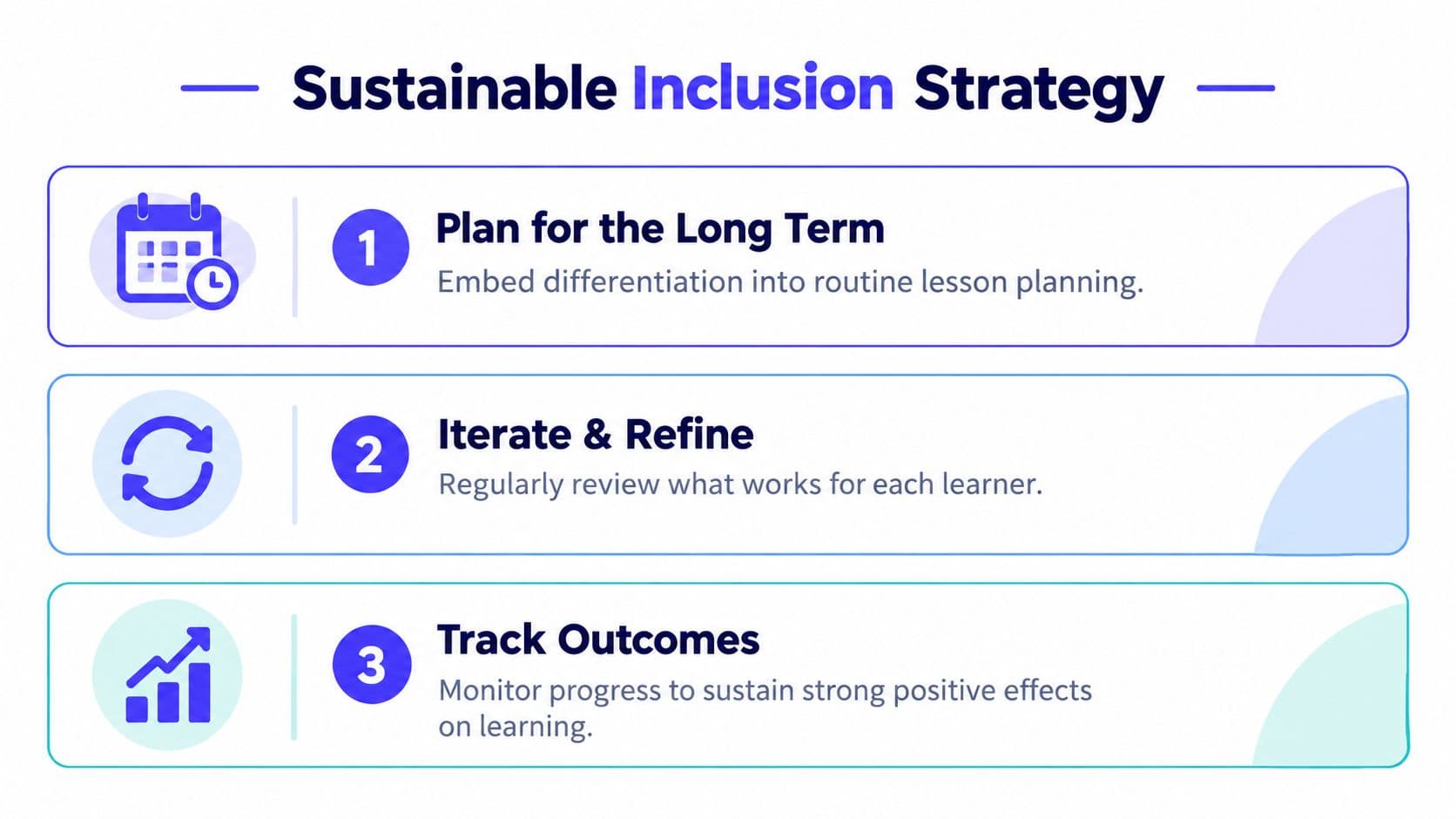
A sustainable approach has three habits:
- Plan once at the lesson level. Identify the target, likely barriers, core UDL options, required IEP supports, and the evidence you'll collect.
- Iterate from observations. Keep the visual that worked, rewrite the prompt that confused students, and remove a scaffold when the learner demonstrates independence.
- Track outcomes in usable forms. Store brief notes, work samples, response modes, and prompting levels where the team can find them.
Technology can support this cycle by generating first drafts, organizing lesson variations, and reducing repetitive formatting. It shouldn't decide whether a student receives a modification, replace a special educator's judgment, or turn IEP implementation into a menu of automated accommodations.
For a practical collection of routines, grouping ideas, and classroom adaptations, the differentiation teaching strategies guide can serve as a planning reference. The strongest systems also make disability awareness part of school culture, not a once-a-year topic. A calendar such as Waymap's 2026 awareness strategy can help schools connect classroom practice with wider conversations about accessibility and inclusion.
The position is straightforward: sustainable inclusion requires less manual reinvention and more intentional systems. Use UDL to design flexible core lessons, collaborate to connect supports to IEP goals, and use AI to prepare materials that still receive careful human review. Protecting teacher time isn't separate from supporting students. It gives teachers more attention for feedback, relationships, observation, and the specialized instruction that no automated worksheet can provide.
Kuraplan helps K–12 educators create standards-aligned lesson plans, differentiated worksheets, visuals, and assessment options in minutes, so one core lesson can become several accessible learning pathways. Visit Kuraplan to reduce repetitive preparation and build more consistent instruction for students with disabilities.