You're probably looking at a student who needs more than your core lesson, and you're also looking at your clock. The reading group needs a tighter plan. The math intervention notes are scattered across sticky notes, a spreadsheet, and whatever you scribbled during PLC. You know the support needs to be targeted, but building a usable intervention lesson plan template can feel like one more system to manage.
A good template fixes that. Not because it gives you more paperwork, but because it helps you make faster decisions. When the template is built well, you can see the student's starting point, the exact skill you're teaching, what you'll do, who's responsible, and how you'll know whether it worked. That's the difference between “extra help” and actual intervention.
What Goes into an Intervention Lesson Plan
An intervention plan is not a list of activities you hope might help. It's a working document for targeted instruction. The strongest templates grew out of MTSS and RTI planning, where teams standardized a few essential fields so support could be documented, monitored, and adjusted over time. Panorama Education's planning model reflects that structure with student identification, intervention tier, measurable goal, assigned adult, and progress monitoring schedule, all built for repeated progress checks and documented outcomes in their intervention planning guide.
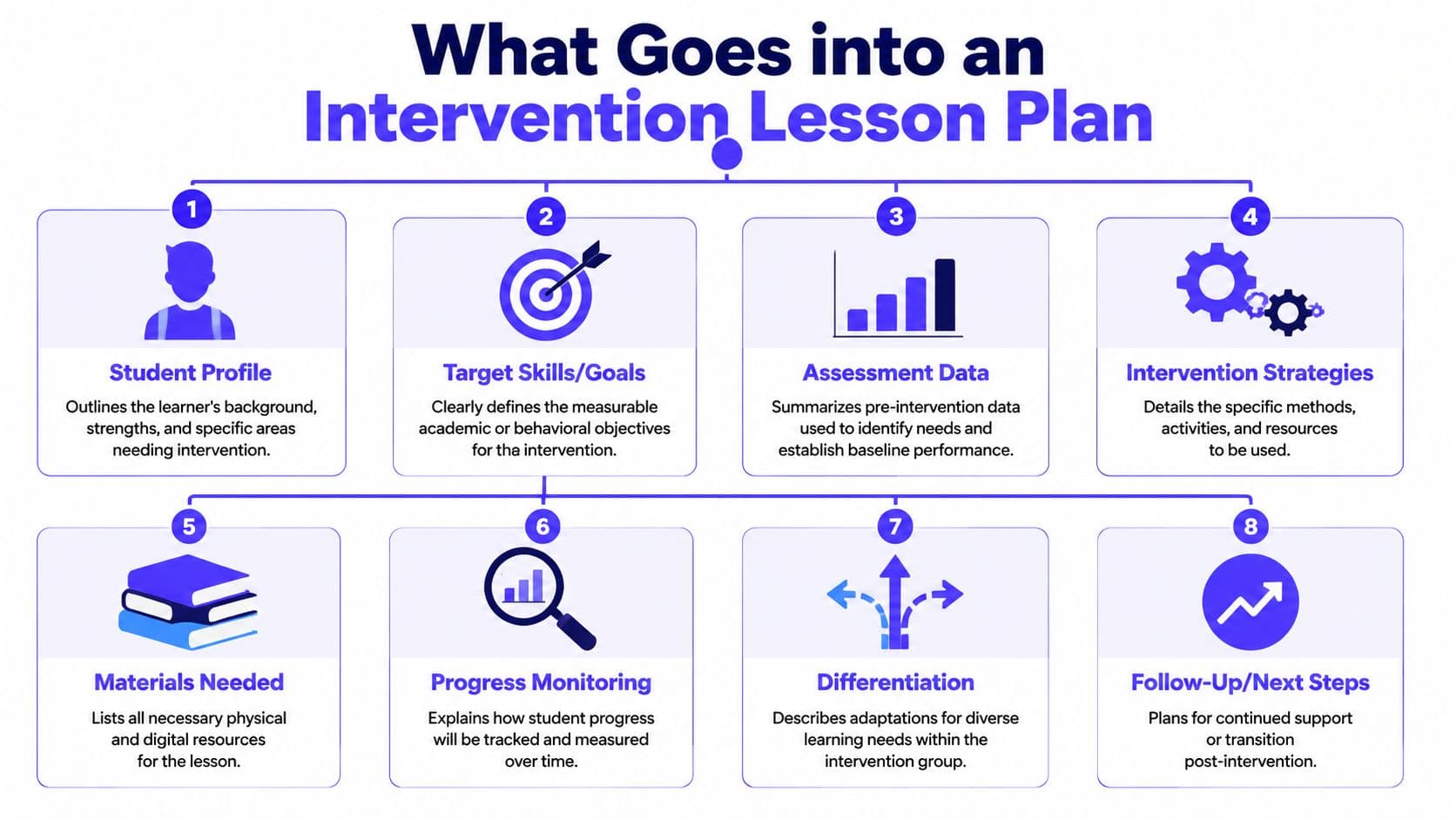
The fields that do the real work
If your intervention lesson plan template is missing any of the pieces below, you'll usually feel it during implementation.
- Student profile: Keep this short and useful. Include the learner's current need, strengths, and any context that affects instruction.
- Target skill or behavior: Name the exact thing you're teaching. “Improve reading” is too broad. “Answer literal comprehension questions from a short passage with text evidence” is usable.
- Baseline data: This is the starting point. Without it, growth turns into opinion.
- Intervention strategy: Write what you will do. Not “small group support,” but the routine, prompt, tool, or instructional move.
- Responsible staff: Someone owns the plan. If that's vague, implementation slips.
- Progress monitoring method: Decide how you'll collect evidence before you start.
- Review cycle: Put the date or cadence in the template so revision is built in.
- Materials and supports: If the lesson depends on a decodable text, a visual checklist, or sentence frames, list it.
What makes a goal measurable
A measurable goal answers three questions: what skill, under what condition, and what success looks like. State-level guidance for intervention planning also points in this direction. Arkansas's math intervention guidance describes intervention plans as specific, targeted, measurable, data-driven, aligned to standards, growth-focused, short-term, flexible, and supportive of foundational skills. It also gives a concrete example: by the end of the first quarter, a student should recall multiplication facts for numbers 0 to 6 with 90% accuracy during fact fluency.
That kind of goal works because a teacher can teach toward it and check it quickly.
Practical rule: If two teachers would interpret the goal differently, it's still too vague.
For literacy, the same principle matters even more. If you're addressing reading comprehension challenges, your template should separate decoding, fluency, vocabulary, and comprehension demands so the intervention targets the right bottleneck.
Why a template saves time later
Teachers sometimes resist intervention templates because they feel formal. In practice, the template is what reduces rework. You stop rebuilding the same plan for every student. You start with a consistent shell and customize what matters.
If you want a starting point instead of a blank page, an editable lesson plan template can help you build a version that matches your classroom workflow instead of somebody else's binder system.
Building Your Master Intervention Template
The most useful intervention lesson plan template isn't the prettiest one. It's the one you can reopen on a chaotic Tuesday and use without thinking.
Start with one reusable shell
Build one master document first. Then duplicate it by student, group, or skill area.
A practical layout looks like this:
| Section | What to include | Why it matters |
|---|---|---|
| Student snapshot | Name, grade, support context, strengths, concern area | Keeps the plan anchored to a real learner |
| Skill focus | One priority skill or behavior | Prevents overloaded sessions |
| Baseline | Current performance evidence | Makes growth visible |
| Goal | Measurable short-term target | Guides teaching decisions |
| Lesson routine | Warm-up, explicit teaching, guided practice, check | Creates repeatable structure |
| Strategy details | Prompts, materials, scaffolds, grouping | Helps adults implement consistently |
| Monitoring | What will be collected and when | Makes the plan accountable |
| Notes and revisions | What changed and why | Preserves the decision trail |
That table is your skeleton. After that, personalize.
Build for adaptation, not perfection
The mistake I see most often is teachers making a template that's too rigid. It works for one student and then falls apart for the next.
Leave flexible fields for:
- Subject-specific moves: Decodable review in reading, worked examples in math, visual checklists for organization
- Group size: Individual, pair, or small group
- Support intensity: Tier placement, session frequency, adult support level
- Accommodation notes: Language supports, chunking, visual prompts, assistive tools
A strong template should let you swap the instructional engine while keeping the planning logic intact.
The template should stay stable. The instruction inside it should change.
Keep the lesson block simple
Inside the plan itself, use a short routine you can repeat. For most interventions, a compact sequence works better than a complicated one.
- Review previously taught material
- Teach one tightly defined new skill
- Practice with support
- Check for understanding
- Record a quick note
That format works across reading, math, writing, and behavior support because it protects focus.
If you use digital planning tools, this is the point where automation can help. Some teachers build templates in Google Docs or spreadsheets. Others use planning platforms that generate an aligned lesson structure and then revise it for intervention use. Kuraplan's lesson plan generation tools are one example of a system that creates standards-aligned lesson structures, which can save setup time before you customize the intervention pieces by baseline, group, and monitoring method.
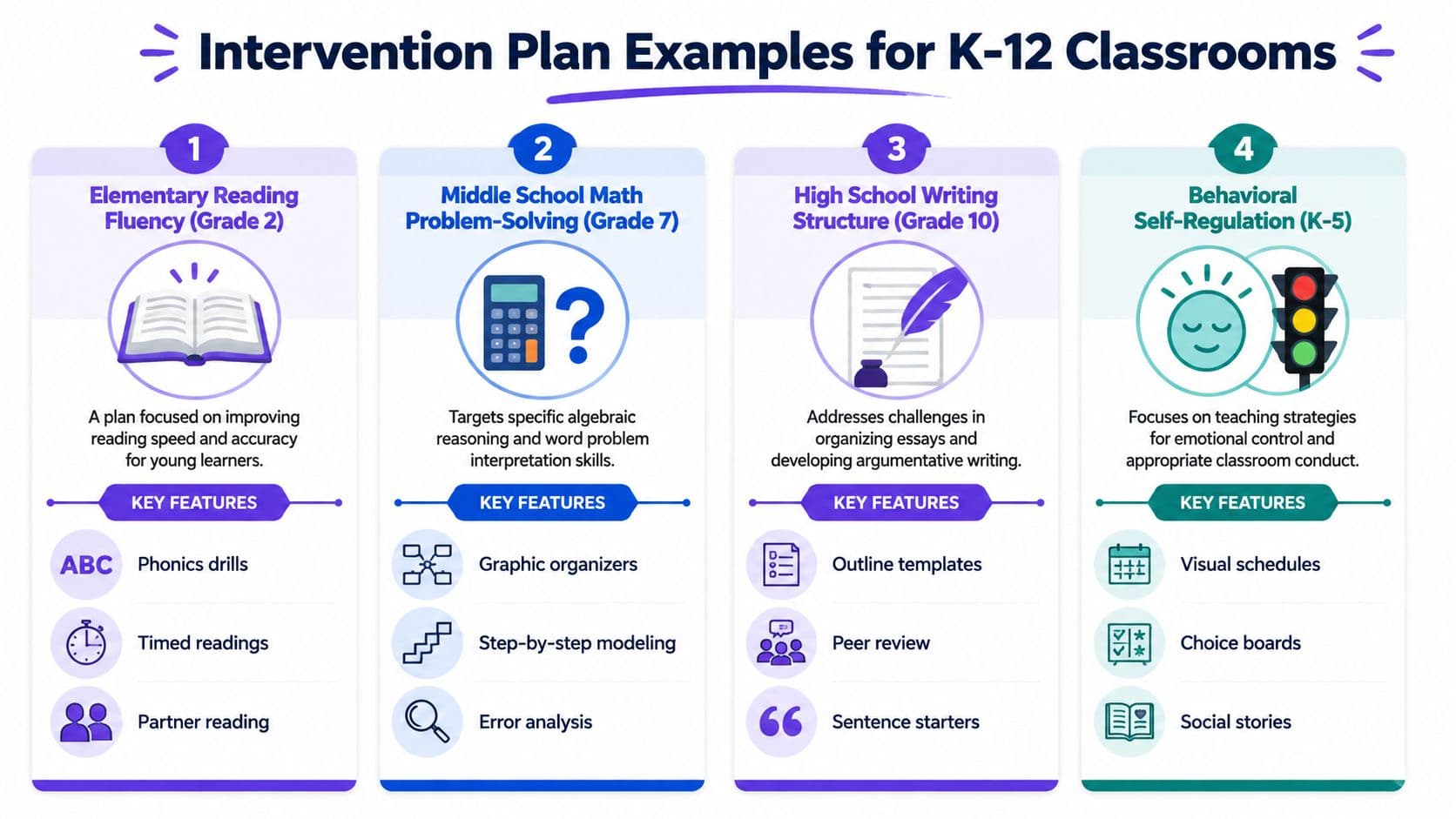
Intervention Plan Examples for K-12 Classrooms
A blank form doesn't tell you much. A filled-in plan does. These examples show how the same intervention lesson plan template can flex across grade levels and needs without turning into a different system every time.
Early literacy in primary grades
A first-grade student can identify most letter sounds but breaks down when reading words with a newly taught pattern. The teacher doesn't need a broad “reading support” plan. The student needs a narrow decoding routine.
For literacy intervention planning, experts recommend a scope-and-sequence approach. Define skill buckets, map progressions, group students using data, and keep lesson timing predictable. Within the lesson, use previously mastered material for review, introduce one new phonogram or sound pattern at a time, and keep practice sets small, such as 10 to 15 review words and 5 to 10 spelling words, to reduce cognitive load and preserve success during decoding and spelling practice in this structured literacy planning article.
A filled plan might look like this:
- Need: Student confuses a newly introduced sound pattern with previously taught patterns
- Baseline: Teacher notes from decoding checks show inconsistent accuracy with the new pattern
- Goal: Read and spell words containing the target pattern during guided practice with increasing independence
- Strategy: Review mastered patterns, teach one new pattern explicitly, practice with a small word set, finish with sentence reading
- Materials: Sound cards, word cards, dictation lines, short decodable text
- Monitoring: Quick decoding record and dictated words each session
The point isn't the exact wording. It's the clean alignment between need, instruction, and check.
A differentiated practice page can help when students in the same group need different entry points. A differentiated learning worksheet is one way to keep the task format consistent while adjusting the support level.
Upper elementary math intervention
A fourth-grade student understands single-step problems but gets lost in multi-step tasks. This kind of plan falls apart when the strategy field says only “reteach.”
A stronger version is more concrete:
| Plan element | Example entry |
|---|---|
| Concern area | Multi-step word problem solving |
| Baseline | Student can complete the computation after teacher setup but struggles to identify steps independently |
| Goal | Use a problem-solving organizer to identify important information, choose an operation sequence, and solve with explanation |
| Strategy | Teacher models one problem using a visual organizer, student completes one with support, then one independently |
| Monitoring | Collect student work and note where breakdown occurs |
This works because the intervention targets the process, not just the answer.
Middle school executive functioning support
A seventh-grade student knows the content but misses assignments, loses materials, and starts tasks late. Academic intervention templates still work here if you shift the target from content to behavior.
In this case, the plan can include:
- Target behavior: Bring required materials and begin assigned task within the expected routine
- Baseline: Teacher observation shows inconsistent task initiation and incomplete organization
- Strategy: Visual checklist, end-of-class materials check, brief teacher conference, planner routine
- Responsible adult: Advisory teacher or case manager
- Monitoring: Daily checklist review and weekly team check-in
Many teams overcomplicate things. If the plan requires five adults and constant data entry, it won't last.
Later in the week, it can help to see another teacher talk through intervention planning in action:
High school functional communication
A high school student in a special education setting may need support with functional communication rather than a grade-level academic standard. The template still holds.
Keep the structure. Change the content. That's how one template serves a wide range of learners.
A completed plan might focus on requesting help, expressing a need, or using a communication support consistently during instruction. The measurable evidence might come from teacher tallies, communication logs, or routine-based observation rather than a quiz. That's still valid intervention planning, as long as the target is specific and the data method matches the skill.
From Plan to Practice Classroom Implementation Tips
Good intervention plans fail for boring reasons. No one can find the materials. The support block gets swallowed by transitions. A para wasn't sure what to do, so the session turned into homework help. Implementation problems usually aren't about teacher effort. They're about friction.
Make the plan easy to run
A usable intervention lesson plan template should fit your school day, not an idealized schedule. That means planning around real constraints.
- Protect a repeatable slot: Tie intervention to a block that already exists, such as stations, WIN time, advisory, or a settled start-of-day routine.
- Prep one container per group: Put texts, manipulatives, checklists, and recording sheets in one place so setup doesn't eat the session.
- Use a visible routine: Students work better when the intervention block feels familiar. The routine reduces direction-giving and buys back minutes.
- Write adult moves into the template: If a paraprofessional or co-teacher is involved, script the prompts, cues, or data task.
Group by need, not convenience
Teachers are often handed groups based on who can fit at the same table. That saves scheduling time and costs instructional precision.
A stronger grouping rule is simple: keep students together only if they need the same kind of teaching. A student who needs decoding support and a student who needs oral language support may both struggle with reading, but they don't need the same intervention lesson.
If the strategy changes for every student in the group, it isn't really a group.
Plan the handoff
Interventions get more consistent when everyone involved knows what success looks like. That includes classroom teachers, specialists, paraprofessionals, and families when appropriate.
Use your template to communicate three things clearly:
- What the student is working on
- What adults should reinforce
- What evidence will be watched
That kind of clarity keeps intervention from becoming isolated work that disappears outside the intervention block.
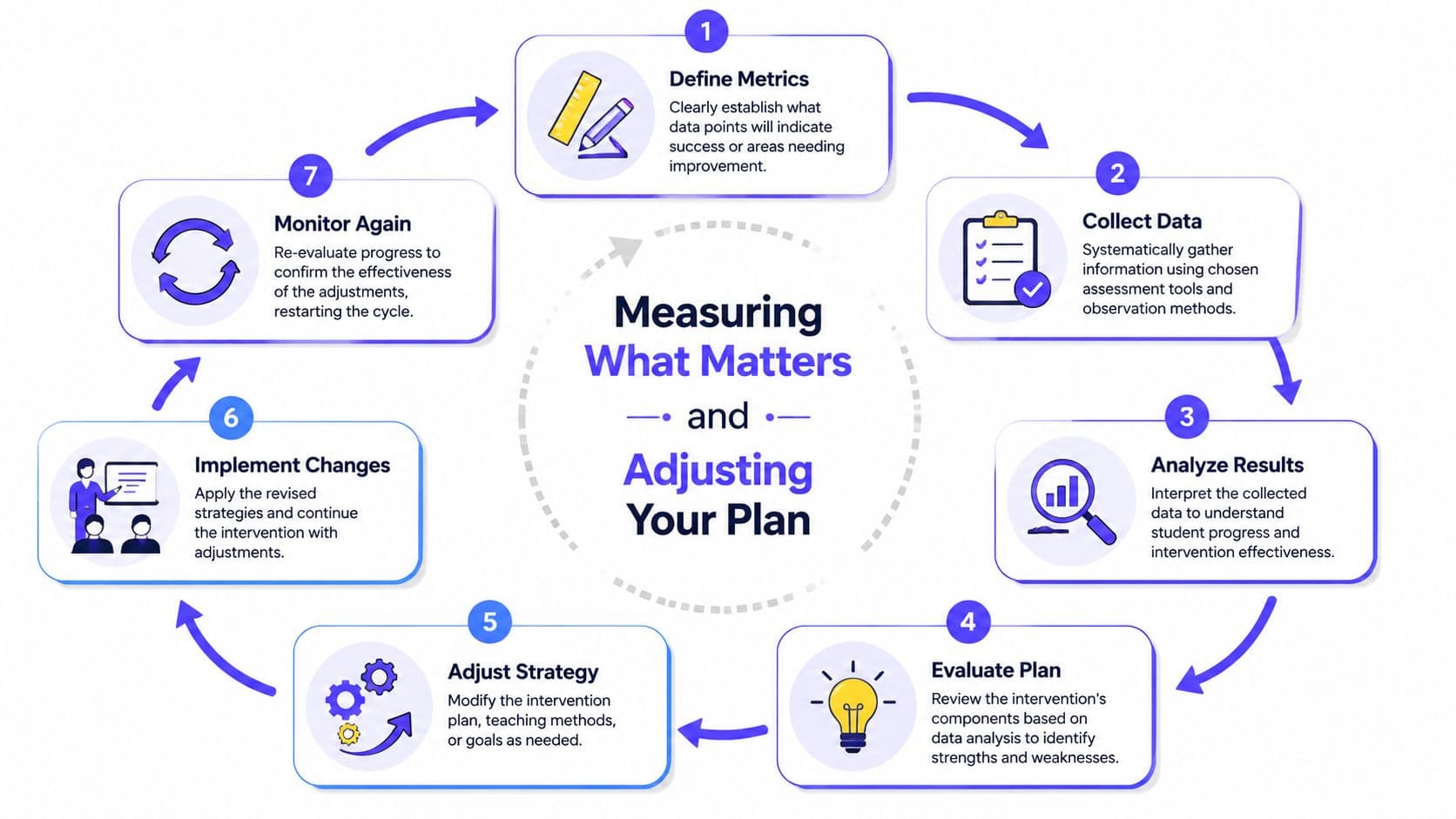
Measuring What Matters and Adjusting Your Plan
A plan only earns its keep if it helps you answer one question: is the student changing in the way we expected?
Choose data you can actually collect
The best progress monitoring system is lightweight enough to survive a busy week. Match the method to the skill.
| Skill type | Useful monitoring method |
|---|---|
| Decoding or fluency | Quick read, error record, timed passage sample |
| Math process | One worked problem, error analysis note, strategy checklist |
| Writing | Short rubric, sentence sample, organization checklist |
| Behavior or routines | Tally, checklist, frequency note, brief observation log |
Don't build a data system so large that you avoid using it. For most interventions, a short recurring measure beats a complicated one you only complete twice.
Review on a real cycle
High-quality intervention planning includes a review cycle on purpose. Guidance for intervention templates recommends reviewing and revising every 4 to 6 weeks, with progress monitoring set as weekly, bi-weekly, or monthly so teams have enough repeated measures to detect a trend against baseline rather than relying on anecdotal impressions in this intervention template guidance.
That matters because interventions need enough runway to show a pattern, but not so much time that an ineffective plan drags on.
How to decide whether to change course
Look for trend, not a single good day or rough day. If the student's data shows movement toward the target, keep going and tighten support where needed. If there's no meaningful shift, inspect the plan before blaming the student.
Ask questions like these:
- Was the target too broad?
- Did the strategy match the skill gap?
- Was the intervention delivered consistently?
- Did the student need a different scaffold, text level, or grouping arrangement?
Data should help you change instruction. It shouldn't just document that a student struggled.
The best teams treat intervention as a cycle: define, teach, check, revise. When that cycle is built into the template, progress monitoring becomes part of teaching instead of an extra task.
Frequently Asked Questions About Intervention Plans
Is an intervention lesson plan template different from a regular lesson plan
Yes. A regular lesson plan covers core instruction for the class. An intervention lesson plan template is narrower and more diagnostic. It focuses on a specific skill or behavior, starts from baseline evidence, and includes a monitoring method so you can judge whether the support is working.
How detailed should my template be
Detailed enough that another adult could run it correctly, but not so detailed that you avoid using it. If the form takes longer to complete than the intervention takes to teach, it's too heavy. Keep the structure consistent and the notes focused on what affects instruction.
Can one template work for reading, math, and behavior
Yes, if the core fields stay broad and the strategy section stays flexible. The framework can remain the same across subjects. What changes is the target skill, the instructional routine, and the way you collect evidence.
What if I don't have strong baseline data yet
Start with the clearest evidence you do have. That might be a work sample, a quick probe, an observation checklist, or notes from a brief diagnostic task. Then tighten the baseline during the first few sessions. Waiting for perfect data often delays support that should start now.
How often should I rewrite the whole plan
Usually, you shouldn't need to rewrite the whole thing often. Revise the goal, strategy, grouping, or monitoring notes when the data suggests it. The template should be stable enough that updates feel like adjustments, not a restart.
Who should have access to the plan
Anyone responsible for carrying out part of the intervention should be able to see the relevant pieces. That may include classroom teachers, interventionists, special educators, case managers, or support staff. Shared visibility reduces mixed messages and keeps the instructional moves consistent.
If you want a faster way to turn strong intervention thinking into usable planning documents, Kuraplan can help you build standards-aligned lessons, templates, worksheets, and visuals without starting from scratch each time. It's useful when you already know the student need and want to spend less time formatting and more time teaching.