At 7:14 a.m., your coffee is already going cold beside the copier. The kindergarten math lesson plan is open on your phone, three children are arguing in the block corner, and one child is crying because his snack has been cut into halves. The plan says “practice number relationships,” but it doesn't tell you what to do when half the class is still reciting numbers by rote and the other half is ready to take apart five in several ways.
That's work of kindergarten math planning. Standards give you direction, but the plan has to survive interruptions, uneven readiness, short attention spans, and the moment when a child reveals a misconception you didn't anticipate. A useful plan isn't a form you complete and file away. It's a live decision document with clear places to pause, reteach, retain, or move forward.
The running example here is a lesson on decomposing numbers to 5. The same planning moves also apply to counting, comparing quantities, composing numbers, shapes, measurement, patterns, and data.
The Reality of Planning Kindergarten Math
A polished template can still produce a weak lesson. I've seen plans with attractive activities, standards copied neatly at the top, and a closing question that arrives far too late to help the children who got lost during the first few minutes.
The trouble usually starts in one of three places:
- The objective is fuzzy. “Students will understand numbers” doesn't tell you what to listen for or look for.
- The activity skips the concrete stage. Children are asked to write equations before they've handled objects or represented the parts visually.
- The assessment comes after the teaching is over. By then, you know who struggled, but the class has already packed up.
A kindergarten math lesson plan must make room for what children can do now, not only what the curriculum map says they should do eventually. The National Academies' early math framework identifies using cardinal counting to solve simple number problems with totals up to 10 as a foundational kindergarten milestone, while an earlier progression for approximately four-year-olds uses totals up to 8 (National Academies early math milestones). That progression is useful because it reminds us that kindergarten instruction should move beyond chanting the counting sequence toward relationships, numerals, and problem solving.
Practical rule: Write the plan you can adjust, not the plan you hope nobody interrupts.
For a decomposing-to-5 lesson, the live decision might sound like this: “Most children can show five as four and one, but several still need to count every object from the beginning. I'll keep the whole-group model short, pull those children for dot-card work, and give confident children a hidden-parts challenge.”
That sentence is more useful than another decorative activity. It tells you what evidence matters, what action follows, and how the lesson stays coherent even when students begin at different points.
The Institute of Education Sciences recommends teaching geometry, patterns, measurement, and data analysis through developmental progressions, alongside early number and operations work (IES-aligned developmental math milestones). So a strong plan isn't a string of counting games. It's a carefully sequenced response to what children already know and what they're ready to notice next.
Setting Clear Objectives and Success Criteria
Start with the learning, not the activity. “Use counters to make five” describes what children will touch. It doesn't tell you what mathematical understanding they should demonstrate.
For the decomposing-to-5 lesson, the content objective could be:
Students will show that 5 can be made from two parts and represent the parts with objects, drawings, and an equation.
The child-friendly version might be:
I can break 5 into two parts and show my thinking.
That gives children a reachable target while keeping the teacher's version precise. The success criterion should be observable quickly, even while children are sitting at the carpet:
Students will represent at least one decomposition of 5 when given five counters and a two-part mat.
The phrase “when given” matters. It identifies the support or condition, and it prevents the criterion from becoming so broad that every response appears successful.
Build the three objective layers
Kindergarteners often understand more than they can explain. Include a language objective so you can separate a math gap from a vocabulary gap:
Students will use the words part, whole, and equation to explain how two parts make 5.
Teach the vocabulary directly. Don't assume a child understands that:
- Decompose means to break a whole number into smaller parts.
- Part means one piece or amount within a whole.
- Whole means the complete amount.
- Equation means a number sentence that shows two amounts are equal.
Model the words with the objects in front of you. Move five counters into two groups and say, “The whole is five. This group is one part. This group is another part. My equation is 1 + 4 = 5.”
The learning intentions and success criteria guide can help you keep the objective, child-friendly statement, and evidence aligned rather than writing them as separate pieces.
| Component | Written Example | Common Trap |
|---|---|---|
| Content objective | Students will show two parts that make the whole 5. | Writing “Students will use counters,” which names an activity |
| Language objective | Students will say, “___ and ___ are parts. Five is the whole.” | Expecting children to explain without teaching the vocabulary |
| Success criterion | Students will show one decomposition of 5 with five counters and an equation. | Using “understand” or “know” without observable evidence |
A common before-and-after makes the difference clear.
Before: Students will practice decomposing numbers using a five-frame.
After: Students will place five counters into two groups, draw the groups, and write or dictate an equation showing how the parts make 5.
The first statement tells you what materials to prepare. The second tells you what children must do and what evidence you should collect. Keep that structure visible in the plan, because it becomes your decision point when the room gets noisy or the activity takes an unexpected turn.
Building the Lesson Arc That Holds Attention
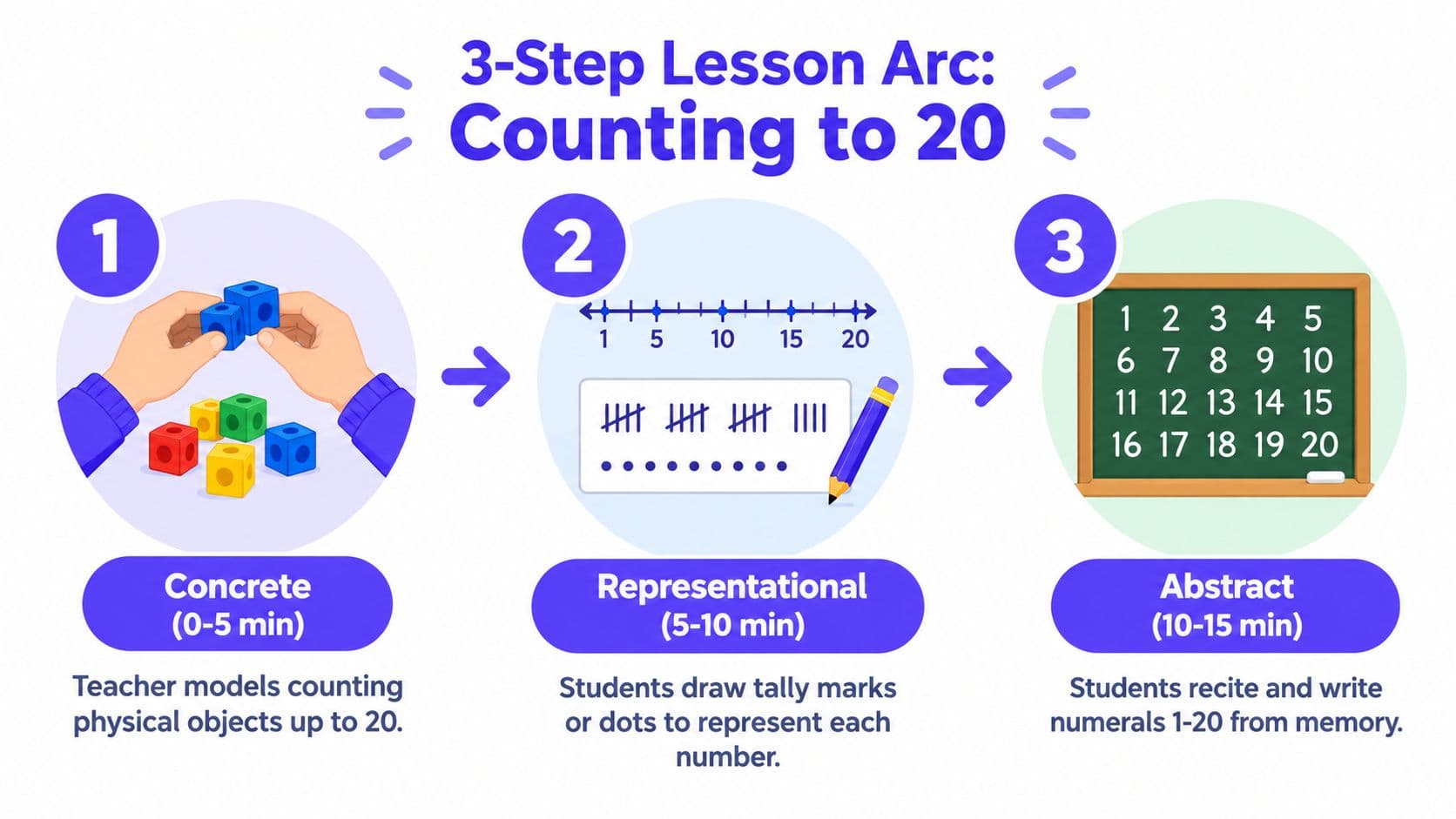
A kindergarten math lesson needs a dependable rhythm, but it shouldn't feel like children are waiting through one long explanation. The concrete–representational–abstract sequence gives you a useful spine. Children handle objects first, represent their thinking with drawings or marks, and then connect that thinking to numerals and equations. Reviews of early numeracy interventions have found that explicit, systematic instruction using this kind of progression was associated with meaningful gains, including an average kindergarten intervention effect size of g = 0.47 and improvement of about 18 percentile points on average (review of effective early numeracy interventions).
Use counting by ones to 20 as the anchor for this sample arc.
Five moves that keep the math moving
Minutes 0 to 2, number sense warm-up. Show a small collection of counters and ask children to count by touching one object for each number word. You're watching for skipped objects, double counting, and children who recite the sequence without tracking. A standards-based counting target includes counting by ones and tens to 100, with one-to-one correspondence when counting objects (kindergarten counting standards).
Minutes 2 to 7, manipulative hook. Place a line of objects on the floor and model touching each one while counting to 20. Ask, “How do we know we counted every object?” Children can move, tap, or point as they count. If attention starts to slide, let them stand and step once for each group of objects while keeping the counting sequence audible.
Minutes 7 to 17, guided exploration. Give pairs a collection and ask them to build, count, and check. You circulate with one question: “What did you count first?” That question reveals whether a child understands the counting process or is copying a partner. Some children will count the same object twice, while others will believe the final number word is just another label rather than the total.
Minutes 17 to 32, student work block. Children draw the objects they counted, add tally marks or dots, and connect the representation to written numerals. Keep the abstract demand modest. A child who can count a set accurately may not yet write every numeral, and that writing difficulty shouldn't hide the counting evidence.
Minutes 32 to 37, share-out and check. Invite two children to show different methods. One might use counters, while another draws dots. Name the connection explicitly: “Your objects and your drawing both show the same amount.” End with a quick prompt, not a long discussion.
Children often lose focus after about eight minutes seated, so use a brief movement reset before the work block. Have them count steps to their tables, tap the next number on a floor number line, or pass a counter while continuing the sequence. The transition still carries mathematical content.
For additional classroom ideas on keeping children physically involved in learning, see Ocodile hands-on learning tips. A short video can also give you another model for active early math instruction:
The exact minutes will shift. The order matters more than the clock. If children can't accurately handle the objects, don't rush them to symbols because the plan says it's time.
Differentiation Moves for Mixed-Readiness Rooms
Mixed readiness doesn't require four separate lesson plans. It requires four clear responses to evidence. In a decomposing-to-5 lesson, you can decide whether to retain, reteach, extend, or split by watching one or two attempts with counters and listening to the explanation.
The decision matrix below is designed for the moment when you're standing beside a table and need an answer quickly.
| Move | What It Looks Like | When To Use It | Time Cost |
|---|---|---|---|
| Retain | Replace a familiar counting activity with a hidden-parts challenge using a five-frame. Add a write-the-room hunt for equations that equal 5. | The child already shows the target skill accurately and explains at least one way to make 5. | Low planning cost, strong payoff because the child stays challenged |
| Reteach | Pull a small group to the carpet for a brief dot-card lesson. Show a small collection, cover part of it, and ask children to identify what they see and what is hidden. | The child missed prerequisite subitizing and must count every dot without recognizing small amounts. | Low preparation cost, immediate support for the missing foundation |
| Extend | Ask finishers to record two different ways to make 5 and draw the matching number bond. Invite them to explain which representation is easiest to check. | The child can show and explain several decompositions without copying a model. | Moderate preparation, useful evidence for the next lesson |
| Split | Divide the class into two teacher-led groups. One group uses counters and five-frames, while the other sorts equation cards or completes a matching task with a partner. | A large portion of the class needs reteaching while another group is ready for independent application. | Higher planning cost, better use of teacher attention and student time |
The distinction between retain and extend is easy to blur. Retain means you keep the same target but remove unnecessary repetition. Extend means you increase the reasoning demand. A child who already knows 2 + 3 = 5 might be asked to find every decomposition of 5, compare two representations, or defend a choice.
Keep the split manageable
When you split the class, prepare materials in two trays before the lesson. The reteach tray needs counters, dot cards, and five-frames. The independent tray needs equation cards, a simple recording page, and a clear partner routine. Children shouldn't need you to explain the directions repeatedly while you're teaching the other group.
The differentiation teaching strategies guide is useful when you're deciding how to vary support without changing the central mathematical goal.
In-the-moment test: If the child's error tells you what to change next, you have formative evidence. If it only tells you the child got an answer wrong, you need a better prompt.
Use the smallest move that addresses the evidence. Don't split the whole class because two children need dot cards. Don't keep everyone on a basic counting routine because three children are still developing one-to-one correspondence.
Assessment Items and Printable Worksheet Examples
Assessment in kindergarten should feel like another way to show thinking, not a surprise test at the end. Use a low-floor entry check, an on-level task, and a stretch prompt. Then decide in advance what each response will make you do.
Three checks with three next steps
Item 1, low-floor five-frame flash. Fill a five-frame and point to it for three seconds. The child writes the matching equation or dictates it to you. A child who records 3 = 2 + 1 has shown a possible decomposition, but you still need to check whether the child understands the whole and the parts or copied a familiar pattern.
Group children who need it for a focused small-group reteach on hidden parts while the rest begin the next activity. Use dot cards, cover one section of the frame, and ask, “What do you see? What is hiding? How many altogether?”
Item 2, on-level printable task. Give students a page with a target number, a five-frame, two empty circles for a number bond, and two equation lines. Ask them to show two ways to decompose the target number. If a child draws the right number of counters but writes the numerals backward, that may be a recording issue rather than a number-relationship issue. If the drawing contains too many or too few objects, revisit counting and quantity before emphasizing equation notation.
Item 3, stretch task. Ask children to find all the decompositions of 5 and explain which one they'd teach to a friend first. Their choices can seed the next lesson. A child who lists several pairs but can't explain why the whole stays 5 may need language support, while a child who explains the invariant whole is ready for a more open problem.
The worksheet should be uncluttered enough that the page doesn't become the challenge. Put the target number near the top, with a large five-frame below it. Place the number-bond circles beside the frame, followed by two equation lines. Add a small word-bank corner with part, whole, and equation, a self-check strip at the bottom showing “I counted all,” “I showed two parts,” and “I checked my equation,” plus a one-line parent note: “Today we practiced breaking 5 into two parts and showing each part with an equation.”
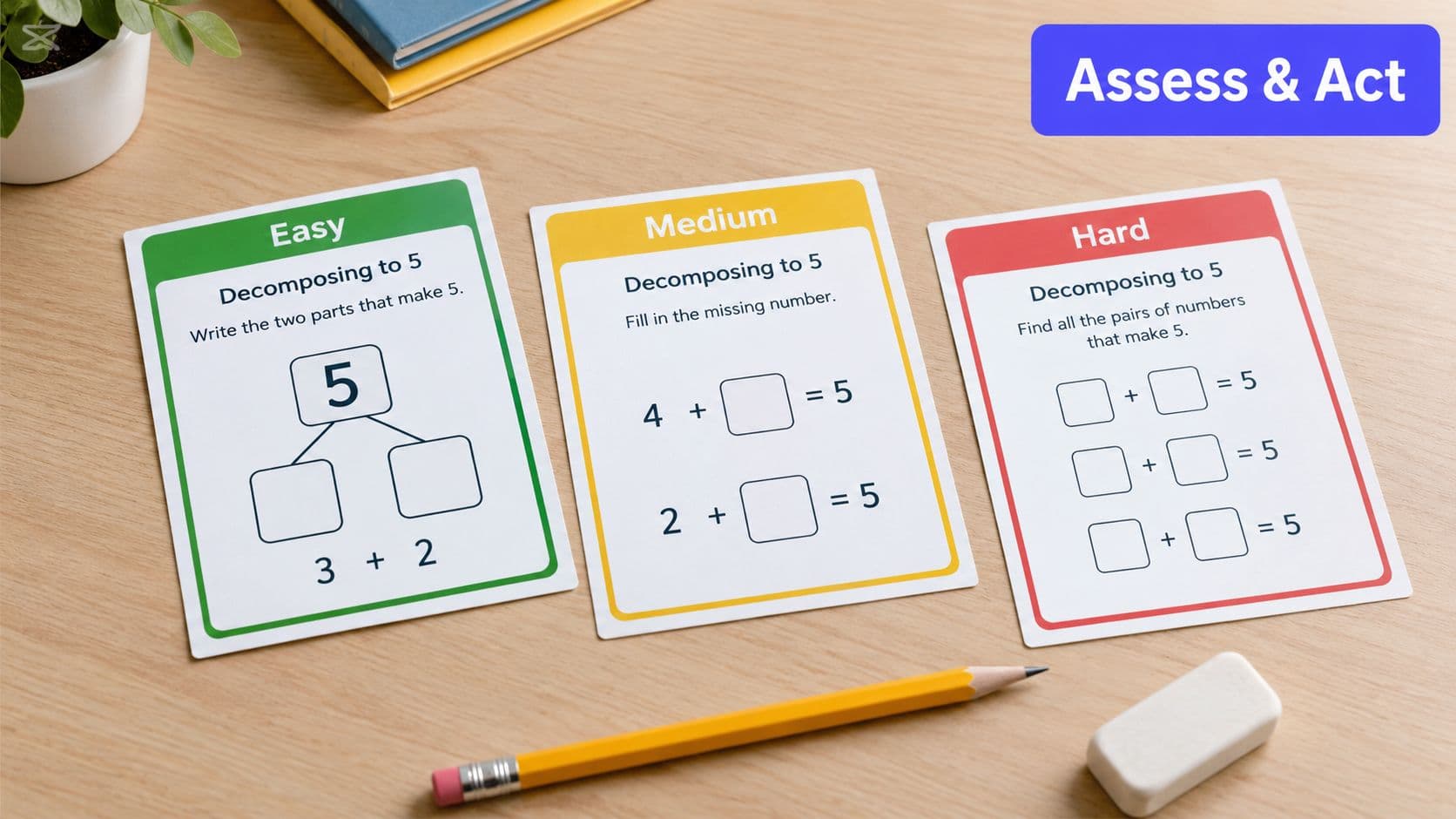
You can use kindergarten math worksheets as a starting point, then adjust the amount of writing, visual support, and number range to match the evidence from your class. A worksheet shouldn't replace manipulatives. It should capture thinking after children have had a chance to build and discuss it.
The assessment can be quick, but the response shouldn't be vague. Mark each child as ready to continue, needing a prerequisite review, needing language support, or ready for a deeper task. That makes tomorrow's grouping decision much easier.
Turning One Lesson Into a Week of Coherent Math
A single kindergarten math lesson can introduce decomposing to 5, but a week gives children time to revisit the idea in different forms. Repetition matters when the representation changes. Repeating the same worksheet five times doesn't create the same kind of understanding.
The Common Core kindergarten focus includes representing, relating, and operating on whole numbers with sets of objects, as well as describing shapes and space. It also connects content to the eight Standards for Mathematical Practice, which ask children to reason, explain, and engage with mathematics rather than only produce answers (Common Core mathematics standards).
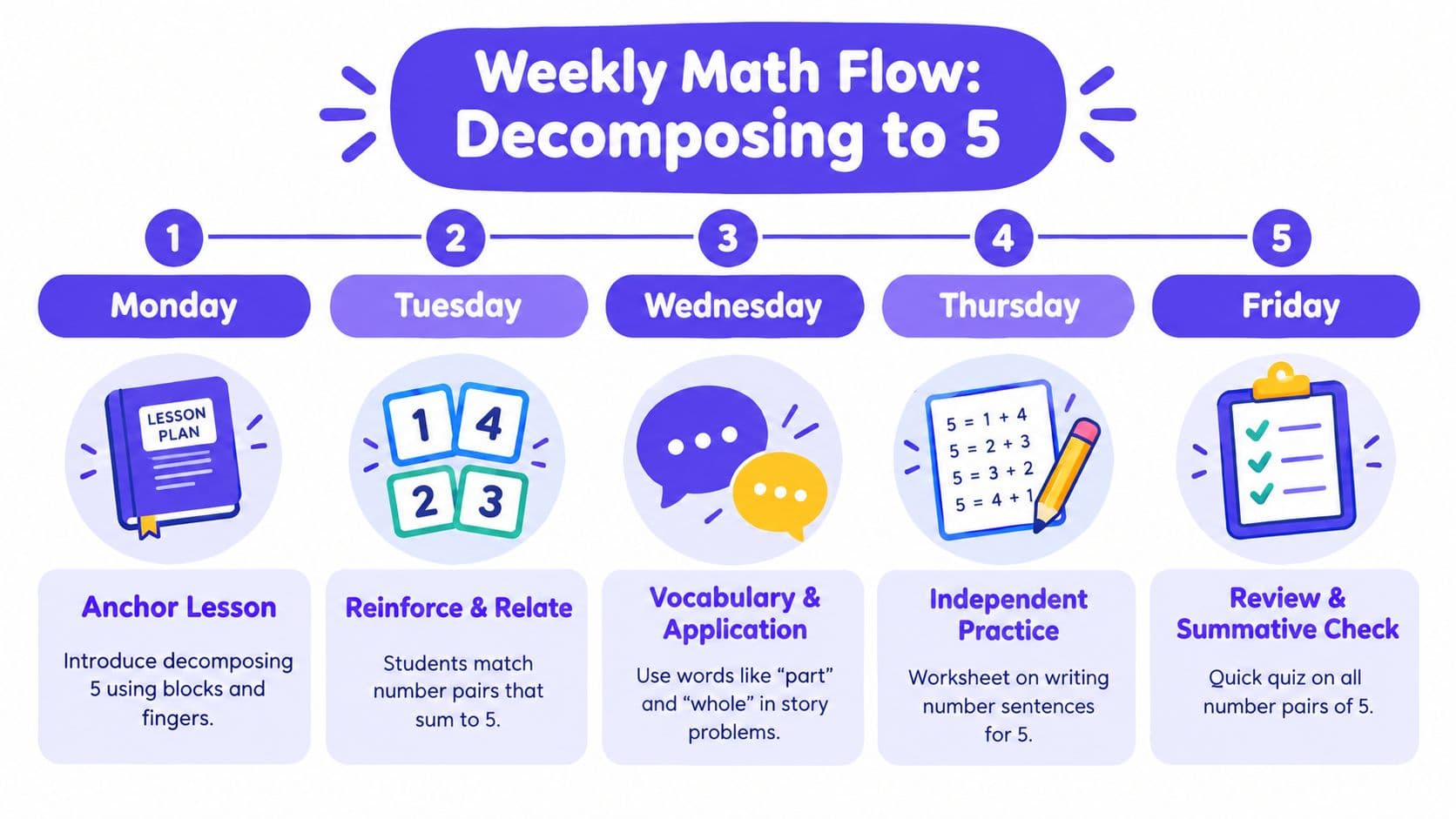
A five-day rhythm
Monday, anchor lesson. Introduce decomposing 5 with counters, fingers, and a five-frame. The main evidence is whether children can separate the whole into two parts and describe what they made. This day addresses whole-number representation and begins the practice of explaining reasoning.
Tuesday, reinforce and relate. Reuse the five-frames, but add a counting-on warm-up. Children match number pairs that make 5 and check each pair with counters. Keep the representation familiar while reducing teacher modeling.
Wednesday, vocabulary and application. Put the mathematics into a snack-sharing story. Children act out one whole snack being shared into two parts, then use part, whole, and equation while explaining what happened. The story gives language a job instead of treating vocabulary as a separate memorization task.
Thursday, independent practice. Children complete a partner number-bond sort, then move to a short recording page. One partner builds a pair, and the other finds the matching number bond or equation. Switch roles so both children must represent the relationship.
Friday, review and evidence. Hold short conferences while the rest of the class works through a familiar matching task. Ask each child to show a way to make 5, then use a one-page exit ticket to capture whether the child can represent, record, and explain the relationship independently.
Idaho's kindergarten standards guidance distinguishes essential standards, supporting standards, and additional standards. Essential standards receive explicit teaching, repeated assessment, and targeted intervention, while supporting standards reinforce the main work and additional standards extend it when time allows (Idaho kindergarten math standards guide). Use that distinction to keep the week narrow. Choose one essential target, one or two supporting skills, and one possible extension.
A short Sunday planning routine keeps the sequence usable. Sketch the five-day arc, name the evidence you'll collect each day, and flag the differentiation move most likely to matter. Kuraplan can help organize standards mapping, lesson progression, worksheets, and assessment materials in one planning view, but your observation notes should still determine what gets retained, retaught, extended, or split.
Use Kuraplan to turn the decomposing-to-5 sequence into a standards-aligned kindergarten math lesson plan, then adapt the objectives, worksheets, and assessment prompts to your children's actual responses. Build the week before Monday morning, print the materials you need, and leave space in the plan for the decision you'll make after you see the math.