Monday morning, the copier line is long, and the social studies block is the short one. You need a format that fits the grade, the topic, and the minutes you have, then a fast path from that idea to standards-aligned lessons students can hold on paper.
Time is the constraint that should drive the choice. Federal survey data for 2011-12 found that teachers in grades 1 to 4 reported an average of 2.4 hours per week on social studies, compared with 11.4 hours on English language arts, 5.9 on mathematics, and 2.5 on science, as Education Week's account of the history and civics squeeze reports. Later survey evidence from 2021-22 placed K-5 social studies at about 3 hours a week. A 2012 study found time fell by about 30 minutes per week after No Child Left Behind, and earlier national figures showed grades 1 to 6 dropping from 3.0 hours in 1999-2000 to 2.6 in 2003-04.
That is why a pile of activities fails and a repeatable format works. Use sourcing when the goal is evidence. Use an inquiry arc when a unit needs a destination. Use jigsaw or a map lesson when you have one or two periods. Save the civic project, mock trial, and seminar for days when talk and action are the learning.
The eight social studies lesson plans below are classroom formats, not scripts. Each one names what to print, how to differentiate, and what to score. Once the format is chosen, Kuraplan can map objectives, build a rubric, and spin the same plan into a worksheet.
1. Reading Like a Historian Sourcing and Corroboration Lesson
A grade 8 class sets a patriot engraving beside a British account of the Boston Massacre of 1770. Nobody writes "what happened" until they can say who made each source, when, and why. That routine, built from the historical thinking skills associated with the Stanford History Education Group, treats history as an argument from evidence.
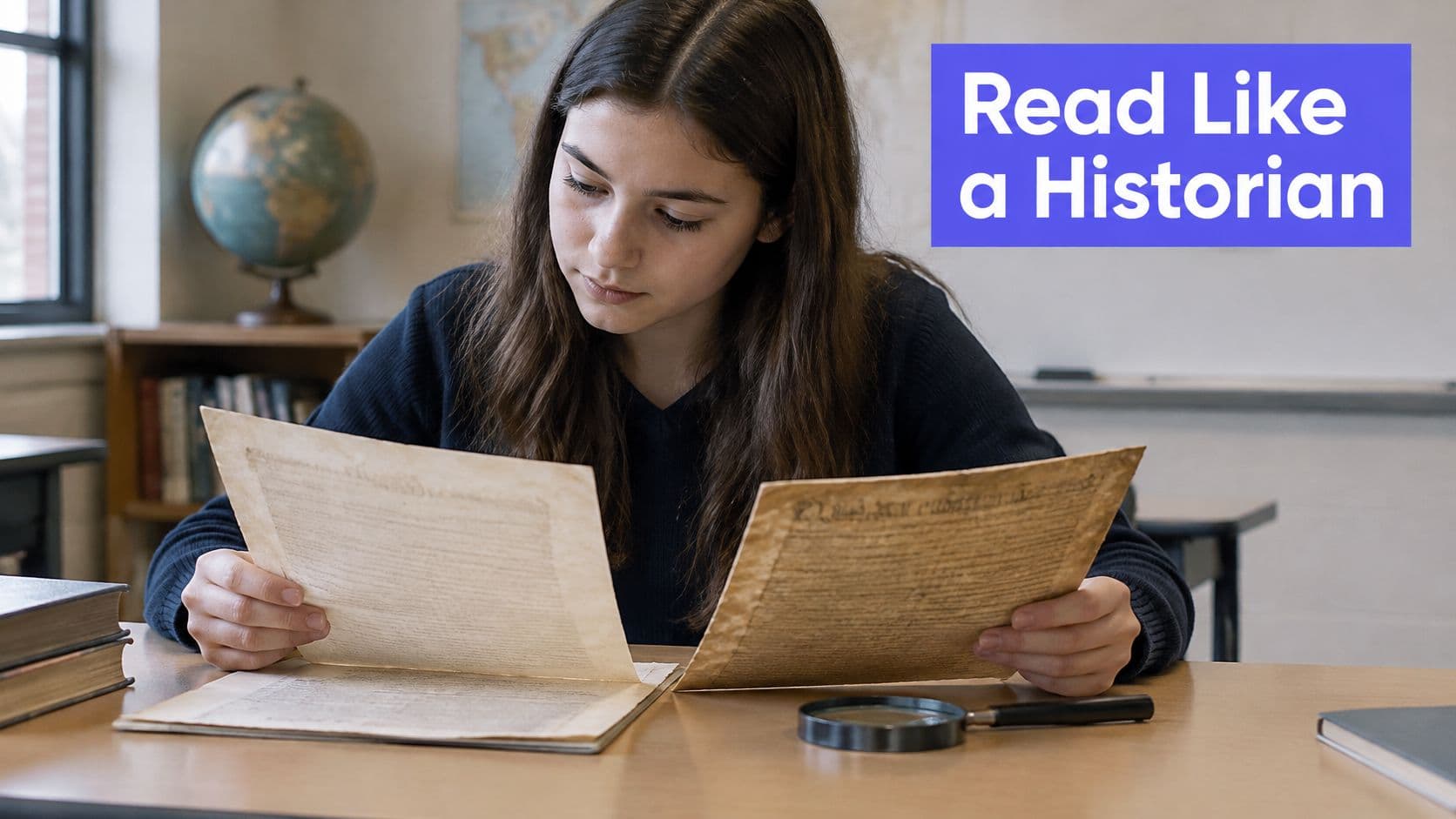
Keep the task smaller than the packet.
- Source first: Put author, date, and purpose on a card that stays on the desk.
- Corroborate second: Students mark where accounts agree and where they split.
- Claim last: One sentence states what the evidence can and cannot support.
A high school U.S. history class runs the same three moves on Civil War editorials from northern and southern papers. The trade-off is length. Two short sources finish in a period. A thick packet becomes a reading race, and the thinking disappears.
Model one source out loud, then release pairs. Close with an exit ticket that asks for one reason an author might be biased. If you lecture the background first, the iScribe Live Transcribe lecture note tips help you turn a recording into a one-page brief. When reading levels spread wide, Kuraplan can draft simpler versions of the same sources and matching questions so the historical task stays the same.
2. The C3 Framework Inquiry Arc
Start with the question, not the worksheet. The College, Career, and Civic Life (C3) Framework, published by the National Council for the Social Studies after a three-year state-led effort, lines a unit up in four dimensions: questions, disciplinary tools, evidence, and conclusions that can lead to informed action. NCSS describes the framework as a way to raise rigor in civics, economics, geography, and history while lining social studies up with literacy expectations.
Practical rule: If you cannot name the compelling question and the final action, you do not have a unit yet. You have a folder of activities.
A fourth-grade class asks, "Why did people move west?" Supporting questions cover routes, laws, and who was pushed aside. The action is a letter to a local museum about what the exhibit leaves out. A high school government class investigates a local ordinance and presents recommendations at a school board meeting. Both end somewhere public, which is the point students feel.
Plan backward in this order.
- Question: Write it so a student can argue more than one answer.
- Action: Decide the audience before you assign sources.
- Evidence: Pick texts and data that can answer the supporting questions.
What does not work is a poster with no decision attached. Keep a running list of student questions. Those often become the next unit. Kuraplan can draft a unit outline from the compelling question. You still rewrite the supporting questions so they match your standards and your minutes.
3. Jigsaw Cooperative Learning on Westward Expansion
Five experts, one timeline, one period and a half. In a fifth-grade jigsaw on Westward Expansion, home groups split the Oregon Trail, the Homestead Act, the Transcontinental Railroad, Native nations' losses, and daily life on the trail. Expert groups master a one-page guide, then go home and teach. Elliot Aronson's 1971 jigsaw was built so every student depended on every other student. That structure still covers a wide topic without a lecture marathon.
A 2025 National Council for the Social Studies publication names the spread of skills, background knowledge, and reading levels as a real barrier. Jigsaw fails when the "expert" page is written for only the fastest readers. It works when each guide has the same three questions, a visual, and a role: summarizer, questioner, or visual builder.

A middle school class can run the same pattern on the Industrial Revolution: factories, child labor, urbanization, transportation, and reform. End with a shared timeline and a five-question quiz so you can see whether the teaching landed. If the quiz shows one topic collapsed, reteach that slice yourself. Do not assume the group chat fixed it.
Kuraplan can generate the expert readings at more than one level, which is the prep that usually eats the weekend. Score the teaching, not just the poster: Did teammates leave able to explain a topic they did not research?
4. Document-Based Question Essay Lesson
Students working through a Document-Based Question sort sources, build a claim, and support it with evidence and outside knowledge, all under a time limit. Sources may include images, speeches, charts, and cartoons. The College Board uses this format in AP U.S. History, but it also works as a classroom writing task. The key trade-off is scope: too many documents can swamp students before they have learned to compare evidence.
Build the essay in stages
For a high school lesson, ask whether the New Deal helped end the Great Depression. Provide cartoons, speeches, and economic data, then model how to group documents by theme before students draft. Share the rubric first so students know how evidence and reasoning will be assessed. A graphic organizer can help students track each source's point of view and relevance to the claim.
Scale the writing to the class. Middle school students might write a three-sentence claim using two documents, while high school students can develop a longer argument. Begin with a small document set, then add sources as students get comfortable weighing evidence. In one classroom study of an integrated history unit, researchers examined document-based instruction alongside differentiated teaching. That example supports setting a clear learning goal and checking student work, rather than treating any single score target as a universal benchmark.
Kuraplan can assemble a document set, sentence starters, and a rubric for you to edit against your standard. Use a short exit response or rubric check to see whether students are citing sources accurately and explaining how those sources support their claims.
5. Project Citizen Civic Action Project
A school policy question can become a civic inquiry when students trace who makes the decision and what evidence could change it. Project Citizen, from the Center for Civic Education, guides students to identify a public problem, examine policy options, and present a proposed response. Keep the issue within reach: a class might study a crosswalk near the school or consider how the town handles recycling. These are classroom examples, not documented case studies. A focused question helps students connect research to an office that can respond.
The James Madison Legacy Project evaluation is listed in the WWC study record. Rather than rely on an unclear comparison of scores, set a civic-knowledge objective and record what students know before the project. Assess their understanding of the issue and policy choices alongside the final presentation. A polished presentation alone does not show whether students can explain how a proposal works.
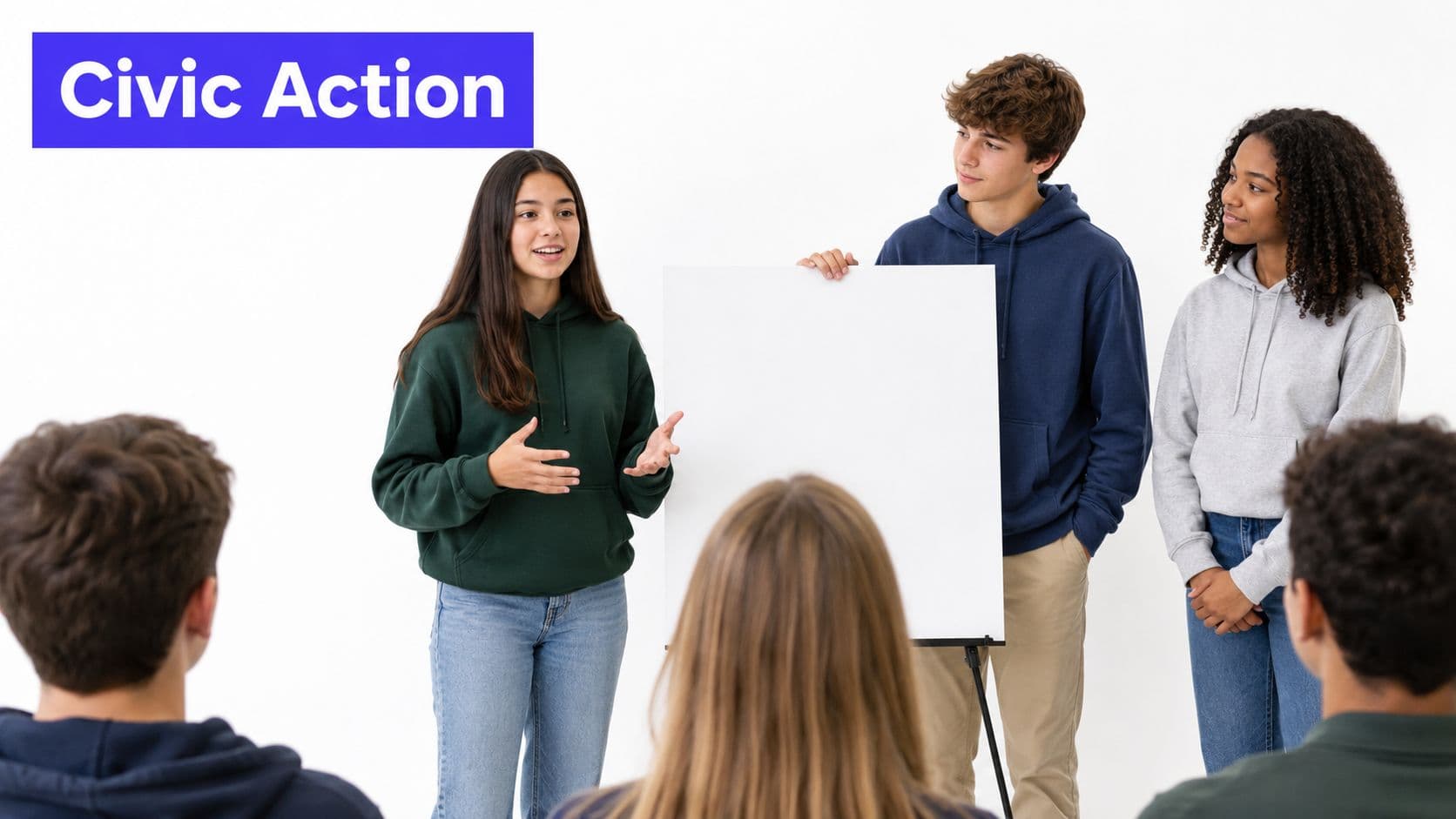
Start with a school concern or an issue handled by a local office. Have each group keep sources and interview notes in a shared document, then invite a local official to respond if one is available. If not, a staff panel can ask questions and test whether the proposal is clear and practical. Use a stage-by-stage rubric for research, evidence, policy comparison, and presentation, with extra practice sheets for students who need support. These printable civics worksheets can support the research stages. Kuraplan can draft a sequence of project steps, leaving more class time for coaching interviews and reviewing evidence.
6. Five Themes of Geography Map Lesson
Third graders can explain their own town if they share a vocabulary. The Five Themes of Geography (location, place, human-environment interaction, movement, and region) entered U.S. classrooms through the National Geography Standards in 1994. Students read one local or national map, find an example of each theme, then compare a place they know with a place they do not.

A third-grade class maps its town, then compares it with a town in another state using a T-chart. A high school world geography class uses the same five lenses to explain why a river valley became a trade center. Listing five examples is the weak version. Choosing which theme best explains the place is the strong one.
The NCSS curriculum framework organizes pre-K to 12 work around 10 themes, including people, places, and environments and global connections. Name both the map topic and the theme on the lesson header so the objective is visible. A labeled student sketch beats a copied glossary.
Ask which theme explains the place, not how many themes the student can recite.
A printable outline such as this U.S. map worksheet gives students a page to mark location and movement without waiting on a device. Kuraplan can add kid-friendly diagrams for each theme when your textbook art is too dense. Skip the lesson if the only task is coloring. Color without a comparison does not teach geography.
7. Mock Trial Simulation
A mock trial puts students in roles (attorneys, witnesses, jurors, and a judge) and makes them use a case packet. Programs such as Street Law and many state bar associations have long supplied this kind of law-related lesson. Students learn how courts use evidence, how an argument is built, and what constitutional rights sound like when someone has to apply them.
A high school government class can try a dress-code dispute under First Amendment ideas. A middle school class can run a short fictional theft case to see what counts as evidence and what due process means. Give every student a speaking turn, even a four-line witness statement. A jury sheet keeps the rest of the room writing while others perform.
The 2022 NAEP civics assessment sampled about 7,800 eighth graders in about 410 schools and reports estimates with statistical uncertainty, which NCES explains in its civics interpretation guide. Your rubric should do the classroom version of that idea: score the rule the student applied and the evidence they used, not only who spoke the loudest.
Debrief with one question. Which piece of evidence moved the jury, and why? Skip the lesson if you have not built the packet. Improvised law turns into shouting. Kuraplan can draft a simpler case, witness scripts, and juror questions for your grade, and you still check every fact before class.
This short walk-through shows how a student-run hearing can look before you write roles.
8. Socratic Seminar on Primary Documents
In a Socratic seminar, students lead and you facilitate. The classroom version draws on a tradition Mortimer Adler pushed in the 1982 Paideia Proposal: read a rich text, ask open questions, and ground every comment in the words. It fits topics where values collide, including civil liberties and immigration, because disagreement has a text to return to.
A high school class can read excerpts from the Declaration of Sentiments (1848) and ask how the authors defined rights. A middle school class can use a short letter from Frederick Douglass and track how freedom and citizenship get argued. Set norms together first: cite the text, and build on the last speaker. Outer-circle observers mark evidence and turns so the seminar is not only a memory of who talked.
Teachers are right to treat current events as part of civics, and it has gotten harder. Recent reporting notes that social studies teachers see that discussion as essential, yet more than half of those surveyed said it was harder than the year before to discuss issues that might raise questions about whether elected officials violated the law, as Education Week reported in 2025. A seminar on a finished primary source gives you a protocol before you touch a developing headline.
Questions with one correct answer belong on a quiz. Seminar questions should expose what the author assumes.
Write prompts such as "What does this author assume about fairness?" A pre-seminar guide, like the planning notes in this Socratic seminar guide, keeps the reading doable. Kuraplan can draft those open questions from your excerpt. You still choose which ones your class can handle without turning the circle into a debate club.
8 Social Studies Lesson Plans Compared
| Social Studies Lesson Approach | 🔄 Implementation Complexity | ⚡ Resource Requirements | 📊 Expected Outcomes | Ideal Use Cases | ⭐ Key Advantage |
|---|---|---|---|---|---|
| Reading Like a Historian: Sourcing and Corroboration | Moderate; requires teacher modeling | Short primary sources; one class period | Source analysis and evidence-based claims | Upper elementary through high school history lessons | Builds critical reading and historical reasoning |
| C3 Framework Inquiry Arc | High; requires unit-level planning | Compelling question, source materials, and time for civic action | Evidence-based conclusions and informed action | Standards-aligned units connecting social studies to real-world issues | Gives a unit a clear purpose and sequence |
| Jigsaw Cooperative Learning | Moderate; requires structured groups and roles | Subtopic readings, group guides, and usually one or two periods | Content learning, peer teaching, and collaboration | Broad topics with several related subtopics | Engages every student in learning and teaching |
| Document-Based Question (DBQ) Essay | High; requires document selection and writing support | Multiple historical documents, rubric, and several class periods | Historical argument supported by documents and outside knowledge | High school history and exam preparation | Develops evidence-based writing and analysis |
| Project Citizen Civic Action Project | High; requires extended planning and coordination | Research materials, community contacts, and a semester or more | Policy proposals, civic participation, and presentation skills | Middle school civics projects focused on local issues | Connects classroom learning with community action |
| Five Themes of Geography Map Lesson | Low to moderate; requires relevant maps and visuals | Maps, photos, or geographic data | Geographic vocabulary and place comparison | Elementary and middle school geography | Provides a reusable framework for analyzing places |
| Mock Trial Simulation | High; requires role and case preparation | Case packet, assigned roles, and substantial class time | Legal reasoning, public speaking, and understanding of evidence | Civics, government, and law-related lessons | Makes legal concepts active and memorable |
| Socratic Seminar on Primary Documents | Moderate; requires preparation and discussion norms | Shared text, open-ended questions, and participation structure | Text-based reasoning, listening, and respectful discussion | Exploring complex texts or topics with competing viewpoints | Encourages student-led, evidence-based dialogue |
Turn These Favorites Into Lessons That Fit Your Class
Pick the format on Sunday, then fit it to the room you have on Monday. A third-grade map lesson and a high school DBQ can share a spine: one objective, one text or map set, one way to show thinking, and one page students can finish if the period shrinks. Change the reading, not the intellectual job.
Social studies became a school subject for this kind of work. Before 1916, secondary programs mostly followed separate history courses. The 1899 Committee of Seven recommended ancient, medieval, modern, and American history as preparation for citizenship. The National Education Association's Committee on Social Studies then published The Social Studies in Secondary Education in 1916, which historians treat as the base of the modern scope and sequence, a story traced in the History of Education Quarterly. The report folded history together with civics, geography, economics, and related fields, and it pushed Community Civics and Problems of Democracy. Many of those course patterns lasted into the early 1970s. Your unit should still do that mix: historical knowledge, civic reasoning, place, and evidence.
Adapt any of the eight formats with the same checklist.
- Grade and access: Shorten the text, keep the question, and offer a print copy when devices or home reading time are thin.
- Standards: Name the state standard and the NCSS theme on the plan so a coach can see the target.
- Differentiation: Parallel readings, a word bank, and a speaking role for students who will not finish a long write.
- Rubric: Score claim, evidence, and reasoning separately. A beautiful poster can still miss the objective.
- Printable: One organizer, one exit ticket, and a key. If it takes longer to format than to teach, it will not get reused.
What does not travel is a lesson that only works for the fastest reader or only works if you lecture the whole block. Define success before you start, the way the war-unit teachers compared pre-test and post-test results, and look at who gained. If only one group moved, the activity was engaging and the access was not.
Kuraplan fits at the end of that checklist, not in place of it. It can draft a standards-aligned plan, a rubric, and a printable with questions and simple visuals, then you cut anything that does not match your students. The judgment stays yours. The blank page does not have to.
Kuraplan builds standards-aligned social studies lesson plans, unit sequences, rubrics, worksheets, and classroom visuals you can edit for your grade and your minutes. Use it to turn one of these eight formats into a printable your class can start tomorrow, with objectives and checks already attached. Visit Kuraplan when the next planning block is shorter than the unit you still owe.