A student points to a map of Mexico and asks, “Why does Mexico have animals we don't have here?” That question can turn a quiet Monday morning into a memorable science unit. Instead of handing students a disconnected list of jaguars, bats, turtles, and butterflies, help them trace each animal to the habitat that supports it.
This guide treats Mexico native animals as a regional story. Students will connect geography with adaptation, compare endemic species with more widely distributed wildlife, examine conservation successes and challenges, and complete activities that turn facts into evidence. The sequence works as a short elementary unit or as a foundation for deeper middle school research.
A Classroom Welcome to Mexico's Wild Side
Start by asking students what they already know. One child may name a jaguar. Another may have seen a monarch butterfly in a garden. Someone else may know the axolotl from a game or video. Write every answer on the board, then ask the question that changes the direction of the conversation: Where does that animal live, and what does it need there?
That shift matters. A jaguar isn't just “an animal from Mexico.” It belongs to particular forest habitats, hunts within a food web, and depends on connected spaces. An axolotl isn't just a strange-looking salamander. Its survival is tied to the lakes and canals around Mexico City. Students begin to see that wildlife distribution follows conditions such as water, temperature, vegetation, elevation, and shelter.
Practical rule: Ask students to locate the habitat before asking them to memorize the animal.
Use a large map of Mexico and mark broad regions with removable notes. Place a jaguar in the Yucatán Peninsula, a monarch butterfly in Michoacán, a lesser long-nosed bat in agave-growing areas, and a green sea turtle along the Caribbean coast. The map doesn't need to be perfect at first. Let students revise it as they learn, because changing an early model is an important part of scientific thinking.
A visual display can anchor the unit. A teacher might create a classroom poster with animal images, habitat labels, and one conservation question per region using the Kuraplan classroom poster generator. Keep the central question visible: How does place shape life?
The lesson arc is straightforward:
- Observe: Identify patterns in animal appearance and habitat.
- Map: Connect species to regions and ecosystems.
- Explain: Use adaptation and food-web ideas to explain those patterns.
- Evaluate: Compare conservation successes with ongoing threats.
- Create: Show understanding through maps, profiles, writing, and evidence-based discussion.
For younger learners, emphasize sorting, drawing, and oral explanation. Older students can investigate endemism, compare sources, and defend a conservation proposal. The subject remains accessible because every path begins with a familiar question about an animal and ends with a specific place.
Why Mexico Is a Global Biodiversity Hotspot
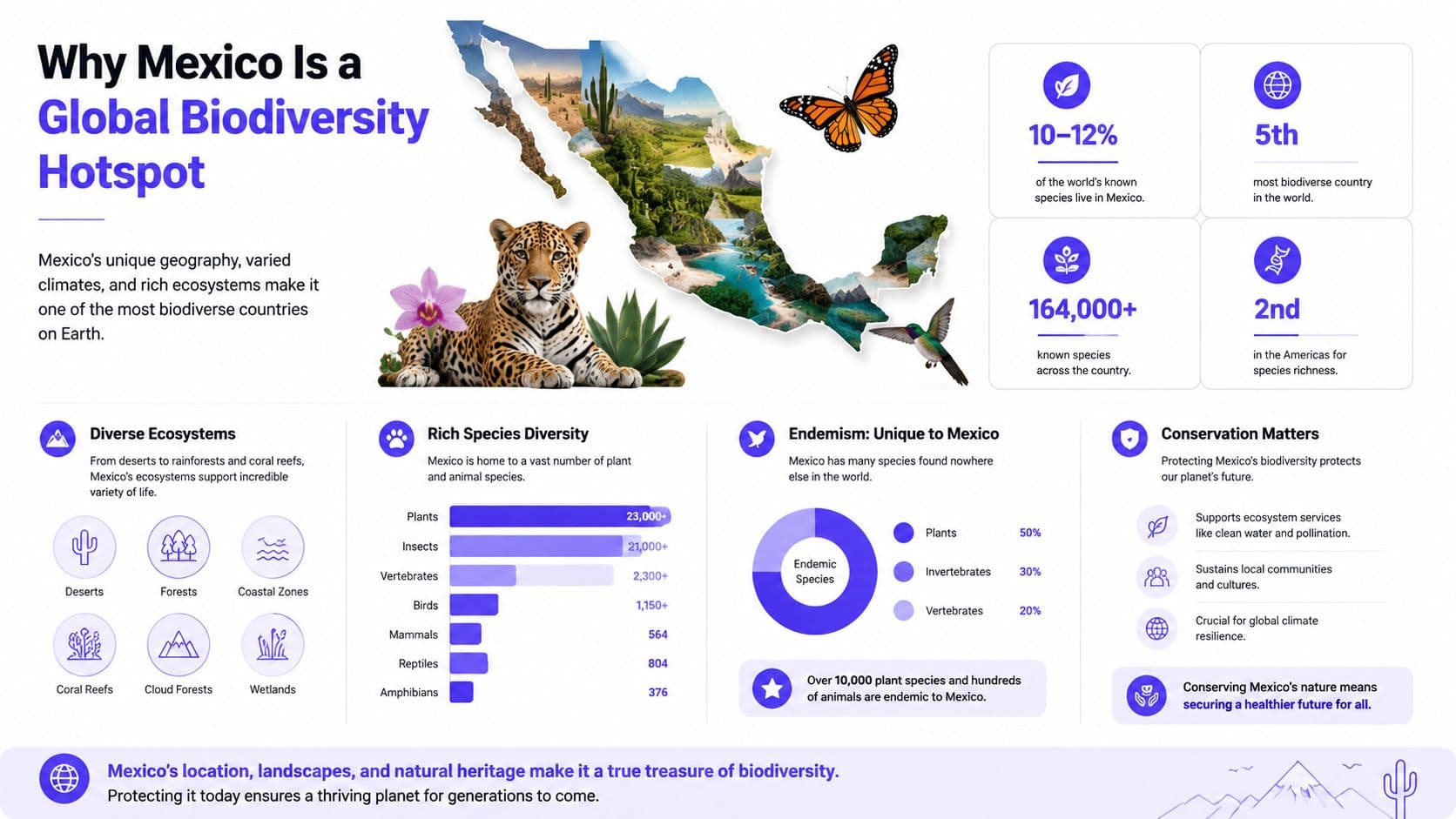
Ask students to trace Mexico from its northern deserts to its tropical southern forests. They quickly see that one country contains sharply different climates, elevations, coastlines, and water systems. Northern and tropical American influences meet here, while mountains, deserts, forests, wetlands, and long coastlines divide habitats and populations.
Mexico's mountains and climate zones create distinct ecological regions that separate populations. Like rooms in a large building, each region offers different temperature, moisture, food, and shelter. A species suited to a dry northern scrubland may not survive in a humid southern forest, even when the regions are relatively close on a map.
Official biodiversity summaries record roughly 5,500 vertebrate species in Mexico, including about 2,695 fish species and 1,107 bird species according to Mexico's biodiversity summary. The same material reports 864 reptile species, 1,096 bird species, and 535 mammal species. Because the bird figures differ between the summary's statements, students can treat the source as an opportunity to discuss checking data rather than copying a number uncritically.
Reading the numbers as a scientist
A large species count is only a starting point. Ask students whether species are spread evenly across Mexico, whether every animal needs the same climate, and how a mountain range might isolate one population from another. Those questions move the class from memorizing totals to explaining patterns.
Biodiversity includes the variety of habitats, genetic differences within populations, and relationships among living things. A fish in a coastal lagoon, a mammal in pine-oak woodland, and a reptile in desert scrub belong to different ecological systems, although all are vertebrates. Students can mark these connections on a regional map and then predict what might happen if one habitat changes.
An older biodiversity study from Mexico's national biodiversity repository reported more than 900 endemic vertebrate species overall and noted that 60% of amphibians in its account occurred exclusively in Mexico in its historical biodiversity study. Scientific counts can change as researchers revise classifications or reclassify species. The lasting lesson is that Mexico has exceptional vertebrate diversity and endemism.
A short vocabulary activity keeps related terms distinct. Native means an organism occurs naturally in a place. Endemic means it occurs naturally in one particular place and nowhere else. Biodiversity describes the variety of life and the relationships connecting it. A biodiversity terms worksheet can turn these definitions into a matching or drawing task.
Teachers can extend the geography lesson to plants. Students may explore caring for Mexican Fire Barrel Cactus, then connect the cactus's structure to survival in a dry environment.
Ecosystems That Shape Mexico Native Animals
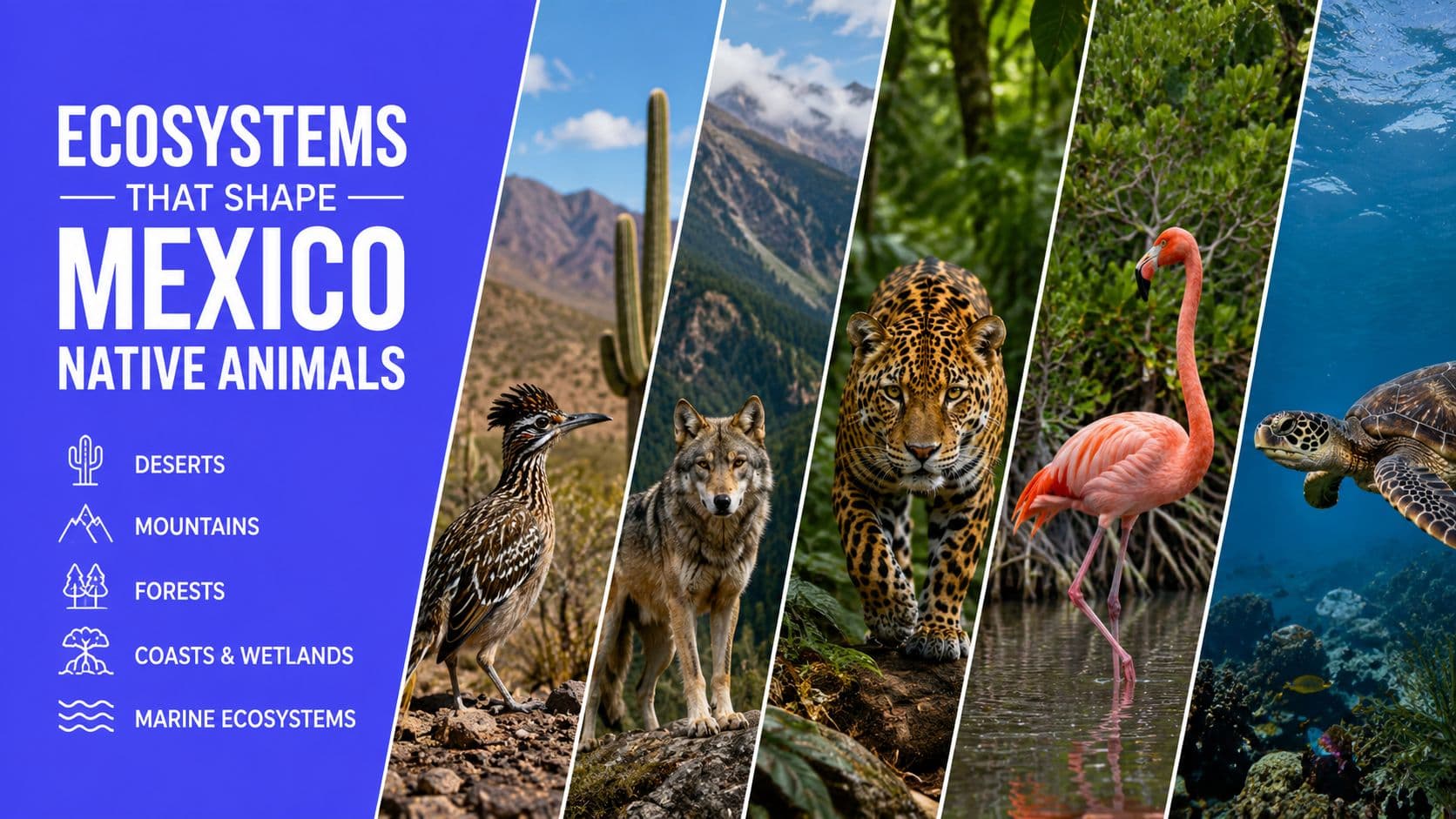
A habitat is more than an address. It supplies food, water, shelter, breeding space, and the physical conditions an animal can tolerate. When students study Mexico native animals by ecosystem, they can explain distribution instead of merely reciting locations.
Forests and mountain woodlands
Cloud forests in southern Mexico are cool, humid, and often wrapped in mist. Mosses and other plants grow on branches, while layered vegetation gives animals places to hide and feed. Students can connect these conditions to forest birds, amphibians, and mammals that need moisture and cover.
The pine-oak woodlands of the Sierra Madre create a different forest environment. Elevation changes temperature, and steep terrain can separate animal populations. The Mexican gray wolf is associated with mountain forests, grasslands, and scrublands, while birds and small mammals use the trees, understory, and forest floor in different ways.
Ask students to draw a vertical forest profile. Place one animal in the canopy, one on a branch or trunk, and one on the ground. Then have them add a food source and a hiding place for each. The drawing becomes a simple model of habitat layers.
Deserts and agave landscapes
The Sonoran and other Mexican desert regions may look empty to a first-time observer, but students quickly learn to look for evidence. Spines, burrows, night activity, water storage, and pale coloration all point to adaptations for heat and limited water.
The lesser long-nosed bat offers an excellent connection between animals and plants. It feeds on nectar and pollen from agaves and other plants, and its movements help connect the needs of a flying mammal with the flowering cycle of desert vegetation. A class can model this relationship with yarn, linking a bat to flowers, seeds, and other organisms.
Roadrunners and reptiles also fit naturally into a desert food-web activity. Students can identify who eats plants, who eats insects, and who may become prey for a larger predator. Avoid presenting the desert as a place without life. Present it as a place where life follows a different schedule and uses resources carefully.
Wetlands, coasts, and tropical forests
The Yucatán Peninsula includes tropical forests, coastal wetlands, mangroves, and reefs. Mangrove roots slow water, shelter young aquatic animals, and create a boundary between land and sea. Caribbean beaches provide nesting space for green sea turtles, while nearby marine habitats supply food.
The monarch butterfly's overwintering sites in Michoacán show that an animal can depend on more than one region during its life cycle. Students can map its movement and ask what the butterfly needs at each stage. That question naturally leads to habitat corridors and the importance of protecting several connected places.
For assessment, give each group an ecosystem card and an animal card. Students must justify the match using two habitat clues, not just a visual guess. A biomes study worksheet can support the sorting task, vocabulary practice, or a short written explanation.
Standout Species Across Mexican Regions
Comparing a rainforest predator with a desert pollinator helps students see that there is no single typical Mexican animal. Each region presents different survival problems, from finding cover in dense forest to locating flowers in dry scrub. A regional map paired with an animal card can turn these examples into a usable classroom investigation.
| Animal | Region | Habitat | Fun Fact for Students |
|---|---|---|---|
| Jaguar | Yucatán Peninsula | Tropical forest and connected woodland | Its powerful body and spotted coat suit a life as a forest predator. |
| Lesser long-nosed bat | Agave-growing regions | Desert and dry scrub regions | It connects animal life with flowering agaves through feeding and pollination. |
| Mexican axolotl | Lakes and canals around Mexico City | Freshwater habitat | It keeps juvenile features as an adult, including external gills. |
| Monarch butterfly | Michoacán | Mountain forest overwintering sites | A tiny insect can depend on a specific seasonal forest refuge. |
| Green sea turtle | Caribbean coast | Beaches, coastal water, and marine habitats | It uses land and sea during different parts of its life cycle. |
Comparing regional adaptations
The jaguar introduces habitat, movement, and food webs. In the Yucatán, dense vegetation provides cover, while connected forest gives a large predator routes between feeding areas. Ask students to mark a road or settlement on a forest map, then predict what changes when one continuous habitat becomes separate patches. The central idea is easy to grasp: fewer connected spaces can make it harder to find food, mates, and safe routes.
The lesser long-nosed bat shifts attention toward mutual dependence. Students can trace how the bat feeds on flowering agaves and may carry pollen between plants. This example broadens conservation beyond animals that people find attractive. A species that seems small or unfamiliar may still help maintain a wider ecological relationship.
Near Mexico City, the axolotl makes adaptation especially engaging. Its external gills invite careful observation, while its habitat raises a practical question: what does a freshwater animal need that a desert animal does not? Groups can compare water quality, shelter, food, and temperature, then identify human activities that could affect each setting.
Endemism and belonging
Endemism gives the regional map greater meaning. Mexico's official endemic-species information identifies reptiles as the most distinctive group in the native fauna, with 493 endemic species out of 864 total, or 57.0%. It also records 164 endemic mammals out of 535 total, or 30.7% in the national endemic-species summary.
A school invention that exists in only one classroom gives that classroom a special responsibility toward it. An endemic animal occurs naturally in one geographic place, so damage to that place can threaten the species across its entire natural range. Students can apply the analogy by circling each species' region on a map and asking what protection that particular habitat requires.
The monarch and green sea turtle clarify another common confusion. An animal may be strongly associated with Mexico without being endemic to Mexico. A species can migrate, nest, feed, or spend part of its life there while also occurring elsewhere. For a short assessment, give each group an ecosystem card and an animal card. Students must justify the match with two habitat clues, then label the animal as native, migratory, or endemic where appropriate. A biomes study worksheet can support the sorting task, vocabulary practice, or a brief written explanation.
Conservation Status and Why It Matters
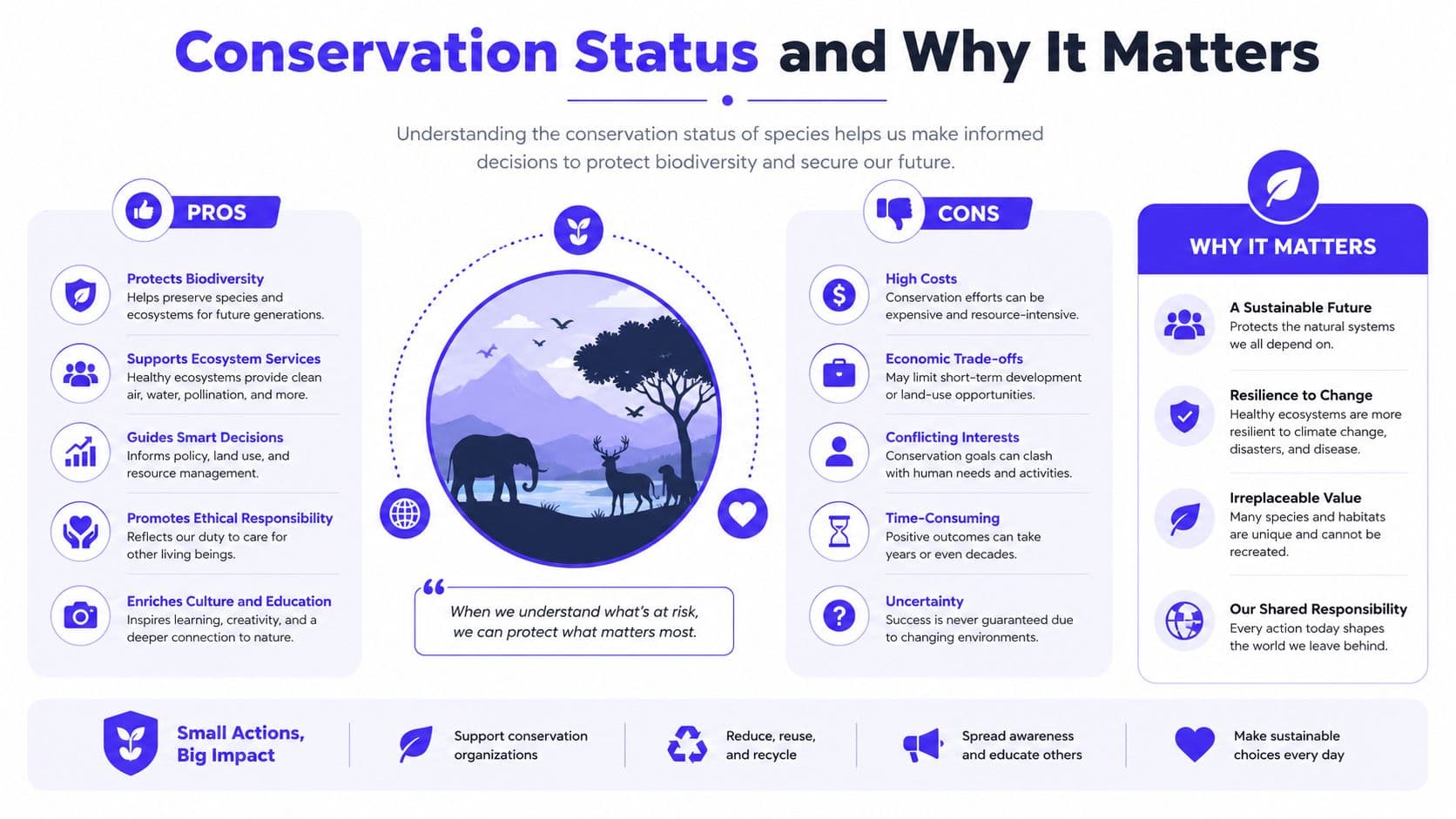
Conservation works best as an evidence question: What shows that a species is doing well, and which pressures shape that evidence? A classroom can treat each animal like a patient in a field investigation. Students examine population records, habitat condition, and threats before deciding whether a species is recovering or at risk.
The jaguar offers a measurable recovery example. A 2025 census reported 5,326 jaguars in Mexico, up 30% since 2010 as reported in a recent regional conservation summary. Students can connect that result to coordinated protection and monitoring, then ask which forests, corridors, and food-web relationships must remain in place for the improvement to continue. A jaguar belongs to particular forest habitats and hunts within a food web, so counting animals is only one part of the picture.
A fuller conservation picture
Endemic Mexican animals require close attention because a local habitat problem can threaten a species throughout its natural range. Recent endemic-species compilations place multiple Mexican bats in threatened categories, including Vulnerable, Endangered, or Near Threatened classifications. Endemic birds such as the Mexican sheartail also face pressure from deforestation and urbanization.
The comparison helps students see why conservation plans need more than a famous success story:
- Recovery story: Jaguar protection and monitoring can support positive change.
- Overlooked risk: Lesser-known bats may receive less public attention despite threatened classifications.
- Habitat pressure: Deforestation and urbanization can remove or divide the spaces animals use.
- Planning challenge: Protecting habitat supports individual animals and the wider food web.
Discussion prompt: Can conservation be successful if one famous species improves while less-visible endemic species continue to lose habitat?
Give students a short fictional field report with observations, habitat notes, and a proposed action. They classify each detail as evidence of recovery, evidence of risk, or information requiring further investigation. The task makes conservation a reasoning exercise rather than a list of alarming labels.
End with a practical design challenge. Students can plan a wildlife corridor, improve a schoolyard for pollinators, or write a public message explaining why a habitat matters. The goal is to connect observation with informed choices and community action, while showing that conservation begins with careful evidence.
Classroom Activities and Assessment Ideas
A strong mini-unit needs tasks that make students use information in different ways. Begin with a map, move into species evidence, and finish with an explanation or design. The activities below can be shortened for a single class or expanded into a sequence of lessons.

Map the habitat
Give pairs a blank map, regional labels, and animal cards. Students place the jaguar, lesser long-nosed bat, axolotl, monarch butterfly, and green sea turtle, then add one habitat clue beside each placement.
For younger students, assess whether they can match an animal with a habitat and explain the match orally. Older students should add a sentence about how geography could help isolate or connect populations.
Build a species profile
Each student chooses one animal and creates a profile with four required parts:
- Identity: Name the animal and describe a visible feature.
- Place: Mark its Mexican region and habitat.
- Relationship: Identify one food-web connection or ecological role.
- Question: Write one conservation question that needs evidence.
Encourage students to distinguish an observation from an inference. “The axolotl has external gills” is an observation. “It needs clean freshwater habitat” is an ecological inference that students can investigate and support.
Invent an endemic animal
Ask students to design an animal that could survive in one Mexican ecosystem. The creature must have a habitat, food source, defense, and adaptation. Students then explain why the animal couldn't just be moved into a desert, cloud forest, or coastal wetland without consequences.
This creative task reveals whether students understand adaptation as a relationship between traits and conditions, rather than as a decorative feature.
Check understanding quickly
Use a short exit ticket with questions such as:
- What makes an animal endemic?
- Why does habitat matter when mapping native animals?
- How can a conservation story include both progress and risk?
- Which evidence would help you decide whether a habitat is suitable?
A teacher can use Kuraplan once to turn the unit into a standards-aligned lesson sequence with printable worksheets, multiple-choice questions, assessment rubrics, and kid-friendly science visuals. For a last-minute axolotl diagram or a differentiated habitat activity, its worksheet and illustration tools can reduce formatting work while leaving the teacher in control of the scientific content.
Bringing It All Together and Going Deeper
Students should leave this unit understanding that Mexico's native animals are diverse, regionally distributed, and often highly endemic. A jaguar, bat, axolotl, monarch, and sea turtle don't tell the same ecological story, and conservation requires attention to both visible successes and overlooked risks.
Keep the investigation going with a virtual museum visit, a local habitat observation walk, or a schoolyard pollinator project. Ask students to return to their first map and revise it using evidence. That final revision is often where the learning becomes visible.
Kuraplan can help you turn this Mexico native animals topic into a complete lesson sequence with worksheets, visuals, differentiated activities, and assessments. Visit Kuraplan to build a classroom-ready biodiversity unit and spend more of your planning time helping students investigate the living world.