Sunday evening. Your copier tray is half full, Monday's lessons still need practice pages, and the last thing you want is to spend hours nudging text boxes in a document that should've taken five minutes. That's why printable math worksheets still matter. They're fast to deploy, easy to send home, and still one of the simplest ways to give students repeated practice without turning every lesson into a device-dependent activity.
The basic options haven't disappeared either. Free repositories still cover a wide span from Grade 2 through high school, especially for statistics and data work like bar graphs, line plots, and histograms, with sites such as Tutoring Hour and Common Core Sheets showing how established the print-first model still is in classrooms. Some libraries even keep everything as straightforward PDF downloads with answer keys and no login barrier, which is exactly what many teachers need when prep time is tight. If you're also weighing digital supports alongside printables, this roundup of best educational apps for schools is worth bookmarking.
What's changed is speed. Instead of choosing between static PDFs and building everything yourself, you can now mix ready-made printable math worksheets with dynamic generators, and when you need something custom in a hurry, Kuraplan's AI can produce standards-aligned printables with far less formatting work. That combination is what works in real classrooms.
1. Kuraplan
If you want one tool that handles planning and worksheet creation together, Kuraplan is the strongest fit on this list. It isn't just a worksheet site. It's an AI-powered planning platform for K to 12 teachers that can turn a lesson idea into print-ready practice, slides, visuals, and assessment support without making you jump across five tabs.
For teachers who build from standards first, that matters. Kuraplan is trained on curriculum standards, and its one-click workflow can turn lessons into worksheets with multiple-choice items, images, and age-appropriate formatting. It also generates differentiated instruction suggestions, rubrics, and unit sequencing, which is useful when your worksheet can't live as an isolated handout.
Where Kuraplan stands out
One of the clearest shifts in this category is that AI worksheet generators now create structured statistics worksheets with headings, spacing, and answer keys in seconds, rather than forcing teachers to format everything manually. That move from static PDFs to flexible generation is already visible across modern tools, including platforms like Porosheets and interactive worksheet builders such as Cuemath, which reflect the broader move toward generate-and-differentiate workflows in math prep for AI worksheet generation and customization trends.
Kuraplan fits naturally into that newer workflow. You can generate a page for whole-class practice, then spin a second version for support and another for extension, all without rebuilding the same lesson shell.
Practical rule: Use Kuraplan when the worksheet is only one piece of tomorrow's lesson. If you also need objectives, differentiation notes, and an aligned check for understanding, it saves more time than a stand-alone generator.
A few details make it especially practical in schools. Kuraplan is trusted by 1,000+ schools and used by 50,000+ teachers, and it also offers 1,000+ free printable worksheets. It includes a weekly planner, a teaching assistant for quick planning help, and collaboration features for departments or larger teams.
Best use cases and trade-offs
Kuraplan is the tool I'd point teachers toward when they're tired of patching together resources from separate sites.
- Best for full planning workflows: It handles lesson plans, unit plans, rubrics, and printable math worksheets in the same system.
- Best for differentiation: It's easier to create leveled versions than on static PDF sites.
- Best for visual support: It can also generate diagrams and classroom-safe illustrations.
The trade-off is simple. AI still needs teacher review. Local standards language, sensitive contexts, and exact pacing expectations should always be checked before you hit print. Pricing also isn't fully visible in the summary material, so schools should review the Kuraplan website directly before rollout.
2. Math-Drills.com
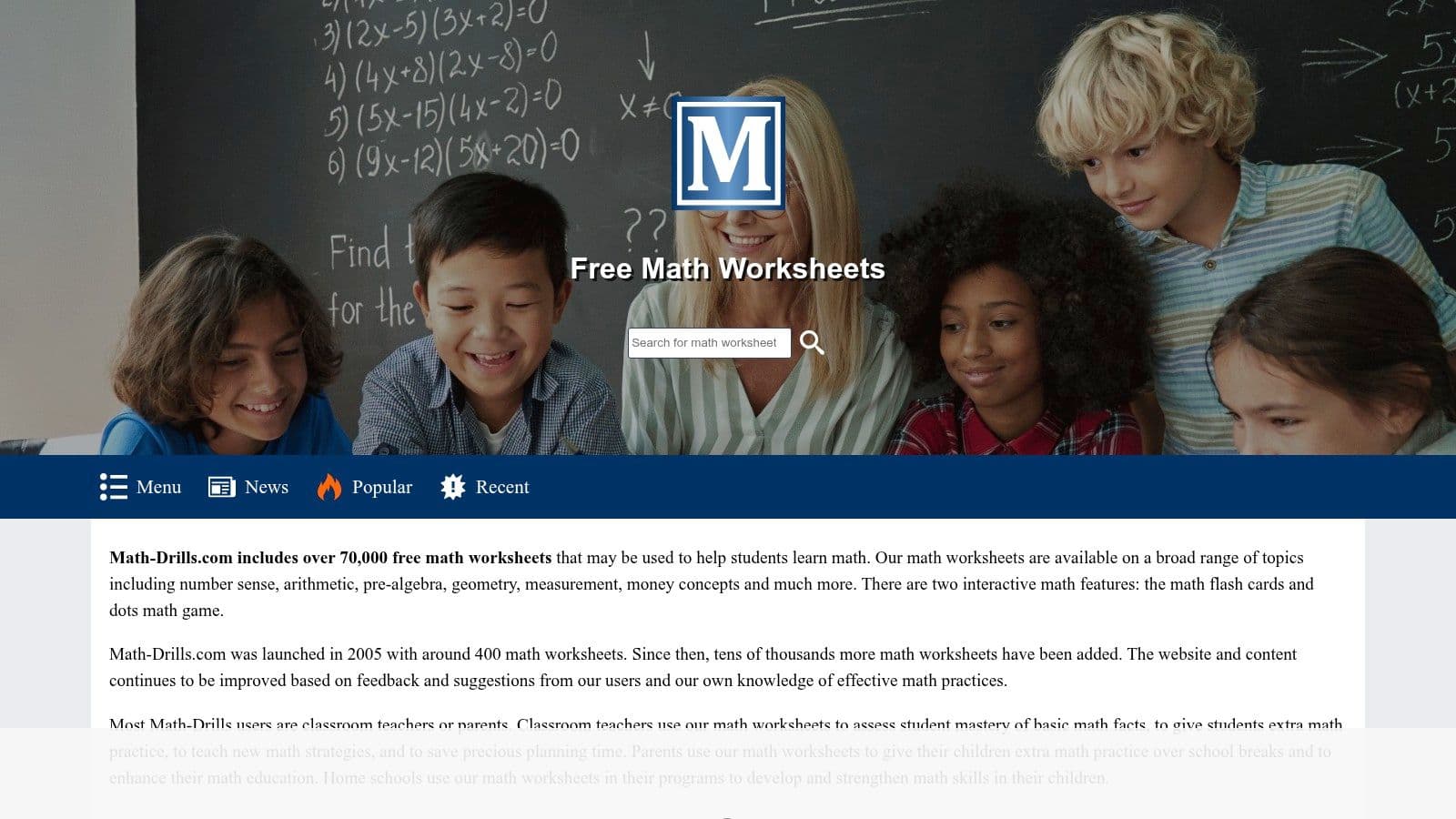
Math-Drills.com is what I'd call a dependable emergency site. If you need a clean practice sheet quickly and don't want to create an account, it's one of the easiest places to grab printable math worksheets and move on with your prep.
Its biggest strength is coverage. The library spans core arithmetic, fractions, integers, algebra, geometry, and measurement, so it works across several grade bands. For elementary teachers, it's especially handy for repeated skill practice because you can usually find multiple versions of the same idea without much digging.
What works well in class
Math-Drills is best when speed matters more than customization. I'd use it for warm-ups, homework, early finisher folders, or quick reteach groups.
- Strong for skill repetition: Multiple versions help when students need a second round without seeing the same exact page.
- Strong for print-and-go prep: Answer keys are commonly included, which keeps it useful for centers, sub plans, and small-group rotation.
- Strong for broad grade coverage: It's not locked into one narrow age range.
If you need a multiplication set more aligned with your own lesson pacing, it can help to pair a static worksheet bank with a generator like Kuraplan multiplication worksheets. That's often the better route when one class needs the standard version and another needs extra scaffolds.
Math-Drills is reliable, but it won't do the thinking for you. You still decide the progression, the support level, and whether the page actually matches what you taught.
The downside is customization. The site is functional rather than polished, and if you need specific number ranges, custom wording, or differentiated versions in the same sitting, a generator will feel faster.
Visit Math-Drills.com.
3. Math-Aids.com
Math-Aids.com leans in the opposite direction. Instead of asking you to search through prebuilt libraries, it lets you generate the worksheet you want on the spot. That difference matters when your class is split between students who need easier numbers and students who are ready for more complex work.
This is the kind of tool that helps when you already know the exact skill target. Fractions with common denominators. Integer operations with a controlled range. Basic algebra with a specific level of complexity. You set the parameters, generate, print, and move on.
Best fit by grade band
For upper elementary through middle school, Math-Aids often works better than static worksheet repositories because it supports cleaner differentiation. It's also useful in intervention settings where students need repeated practice on the same structure without repeated questions.
One recurring classroom problem with printable math worksheets is that most free sites offer only one version of a topic, even though teachers regularly need multiple levels in the same lesson. That gap is especially frustrating in mixed-ability rooms, where one page rarely works for everyone for the differentiation gap in worksheet design.
Math-Aids doesn't solve differentiation automatically, but it does make manual differentiation much easier than a one-version PDF site.
- Best for controlled practice: You can adjust difficulty and structure without rewriting by hand.
- Best for intervention groups: It's easy to create another set for reteach or review.
- Best for repeated use: Fresh versions reduce memorization of answers.
The weak point is the interface. It feels dated, and new teachers sometimes miss options because the pages can look dense. There's also no built-in student data layer, so this is still a print-first workflow rather than a full assessment platform.
Visit Math-Aids.com.
4. K5 Learning
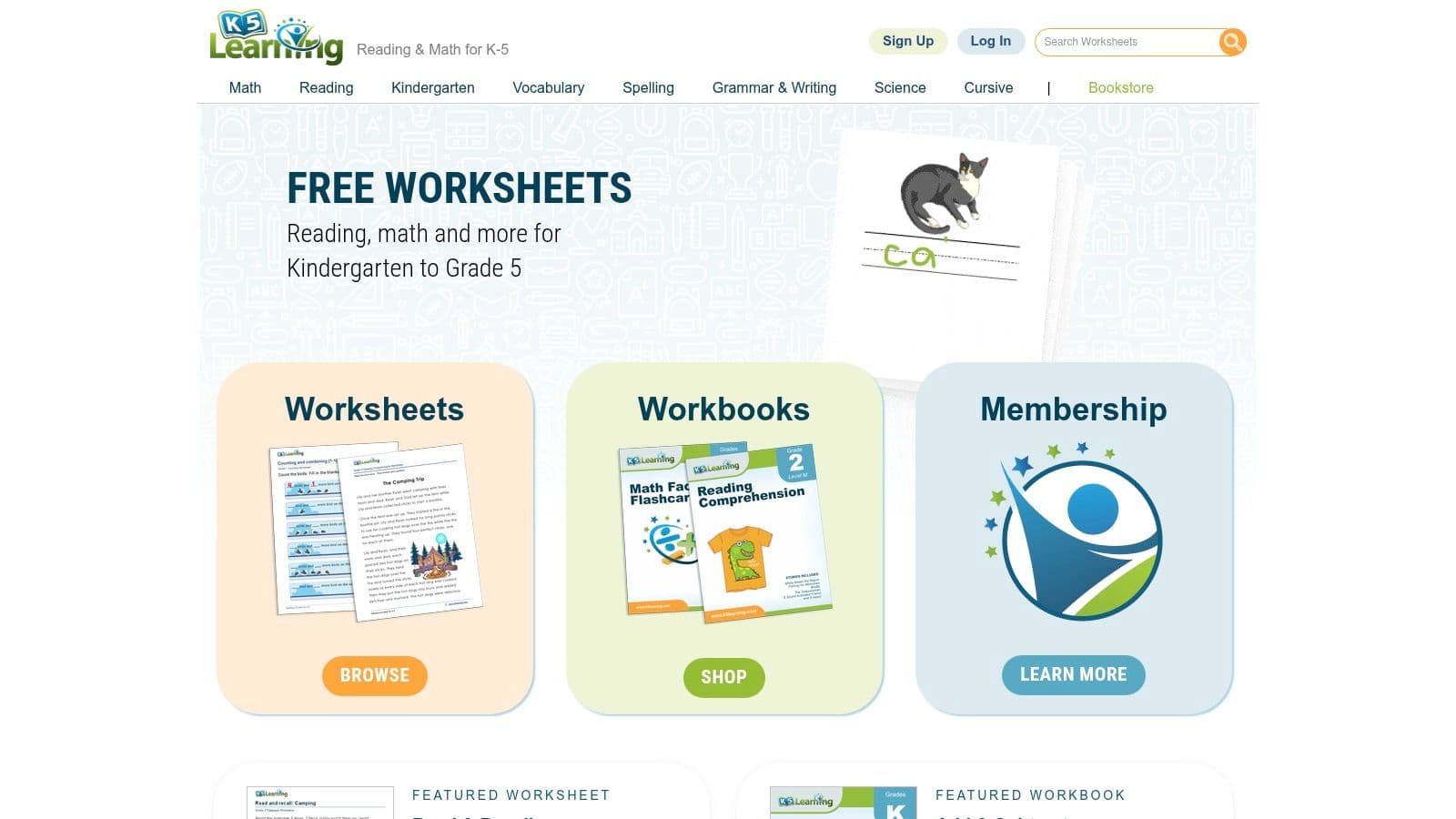
K5 Learning is one of the easiest sites to recommend to elementary teachers who want polished PDFs without spending much time hunting. The organization is straightforward. You browse by grade or skill, and the worksheets usually look classroom-ready right away.
That matters more than people admit. A cluttered worksheet can derail younger students before the math even starts. K5 Learning generally avoids that problem, which makes it a good fit for kindergarten through grade 5 classrooms, intervention folders, and home-school communication packets.
Why elementary teachers like it
K5 Learning feels built around scope and sequence. If your team plans by grade-level standards and wants practice pages that look consistent across units, this site saves time.
For data and graphing work, printable math worksheets continue to play a foundational role across K to 12, especially because students need repeated, structured exposure to graph types such as bar graphs, line plots, and histograms as statistical literacy develops over time. That broad print-first tradition helps explain why elementary teachers still rely on simple PDFs for concrete practice before moving students to more open-ended tasks for the role of printable graphing worksheets across grade bands.
- Best for K to 5 pacing: The grade-based browsing is intuitive.
- Best for clean presentation: PDFs are uncluttered and easy for younger students to use.
- Best for homework packets: The professional formatting looks consistent across pages.
K5 Learning is less useful once you move heavily into middle school content. It also won't satisfy teachers who want to generate custom versions on demand. In that case, I'd use K5 for core on-level practice and a tool like Kuraplan when I need a modified companion page quickly.
Visit K5 Learning.
5. CommonCoreSheets.com
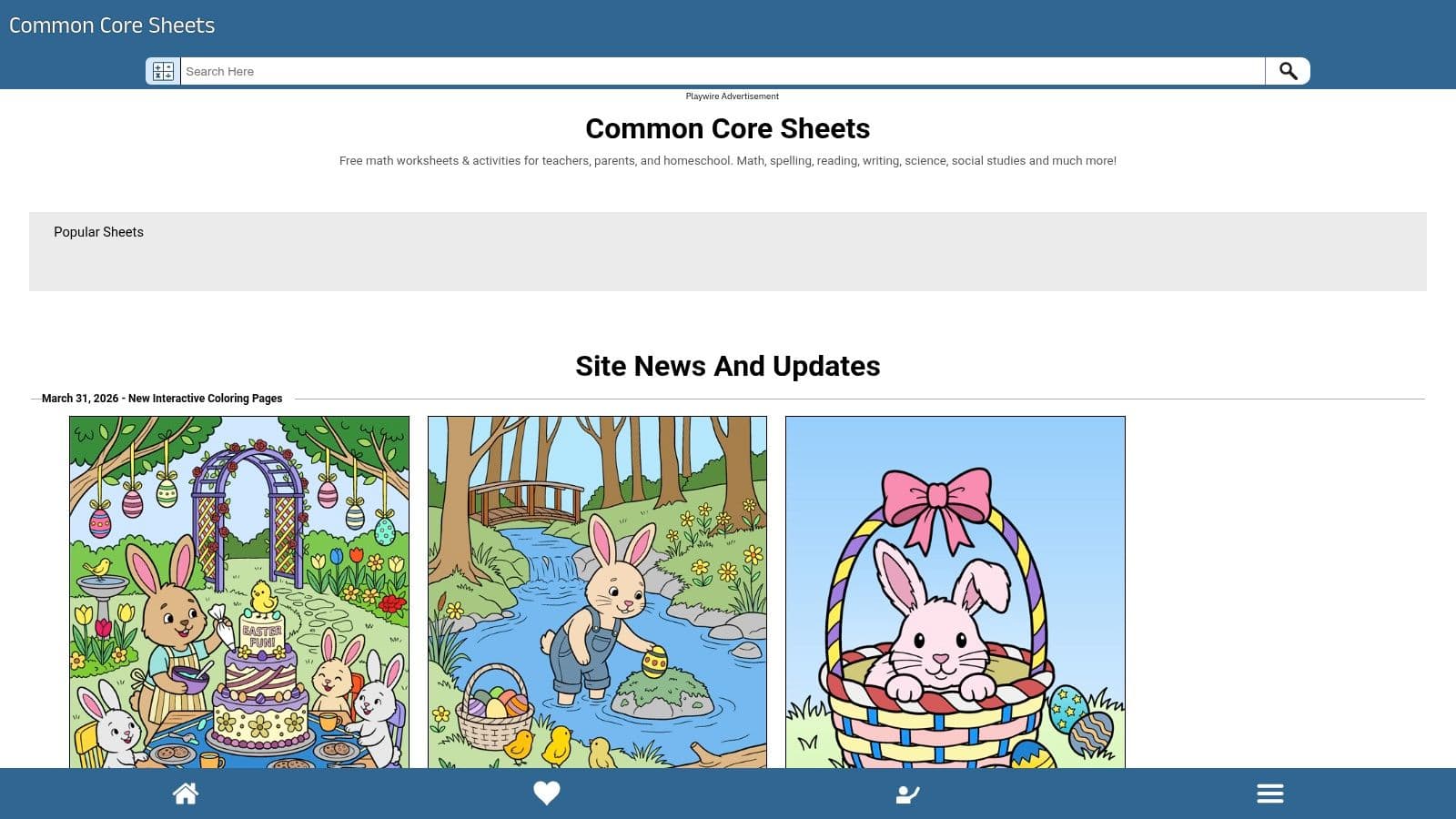
CommonCoreSheets.com is a practical teacher site. It's not pretty, but it's useful. That's a trade I'll take every time when I need a targeted page for remediation, daily review, or a fast skill check.
The draw here is granularity. You can go skill by skill, generate additional practice, and use tools like Create-A-Sheet or Create-A-Test without requiring students or teachers to log in first. For intervention blocks, that saves a surprising amount of friction.
Where it earns a spot
This is one of the better sites for pinpointing a narrow weakness. If a student understands area but keeps missing angle relationships, or can read a bar graph but struggles with line plots, CommonCoreSheets lets you pull just that practice.
It also reflects a durable part of the printable worksheet market. Some of the largest free repositories offer thousands of printable PDFs without login requirements and include answer keys for immediate classroom use, which is a major reason teachers keep returning to these sites during busy weeks for no-login printable worksheet access with answer keys.
If you teach intervention, keep this site open in a tab. It's faster to pull a single focused sheet here than to slice apart a broader packet from somewhere else.
The page design is busy, and ads can get in the way. Students won't care because you'll be printing the PDF, but teachers might. Visually, it's basic. Functionally, it's strong.
Visit CommonCoreSheets.com.
6. Super Teacher Worksheets
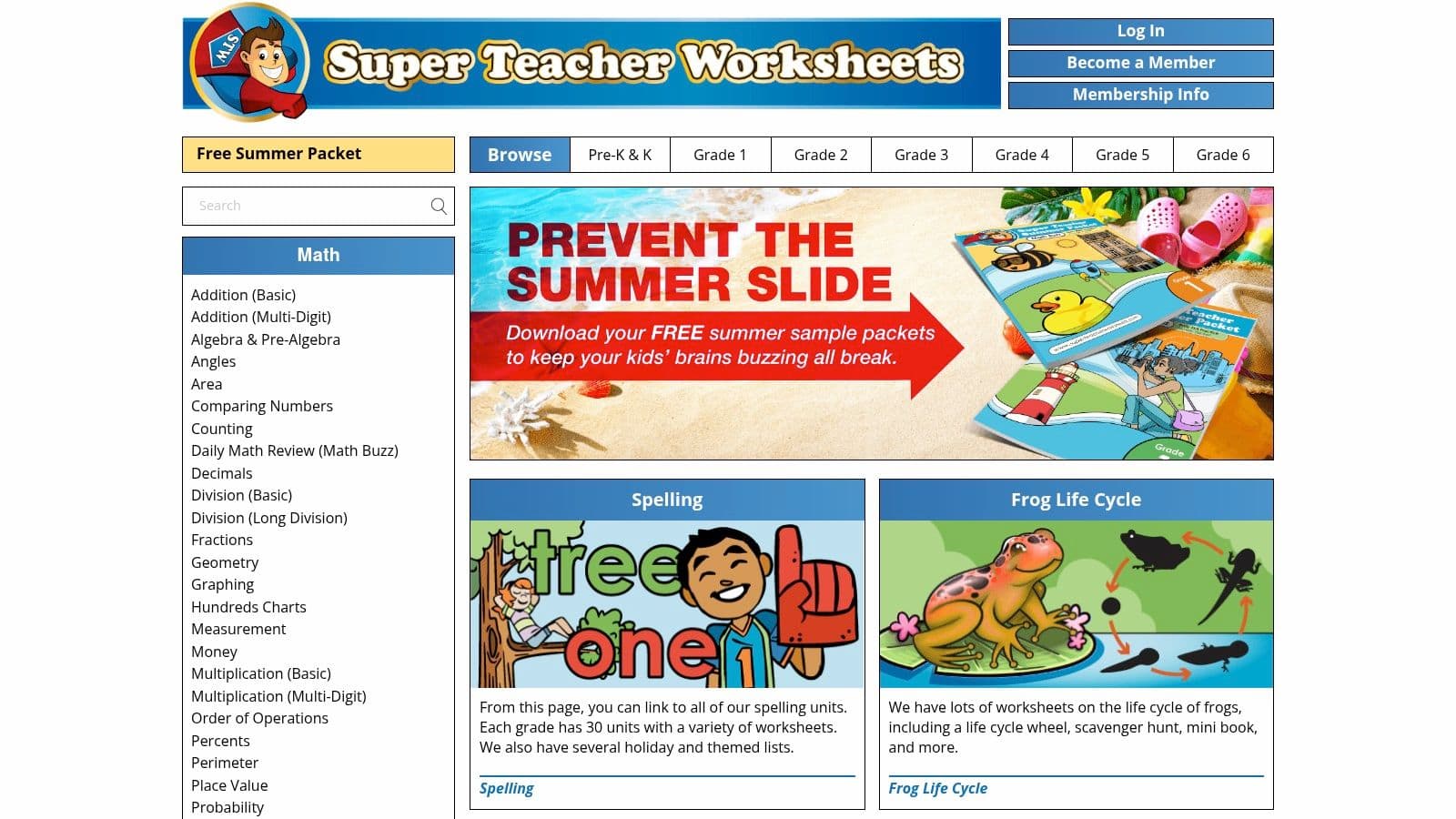
Super Teacher Worksheets is a good choice when your priority is elementary engagement. The math content is solid, but its primary strength is its presentation. Pages tend to be kid-friendly, visually consistent, and easy to slot into centers, homework folders, or substitute plans.
It isn't only a math site, which can be a plus for self-contained classrooms. If you're building weekly packets and want one membership that covers multiple subjects, it's convenient.
Practical classroom fit
Super Teacher Worksheets works best in kindergarten through grade 5. I'd use it when worksheet design matters almost as much as the content itself, especially with younger learners who benefit from clean visuals and familiar page structures.
One issue with many geometry and angle worksheets is that they stay abstract and rarely show teachers how to connect the page to practical, real-world contexts. That matters because teachers are increasingly looking for printable math worksheets that don't stop at isolated drills, especially for concepts like angles around a point for the real-world application gap in printable geometry worksheets.
That's where teacher judgment still has to step in. Even with a well-designed page, you often need to add your own context, discussion prompt, or hands-on example.
- Best for elementary visuals: The pages look inviting without becoming distracting.
- Best for packet building: Consistent formatting helps when you're combining several sheets.
- Best for cross-subject classrooms: One resource library can support more than math.
The limitation is depth past upper elementary. Middle school teachers usually need more specialization than this library offers, and full access requires a paid membership.
Visit Super Teacher Worksheets.
7. WorksheetWorks.com
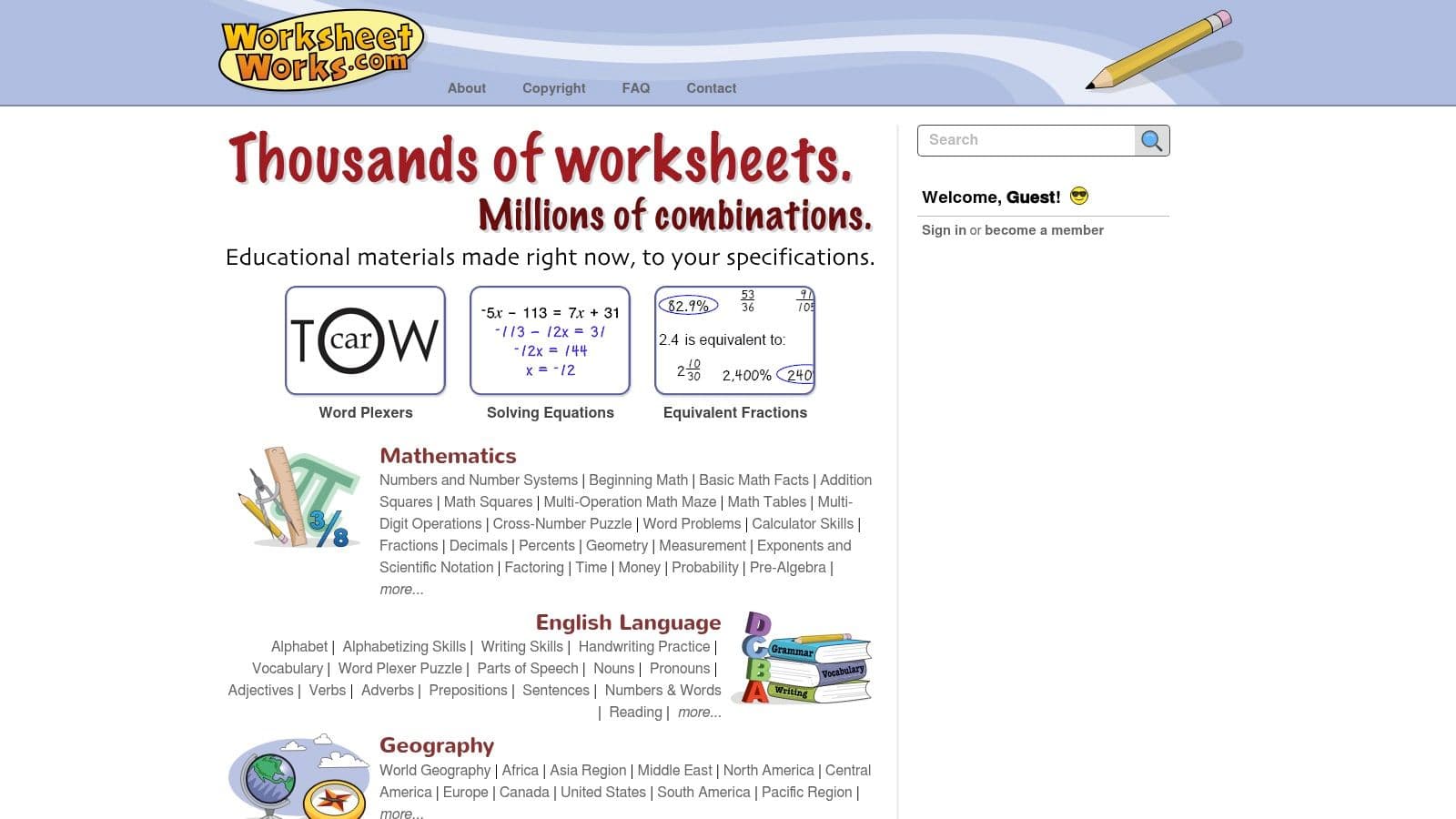
WorksheetWorks.com is one of those tools teachers tend to keep once they've used it for a while. It doesn't try to be flashy. It focuses on clean generator-based documents with enough control to make repeated practice manageable.
Its value shows up when you need precision. Problem count, ranges, formats, graph paper, table work, basic algebra, measurement, graphing. If your class benefits from structured repetition but not from cartoon-heavy layouts, this is a strong option.
Best for repeatable differentiation
WorksheetWorks sits in a useful middle ground. It offers more control than a static repository, but it stays simpler than a full AI planning platform. That makes it a practical fit for teachers who still want to drive every setting themselves.
If you're starting to move from static PDFs toward faster custom generation, it's worth comparing a traditional generator with a newer AI flow like Kuraplan worksheet generation. The big difference is how much setup you want to do manually.
Clean worksheet generation matters. If a site saves time finding a page but creates more time editing the page, it hasn't actually helped.
WorksheetWorks is less visually rich than elementary-focused platforms, and its library isn't as broad as massive teacher marketplaces. But for straightforward math practice, especially in upper elementary and middle grades, it's efficient.
Visit WorksheetWorks.com.
8. Education.com
Education.com is the hub option. If you want printable math worksheets, digital practice, and a searchable multi-grade library in one place, it does a lot under one roof.
That combination is useful in hybrid classrooms. Some students need a paper copy in class, others need an interactive version at home, and teachers don't always want to maintain two separate systems.
When it makes sense
Education.com is strongest for Pre-K through grade 8 teachers who like having both printable and digital formats available. The worksheet generator helps, but the bigger advantage is convenience. You can browse, assign, and print from the same ecosystem.
The broader demand picture supports that hybrid approach. The global market for math learning apps for kids was valued at USD 675.17 million in 2025 and is projected to reach USD 1,155.61 million by 2032, growing at a CAGR of 7.97%. That projection helps explain why so many worksheet platforms now blend printable and digital practice instead of treating them as separate categories.
- Best for mixed delivery: Print at school, assign digitally at home.
- Best for broad browsing: The searchable catalog saves time across multiple subjects and grade levels.
- Best for teachers who want one hub: Less platform switching.
The free tier is limited, so regular use usually pushes teachers toward a paid plan. And while the range is broad, highly customized differentiation still tends to be easier in dedicated generators or AI tools like Kuraplan.
Visit Education.com.
9. SplashLearn Worksheets
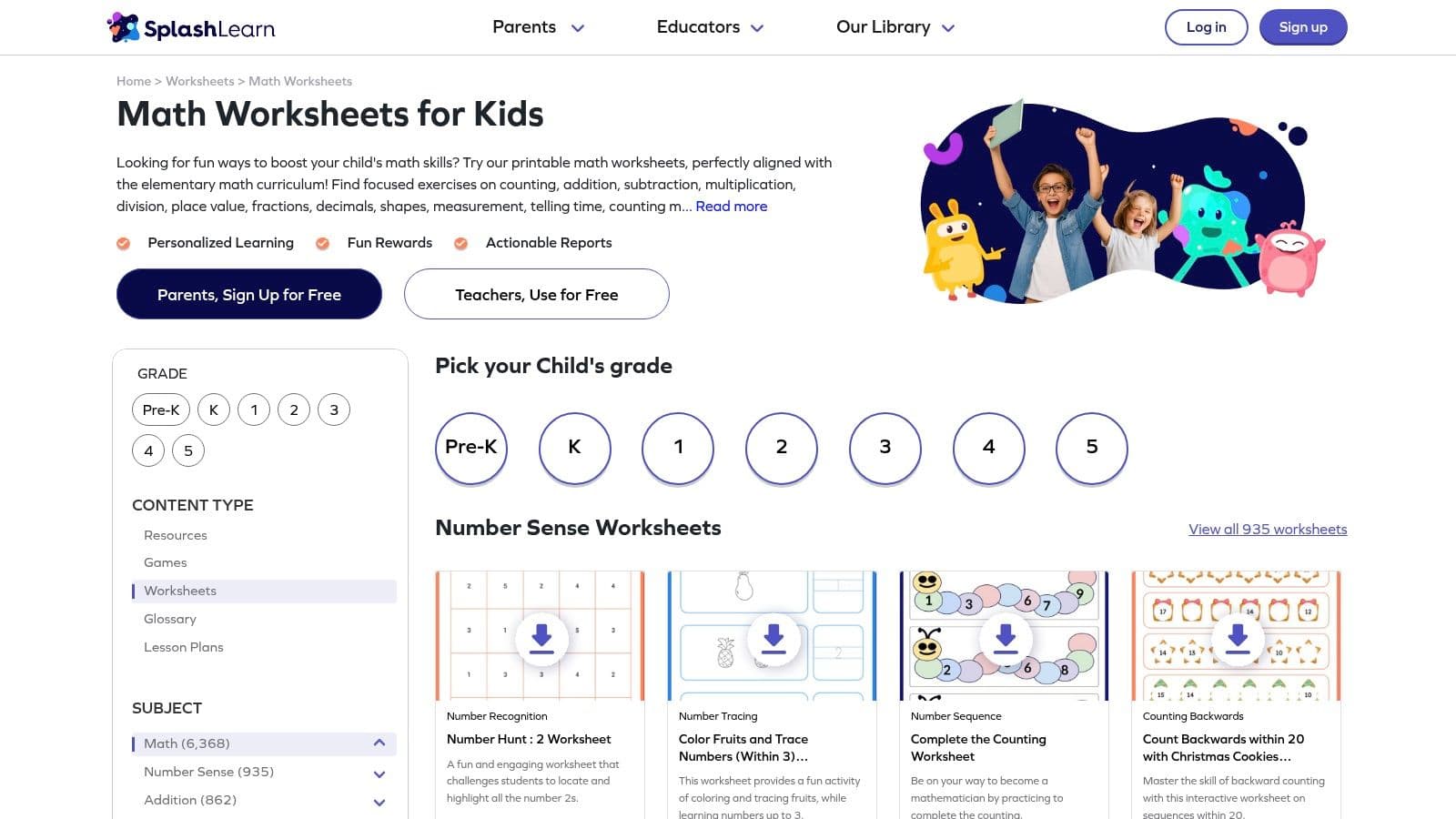
SplashLearn Worksheets makes the most sense if you already like pairing offline and online practice for younger students. The printable side is organized by skill and grade, and it mirrors the elementary-friendly feel of the broader SplashLearn platform.
That pairing can help with continuity. Students see a familiar style across game-based work and paper practice, which can reduce friction for some early learners.
Elementary strengths and cautions
SplashLearn is built for Pre-K through grade 5, and that shows. It's easy to filter by grade and topic, which is helpful for centers, homework, and quick reteach groups.
Its biggest strength is that it doesn't make printable math worksheets feel like an afterthought. The pages are clearly meant to support the same skill progression as the digital tools.
Still, printable design quality alone doesn't guarantee instructional flexibility. In many classrooms, the hardest part isn't finding a worksheet on the right topic. It's adapting one sheet for learners who need more support or more challenge. When that's the issue, I'd use SplashLearn for the on-level version and create companion differentiated pages in Kuraplan.
- Best for early grades: Strong fit for foundational skills.
- Best for paired practice: Useful if your students already use SplashLearn online.
- Best for quick filtering: Easy to sort by grade and skill.
The limitation is depth beyond elementary content. Site navigation also pushes users toward the app ecosystem, which some teachers like and others find distracting.
Visit SplashLearn Worksheets.
10. Twinkl (U.S.)
Twinkl is the polished staff-room answer. If a teacher asks for printable math worksheets that look professionally designed, are easy to share, and span a wide range of classroom situations, Twinkl usually comes up quickly.
The U.S. version offers a large catalog, standards-aware organization, templates, and even custom creation features. It's especially useful for teachers who want resources that already look presentation-ready before any editing.
Best for teams and polished resource packs
Twinkl works well for grade-level teams, support teachers, and schools that value consistency across classrooms. If you're creating packets for intervention, home learning, substitute days, or seasonal review, the platform's breadth helps.
There's also a practical business side to printable math worksheets that Twinkl fits well. High-value printables tend to work best when they're bundled into clear thematic or grade-level packs, include answer keys, and stay simple and ready to use, which matches what educators usually want from polished downloadable resources for printable worksheet packaging and format best practices.
For classrooms that also use visual supports on walls or anchor charts, pairing worksheets with Kuraplan math posters can create a cleaner lesson flow.
A polished worksheet saves teacher credibility with families. When a take-home page looks clear and intentional, parents are more likely to use it as designed.
Twinkl's drawback is volume. There's a lot there, and that can slow down selection if you don't start with a clear skill target. Full access also requires a subscription.
Visit Twinkl.
Top 10 Printable Math Worksheet Sites, Comparison
| Product | Core features | UX / Quality | Value & Pricing | Target audience | Unique selling points |
|---|---|---|---|---|---|
| 🏆 Kuraplan | ✨ AI‑powered standards mapping, unit sequencing, rubrics, printable worksheets & visuals | ★★★★★, polished, curriculum‑trained AI | 💰 Free trial + contact for plans; free resources available | 👥 K–12 teachers, teams, districts | ✨ 24/7 AI teaching assistant; one‑click worksheet/slide/diagram export |
| Math-Drills.com | Thousands of free printable PDFs by topic | ★★★, utilitarian, fast downloads | 💰 Completely free to use | 👥 Teachers needing quick math drills (elementary–middle) | ✨ Massive ready-to-print catalog with answer keys |
| Math-Aids.com | Dynamic worksheet generator (custom ranges/difficulty) | ★★★★, highly functional though dated UI | 💰 Core generation free | 👥 Teachers needing customizable practice & differentiation | ✨ Unlimited on‑the‑fly PDF generation with answer keys |
| K5 Learning | K–5 leveled worksheets, drills, optional workbooks | ★★★★, clean, grade‑organized PDFs | 💰 Many free sheets; low‑cost workbooks available | 👥 K–5 classroom & homeschool teachers | ✨ Easy grade/skill navigation with professional formatting |
| CommonCoreSheets.com | Skill‑by‑skill CCSS worksheets + generators | ★★★, dense pages but granular | 💰 Free, no login required | 👥 Remediation specialists & standards-driven teachers | ✨ Create‑A‑Sheet/Test and one‑at‑a‑time practice tools |
| Super Teacher Worksheets | Large K–5 printable library + simple generators | ★★★★, consistent, kid‑friendly visuals | 💰 Membership required for full access | 👥 Elementary teachers & homeschoolers | ✨ Appealing visuals, puzzles and worksheet builders |
| WorksheetWorks.com | Fine‑grained math generator (geometry, graphs, drills) | ★★★★, precise control, clean PDFs | 💰 Low annual price for unlimited generation | 👥 Teachers needing differentiated, repeatable practice | ✨ Dozens of specialized generator types and previews |
| Education.com | PreK–8 printables + interactive worksheets & grading | ★★★★, large searchable hub, mixed modes | 💰 Limited free tier; premium subscription for full access | 👥 PreK–8 teachers wanting print + digital practice | ✨ Combines printable PDFs with interactive assignments & basic grading |
| SplashLearn Worksheets | PreK–5 CCSS‑aligned printable sheets | ★★★, simple, easy filtering | 💰 Many free printable sheets | 👥 Elementary teachers using SplashLearn curriculum | ✨ Worksheets mirror digital game skills for offline practice |
| Twinkl (U.S.) | Huge teacher‑made resource library, create/request tools | ★★★★, polished, educator‑focused | 💰 Subscription required for full access | 👥 K–8+ teachers seeking high‑quality, ready‑made materials | ✨ 'Create Your Own' builder and bespoke request service |
Empower Your Classroom with Tailored Practice
The best printable math worksheets aren't always the fanciest ones. They're the pages that match tomorrow's lesson, fit the students in front of you, and don't take your entire evening to prepare. That's why the strongest approach usually isn't choosing one site forever. It's building a small working stack.
For free print-and-go practice, Math-Drills.com and CommonCoreSheets.com are easy wins. For elementary polish, K5 Learning, SplashLearn, and Super Teacher Worksheets are dependable. For tighter control over difficulty and repeated versions, Math-Aids.com and WorksheetWorks.com do the job well. If your school wants one broader ecosystem that includes both digital and printable practice, Education.com and Twinkl make sense.
What doesn't work as well is relying on static worksheets for every situation. Students rarely sit in neat, same-level groups, and one version of a worksheet often falls short. That's especially true in inclusion settings, intervention blocks, and mixed-readiness math classes. Teachers need on-level practice, a scaffolded version, and a stretch version far more often than worksheet libraries acknowledge.
That's where AI tools have become useful, not because they replace teacher judgment, but because they cut the repetitive formatting and regeneration work. Modern worksheet generators can create print-ready pages in seconds, and that changes the prep equation for busy classrooms. If you need a differentiated page on short notice, or you want to turn a lesson objective directly into a worksheet without rebuilding the layout yourself, Kuraplan is one of the most practical options here.
There's also a place for printables beyond simple drill. The best ones support fluency, give teachers quick formative checks, and create a stable bridge between abstract concepts and student practice. In statistics and probability, for example, printable worksheets still help students work through core mechanics like data collection, graphing, and measures of central tendency in a way that's easy to annotate and review by hand. In test prep, topic-specific PDF collections with answer keys and step-by-step explanations remain useful because they help students move from isolated review into test-style thinking building student math confidence.
My practical advice is simple. Keep two or three reliable free libraries for fast downloads. Keep one generator for custom reteach pages. And if your planning workload regularly spills into evenings, use Kuraplan when you need standards-aligned, differentiated printable math worksheets without the usual formatting grind. That mix gives you flexibility without overcomplicating your workflow, and it keeps your time where it belongs, with students instead of page setup.
If you want printable math worksheets that don't stop at drill sheets, Kuraplan is worth trying. It helps you generate standards-aligned worksheets, lesson plans, visuals, and differentiated support in minutes, which makes Monday prep a lot lighter.