Monday morning in a fourth-grade room can feel like a puzzle with too many missing pieces. You've got 27 students, three with IEPs, one English learner, four more still decoding below grade level, and a science lesson that was written for a classroom that never exists. The hard part isn't caring about everyone. The hard part is building a special needs curriculum that keeps the grade-level goal intact while giving different learners a real way in.
That's why curriculum planning matters more than a stack of accommodations. The students who need support are not a side group, and they're not a niche population. In the United States, 7.5 million students ages 3 to 21 received special education and/or related services under IDEA in 2022–23, which was 15% of all public school students (NCES). In England, more than 1.7 million pupils currently have special educational needs (Education Statistics service). When the need is measured in millions, curriculum can't be an afterthought.
The bigger shift is that special education caseloads don't stay still. In the U.S., enrollment grew from 6.4 million students, or 12.9%, in 2012–13 to about 7.5 million, or 15.2%, in 2022–23 (NCES). That tells classroom teams something plain and important, more students need differentiated access, and more teachers need planning structures that hold up under real pressure.
Why Special Needs Curriculum Planning Deserves More Attention
A teacher can hand out the same worksheet to every student and still end up with three different classrooms. One group is already working, one group is waiting for adult help, and one group has checked out because the task never fit their access needs in the first place. That is why curriculum planning deserves more attention than a stack of accommodations taped onto the side of a lesson.
I've sat through enough IEP meetings to see the same split over and over. The needs are discussed carefully, but the curriculum plan stays broad enough to sound safe and vague enough to be unusable on Monday morning. Then the teacher is expected to reshape a grade-level unit in the middle of a busy week, keep expectations intact, and somehow make it all hold together. That is not a planning system. It is improvisation under pressure.
The scale changes the job
Special education sits inside mainstream K to 12 systems, so curriculum decisions affect everyday teaching, not a separate corner of the building. In the U.S., the most common disability category served under IDEA is specific learning disabilities, which accounted for 32% of students served (NCES). That points straight to the barriers teachers meet most often, reading, writing, and math access.
England shows the same need from another angle. SEN identification has shifted over time, from 21.1% in 2010 to 14.4% in 2017, while the number of pupils recorded as having SEN moved from 1.23 million to 1.24 million by 2017, and now stands at more than 1.7 million (Education Statistics service). That matters because caseloads are shaped by both student need and the way systems define and identify that need.
Practical rule: if the lesson only works after the accommodation is added, the lesson was not ready yet.
The bigger shift is mental. A special needs curriculum is not a separate binder sitting beside the standard curriculum. It is the planning lens that makes the general curriculum usable for students who learn differently, process information differently, communicate differently, or need different routes to the same standard.
What Special Needs Curriculum Actually Means
A lot of people use the phrase loosely, which is why teams end up talking past one another. In plain language, special needs curriculum means a standards-aligned plan that makes general education content accessible to learners with disabilities without stripping out the academic target. The point is access to the same curriculum, not a different set of expectations.
That's also where the legal anchor matters. The U.S. Department of Education says students receiving special education must be taught the same curriculum as nondisabled children, meaning the curriculum is based on the state's academic content standards for the grade the child is enrolled in, and annual IEP goals are expected to align to those grade-level standards (USED guidance). That's a big distinction from “make it easier.” It means access and rigor are supposed to sit in the same lesson.
UDL is the design frame, not an add-on
The cleanest way to build that kind of access is Universal Design for Learning, or UDL. UDL asks teachers to plan for multiple means of engagement, representation, and action/expression so students can reach the same standard through different pathways (OSPI guidance). In practice, that means you don't wait until a student fails to realize the lesson needs another route.
Think of UDL like a curb cut. A curb cut doesn't lower the sidewalk for one person, it changes the design so more people can move through the space. That's what good curriculum planning does. It removes barriers at the design stage instead of asking students to climb over them later.
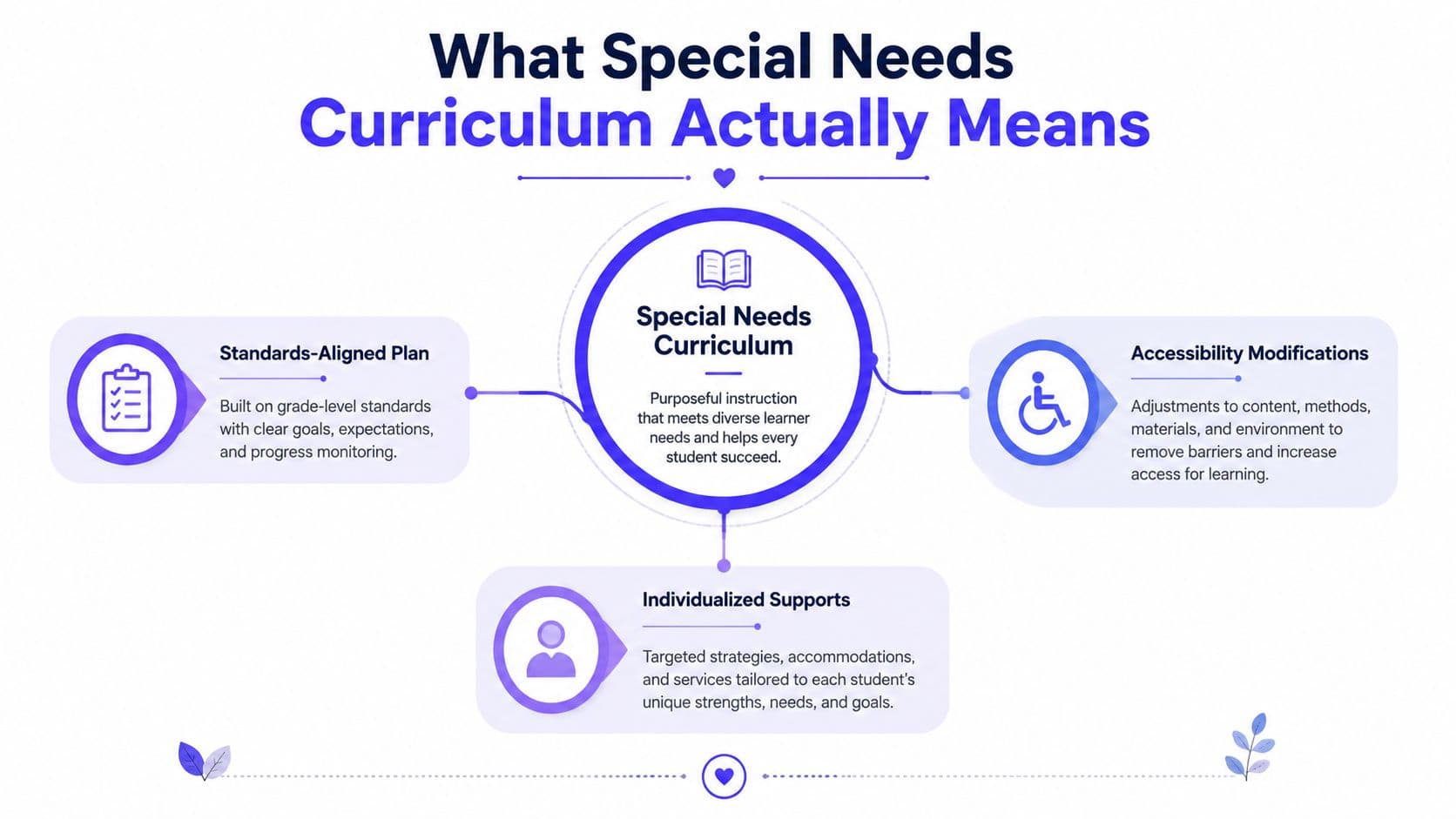
The key is not confusing adaptation with lowering the bar. A strong special needs curriculum keeps the standard visible, then adjusts how students reach it, how they engage with it, and how they show what they know.
Planning Across Long, Medium, and Short Horizons
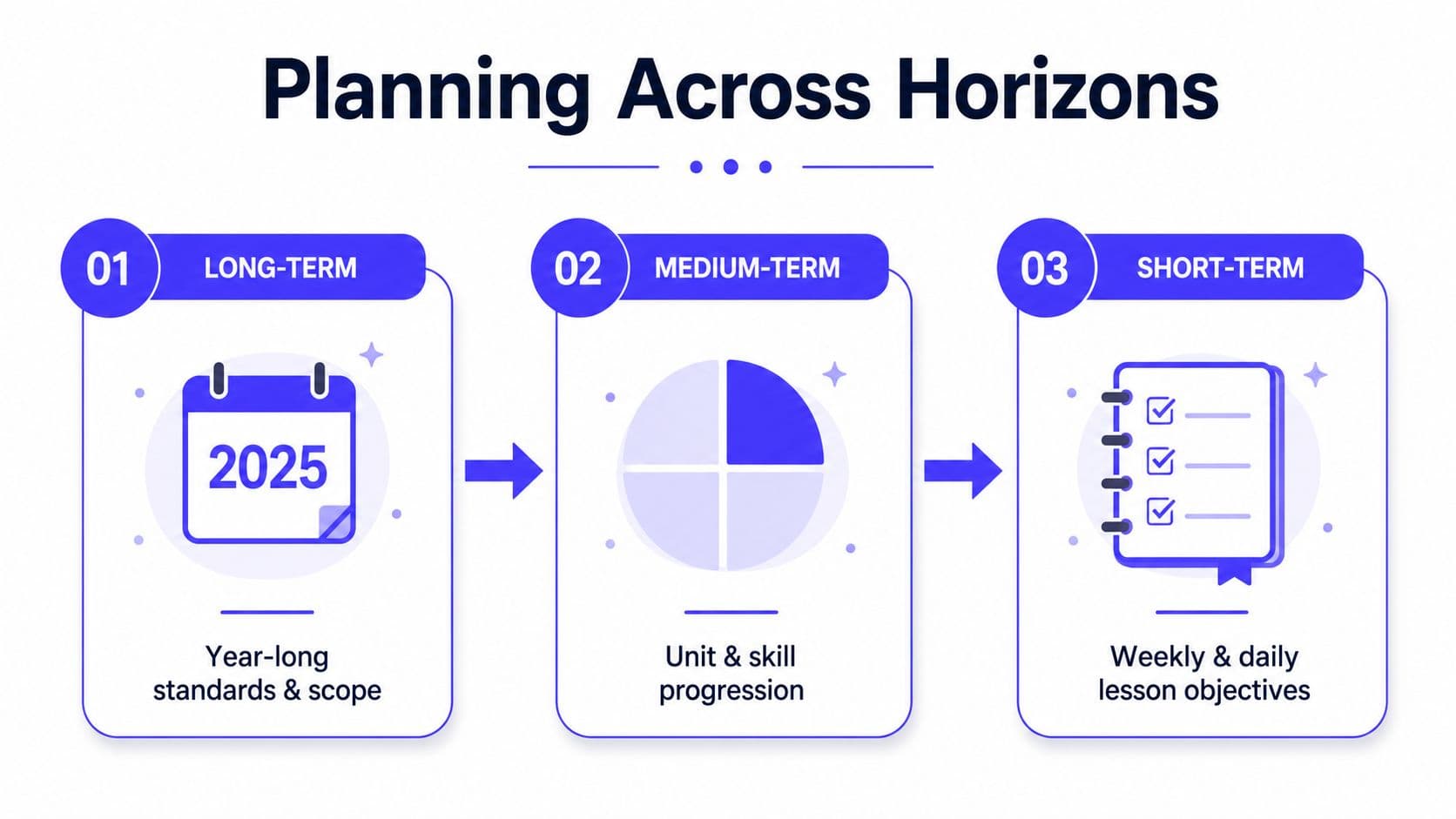
The best inclusive classrooms I've seen don't rely on last-minute fixes. They use a planning rhythm that runs across the year, the unit, and the lesson. That three-horizon view is useful because special education planning has to hold steady over time, not just look good on paper for one day.
Long term planning sets the map
At the long-term level, I'm thinking about the year as a whole. Which standards cluster together? Which IEP goals connect to which units? Where do project-based tasks, routines, or community experiences fit naturally? A fifth-grade ecosystems unit, for example, might sit beside reading informational text, writing claims with evidence, and building vocabulary for science talk.
Long-term planning is where teams decide what stays common and what becomes individualized. A student might work on the same science concept as peers, but with a different communication target or a more concrete evidence product. That choice belongs in the year plan, not as a surprise during week seven.
Medium term planning turns scope into units
The unit's design takes shape through careful planning. The fifth-grade ecosystems unit might have an enduring understanding about how living things depend on one another and an essential question about how changes in one part of a system affect the whole. From that foundation, the teacher pre-plans where support will show up, maybe vocabulary previews in one lesson, a graphic organizer in another, and a structured discussion task when students compare ecosystems.
A useful habit is to mark your differentiation points before the unit starts. That keeps you from rewriting the plan every afternoon. If you like using an AI planning tool, Kuraplan can be one option for scaffolding medium- and short-term planning by mapping objectives to standards and turning a unit skeleton into more usable lesson pieces.
Short term planning is the daily move
At the lesson level, the question becomes simple. Which UDL representation leads today? What will students use to act, respond, or demonstrate understanding? In the ecosystems example, one day might open with an image-rich explanation, followed by partner talk, then a choice between written exit ticket, oral response, or labeled diagram.
The Hong Kong Education Bureau's special schools curriculum guide breaks this into long-term, medium-term, and short-term planning horizons as well (EDB chapter 2_e.pdf)). That structure works because inclusive teaching needs more than a good lesson. It needs a system.
Designing Lessons Around UDL's Three Networks
A lesson gets stronger when the design gives students more than one way to connect, understand, and respond. I like to plan UDL with one real example, not a list of abstract principles. A middle-school primary source lesson makes the differences easy to see.
Engagement starts with a reason to enter the task
For engagement, the question is how students get hooked and stay regulated enough to work. In a primary source lesson, that could mean giving a choice between two documents, using culturally relevant examples, or keeping routines predictable so students know what comes next. Predictability matters because it lowers the energy students spend figuring out the structure.
A student with ADHD may need a brief timer and a clear first step. Another student may need a partner role that feels safe and concrete. A student with anxiety may do better when the lesson opens the same way every time, with the same visual routine and the same expectations.
Representation gives the same idea more than one doorway
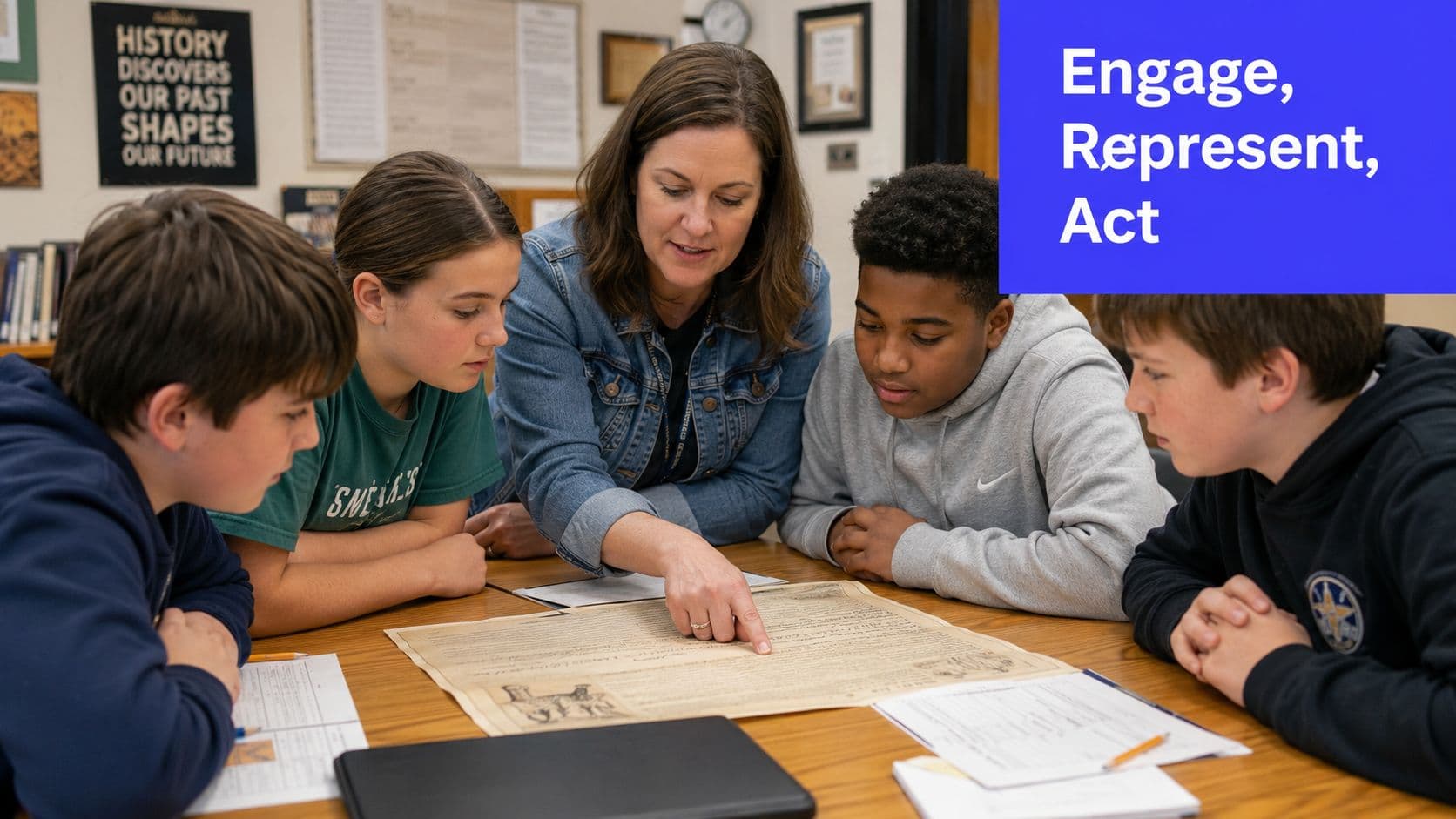
For representation, the same source can appear in more than one form. A handwritten letter might be available as text, audio, simplified annotations, and a graphic organizer. That doesn't change the source. It changes the access point.
The image below fits best when students are working through a document together and need a visual anchor for discussion.
Action and expression should not force one format
For action and expression, the teacher plans more than one way for students to show understanding. A five-paragraph essay might be one option, but so could an oral response, a visual timeline, a labeled sequence, or a structured discussion with sentence stems. The barrier is often output, not understanding.
A student doesn't always need a simpler idea. Sometimes the student needs a different route to show the idea they already understand.
The video below works well after students have seen the source and before they choose how to respond.
A quick classroom example makes this concrete. A student with dyslexia might use audio plus simplified annotations. A student with ADHD might use chunked steps, movement built into the task, and a short response window. A student who uses a speech-generating device might respond through programmed phrases, visual supports, or a shared communication board. Same lesson, different access routes, same academic idea.
The Four Categories of Adaptation Teachers Actually Use
Teachers often use a lot of adaptation language without sorting out what each move changes. That's where confusion creeps in. If you separate adaptations into content, pedagogy, materials, and assessment, planning gets cleaner fast.
| Adaptation Categories at a Glance | Example Move | Preserves Rigor? |
|---|---|---|
| Content | Keep the same standard, but change the complexity of the text or the number of examples a student must process | Sometimes, if the standard stays intact |
| Pedagogy | Use modeling, guided practice, pairing, or gradual release | Yes |
| Materials | Offer anchor charts, manipulatives, color-coded organizers, or assistive technology | Yes |
| Assessment | Allow oral response, extended time, or a different product for the same target | Yes, if the target stays the same |
Content adaptation is the one that needs the most care. If you simplify the actual learning target too quickly, you may solve a short-term frustration but lose the standard. Pedagogical and material changes are often the cleaner fix when the barrier is access, not expectation.
A common trap is calling every change a differentiation strategy when some changes lower the work. If a student can't access the text, the answer may be audio or annotation, not a smaller concept. If a student can explain reasoning but can't write it fluently, the answer may be oral response or structured templates, not fewer ideas.
The internal logic behind that distinction shows up clearly in broader differentiation guidance too, including this practical overview of teaching strategies for differentiation. The point is to match the barrier, not just reduce the demand.
Choosing Supports That Build Independence
The strongest support is the one that helps a student complete more of the work with less adult help. That point gets missed in a lot of meetings. Teams choose something that looks helpful in the moment, then discover the student still needs a paraprofessional close by to make the support usable.
A better question is whether the support changes who is doing the thinking, the reading, or the recording.
Ask what the support changes
Text-to-speech is a clear example. For a student with dyslexia, it can open a grade-level novel without asking an adult to read every page aloud. That is a real shift in independence. A read-aloud accommodation can still be helpful, but it often depends on adult presence and does not carry as well across settings.
Switch and scanning systems, alternative keyboards, and touch-screen overlays matter for the same reason. They do more than make a task possible, they can make the task more self-directed. A choice board may support participation, but it does not always reduce the adult labor needed to reach the content.
The same idea shows up in scaffolding in education. A scaffold should support the student long enough to build skill, then fade as the student takes over more of the task.
Use person-centered questions before adding a tool
Before adding a support, I ask three things.
- Does this let the student do more on their own? If not, it may be helping the adult more than the learner.
- Does it work across settings? A tool that only works in one room is not building true access.
- Does it move the student toward an IEP goal? If it only helps with the next worksheet, it may be too narrow.
That same logic appears in curriculum-access frameworks that focus on autonomy and least dependence, especially for low-incidence disabilities. CAST's curriculum-access framework emphasizes choosing technologies that provide the greatest independence and least dependence, while special-needs guidance from Assam also stresses the use of assistive technologies to support equal participation (CAST curriculum-access framework, Assam curriculum guidelines.pdf)).
The familiar support language in a lot of schools focuses on compliance. The better question is whether the support helps a student take part without waiting for an adult to translate every part of the lesson. That is the difference between access and independence.
A Sample Two-Week Unit With Differentiation Built In
A two-week persuasive writing unit is a good place to see the whole design at once. The aim is still standard-aligned writing, but the path to the final product is flexible enough to fit different learners without splitting the class into separate curricula.
The unit can start with an enduring understanding that writers make choices to persuade a real audience. The essential question might ask how evidence, reasons, and counterarguments strengthen a claim. From there, the class can move through thesis statements, supporting reasons, counterarguments, rebuttals, and conclusions.
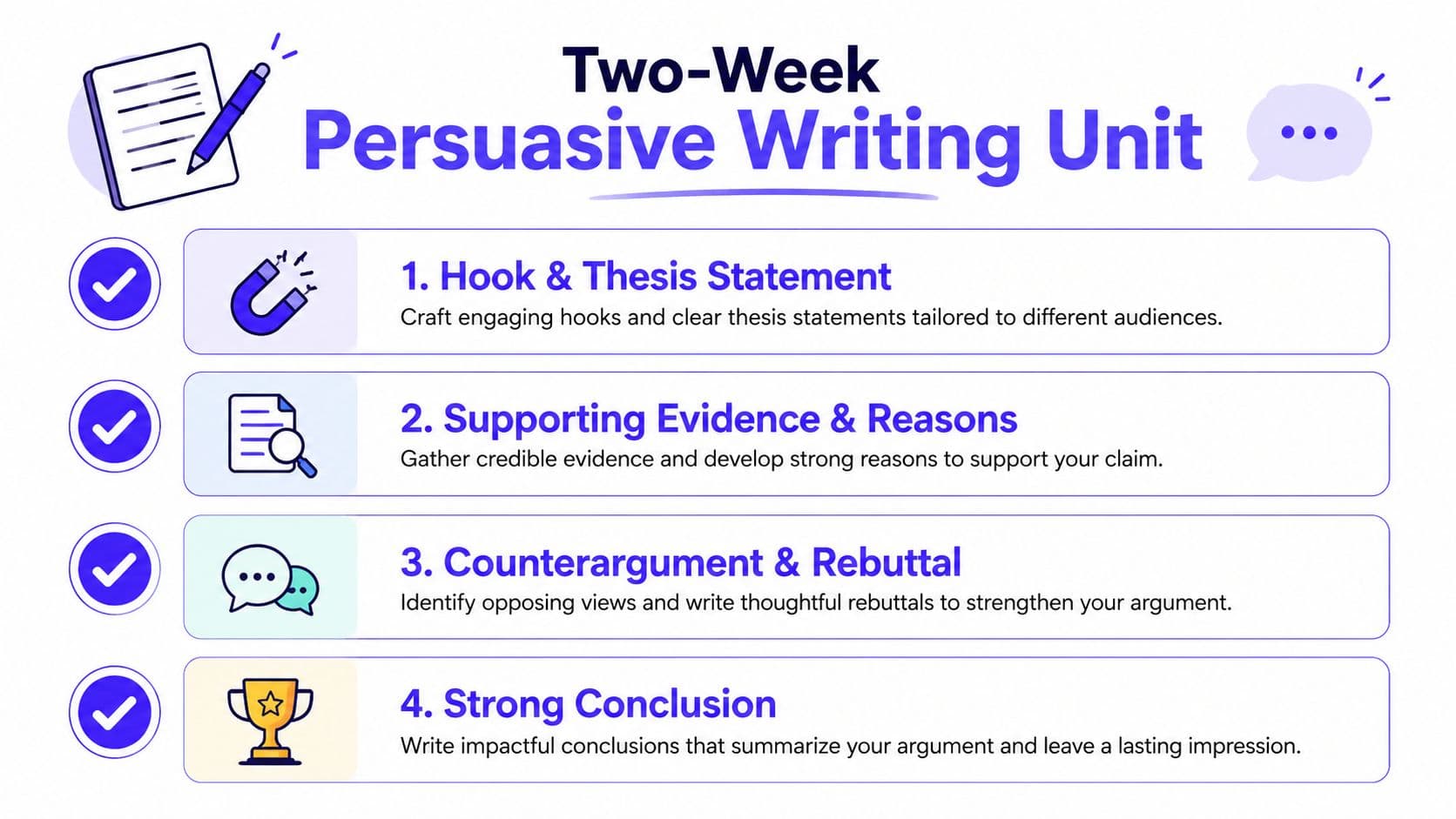
The unit skeleton holds the class together
The standards stay visible, and so do the IEP connections. A student working below grade level might need sentence frames, oral rehearsal, or a reduced number of sources, while a student on grade level might draft a full paragraph set. Both can still work toward the same persuasive writing target.
The most important part is that formative checks are built in from day one. One student may show understanding with a spoken claim, another with a labeled organizer, another with a draft paragraph. If the teacher waits until the end for evidence, the unit loses its flexibility.
What changes and what stays common
The hook can be shared. The brainstorming can be shared. The final assessment can offer more than one response mode while still asking for claim, evidence, and reasoning. That's the design move that keeps rigor from collapsing into sameness.
If you use tools to speed up production, Kuraplan can convert a finished unit plan into differentiated printable worksheets and visuals in minutes, which can free you up for the judgment calls that only a teacher can make.
The unit details also work well when drafted in a planning system like Kuraplan unit plans, especially when a team wants the same structure across classes while still leaving room for individual supports.
Putting It All Together in Your Classroom
A strong special needs curriculum is usually easier to recognize than to build from scratch. Before your next unit, check five things. The standards are named. The IEP goals are mapped. UDL options are pre-planned for at least two networks. Assessment offers more than one response mode. At least one support helps the student become more independent, not more adult-dependent.
That's the work that makes the legal promise real. Students with disabilities are entitled to the same grade-level curriculum as their peers, and inclusive planning is what turns that sentence into an ordinary school day instead of a compliance document.
I'd keep an eye on AI-supported differentiation, more person-centered planning, and better tools for converting one solid unit into multiple usable access points. If you want a planning partner that can help turn standards-aligned ideas into lesson plans, worksheets, and visuals, take a look at Kuraplan and see whether it fits the way your team already plans.