Unusual Animals Exploration
A free languages worksheet ready for your classroom. Open in Kuraplan to grab the print-ready PDF, customize it for your students, or generate a fresh version in seconds.
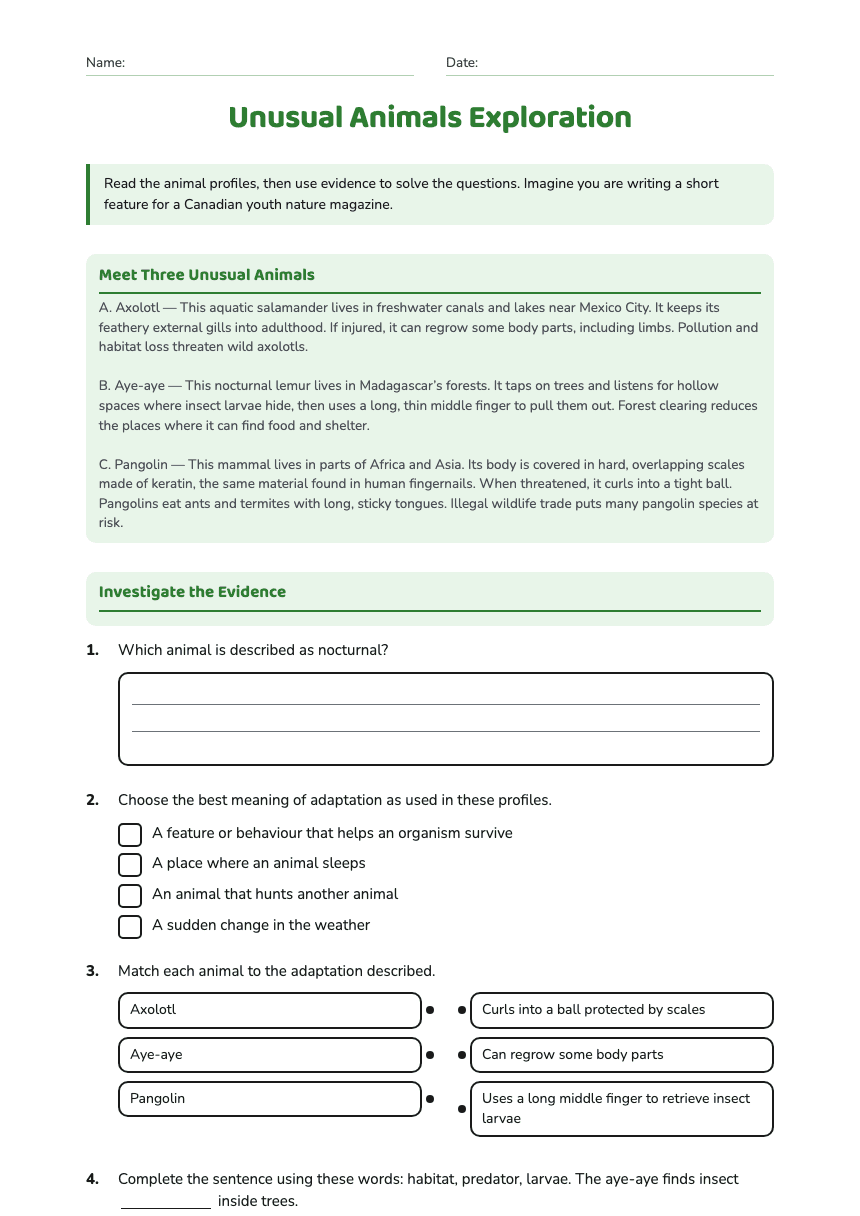
Unusual Animals Exploration
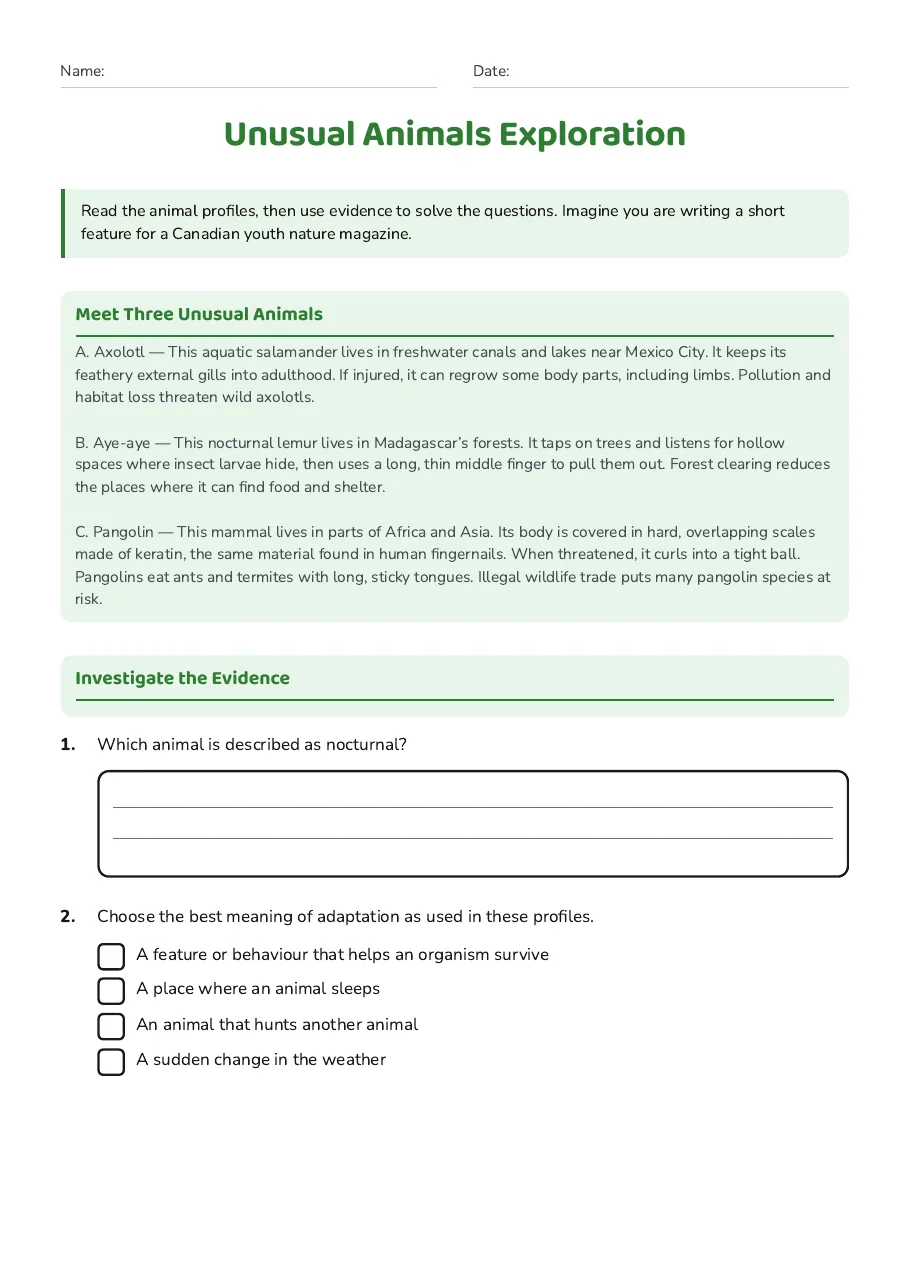
Meet Three Unusual Animals
A. Axolotl — This aquatic salamander lives in freshwater canals and lakes near Mexico City. It keeps its feathery external gills into adulthood. If injured, it can regrow some body parts, including limbs. Pollution and habitat loss threaten wild axolotls. B. Aye-aye — This nocturnal lemur lives in Madagascar’s forests. It taps on trees and listens for hollow spaces where insect larvae hide, then uses a long, thin middle finger to pull them out. Forest clearing reduces the places where it can find food and shelter. C. Pangolin — This mammal lives in parts of Africa and Asia. Its body is covered in hard, overlapping scales made of keratin, the same material found in human fingernails. When threatened, it curls into a tight ball. Pangolins eat ants and termites with long, sticky tongues. Illegal wildlife trade puts many pangolin species at risk.
Investigate the Evidence
- A feature or behaviour that helps an organism survive
- A place where an animal sleeps
- An animal that hunts another animal
- A sudden change in the weather
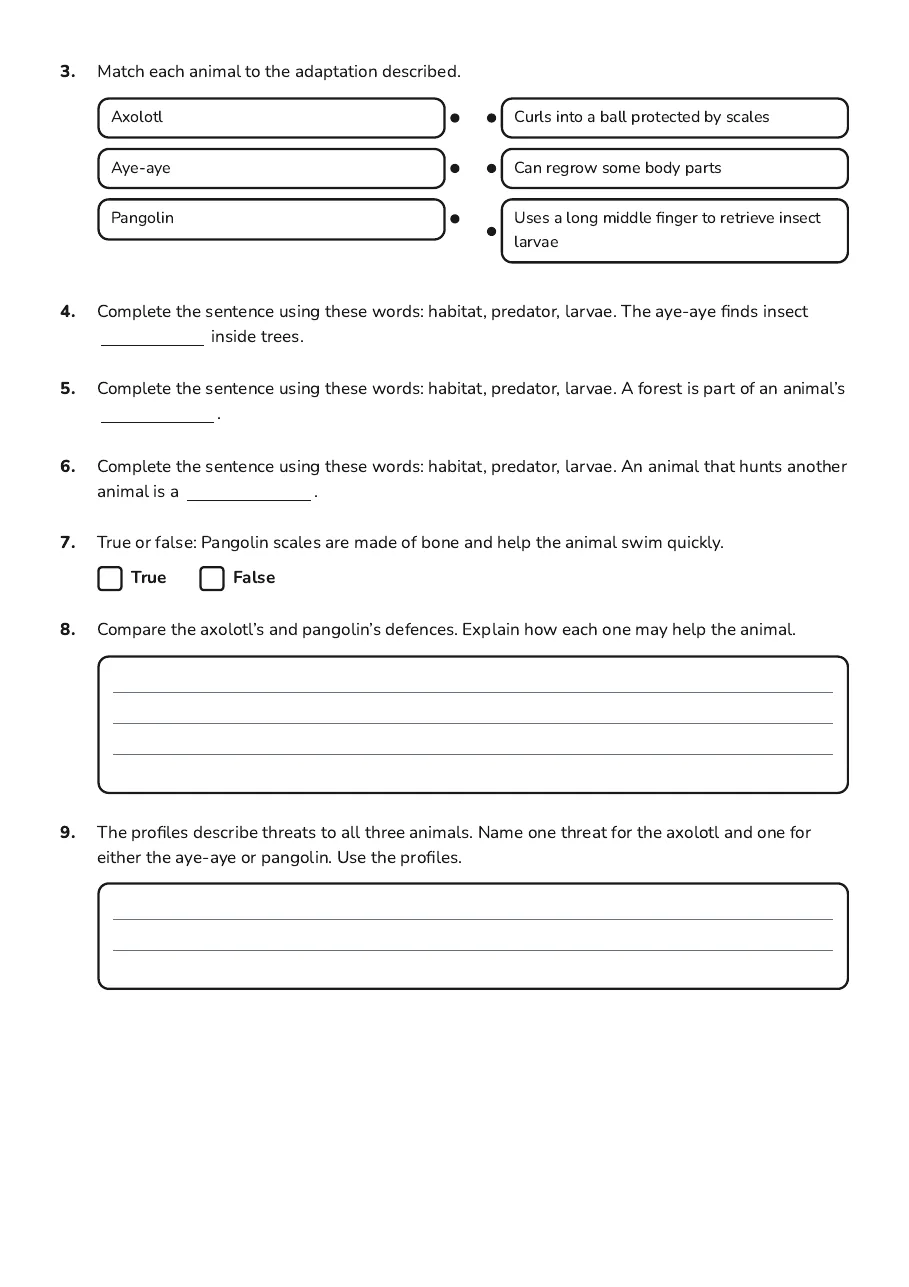
- Axolotl
- Aye-aye
- Pangolin
- Curls into a ball protected by scales
- Can regrow some body parts
- Uses a long middle finger to retrieve insect larvae
3 printable pages
Page 1
Page 2

Page 3
About This Worksheet
Free in Kuraplan
Sign up free, grab the PDF, and customize it for your class.
Print-Ready
Formatted for standard paper. Clean layout, easy to read.
AI-Generated
Created with Kuraplan's AI, designed for real classroom use.
For Teachers & Parents
Use in classrooms, for homework, tutoring, or homeschool.
Need a custom version of this worksheet?
Kuraplan's AI generates custom worksheets in seconds — differentiated for every learner, aligned to your curriculum.
Generate Custom Worksheets — Free