
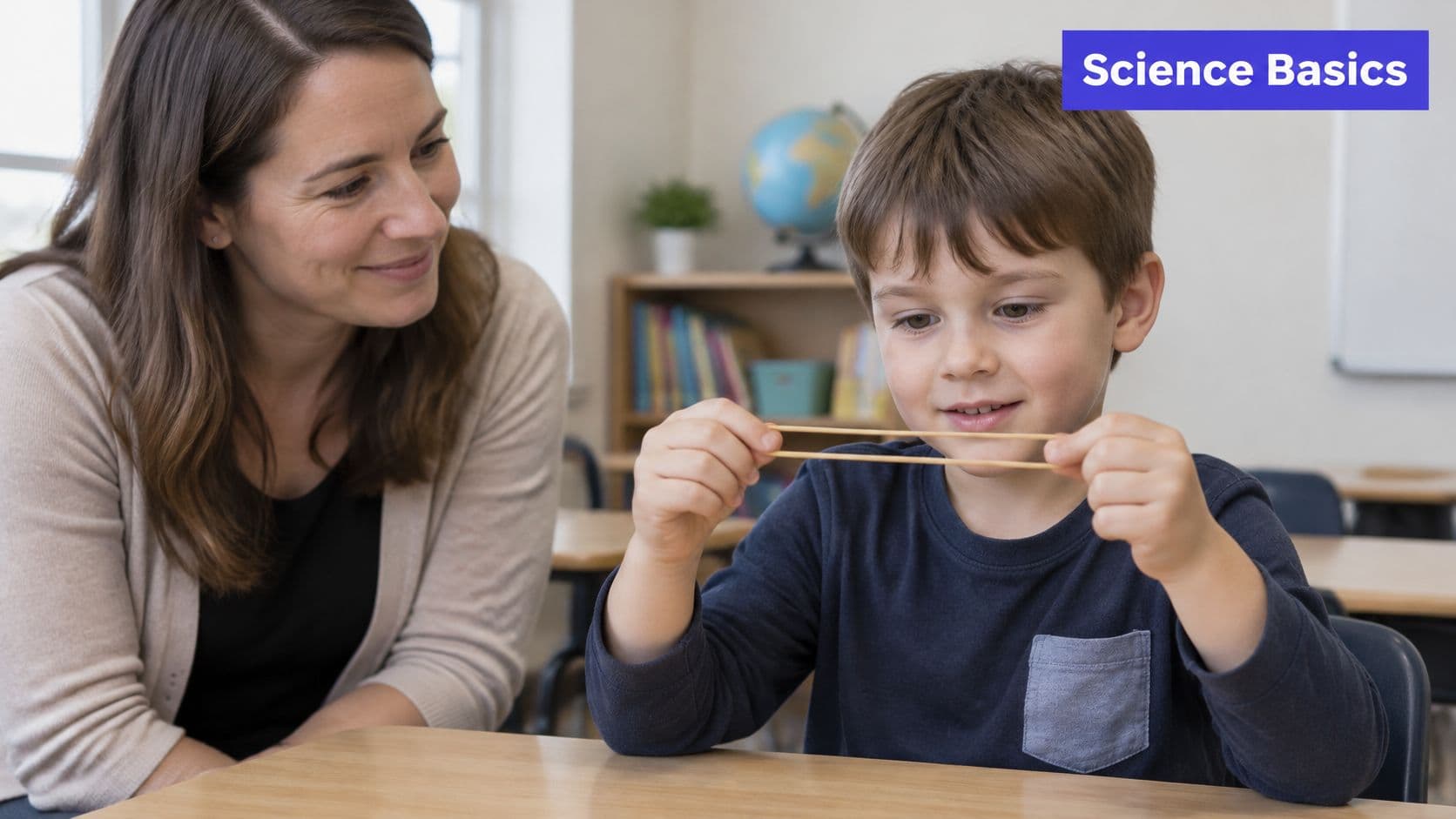
A child at your table shakes a rubber band, hears a faint hum, and announces that it's making music. Nearby, someone is stretching another band toward a classmate, and you're wondering whether there's enough time before lunch to turn this into an actual science lesson.
There is, provided you narrow the question. Instead of explaining everything about sound, ask children to watch what moves when the band makes a noise. That small shift, from handling materials to noticing evidence, is where useful 1st grade science begins.
What First Graders Learn in Science
First graders need something they can examine before they need a definition to remember. A trembling rubber band gives them a reason to learn vibration. A patch of light behind clear plastic gives them something to compare with the darkness behind cardboard.
Keep attention on the material while it's moving.
The Content Behind the Activities
The NGSS first-grade standards draw from four disciplinary core ideas, PS4, LS1, LS3, and ESS1, across physical science, life science, and Earth and space science; expectations include investigating vibration and sound in 1-PS4-1 and observing seasonal daylight in 1-ESS1-2.
That distinction matters: there are broad science domains, with separate ideas within them, rather than an unlimited list of themed activities.
- Sound and light: Children investigate vibrating materials, visibility, and what happens when materials interrupt light.
- Living structures: Students connect plant and animal parts to the jobs those parts do.
- Parents and offspring: Children look for similarities without assuming that young organisms are exact copies.
- Sky and daylight patterns: Students revisit observations of the Sun, Moon, stars, and daylight rather than relying on a single weather worksheet.
A craft can support these ideas, but it isn't automatically an investigation. Making a paper flower becomes useful science when children explain what a leaf does or use a plant structure to inspire a solution to a human problem.
What Practicing Science Looks Like
First graders can help plan a test when the choices are manageable. They can choose which material to investigate, predict what might happen, examine the result, and decide whether their prediction needs changing.
They usually can't manage unfamiliar equipment, remember a long procedure, record detailed notes, and explain a result simultaneously. Model the procedure separately from the recording task. Let children rehearse explanations aloud before asking them to write.
Practical rule: Reduce the reading and equipment demands before you reduce the scientific thinking.
Analyzing data might mean sorting drawings into “light passed through” and “light was blocked.” Communicating findings might mean pointing to a drawing while a partner records the explanation. Neither requires a polished paragraph.
The important progression is from noticing to comparing to explaining. Children should leave with more than a new word: they should be able to identify something they observed and explain how it supports their thinking.
Scope and Sequence for the Year
First-grade science scope and sequence
| Unit | Performance expectation | Phenomenon to observe | Suggested timing |
|---|---|---|---|
| Sound and vibration | 1-PS4-1 | Rubber band or tuning fork vibrating and sounding | Weeks 1-3 |
| Light and materials | 1-PS4-3 | Beam of light passing through clear plastic, wax paper and cardboard | Weeks 4-6 |
| Plant and animal structures | 1-LS1-1 | Roots, stems, leaves, flowers and fruits matched to function | Weeks 7-10 |
| Heredity | 1-LS3-1 | Parent and offspring showing shared and different traits | After structures, before the next seasonal comparison |
| Daylight and seasons | 1-ESS1-2 | Daylight compared across seasons as longer or shorter, not in hours | Begin a shared log at the start of the year; revisit across seasons |
Treat this as a suggested opening sequence, not a complete year compressed into a term. Leave room for reteaching, engineering tasks, school interruptions, and further observations. The timing blocks are planning choices, not required durations.
Why This Order Works
Sound gives children quick feedback. They act on an object and immediately notice a change. Light investigations then introduce a more deliberate comparison: keep the light source steady while changing the material.
Structures require children to connect what they can see with what a part does. Heredity follows naturally because students already have language for describing features. Use animal photographs rather than requiring children to discuss biological family relationships.
Sky observation runs alongside these units. A brief shared observation can continue while the main lesson concerns plants or sound. Don't save seasonal observations until the end of the year, when the opportunity to compare has passed.
Protect Time for the Investigation
Science competes with reading, writing, and mathematics. Across participating countries in TIMSS 2019, fourth graders averaged approximately 73 hours of science, or 8% of annual instruction, according to the TIMSS instructional-time report.
For a sample classroom timetable, try two to three science blocks a week lasting 30 to 40 minutes. That's a proposed schedule, not a benchmark for every school.
When the timetable shrinks, separate the investigation from the discussion rather than rushing both. Test materials during science, then use the resulting drawings for an oral-language lesson. Keep the science objective visible: children still need to explain what happened, not merely practice a sentence pattern.
Protect repeat testing before adding another worksheet. A child who gets an unexpected result needs permission and time to try again.
Sample Lessons and Printable Activities
Use a recording sheet with plenty of drawing space. A crowded page can make a straightforward investigation feel like a reading test.
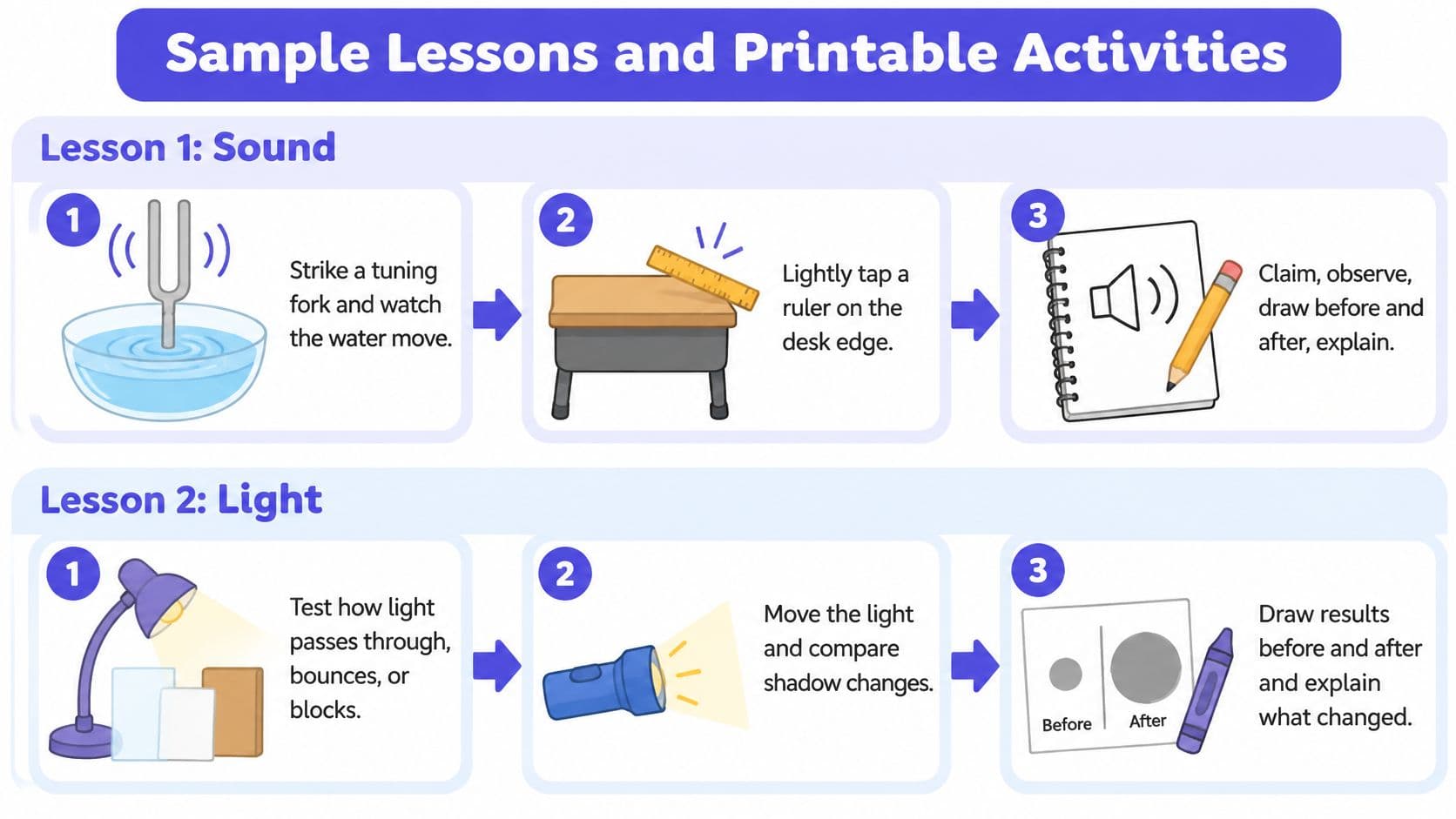
This handout provides a visual sequence for the sound and light activities.
Sound From Moving Materials
Materials: A rubber band, a ruler, paper, and pencils. A tuning fork and shallow water container are optional. Check for latex allergies and supervise stretched bands.
- Ask children what they think will happen when a secured rubber band is plucked. Record predictions without marking them correct or incorrect.
- Pluck the band while children watch from nearby. Alternatively, hold a ruler firmly against a desk with its end projecting beyond the edge, then lightly tap the free end.
- If using a tuning fork, strike it against an appropriate soft striking surface and gently touch it to the water surface. Keep the container on a tray.
- Students draw the material before and during movement, then explain what they noticed. Help them distinguish the prediction made beforehand from the evidence collected during the test.
No special science equipment is necessary for the basic sound test. A rubber band works, provided children can see or feel its movement rather than only hear it.
Light Through Different Materials
Materials: A torch or flashlight, clear plastic, wax paper, cardboard, foil, fabric, tape, and a recording sheet.
- Establish a fixed flashlight position and test location. Ask children to predict which materials will let light reach the surface behind them.
- Test each material in turn. Record passes through, partly blocked, or blocked, using the same setup throughout.
- Discuss surprising results. Thin fabric may behave differently from thick fabric, so name the material tested rather than teaching a universal rule about all cloth.
- Design a light-signal device for a partner. Agree on a message, test whether the partner understands it, and revise the device or signal.
The Idaho first-grade science guide connects investigations of light and materials with designing a device that uses light or sound to communicate over a distance.
If you use a video alongside the practical work, give children a viewing question and preview it before class.
Printable Prompts and Life-Science Swaps
Choose an adaptable page from these first-grade science worksheets, then retain only the prompts that match the investigation.
- Labelled drawing: Draw the sound source and label the moving part.
- Yes-or-no check: Did the ruler move while it made sound? Show or describe your evidence.
- Claim with evidence: Complete “I think ___ because I observed ___.”
For a short rubric, mark observation as specific, vague, or missing. Mark explanation separately as connected to the observation, unsupported, or not yet expressed. Accept dictated responses.
For plant work, place a labelled plant or a teacher-opened, soaked bean seed on the table. Use an accompanying whole-plant picture because a seed won't show every mature structure. Match roots to taking up water, stems to support and transport, leaves to making food, flowers to seed production, and fruits to protecting seeds.
Students choose a structure and explain how it helps the plant. For heredity, compare parent-animal and offspring photographs, identify two shared traits and one difference, and make a claim using similar and not identical. Swap the sound question on the exit ticket for a labelled structure-and-function drawing.
Reaching Every Learner Without Lowering the Science
Hands-on isn't automatically equitable. A garden investigation can exclude children without outdoor access. A take-home experiment can assess adult availability and household supplies more than a child's understanding.
Choose the scientific idea first, then choose a material that everyone can access. Looking closely at a teacher-provided plant photograph can support a useful structure discussion; owning a magnifier shouldn't be the entry requirement.
Check the Hidden Requirements
Low-cost versus equipment-heavy investigations
| Activity | Materials needed | Hidden requirement | Equity note |
|---|---|---|---|
| Rubber band hum | Rubber band and desk edge | None | Works in any classroom |
| Light through materials | Torch, five sheets and tape | Dark corner | Use a shoebox if no room can be darkened |
| Plant structure hunt | Hand lens and school garden | Outdoor space | Use a picture card set instead |
| Tuning fork test | Tuning fork and cup of water | Purchased kit | Lend one fork per table or tap a ruler |
| Seasonal daylight log | Window and class calendar | Regular home observation | Keep one shared class chart at school |
Use this table before choosing the first investigation for a unit. “Works in any classroom” assumes the teacher supplies a suitable rubber band and checks individual access needs. Low cost doesn't remove the need for accessibility planning.
For apartments and rural homes alike, make home extensions optional. Children can compare ordinary objects already available to them, but bring the essential observation into school. Don't require photographs, printing, a garden, or an adult's written explanation.
Assess the idea the child understands, not the resources their family can provide.
Offer Different Ways Into the Same Question
A child who doesn't hear the sound clearly may be able to feel a ruler's vibration through a safe contact point. Secure materials within reach for students with mobility needs rather than expecting everyone to rotate around standing stations.
Accept pointing, drawing, signing, speech, or an established communication device. Ask multilingual learners for familiar words in their home languages and pair those words with photographs, gestures, and the classroom vocabulary.
Use sentence frames without turning them into scripts children must copy. “I noticed ___” supports observation; “I think ___ because ___” supports explanation. These differentiation strategies can help you plan alternative routes while keeping a shared learning objective.
At least 40% of students surveyed across grade levels reportedly lacked access to inquiry-based learning or scientific-method instruction, with Indigenous, Black, Latino, and low-income students among those least likely to receive it, according to the science-education article available through ERIC.
Start inquiry with limited choices of materials or predictions, then gradually remove scaffolds. Ask “What have you noticed about this?” rather than “Who already knows the answer?” Unfamiliarity with a garden, tool, or English term isn't evidence that a child can't reason.
Classroom Routines That Keep Investigations Calm
Put the materials on a tray before children arrive. Leave spare supplies out of sight, and display a sequence card showing predict, test, record, explain, and tidy.
The routine needs teaching just as much as the science does. Rehearse passing the tray and responding to the stop signal with materials that aren't especially exciting.
Give Everyone a Useful Job
- Materials manager: Collects the tray and returns equipment to its marked place.
- Recorder: Draws the group's observations, with partners contributing details.
- Speaker: Shares the result after checking that partners agree.
- Shared cleanup: Everyone checks the floor and table before the tray goes back.
Rotate jobs. Don't routinely assign the strongest writer to record or the most confident talker to speak.
Before releasing equipment, ask each child to make a prediction by pointing, drawing, or speaking. That gives children something to check and reduces the temptation to treat the materials as toys.
Manage Sound Without Demanding Silence
Sound lessons will be noisy. Have groups test in turns while others watch for movement, then use a familiar quiet-count signal paired with a raised hand.
When the signal begins, children place equipment flat, move their hands away, and look toward you. Practice that response before the first test; calling louder over vibrating rulers rarely helps.
Reset cue: Equipment down, hands clear, eyes ready.
The common failure points are too many materials and no question. If children are distracted, remove the unused equipment rather than repeating the instructions more loudly.
If exploration becomes aimless, return to a narrow task: “Show your partner what moves.” Keep a cleanup job inside the lesson time, not after the class is already lining up. Calm investigations depend on a predictable ending as well as an engaging start.
Formative Checks That Show What Students Know
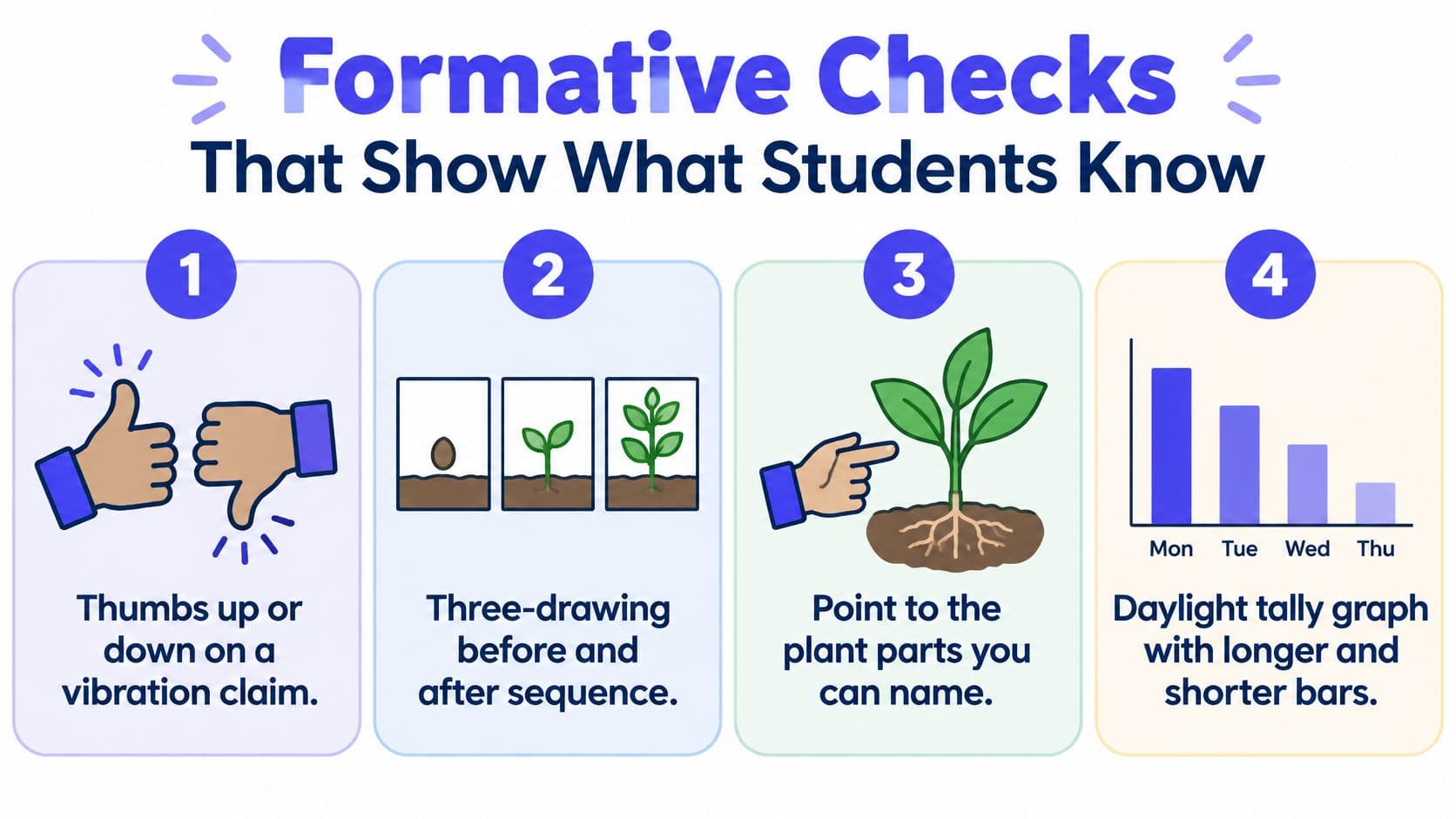
Start with a response children can give without a pencil. Ask for thumbs up or down on a vibration claim, then invite someone to demonstrate the evidence. A correct gesture alone may reflect copying rather than understanding.
Use the following visual as a reminder to vary the response format.
Look Past the Finished Page
- Sequence drawings: Ask for before, during, and after pictures. Check whether the child shows a meaningful change.
- Plant pointing: Name a function and have the child point to the matching part, then reverse the task.
- Daylight graph: Use longer and shorter bars to represent relative daylight. Ask children to compare the bars and explain what they represent.
For seasonal assessment, the California science standard explicitly limits expectations to relative amounts of daylight and doesn't require students to quantify hours or minutes. Keep questions grounded in comparisons such as winter versus spring in your location, not elapsed-time calculations.
Choose Visuals and Digital Checks Carefully
Display a labelled light-path diagram that matches your classroom setup, a sound-vibration poster made from students' observations, and a seasonal sunrise chart with dates and a consistent observation location. Avoid decorative diagrams that introduce details children haven't investigated.
These formative assessment examples can help you select a response format that reveals the specific misunderstanding you're checking.
If your school uses digital checks, Form Timer's guidance on timed classroom assessments with Google Forms may help organize a teacher-managed assessment window. Timing shouldn't measure a first grader's reading speed or device fluency; provide oral support and follow individual accommodations.
Sort responses by the next teaching move: ready to apply, needs another observation, or needs help expressing an idea. That's more useful than treating every incomplete sentence as a science error.
Start With One Vibration Lesson This Week
Start with sound because a rubber band, ruler, and desk edge will do. Choose a manageable claim-evidence routine rather than preparing a roomful of stations.
- Ask children to predict what will happen when you pluck the rubber band.
- Pluck it while they watch. Let them gently feel the movement where safe, keeping stretched bands away from faces.
- Have students draw before and after, then state a claim supported by something they noticed.
- Finish with the printed exit ticket. Separate observations from inferences so you know who needs another look and who needs help explaining.
Before planning Week 4, check the sequence against your term dates and move the light unit if the schedule has tightened. Preserve the investigation rather than squeezing in every planned page.
AI planning tools such as Kuraplan are an option alongside school templates and shared team plans for producing standards-aligned worksheets and visuals. Check every item against what your class has observed and can read.
Kuraplan offers lesson and unit planning, printable worksheets, educational visuals, and assessment rubrics for classroom teaching. Visit Kuraplan to build a first-grade science lesson around your chosen phenomenon, then adapt the materials and response options for your learners.