On Monday morning, the water-cycle diagram is projected at the front of the room. Maria, a newcomer at the Entering level, studies the arrows without knowing where to begin. Ahmed, who is Expanding, copies the vocabulary list carefully but avoids the discussion. Linh, a long-term English learner at the Bridging level, finishes the worksheet quickly and starts drawing in the margin.
They're all learning the same science concept. They don't need three unrelated lessons. They need different ways into the same rigorous content, with language supports matched to what each student can understand and produce today.
That's the heart of differentiated instruction for English language learners. You adjust the content, process, product, and learning environment while keeping the important learning goal steady. This approach became especially influential in the late 2000s, when major teacher-preparation and support organizations helped move differentiation from a broad teaching principle into a practical model built around visuals, charts, timelines, realia, multiple reading levels, flexible grouping, and ongoing assessment. Colorín Colorado's overview of differentiated instruction for ELLs describes that shift clearly.
Generic advice such as “use visuals” or “group students flexibly” only takes you so far. A picture card may be exactly right for Maria, too easy for Linh, and useful but insufficient for Ahmed. The proficiency band tells you how much support to provide, what kind of language to invite, and how to recognize understanding.
A Classroom Moment That Shows Why One Lesson Never Fits All
The teacher pauses beside the table and looks at the three papers. Maria has circled the sun. Ahmed has copied “evaporation,” “condensation,” and “precipitation.” Linh has written a complete explanation, but the task asked everyone to label the diagram.
Nothing is wrong with the students' effort. The mismatch is in the lesson design. The diagram assumes that students can read the labels, interpret arrows, understand the science verbs, and explain a sequence in English. Those are several demands layered onto one activity.
One standard, several access points
A stronger version keeps the content goal intact: students will explain how water moves through the water cycle.
Maria might work with a labeled diagram, picture cards, gestures, and a bilingual glossary. She can point to the sun, match “water vapor” to an image, and rehearse a short response such as, “Water goes up.” That response is small in English, but it can show meaningful conceptual understanding when the teacher also checks the student's sorting and pointing.
Ahmed can use the same diagram with a sequence organizer. He might explain, “First, the sun heats the water. Then the water evaporates,” using vocabulary and a sentence frame. His support should help him connect ideas, not just copy terms.
Linh needs a different challenge. She could compare evaporation and condensation, explain the role of temperature, or write a paragraph using cause-and-effect language. Giving her only the beginner worksheet doesn't protect her. It removes the opportunity to develop academic language.
Practical rule: Differentiate the route, not the destination.
The need for this work is broad. A U.S. education source projected that English learner enrollment would reach 10 million by 2015, highlighting why mainstream classrooms needed instruction that could accommodate wide differences in language proficiency, prior schooling, and literacy. The academic study hosted by California State University, Sacramento also cites research in which student-centered strategies had a greater positive influence on English learners' academic language development than teacher-centered approaches.
At lunch, I'd describe differentiation this way: don't make Maria wait until her English catches up before she can learn science, and don't make Linh repeat beginner work because she still needs language support. Use proficiency information to make the lesson reachable, then adjust as students show you what they can do.
The Four Things Teachers Can Actually Adjust
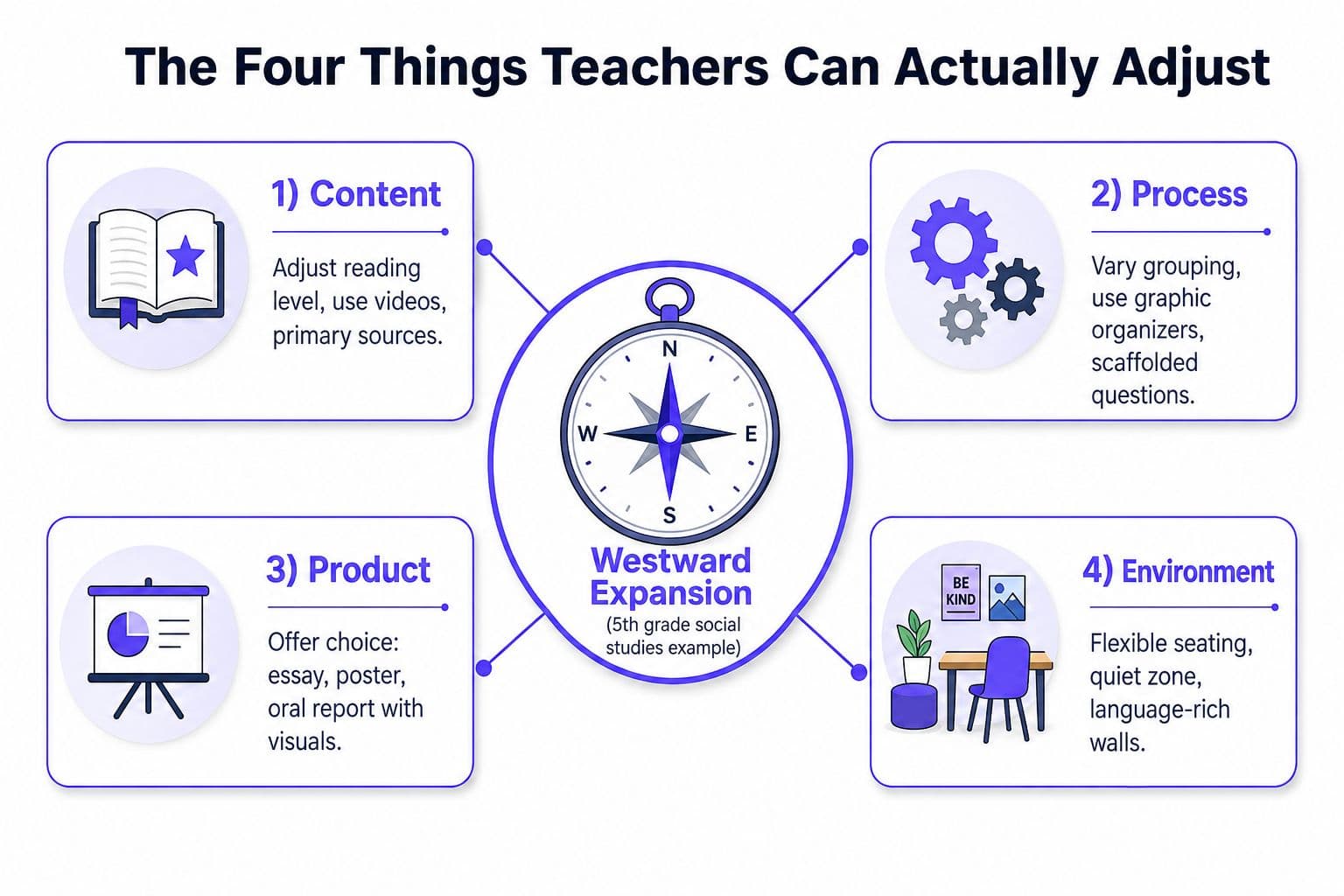
Differentiation sounds complicated until you make the adjustments visible. In practice, teachers usually change content, process, product, or environment. You don't need to change all four every time. Start with the one creating the biggest barrier.
Take a fifth-grade social studies lesson on westward expansion.
Content
Content is the material students access. Maria might read a short, clearly formatted passage with photographs, a map, and a short video. Key terms such as “migration,” “territory,” and “resources” can appear beside images and, when helpful, in a bilingual glossary.
Ahmed may read the grade-level passage with selected sentences highlighted and a timeline to support sequence. Linh can work with the same textbook section plus a primary source that asks her to consider perspective and evidence.
The mistake is replacing the standard with a much easier topic. Scaffolded, challenging content is a stronger choice than lowering task demands. The ERIC resource on differentiated instruction for multilingual learners emphasizes grade-level materials paired with temporary supports such as visuals, bilingual resources, simplified text, discussion, and flexible grouping.
Process
Process is what students do while learning. Maria might sort picture cards showing people, places, and movement. Ahmed could complete a cause-and-effect organizer with a partner. Linh might analyze a primary source and mark evidence that reveals a settler's perspective.
Keep the activity purposeful. A worksheet with more boxes isn't automatically better differentiation. Ask what thinking the task requires, then remove language obstacles that aren't part of the standard.
Product
Product is how students demonstrate understanding. Maria might create a labeled drawing with an oral explanation. Ahmed could write a supported paragraph or record a short presentation using a map. Linh might write an evidence-based response comparing two perspectives.
The product can vary without making one student's work less meaningful. Use the same success criteria for the content, while making language expectations appropriate to each learner's current level.
Environment
Environment includes grouping, seating, classroom routines, and available language resources. Partner talk may help Maria rehearse before sharing. A quiet workspace may help a student who needs processing time. Language-rich walls, maps, word banks, and visible directions reduce the number of instructions students must hold in memory.
For planning ideas that keep these choices connected to the lesson rather than scattered across separate worksheets, see Kuraplan's guide to differentiation teaching strategies.
Matching Scaffolds to Each Proficiency Level
A proficiency label should change your planning. Illinois' English Language Proficiency Standards use a 1-to-5 developmental progression, from Entering to Bridging, giving teachers a concrete way to differentiate expectations by stage. The Illinois framework provides that progression.
WIDA-based frameworks commonly use a 1.0 to 6.0 scale and separate receptive skills, listening and reading, from productive skills, speaking and writing. This WIDA-aligned English learner framework shows why a student may understand a complex explanation while still needing support to produce a complete response.
Use an ecosystem lesson to see how one concept can lift across bands.
| Proficiency Level | Language Goal | Recommended Scaffolds | Sample Student Output |
|---|---|---|---|
| Entering | Identify and name ecosystem parts | Picture cards, gestures, realia, bilingual glossary, yes/no frames | “Plant.” “Yes, food.” |
| Emerging | Describe a relationship | Sentence starters, manipulable sentence strips, labeled diagram | “I see a rabbit because it eats plants.” |
| Developing | Explain a simple interaction | Content vocabulary, paired sentence frames, graphic organizer | “The rabbit depends on the plant for food.” |
| Expanding | Discuss cause and effect | Structured academic talk, transition words, paragraph frame | “Because plants provide energy, herbivores depend on them.” |
| Bridging | Extend and justify an explanation | Minimal prompting, academic vocabulary bank, evidence notes | “Removing plants can affect several organisms because energy moves through the food web.” |
Entering and Emerging
At Entering, reduce the amount of language needed to begin thinking. Use picture cards, total physical response gestures, bilingual glossaries, and yes/no response frames. “Is this a producer?” with a picture and a gesture can create a meaningful check without demanding a sentence the student can't yet form.
At Emerging, add sentence starters such as “I see ___ because ___.” Sentence strips students can move and rearrange help them notice English word order while still discussing the science.
Developing through Bridging
Developing students benefit from paired frames and a simple organizer that separates organism, action, and result. Expanding students are ready for structured academic talk, transition words, and paragraph frames. Bridging students should carry more of the discourse independently, but an academic vocabulary bank remains a legitimate support.
Technology can help students rehearse language when it serves a clear classroom purpose. For ideas about speech apps with Voice Control Pro, look for tools that let students practice speaking, listening, or recording a response without turning the device into a distraction.
Scaffolds should be temporary and responsive. If a student can explain the relationship without a frame, remove the frame and keep the content vocabulary. This guide to scaffolding in education offers a useful planning lens for deciding what to add, what to fade, and what evidence to collect.
Writing Language Objectives That Move Beyond Content
A content objective names the knowledge students will learn. A language objective names the language move they'll use to access or demonstrate that knowledge.
“Students will analyze the causes of the American Revolution” is a content objective. A paired language objective could be, “Students will use transition words such as because and as a result to connect cause and effect in a written paragraph.” The first tells students what to understand. The second tells them how language will make that understanding visible.
Write both objectives together
Start with the content standard, then identify the function students need. Common functions include describe, compare, justify, sequence, classify, and explain. Next, choose the language domain, reading, writing, listening, speaking, or a combination, and name the support and product.
A practical template is:
Students will [language function] using [target language] with [support] to produce [observable product].
For an elementary math lesson, the content objective might be, “Students will identify equal fractions.” The language objective could be, “Students will compare two fractions orally using greater than, less than, or equal to with a visual fraction model and sentence frame.”
In middle school science, students might learn to describe how energy moves through an ecosystem. The language objective can ask them to use “because,” “therefore,” and “depends on” in a partner explanation supported by a diagram.
In high school history, students may evaluate the reliability of a source. The language objective might require them to justify a claim in writing using evidence verbs such as “suggests,” “reveals,” and “contradicts.”
| Content Area & Topic | Content Objective | Language Objective |
|---|---|---|
| Elementary science, life cycles | Students will sequence stages of a plant life cycle. | Students will use first, next, and finally to describe the sequence orally with picture support. |
| Middle school math, proportional relationships | Students will determine whether two quantities are proportional. | Students will justify a conclusion in writing using because and a table of values. |
| High school history, primary sources | Students will evaluate a source's perspective. | Students will compare two perspectives in a paragraph using evidence and contrast transitions. |
Posting both objectives changes the student's task awareness. A beginner can identify which frame or word bank to use, while a more advanced learner can stretch toward precise vocabulary and longer explanations. The teacher can assess content and language separately instead of treating silence or grammatical errors as proof that no learning occurred.
Building Tiered Tasks Around the Same Standard
Tiering works when the standard stays steady and the access point changes. I begin with the most demanding version of the task, then identify what language, background knowledge, or organization might prevent a student from reaching it.
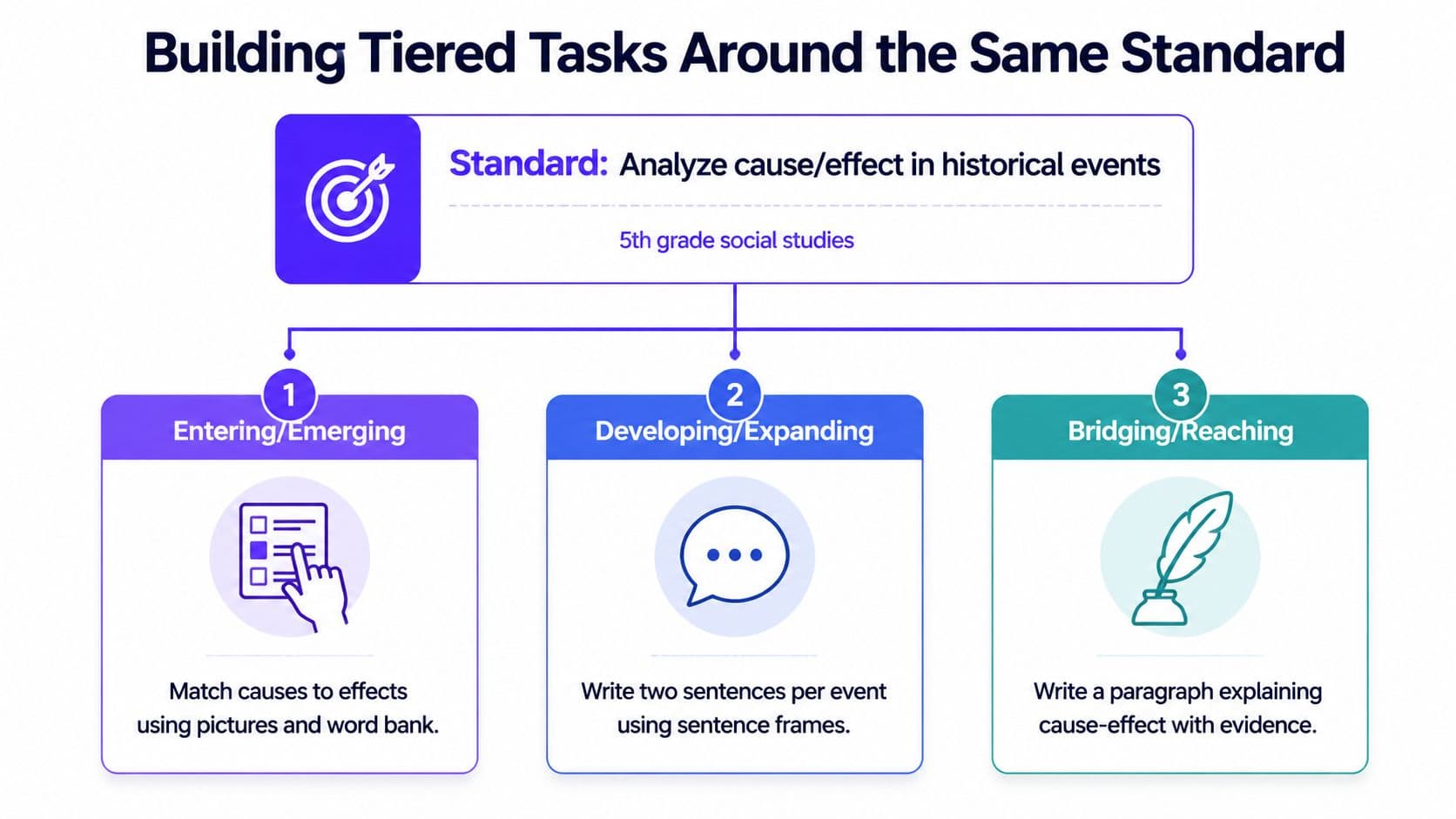
Suppose the fifth-grade standard asks students to analyze cause and effect in historical events. The final expectation is an explanation supported by evidence. That remains the destination for every student.
Design downward from the highest expectation
For an Entering or Emerging learner, use picture cards and a word bank. The student matches a cause to an effect, then rehearses the relationship with a frame such as, “The cause is ___. The effect is ___.” The cognitive work is still causal reasoning. The visual and language supports reduce the English barrier.
A Developing or Expanding student can complete a graphic organizer and write two sentences per event. Provide a sentence frame, but leave space for the student to select evidence and content vocabulary.
A Bridging student can write a paragraph explaining cause and effect with evidence. Offer an academic word bank if needed, but remove the sentence-by-sentence structure.
Plan the task quickly
A twenty-minute planning routine can look like this:
- Name the standard. Write the strongest version of the thinking students must show.
- List the language demands. Identify vocabulary, sentence structure, reading load, and discussion expectations.
- Build the Bridging task. Keep the evidence and reasoning visible.
- Create the Developing version. Add an organizer, selected vocabulary, and partial frames.
- Create the Entering version. Add visuals, bilingual resources, audio directions, and a response mode that makes understanding observable.
- Choose movement signals. Decide what evidence will let students move toward less support.
Flexible grouping matters here. Students shouldn't be assigned permanently to a “low” task. Maria may need picture matching in one lesson and a supported sequence explanation in the next. Ahmed may move from a paragraph frame to an independent response as his control grows.
A recorded audio prompt can help a student revisit directions without asking the teacher to repeat them during every transition. A bilingual glossary can protect the content goal while students build English. Neither support waters down the standard when the thinking remains demanding.
A Real Lesson Walkthrough
Ms. Alvarez's seventh-grade science class has 32 students, including nine English language learners ranging from Entering to Bridging. Two students also have IEPs for processing speed. The lesson focuses on photosynthesis, and the language objective is posted at the door: students will verbally explain the relationship between sunlight and plant growth using the frame, “Plants need ___ because ___.”
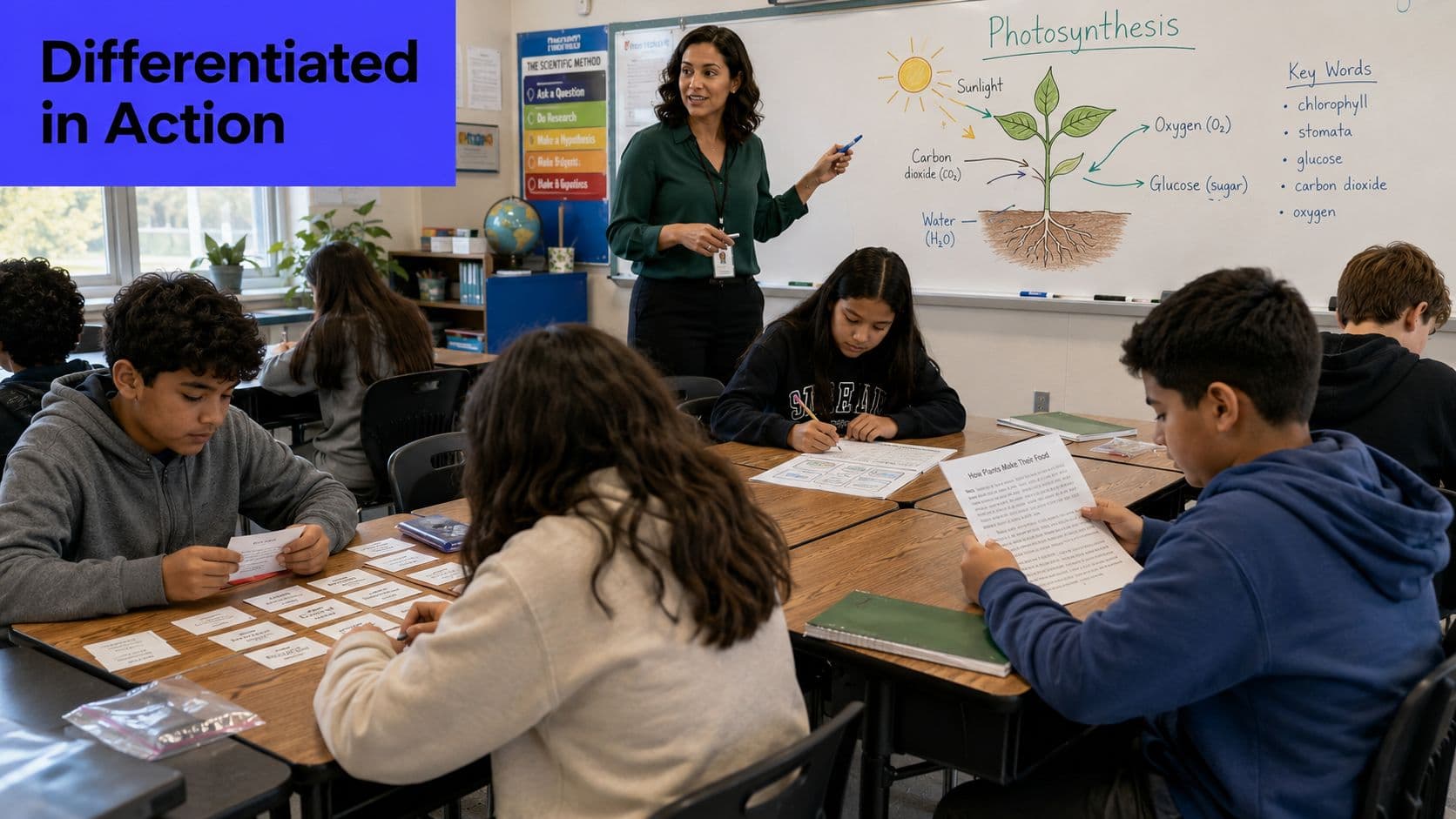
Students begin with a card sort. Each card shows a term such as sunlight, absorb, leaf, or growth beside a visual. Entering students match pictures and repeat words with gestures. Developing students sort terms into “what plants need” and “what plants do.” Bridging students add a brief written explanation to one category.
During the lab, heterogeneous pairs observe plants and record what they notice on a tiered observation log. The Entering log has labeled diagrams and checkboxes. The Developing log includes prompts for “I observed” and “This may mean.” The Bridging log asks for a written hypothesis and evidence.
Ms. Alvarez doesn't wait until the end to discover confusion. She uses thumbs-up checks after modeling, asks students to show vocabulary meanings on small whiteboards, and conducts quick conferences while pairs work.
Teacher move: Check understanding before students begin the independent part, not after an entire page is complete.
When the Entering pair struggles with “absorb,” she pulls them aside briefly, points to a labeled diagram, and uses a gesture showing water moving into a plant. The students then act out the word and place it in their observation log. Across the room, the Bridging pair works independently on a written hypothesis, so the teacher isn't holding advanced learners back while supporting beginners.
Later, students complete band-specific exit tickets. One student identifies a plant need and explains it orally with the frame. Another writes two connected sentences. A Bridging student explains the relationship with evidence from the observation. The lesson stays unified because the content remains photosynthesis, while the language pathway and response demand change.
Assessment That Sees What Students Know
Assessment becomes fairer when you separate content mastery from English production. A student may understand photosynthesis but lack the English syntax to write a polished paragraph. That doesn't mean the science learning is absent.
Formative checks should be brief enough to influence the next teaching move. Use an exit ticket with a sentence frame, an observation checklist tied to proficiency descriptors, a labeled diagram, a whiteboard response, or a short oral conference. The question is always, “What evidence do I need from this student to decide what happens next?”
| Proficiency Level | Formative Check | Summative Option | Language Accommodation |
|---|---|---|---|
| Entering | Point to or sort labeled visuals | Labeled drawing with oral explanation | Bilingual glossary, visuals, clarified directions |
| Emerging | Complete a sentence frame orally | Picture sequence with supported explanation | Sentence strips, oral rehearsal |
| Developing | Fill in a cause-and-effect organizer | Short paragraph using a word bank | Graphic organizer, selected vocabulary |
| Expanding | Explain a process to a partner | Structured written response with transitions | Paragraph frame, academic vocabulary |
| Bridging | Defend an idea in discussion | Evidence-based paragraph or presentation | Vocabulary bank, planning notes |
For summative work, consider bilingual glossaries, oral response options, extended time, and directions that are clear without changing the intellectual demand. A rubric can weight content knowledge more heavily than language accuracy, for example 80% content knowledge and 20% language accuracy, when the assessment is intended to measure content rather than English proficiency. That weighting should fit local policy and the purpose of the task, not become an automatic rule.
A Beginning student might demonstrate photosynthesis with labeled drawings and an oral explanation. An Advanced student might write a comparative paragraph about plant growth under different conditions. Their products differ, but the teacher can identify the same scientific understanding.
Record growth across listening, speaking, reading, and writing rather than relying on one overall impression. These formative assessment examples from Kuraplan can help you build quick checks into ordinary lessons, where assessment informs grouping and scaffolding instead of arriving as a separate event.
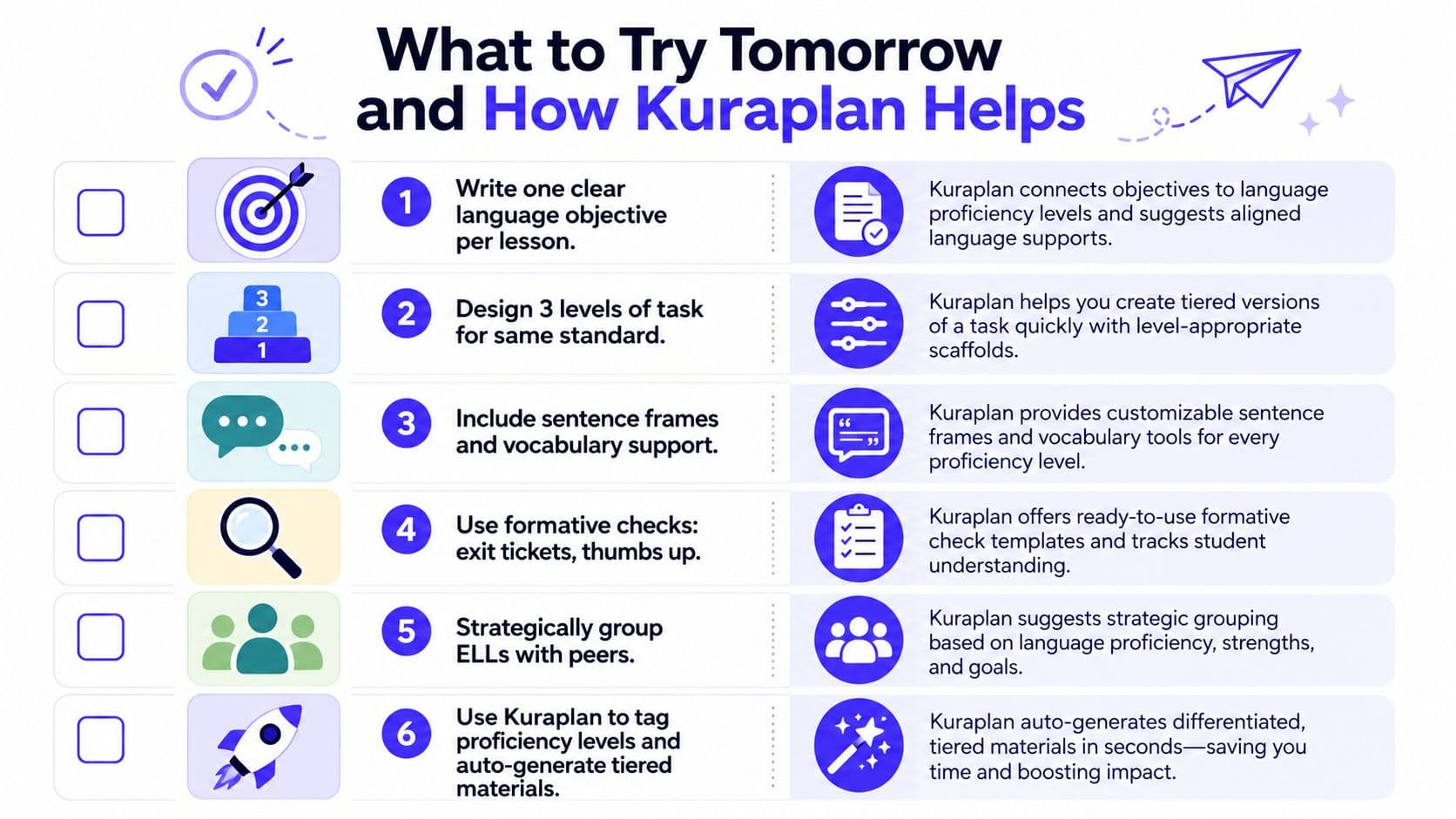
What to Try Tomorrow and How Kuraplan Helps
You don't need three complete lesson plans to begin. Differentiated instruction for English language learners means designing one strong lesson, identifying its language demands, and preparing different access points for students at Entering, Emerging, Developing, Expanding, or Bridging levels.
Try one of these tomorrow:
- Pair the objectives: Write one content objective and one language objective, then post both where students can use them.
- Tier one task: Create an Entering version with visuals, a Developing version with an organizer and frames, and a Bridging version with independent evidence-based writing.
- Change the exit ticket: Let beginners point, draw, or use an oral frame while more advanced learners explain, compare, or justify in connected language.
- Use flexible groups: Group students by the language demand of the moment, then regroup when the task changes.
- Track the evidence: Note whether a student understood the concept through listening, speaking, reading, or writing, rather than treating English output as one undifferentiated skill.
Kuraplan can support this planning by mapping content objectives alongside English language objectives, generating vocabulary supports, creating leveled questions, and adapting one task into scaffolded, on-level, and stretch versions. It can also produce lesson materials, worksheets, visuals, and assessment rubrics, giving teachers a way to reduce formatting work while keeping proficiency bands visible in the plan.
The most useful adjustment is often small: one visual beside a critical term, one sentence frame before partner talk, one alternative response mode on an exit ticket. Applied consistently, those choices help students enter rigorous work sooner and give you better evidence for the next lesson.
Kuraplan helps you turn one content standard into proficiency-aware lesson plans, scaffolded materials, visuals, and assessment rubrics for multilingual learners. Visit Kuraplan to plan tomorrow's differentiated lesson with clearer language objectives and practical entry points for every student.