You're at the front of the room explaining equivalent fractions. One student has already finished, two are still stuck on the opening problem, and three groups are waiting at different stations for directions you haven't had time to give. The lesson was designed for everyone, yet nobody seems to be receiving the same lesson.
That's the daily tension behind differentiated math instruction. The aim isn't to create a separate curriculum for every student. It's to keep the mathematical destination constant while adjusting the route, support, pace, representation, grouping, or way students demonstrate understanding. The approach is promising, but the difficult work happens in the implementation. Research reviews report largely positive outcomes while also identifying limited guidance on how to differentiate effectively at scale and less evidence for formats such as game-based and outdoor learning in recent mathematics differentiation research.
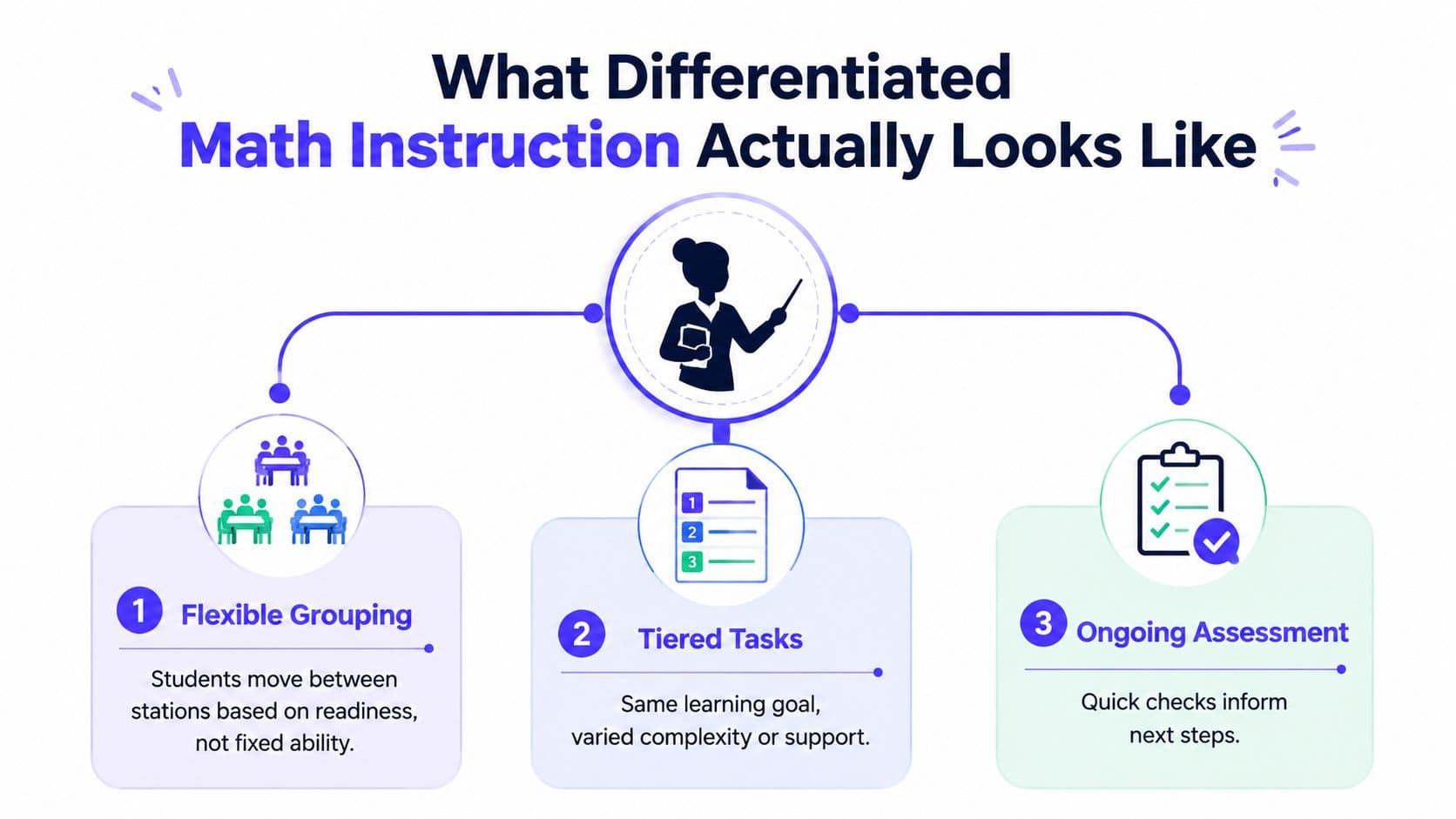
What Differentiated Math Instruction Actually Looks Like
Differentiation is often introduced through four words: content, process, product, and environment. Those categories are useful, but they're too broad to guide the next ten minutes of a real lesson.
In practice, differentiated math instruction means making responsive decisions while keeping the grade-level mathematical goal visible. You might adjust the complexity of the numbers, provide a visual model, slow the pace of a demonstration, change a partner structure, offer a choice of representations, or ask students to explain their reasoning in writing, orally, or with a diagram. A practical description of differentiated mathematics teaching includes changing task difficulty, varying activities and groupings, using visual or auditory supports, reteaching, increasing practice, providing individual help, and using assessment formats such as exit tickets or different worksheets (ERIC's mathematics differentiation resource).
What it is not
Differentiation isn't individualized pacing for every learner. It isn't giving a struggling student fewer problems while lowering the mathematical expectation. It also isn't handing out a choice board and hoping that choice alone produces productive thinking.
A differentiated lesson still needs a shared target. Students may use different representations, receive different scaffolds, or produce different forms of evidence, but the teacher should be able to answer one question: What mathematical understanding are all students developing?
The common breakdowns are practical:
- Planning overload: Teachers create too many versions of every task and spend more time formatting than studying student thinking.
- Material confusion: Students don't know which card, worksheet, manipulative, or digital activity they're meant to use.
- Fixed labels: Groups become permanent, and a temporary support need turns into an identity.
- Weak independence: The teacher pulls a small group while the rest of the class waits for help because the independent task has no built-in check.
Practical rule: Differentiate the next instructional decision, not every feature of the entire unit.
A useful starting point is to plan one core task, one support route, and one extension route. Teachers can also use a resource such as differentiation teaching strategies to generate ideas, but the final decision still depends on the students in front of you, the available time, and the evidence they produce.
Anchor the Lesson on the Big Idea and Student Readiness
Differentiation becomes manageable when the teacher makes fewer, sharper decisions before class. Start with the mathematical destination, not with three worksheets.
Write the learning goal as one grade-level statement. Then name the big idea underneath it and the mathematical practice students will use. A fraction equivalence lesson, for example, may focus on understanding that different fractions can name the same quantity, while students represent, compare, and justify relationships rather than merely complete a procedure.
Use the instructional trajectory as your spine
An instructional trajectory describes the route students may take toward the goal. It can include concrete materials, visual representations, language, strategies, questions, and increasingly formal notation. The trajectory prevents tiered tasks from drifting into unrelated work.
For a fourth-grade lesson on equivalent fractions, the route might look like this:
- Build fractions with strips or area models.
- Compare two representations that cover the same quantity.
- Connect the model to a number line.
- Record equivalent fraction pairs with number sentences.
- Explain why the pair is equivalent without relying only on a picture.
Students won't all enter at the same point. Some may need to stay with the model, while others are ready to reason symbolically. They're still working toward the same mathematical idea.
Before class, use a short pre-check, previous work, and observation notes to identify approximate readiness zones. Don't turn those zones into permanent groups. A student may show strong visual understanding and weak symbolic fluency, or solve accurately while struggling to explain the reasoning.
A useful resource for organizing that first look at prior understanding is Magna Education's 2026 AP baseline assessment. The principle applies beyond advanced courses: baseline information is valuable when it helps you decide what students need next, rather than when it becomes a label.
Readiness signals to watch
| Readiness Signal | What to Look For | Likely Zone |
|---|---|---|
| Model interpretation | Can the student identify the same quantity in two fraction representations? | Ready for visual comparison or consolidation |
| Multiplicative relationship | Can the student explain how the numerator and denominator change between equivalent fractions? | Ready for number sentences and connected representations |
| Justification | Can the student defend equivalence without copying a demonstrated rule? | Ready for abstraction and extension |
The point isn't to predict every student perfectly. It's to notice the evidence that will shape your first question, representation, or grouping choice.
Start with the big idea, then decide how much support each student needs to reach it.
Designing Tiered Tasks and Open Questions
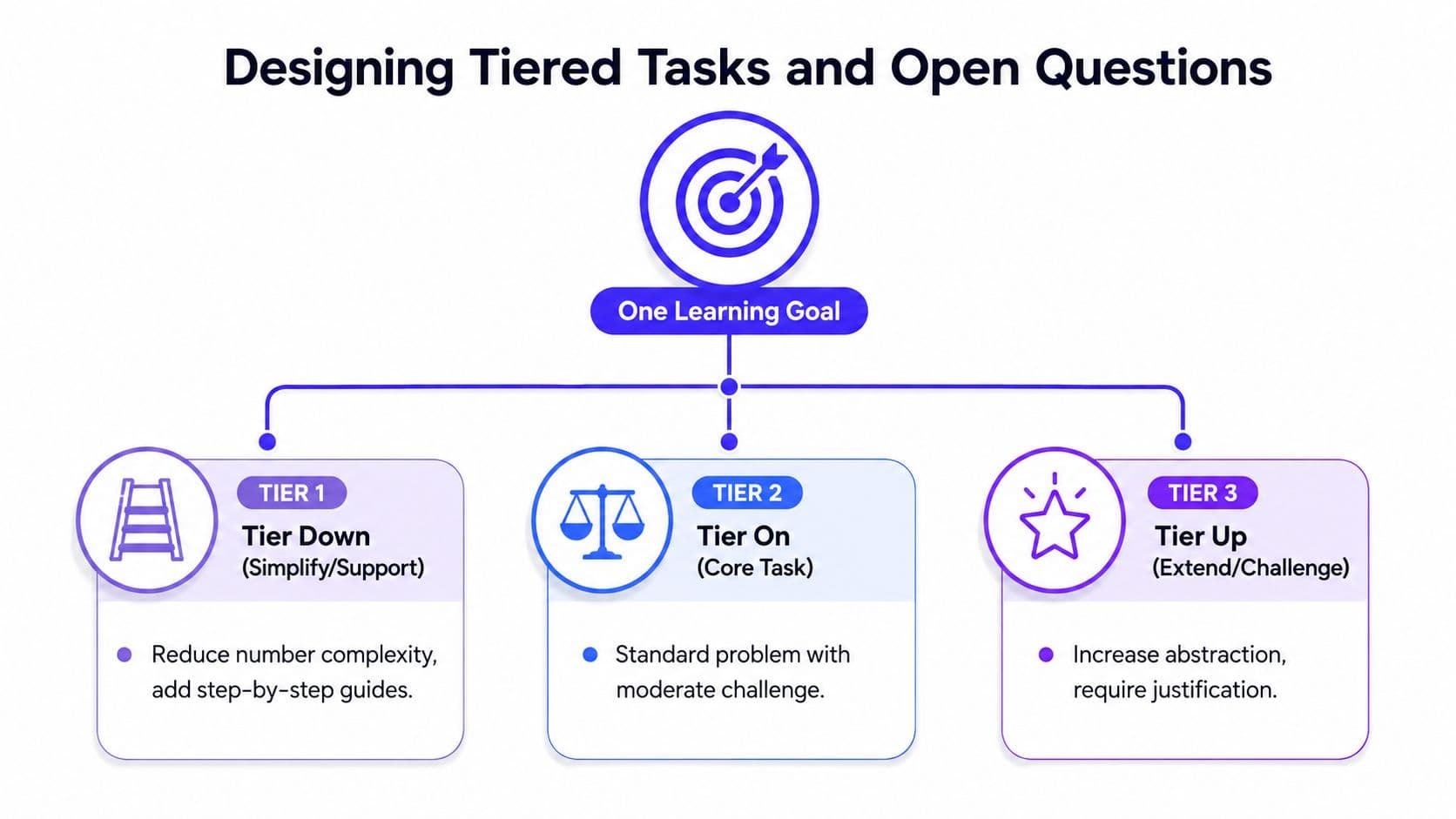
A tiered lesson doesn't require three unrelated assignments. It requires one learning goal with different entry points, supports, and demands.
Take a fifth-grade goal involving multi-digit multiplication. The shared target is to solve accurately and explain a strategy. The task can then branch without changing the destination:
- Tier down: Multiply a two-digit number by a one-digit number using an area model, place-value chart, and partially completed steps. The student explains what each partial product represents.
- Core task: Solve a multi-digit multiplication problem using a chosen standard strategy or area model, then compare the efficiency of two approaches.
- Tier up: Analyze a multiplication error, determine whether the answer is reasonable, and create a related problem that produces a specified partial product.
The first version reduces complexity and increases support. The second holds the grade-level task. The third increases abstraction, justification, or transfer. None should become busywork.
Write the floor and ceiling
Open questions make differentiation less dependent on separate worksheets. A strong prompt has a low enough floor that students can begin and enough intellectual room for deep reasoning.
The University of Toronto mathematics handout recommends building open questions around two or three versions of the same big idea, similar enough to discuss together but different enough to match developmental ranges. The questions should allow multiple answers and strategies, perhaps by turning a problem around, leaving a number blank, changing the question, or asking students to write number sentences (Differentiation and Assessment in Mathematics).
For multiplication, the floor question might be:
Find a product using an area model. Show the partial products.
The ceiling question might be:
Create two different multiplication expressions with the same product. Prove they're equivalent.
The middle shouldn't be an accident. Write both questions while planning, then decide which supports let more students reach the core reasoning.
Parallel tasks work similarly. Students solve related problems with different numbers, representations, or contexts, then share methods in a common discussion. The teacher can preserve the shared mathematical conversation without forcing every learner through the same level of abstraction at the same moment.
Students can also choose within a structure. Let them select an area model, partial products, or a written strategy, but keep the success criteria clear. Choice should alter the route or product, not remove the learning goal.
For further classroom-ready ideas, tips for teaching math skills can help expand the question types and representations you offer. The important discipline is to choose only the prompts that serve the current standard.
Grouping Strategies That Hold Up in a Real Classroom
Grouping works when it solves an instructional problem. It fails when the teacher treats movement as evidence of differentiation.
Whole-class instruction is efficient for introducing the big idea, modeling a representation, establishing vocabulary, and closing with a shared discussion. Pairs are useful when students need to rehearse an explanation or compare strategies. Small groups pay off when the teacher has a precise misconception to address. Individual work matters when students need to show independent understanding or when the teacher is collecting evidence.
The most effective structure blends these modes. NCTM recommends combining whole-class, group, and individual instruction, while also encouraging real-world applications that keep mathematical tasks meaningful across readiness levels (NCTM's guidance on differentiated learning).
Flexible doesn't mean constant
Group students by readiness when you need targeted reteaching. Group by strategy when students can compare methods. Use heterogeneous pairs when the purpose is mathematical communication, provided both students have a genuine role.
Grouping purely by perceived ability tends to collapse because students' needs change by topic. A student who needs support with fraction notation may be a strong contributor during geometry problem solving. Fixed groups also communicate expectations before students have had a chance to show new learning.
A workable two-week pattern might include heterogeneous partner talks during the first lessons, strategy-based triads when students have produced different solution methods, and teacher-led small groups for students who need the heaviest scaffolding. Not every group needs to rotate every lesson. Predictable routines reduce transition time and keep the teacher focused on instruction.
| Grouping Type | Best Used For | Common Failure Mode |
|---|---|---|
| Whole class | Modeling, launching a problem, synthesizing strategies | The teacher talks while students passively copy |
| Heterogeneous pairs | Rehearsing explanations and comparing representations | One student does the mathematics for both |
| Strategy-based triads | Analyzing different methods and errors | Students are grouped by labels instead of evidence |
| Teacher-led small group | Targeted reteaching or extension | The rest of the class lacks an independent check |
| Individual work | Showing independent understanding | Practice becomes isolated and unsupported |
Pull a small group only when the rest of the class has a task with a built-in check for understanding.
Math workshop structures provide time for this teacher-led work. Station rotations are useful when each station has a clear purpose, directions, and a way to verify progress. Partner talks serve a different goal, they develop language and reasoning without requiring a full station system.
If you need help organizing temporary groups, a group generator can reduce the clerical work. It won't decide the instructional purpose for you, but it can make regrouping easier when your evidence changes.
Formative Assessment and Progress Monitoring
Differentiation without assessment becomes guesswork. The check doesn't need to be a formal test. It needs to reveal what students understand well enough to determine the next move.
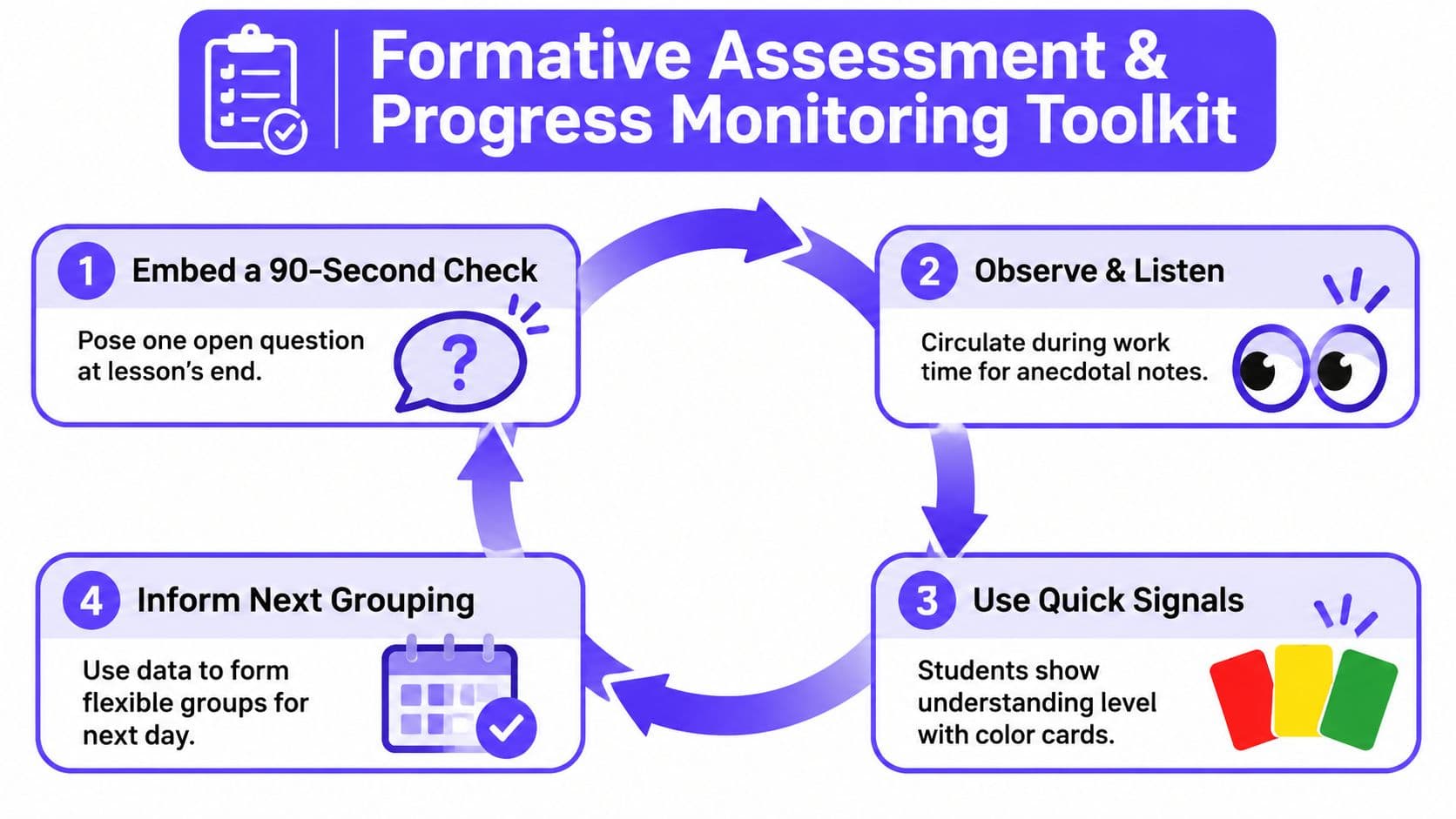
Embed a 90-second check at the end of a task or discussion. Students might solve one open question on a whiteboard, answer a cold-call prompt after private think time, hold up a quick signal, or complete a two-problem exit slip tied directly to the learning goal.
Read the evidence quickly
Sort responses into three working categories:
- Got it: The student solves and explains the central idea with appropriate independence.
- Almost there: The student has a sound representation or strategy but makes an error that targeted feedback can address.
- Missed it: The student's response shows a foundational misconception or an inaccessible entry point.
Use those categories to decide whether to advance, reteach, or form a short teacher-led group. Don't move a student between tiers because a single answer looks unusual. Look for a pattern across classwork, explanation, and independent evidence.
A compact tracking template can use student codes rather than names:
| Student Code | Representation | Strategy | Explanation | Next Move |
|---|---|---|---|---|
| A1 | Accurate | Partial products | Complete | Extend |
| B4 | Accurate | Inconsistent | Partial | Confer |
| C2 | Incomplete | Misapplied | Limited | Reteach |
Keep anecdotal notes short. Record the misconception, not a paragraph about the student. For example, “confuses denominator with number of shaded parts” is more useful than “needs help with fractions.”
Formative assessment examples can provide additional formats, but the routine should fit your existing lesson. In K-5 classrooms, a teacher may gather quick evidence daily and regroup for the next lesson. In grades 6-12, monitoring may happen through warm-ups, whiteboards, brief conferences, and common task reviews across a teaching team. The cadence can vary, but the decision rule stays the same: evidence should change what happens next.
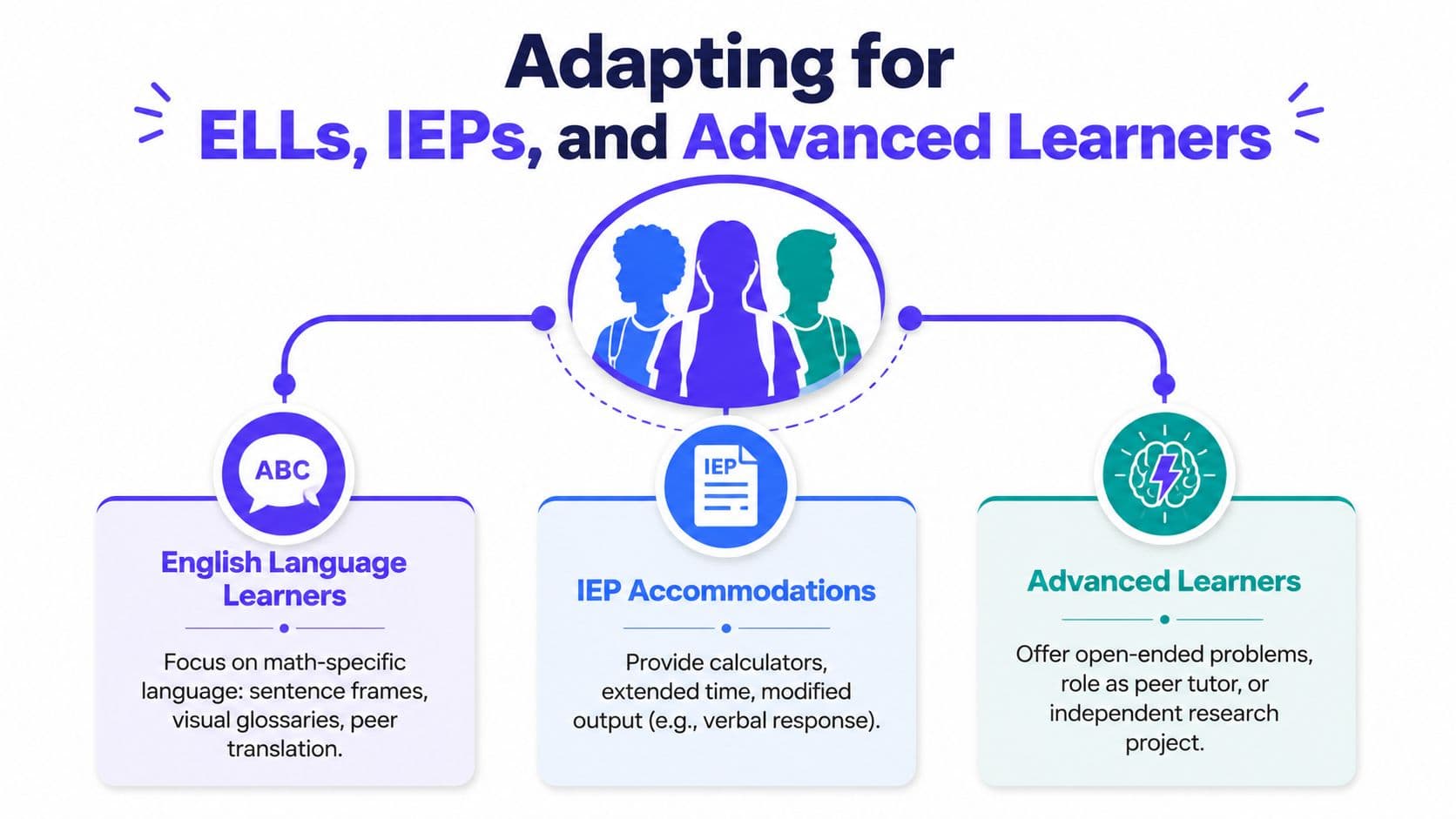
Adapting for ELLs, IEPs, and Advanced Learners
The same mathematical goal can require very different access supports. The mistake is to treat a student category as a lesson plan. English learners, students with IEPs, and advanced learners each need adjustments tied to the actual barrier or opportunity in the task.
For English learners, examine the language demand before simplifying the mathematics. Pre-teach essential vocabulary with visual anchors, use sentence frames for reasoning, and pair students strategically, including bilingual peers when that supports communication. A translated worksheet may still leave the mathematical relationship unclear, while a model such as “I know ___ is greater because ___” gives students a structure for precise explanation.
Students with IEPs often need access accommodations rather than less rigorous thinking. A graphic organizer can separate the steps in a multi-part problem. Manipulatives can sit beside symbolic notation instead of replacing it. A reduced item count can preserve the reasoning demand while limiting writing or repetitive processing.
Advanced learners need more than larger numbers or extra pages. Increase depth, complexity, abstraction, or justification within the same standard. Ask them to prove a relationship, compare methods, identify the conditions under which a strategy works, or create a problem that will expose a common error.
One fraction-comparison goal, three access routes
Suppose the shared goal is to compare fractions and justify the comparison.
- ELL newcomer: Use fraction strips, a visual word bank, and a sentence frame such as “___ is greater than ___ because ___.” The student may explain orally while pointing to the representations.
- Student with a math processing IEP: Provide a comparison organizer, clearly separated steps, manipulatives paired with a number line, and fewer comparison items that still require justification.
- Advanced learner: Compare fractions with unlike denominators, construct a symbolic justification, and analyze whether a proposed shortcut always works.
The target remains comparison and justification. Only the access route and expected sophistication change.
A useful safeguard is to ask, “What barrier am I removing?” If the answer is language load, processing load, or insufficient challenge, the support is probably purposeful. If the answer is “this student is low,” the plan needs more precise evidence.
This short visual resource can also help teachers think through access adaptations:
Troubleshooting the Parts That Fall Apart
The hardest part of differentiation usually isn't understanding the framework. It's making the framework survive a busy week.
Research on implementation points to teacher capacity as a central issue. A 2025 training study found that teachers who received differentiated math instruction training improved in pedagogical competence and instructional planning, while another 2025 study reported that flexible grouping was the least effective practice among commonly used approaches because implementation was difficult (research on teacher training and classroom execution). The implication is practical: better routines and planning support may matter more than adding another strategy to your list.
Use one prep period intelligently
A workable weekly rhythm begins with one existing lesson, not an entire unit.
- Write the single learning goal and identify the readiness variable that matters most.
- Keep the core task and create one support or extension route.
- Prepare the independent check before deciding to pull a group.
- Store the materials in labeled folders or trays by lesson, not by student level.
- Review the quick evidence and adjust the next lesson.
For a classroom with 28 students, use a physical system students can manage without asking you every few minutes. Keep task cards in labeled envelopes, place manipulatives in matching containers, and put a sample finished response or self-check at each station. The system should tell students what to take, where to work, and how to know they're finished.
Choose the format that reduces work
| Feature | Digital Tools such as Slides, Desmos, and Forms | Paper-Based Materials such as Task Cards and Printables |
|---|---|---|
| Best advantage | Quick distribution, interactive representations, and easy response collection | Immediate access, visible work, and no device or login dependency |
| Useful for | Modeling, dynamic graphs, short checks, and varied prompts | Manipulatives, annotation, partner discussion, and small-group teaching |
| Common problem | A password reset, dead battery, or unclear navigation interrupts the lesson | Cards disappear, pages get mixed, and copies require preparation |
| Practical fix | Test the student path, prepare a non-digital backup, and keep directions visible | Color-code sets, number cards, and store each lesson in one labeled packet |
Digital materials aren't automatically more efficient. A Desmos activity can make a representation visible and interactive, but it can also create troubleshooting work. Google Slides can distribute differentiated prompts quickly, but students may click ahead or lose the intended sequence. Forms can collect responses, yet they may not show the diagrams, annotations, or partial reasoning you need.
Paper has its own trade-offs. Task cards support table work and quick teacher conferences, but only if students can return them to the correct place. Printable worksheets are reliable, but a stack of nearly identical versions can increase confusion rather than access.
Avoid creating seven micro-groups. Use a small number of pathways, then adjust support through questions and representations. The research base itself warns that positive outcome claims don't answer every implementation question, particularly which moves work for which learners under which classroom conditions. A 2025 experimental study also found that differentiated digital materials may support students with low prior knowledge more than other students, while paper-based versions may better support motivation across learners, reinforcing that format matters (the 2025 study on digital and paper differentiated materials).
Narrowing the focus is not giving up on differentiation. It's how differentiation becomes teachable.
This week, redesign one existing math lesson around one readiness variable. Keep the goal, write a supported entry point and a meaningful extension, then use one quick check to decide what happens next. Don't retrofit the entire unit until that smaller routine works.
Kuraplan can help you build standards-aligned math lessons, differentiated worksheets, visuals, and assessment materials without starting each version from a blank page. Use Kuraplan to prepare one core task with scaffolded and extended pathways, then spend the reclaimed planning time studying student reasoning and refining your next move.