Your planning period is short, the inbox is full, and the students in front of you need something more meaningful than another worksheet. The strongest enrichment activity ideas don't just keep kids occupied, they give them a reason to think, build, talk, revise, and show what they know in a way that feels real. In practice, that usually means shifting away from one-off “fun” tasks and toward repeatable frameworks that work across grades, subjects, and readiness levels.
That shift matters because enrichment isn't only about extra challenge. It's also about access, motivation, and depth. The best classroom enrichment can look like a quick station, a longer project, or a reflective routine, but it always has a clear purpose, a visible product, and enough structure that students can succeed without the teacher carrying every step.
Teachers also need ideas that hold up on a Tuesday afternoon, not just in a lesson-plan sample. That's why the frameworks below focus on what scales, what keeps standards visible, and what helps you reuse the same structure with different content. Tools like Kuraplan can help when you need a fast way to align objectives, differentiate tasks, and turn a good idea into something you can teach tomorrow.
1. Project-Based Learning
Project-Based Learning works best when students are solving something they can name, not just completing an assignment they can turn in. A water-quality challenge, a neighborhood history documentary, or a classroom micro-economy simulation gives students a reason to research, discuss, design, and present. The enrichment happens because the work asks for multiple skills at once, and students can see why each step matters.
Build the project around a driving question
A weak PBL task starts with a topic. A strong one starts with a question students can wrestle with for days or weeks. “How can our school reduce waste?” pushes students to collect evidence, compare options, and defend choices, while “What stories from our neighborhood should be preserved?” invites interviews, writing, and media creation.
Practical rule: if students could finish the task without making a decision, the project probably needs more inquiry.
The mechanics matter too. Clear roles keep group work from sliding into chaos, and reflection checkpoints stop the project from becoming a pile of disconnected tasks. Before students begin, map the rubric and the learning targets so the final presentation measures thinking, not just poster design.
Kuraplan can help here by scaffolding standards-aligned objectives alongside your project outline, which is useful when you're trying to keep creativity and rigor in the same space. It's especially helpful when a team of teachers wants the same project structure but different content areas or grade-level expectations.
A project also feels more authentic when someone outside the room has a stake in it. A local expert, family member, librarian, or community partner can raise the quality of student questions without taking over the work.
2. Maker Spaces and STEAM Activities
Maker activities turn enrichment into something students can touch, test, rebuild, and improve. A robotics corner, a collection of cardboard and recyclables, or a shelf of tape, string, and craft sticks can produce serious learning when students are asked to design for a purpose. The point isn't the fancy equipment. The point is that students get to learn by making.
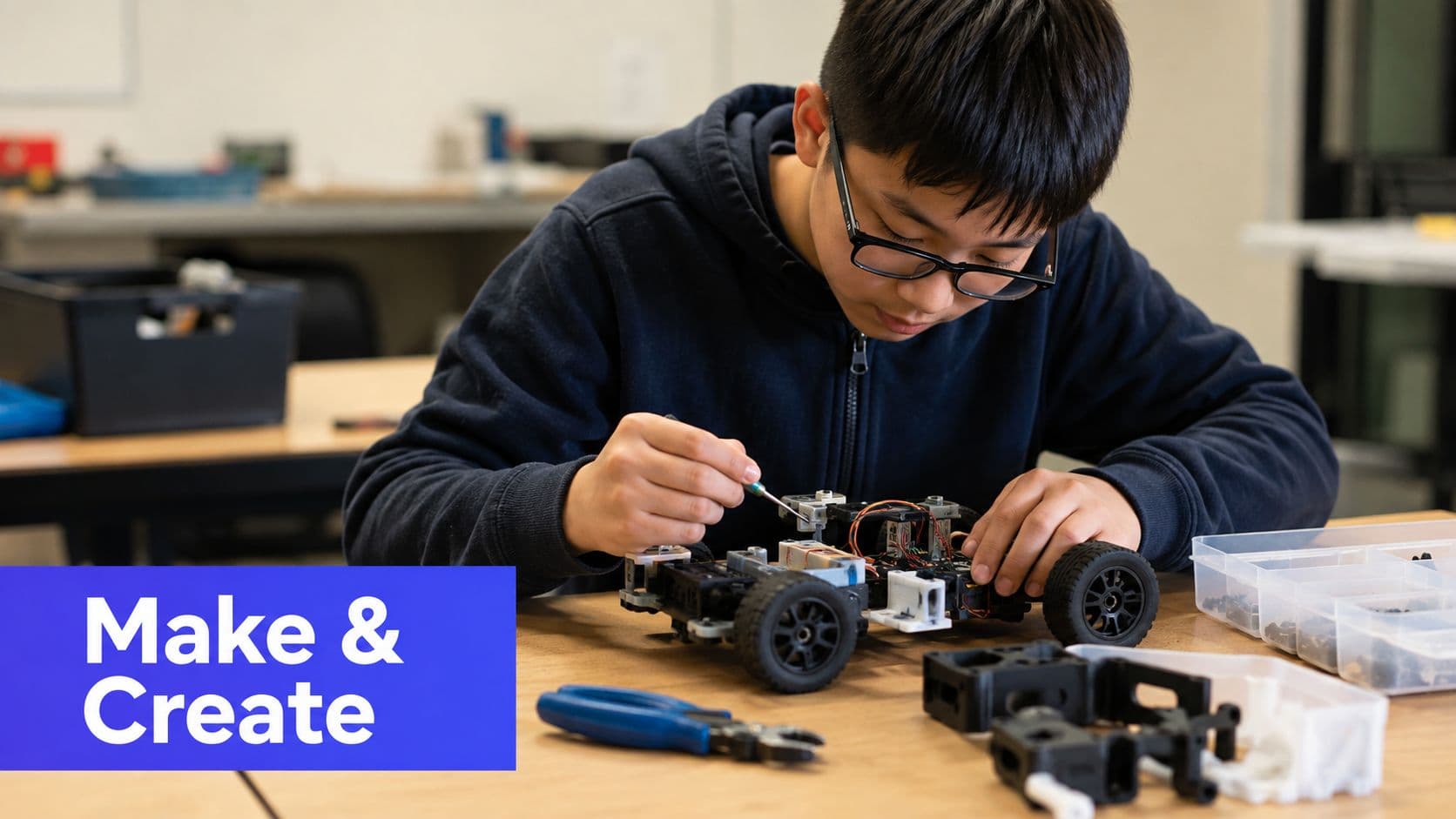
A marble run can open the door to conversations about force, angle, and trial-and-error. A 3D-printed accessibility tool can push older students to think about design for real users. An Arduino-based monitoring project gives students a reason to connect coding, measurement, and environmental thinking in one activity.
Keep the entry point low and the thinking high
Many teachers wait for a full makerspace before they begin. That's a mistake. A basic maker corner with reusable materials is enough if students have a design challenge and a way to explain their choices. Learning comes from iteration, not from expensive tools.
Document the process as much as the product. Photos, quick reflections, and short share-outs help students explain what failed, what changed, and what they'd do next. That record also makes assessment easier because you can see decision-making instead of only the final build.
Kuraplan can support unit planning here by helping you connect maker tasks to standards and build assessment rubrics that match the hands-on work. It's useful when you want the activity to feel open-ended without losing instructional clarity.
3. Inquiry-Based Science Learning
Inquiry-based science gives students the feeling that they're doing science, not just reading about it. They ask questions, test variables, collect evidence, and argue from observations. That structure builds curiosity fast because students are responsible for figuring something out, not just repeating the right answer.
A plant-growth investigation, a pond or soil sampling task, or a water-quality comparison can all work well because each one starts with a question students can observe. The best inquiries are manageable enough to finish, but open enough that students have to interpret what they find.
The 5E model fits this framework well because it gives the lesson a shape without making it rigid. Engage with a phenomenon, explore with materials or data, explain with evidence, elaborate through application, and evaluate with a task that shows understanding. When students predict before they test and reflect after they test, the inquiry becomes more than a science demo.
One practical move is to start with guided inquiry before asking for open inquiry. Students who are new to the process need help with question quality, data recording, and making claims from evidence. Journals, photos, and data tables make their thinking visible and give you better feedback points along the way.
For a ready-made planning reference, the science fair project guide can be a useful model when you're shaping student investigations into something more structured and assessable.
4. Differentiated Stations and Rotations
Stations work because they let one classroom become several learning spaces at once. One group can practice with manipulatives while another reads independently, and a third works on teacher-led support without waiting for the entire class to move at the same pace. That flexibility makes stations one of the most practical enrichment activity ideas for mixed-readiness groups.
Design stations that do different jobs
A useful station set doesn't repeat the same skill in four formats. It gives each area a purpose. In reading, that might mean guided reading, word work, independent reading, and literature response. In math, it might mean manipulatives, computation practice, problem-solving, and games. In social studies, it could include primary source analysis, mapping, interviews, and creative projects.
Students need to know exactly what to do, where to go, and how to prove they finished. Visual directions, timers, and rotation charts prevent a lot of the management problems that make station work feel harder than it should. I've found that stations fall apart when too many of them require the teacher's attention at the same time.
Train for independence first. The first few rotations should be simple enough that students can focus on the routine, not the content load. Once the routine is solid, rotate the stations weekly or bi-weekly so the novelty stays high and the tasks don't feel stale.
The station activity submission template is a practical starting point when you want to document different station versions and keep the structure consistent across classes.
Students do better with stations when every center has a visible finish line.
5. Flexible Small Group Instruction
Small groups give you room to teach the right thing to the right students without turning the lesson into a whole-class compromise. The key is flexibility. Group students by current need, skill gap, or interest, then regroup often as progress changes. That keeps the work targeted instead of sorting children into fixed labels.
A phonics support group, a math fluency group, or an extension group can all live in the same schedule if the routines are tight. The best groups are small, usually 3–6 students, because everyone gets a turn and the pace stays focused. The size matters less than the quality of the match between the lesson and the need.
Keep the group purposeful, not punitive
The emotional tone matters as much as the content. Students should feel that they're in a strategy group, a skill group, or an intensive support group, not a low-status room. That language shapes how they show up, especially when they've already had repeated difficulty.
Assessment data should drive the regrouping. Running records, exit tickets, and formative checks tell you who needs what next. A strong small-group routine also depends on independent work systems, because the rest of the class can't stall while you're teaching one table.
Kuraplan can save time here by generating differentiated materials at multiple complexity levels. That's useful when you need similar learning targets but different levels of scaffolding, especially for intervention blocks or extension time.
Track consistency too. Small groups only help when students attend, participate, and get repeated practice. A powerful lesson with inconsistent follow-through won't move much.
6. Peer Teaching and Collaborative Learning
Peer teaching changes the classroom from an audience model into a community model. When students explain a concept to someone else, they have to organize their thinking, listen carefully, and adjust language in real time. That makes the learning stick in a way a worksheet rarely does.
Jigsaws, peer editing, tutoring, and think-pair-share all create different versions of the same basic idea, students learn by interacting with one another. A student who becomes the expert on one section of text and teaches it to a group has to read more carefully than if they were just answering questions on their own. Cross-age tutoring works for the same reason, because the tutor has to make the content understandable.
Teach collaboration like content
Collaboration isn't automatic. Students need explicit instruction in how to listen, disagree respectfully, and ask clarifying questions. Sentence stems help a lot here, especially in the first weeks of using peer structures.
I liked when you...
I wonder if...
You could also try...
Those stems keep feedback specific and usable. Graphic organizers can also help students track what their partner said so the discussion doesn't drift into unstructured talk. Rotate partnerships regularly, too, so students build relationships beyond their closest friends.
Kuraplan can support this kind of work by generating discussion prompts, comprehension questions, and rubrics that keep peer interaction focused. That's especially helpful when you want the collaboration to stay tied to content instead of turning into free conversation.
7. Gamification and Game-Based Learning
Game elements can make practice feel more purposeful, but only if the structure still serves the learning. Points, badges, leaderboards, and narrative all create momentum, yet they can also distract if the task underneath isn't solid. The best game-based enrichment activity ideas make progress visible without hiding the actual skill.
Classcraft, Prodigy Math, vocabulary scavenger hunts, and Kahoot review sessions all show different ways teachers use play to increase participation. The shared feature is immediate feedback. Students know quickly whether they're on track, and that keeps the room moving.
Reward progress, not just speed
Leaderboards can motivate some students and shut down others, so they need careful handling. Growth-based recognition usually works better than absolute ranking because more students can see themselves improving. A quiet student who earns a badge for persistence or accuracy often learns more than a top scorer who cruises through the task.
Narrative and choice also matter. If students can pick a path, a role, or a mission, they're more likely to stay engaged long enough to practice the skill. The content still has to be the point, though. A game without a learning goal is just a game.
When you design a gamified lesson, pair it with Kuraplan so the standards stay visible while you build the mechanics. That combination helps you protect instructional intent while still making the work feel energetic and fresh.
8. Student Choice and Voice in Learning
Choice is one of the simplest ways to make enrichment feel personal without lowering expectations. When students choose a topic, format, partner, or pace, they begin to act like owners of the work instead of passengers in it. That shift matters, especially for students who rarely get to make academic decisions.
Menu boards, choice boards, and tic-tac-toe grids are practical because they organize freedom. Every option still needs to hit the same standards, but students can move through the content in a way that fits their strengths. A student might write an essay, make a podcast, design an infographic, or deliver a presentation, depending on the goal.
Give choices that still demand the same thinking
Too much freedom can make planning messy and learning uneven. Too little freedom makes the work feel scripted. The sweet spot is structured choice, where the path changes but the destination stays the same.
An interest survey can help you choose options students will use. A student-designed option can work well too, especially for advanced learners who want more agency. Build in reflection after the choice so students explain why they picked what they picked and what they learned about themselves.
Kuraplan is helpful when you're building choice menus because it can keep the pathways aligned to standards while you create differentiated versions quickly. That matters when you want voice without sacrificing clarity.
9. Cross-Curricular Integration and Thematic Units
Cross-curricular work makes enrichment feel coherent because students see how subjects fit together. A weather theme can combine atmospheric science, climate data, writing, and historical events. A water theme can connect ecosystems, poetry, geography, and conservation. That kind of unit often leads to better transfer because students use a skill in more than one setting.
The strongest thematic units start with one driving question or big idea. From there, the teacher maps standards across subjects instead of stacking unrelated lessons side by side. That keeps the unit from feeling like a collage of activities with the same title.
Practical rule: if a lesson could be removed without changing any other part of the unit, it probably isn't integrated yet.
The strength of this framework is that it gives students a reason to revisit the same concept through different lenses. Data from math supports science work. Writing explains the reasoning. Social studies adds context. Students begin to understand that school subjects aren't separate rooms in the brain.
Kuraplan can support integrated planning by helping you map standards across math, science, ELA, and social studies in one place. That's especially useful when you need differentiated lessons and assessments for the whole unit instead of building everything separately.
10. Reflection, Metacognition, and Learning Portfolios
Reflection turns student work into student learning. When children think about what they learned, how they learned it, and what they'd change next time, they build habits that stick beyond one assignment. Learning portfolios make that growth visible by collecting work samples, annotations, and reflections over time.
Math journals, reading logs, digital portfolios, and exit tickets all fit this framework well because they ask students to explain their thinking instead of only showing an answer. A student who writes, “I used to think... Now I think... because...” is doing more than summarizing. They're building metacognition.
Make reflection routine, not rare
Reflection works best when it happens often enough to feel normal. End-of-lesson prompts, weekly check-ins, and end-of-unit entries all help students notice patterns in their own learning. Modeling matters here too. Students need to see what a thoughtful reflection sounds like, otherwise they'll give you a sentence that repeats the prompt and stops there.
The formative assessment examples guide can be useful when you want reflection prompts that align with what you're already teaching. That kind of alignment keeps the portfolio from becoming a scrapbook and turns it into usable evidence of growth.
Family sharing also makes a difference. When students show their portfolios to parents or caregivers, the work feels more real, and the growth becomes easier to celebrate. Peer feedback can add another layer, as long as students know how to respond with care and specificity.
10 Enrichment Activity Ideas Comparison
| Enrichment Model | 🔄 Implementation complexity | ⚡ Resource requirements | 📊 Expected outcomes | 💡 Ideal use cases | ⭐ Key advantages |
|---|---|---|---|---|---|
| Project-Based Learning (PBL) | High, multi-week planning, cross-subject coordination | Moderate–High, planning time, materials, community partnerships | Deeper content understanding, collaboration, authentic problem-solving | Long-term units, community problems, capstone projects | Promotes critical thinking, engagement, authentic assessment |
| Maker Spaces and STEAM Activities | Medium, tool supervision, open-ended facilitation | High, equipment, consumables, dedicated space | Hands-on technical skills, creativity, iterative design mindset | Design challenges, electives, after-school clubs | Tangible student artifacts, practical skills, high engagement |
| Inquiry-Based Science Learning | Medium–High, experiment setup, safety management | Moderate, lab materials, data tools, class time | Scientific reasoning, data literacy, deeper conceptual understanding | Lab investigations, field studies, science fairs | Builds evidence-based thinking and scientific habits |
| Differentiated Stations and Rotations | Medium, station design, routines, transitions | Low–Moderate, varied materials, organization systems | Personalized practice, multiple modalities, small-group teacher time | Literacy/math centers, mixed-ability classrooms | Addresses diverse needs while enabling targeted instruction |
| Flexible Small Group Instruction | Medium, frequent data analysis and regrouping | Low–Moderate, assessment tools, small-group resources | Rapid skill gains, targeted remediation or extension | Interventions, focused skill blocks, short reteach sessions | Precise targeting, stronger teacher-student relationships |
| Peer Teaching and Collaborative Learning | Low–Medium, explicit collaboration training needed | Low, simple materials, structured protocols | Deeper understanding via explanation, communication skills | Jigsaws, peer editing, cross-age tutoring | Builds communication, empathy, and peer-supported learning |
| Gamification and Game-Based Learning | Medium, design alignment and maintenance | Moderate, platforms, content development, updates | Increased motivation, frequent practice, immediate feedback | Review sessions, behavior systems, skill practice | High engagement, safe failure, clear progress indicators |
| Student Choice and Voice in Learning | Medium, design aligned options and management | Low–Moderate, varied task materials, rubrics | Greater ownership, intrinsic motivation, varied demonstrations | Independent projects, choice boards, reading units | Honors autonomy, supports differentiation and relevance |
| Cross-Curricular Integration & Thematic Units | High, cross-subject planning and standards mapping | Moderate, collaborative planning time, shared resources | Coherent transfer, interdisciplinary understanding, synthesis | Thematic semesters, school-wide projects, integrated units | Increases relevance, efficiency, and deeper connections |
| Reflection, Metacognition & Learning Portfolios | Low–Medium, routine building and modeling | Low–Moderate, portfolio tools, time for reflection | Improved self-regulation, documented growth, transferability | End-of-unit synthesis, ongoing formative assessment, conferences | Develops metacognition, provides evidence of learning progress |
Making Enrichment Work for You and Your Students
The hardest part of enrichment is usually not finding ideas. It's choosing a structure that you can repeat without burning out. A good enrichment routine should help students think more, but it should also help you teach more clearly. If a strategy only works when you have extra time, extra materials, and a perfect class period, it's not a sustainable framework.
Start with one approach that matches your current reality. If your students need more movement and interaction, stations or peer learning may be the easiest entry point. If they need more ownership, choice boards or portfolios might be the better first step. If you want students to connect learning across subjects, a thematic unit can create that coherence without adding random extra tasks.
The biggest mistake teachers make is treating enrichment as decoration. A craft without a learning target, a game without feedback, or a project without reflection may keep students busy, but it won't build much depth. The stronger move is to ask what students will know, do, explain, create, or revise by the end of the activity. That question changes everything.
Kuraplan can help when the planning load starts to pile up. It's useful for aligning activities to standards, generating differentiated materials, and building rubrics or worksheets that match the structure you want to use. That kind of support matters when you're trying to move from a good idea to a workable routine.
If you're choosing just one next step, pick the framework that solves your biggest classroom problem first. Then build from there, one repeatable enrichment structure at a time.
If you want a faster way to plan enrichment that still stays tied to standards, visit Kuraplan and see how it can help you build differentiated lessons, worksheets, and assessments for the kind of classroom experiences described here. It's a practical place to turn a strong enrichment idea into something ready for students, without losing time to formatting and planning.