You're checking a colleague's Year 6 science quiz before it goes home. Say the longest option is the key on nine of ten items: the scores look strong, but a follow-up discussion reveals shaky understanding. Some students have learned how to spot the answer, not how to explain the science.
That's the problem good multiple choice questions must solve. A correct response should reflect learning, while a wrong response should give you something useful to investigate.
What a Good Multiple Choice Question Looks Like
A finished question needs more than a correct answer. It needs a clear purpose, believable alternatives, and wording that doesn't give students an accidental shortcut.
Start by hiding the options. Can you tell what the question asks? Then uncover them and check whether another answer could reasonably be defended. If students need to guess what the writer meant, you're measuring interpretation of the question rather than understanding of the lesson.
Six checks every finished item must pass
| Element | Passes when | Fails when |
|---|---|---|
| Stem | A student can answer it from the stem alone, before reading the options | It opens with “Which of these is important for…” |
| Answer key | One answer is clearly best and defensible | A second option can be argued as correct |
| Distractors | Each wrong option matches a real misconception or error | Wrong options are jokes or obviously false |
| Option set | Same grammar, length and type across all choices | The key is the longest or most specific option |
| Alignment | Tests one stated objective at one stated thinking level | Tests vocabulary, reading stamina or familiarity with a scenario |
| Accessibility | Reading level suits the class and idioms are not hiding the concept | The scenario assumes background knowledge nobody taught |
Next, ask what each incorrect choice means. Could you finish the sentence, “A student might choose this because…”? If not, it probably isn't a useful distractor.
Read the choices together for accidental clues, then compare the item with your objective. Finally, read it through the eyes of a learner who understands the subject but finds lengthy sentences difficult.
The visual below provides a quick design reminder.
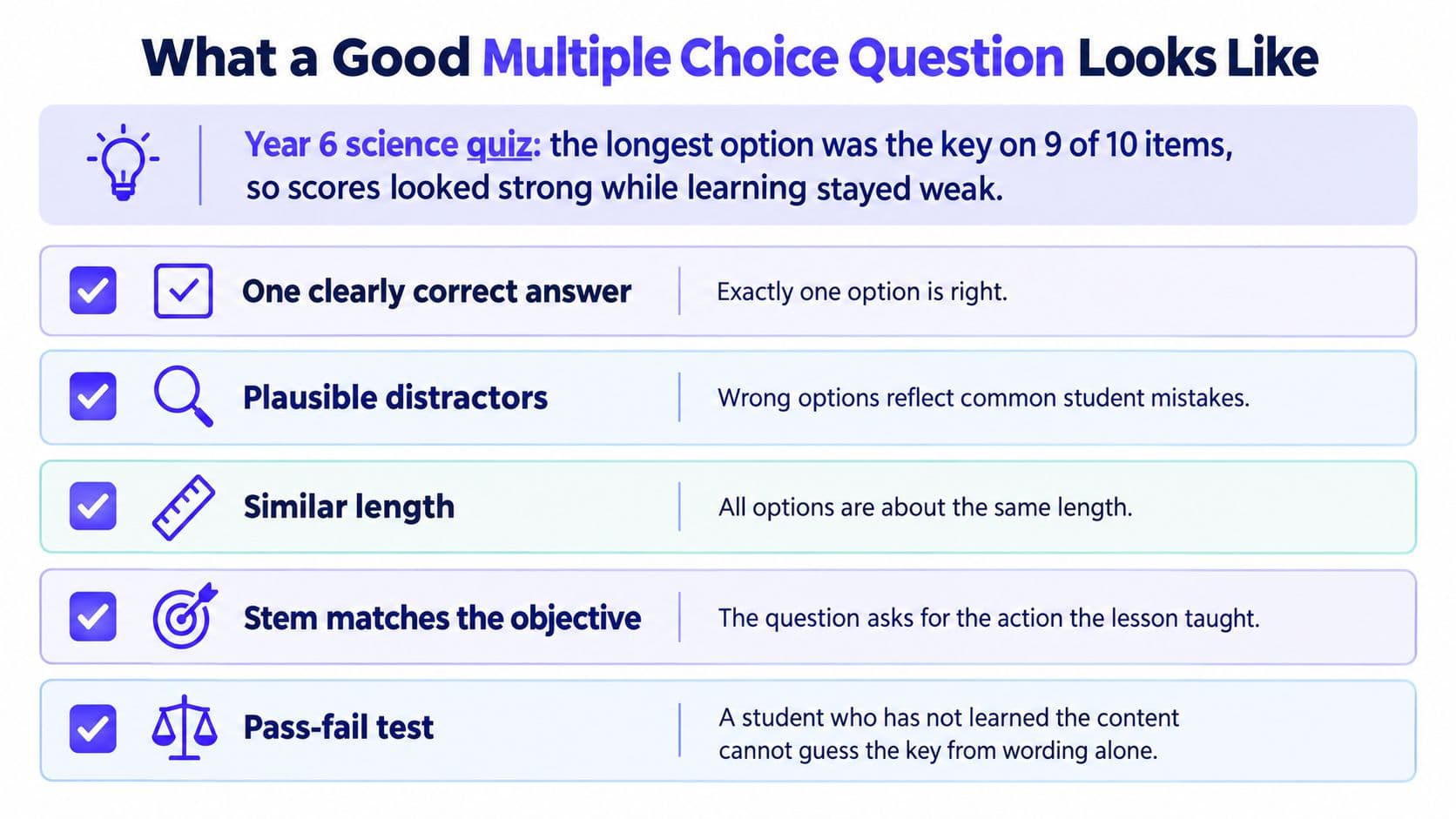
Pass-fail rule: A failed check is a reason to revise, not something to average away.
In our hypothetical quiz, nine passing items wouldn't excuse the remaining weak item. Fix that question before sending the quiz home. Begin with the learning you want to see, rather than with an interesting set of answer choices.
Matching Question Level to Bloom's Taxonomy
Recall is the easiest kind of question to write, so it's an easy default. Asking students to identify a term takes less preparation than asking them to use an idea in an unfamiliar situation.
The stem's verb helps establish the thinking demand, but the task must support it. “Analyze” doesn't make a question analytical if students can answer by recognizing a memorized phrase.
Stem verbs and sample items by thinking level
| Level | Stem verbs | Sample item [answer] |
|---|---|---|
| Remember | identify, name, define | Which organ pumps blood through the body? [heart] |
| Understand | explain, compare, classify | Why is a shadow longer in the late afternoon? [the sun is lower in the sky] |
| Apply | calculate, predict, use | A rectangle is 3 cm by 4 cm. Each side is doubled. What is its new area? [48 cm²] |
| Analyze | infer, distinguish, identify cause | A river bends sharply through soft rock. Which process is most likely widening the bend? [erosion of the outer bank] |
| Evaluate | judge, justify, critique | Student A says the fan cooled the room; Student B says it only made people feel cooler. Which evidence would settle the disagreement? [a thermometer reading before and after, under controlled conditions] |
Make the wrong answers match the thinking
In the rectangle example, the new dimensions are 6 cm by 8 cm, giving an area of 48 cm². An answer of 24 cm² suggests the student doubled the original area instead of both dimensions. An answer of 14 cm² suggests they calculated the original perimeter and treated it as area.
These are hypothetical student responses, not findings about how frequently children make those errors. They demonstrate why an application question needs application-level distractors: unrelated facts would let students eliminate choices without doing the intended thinking.
Keep the reading demands manageable so students can concentrate on the problem.
Plan the demand before drafting
As a practical planning goal, aim for at least two application-or-higher items in a hypothetical ten-question quiz, adjusting the balance to your objectives. Draft a stem at each level before writing the full set; this makes an unintended reliance on recall easier to notice.
LearnStream's guidance on how to create measurable learning outcomes can help turn broad intentions into observable actions. A Bloom's taxonomy verbs guide is also useful when choosing the action, provided you inspect the actual reasoning required.
Higher-order thinking doesn't require adult vocabulary. The thinking should be the challenge, not deciphering the sentence.
How to Write a Multiple Choice Question in Seven Steps
Write the objective before the options. Otherwise, it's surprisingly easy to produce an attractive question that tests something you didn't teach.
Keep this process beside you while drafting.
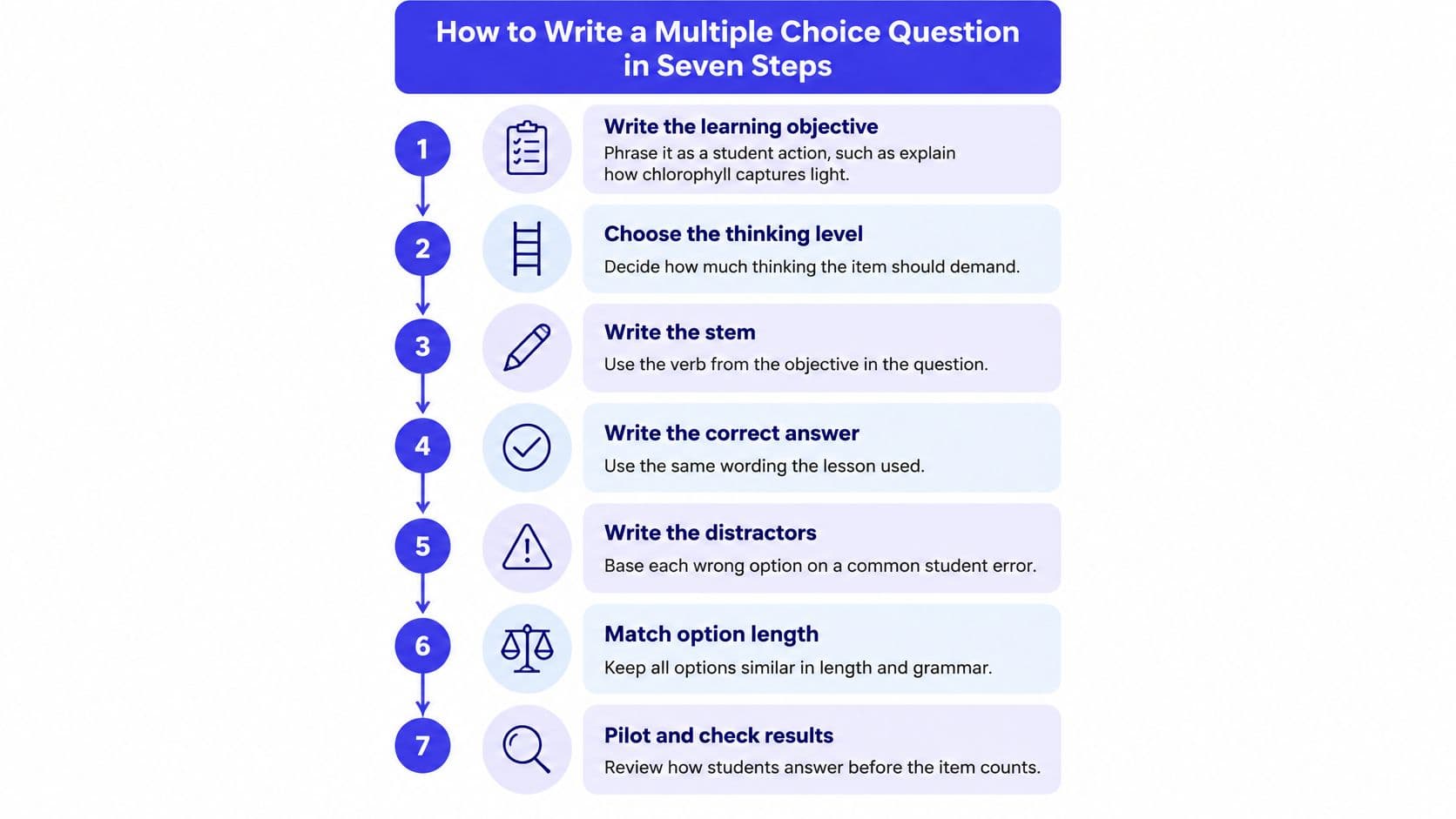
Draft in the order students need you to think
Write the learning objective as a student action. For example, students will explain how chlorophyll captures light for photosynthesis. This gives you a specific learning claim to assess, rather than a topic such as plants.
Choose the thinking level. Decide whether students should recognize chlorophyll's function, explain it, or apply it to a changed condition. That choice determines what evidence a correct response must provide.
Write a complete, focused stem. Compare “What role does chlorophyll play in photosynthesis?” with the unfocused “Which of these is important for plants?” The National Board of Medical Examiners' item-writing guide describes the “cover-the-options” rule and warns against vague wording such as “is associated with” and “is important,” alongside cueing words such as “may” and “could.”
Write the correct answer in a strong student's language. For this example, that might be: it absorbs light energy used in photosynthesis. Establishing the key first helps you notice when the stem permits a broader or different answer.
Draft distractors from known misconceptions. Possible alternatives include absorbing water from soil or taking in carbon dioxide from air, if students have genuinely confused those functions. Use mistakes from classwork rather than inventing absurd alternatives just to complete the set.
Edit the options together. Compare their grammar, length, specificity and answer type, rather than polishing each independently. Students should compare competing explanations of chlorophyll's role, not a function against an organelle against an unrelated fact.
Reread the item cold and verify the key. Check the answer against your lesson materials or a reliable subject reference, then ask a colleague to look for another defensible choice. Where possible, try the item in low-stakes practice before using it for a consequential mark.
Use drafts without outsourcing judgment
You can draft in a shared document, adapt an existing item bank, or use Kuraplan's Quiz Maker to generate questions from lesson content and objectives. Treat generated questions as starting points for the stem-writing stage, not as finished assessments.
Check whether the question is focused and whether every distractor deserves its place. A neatly formatted worksheet can still contain an ambiguous key or a wrong answer no student would consider.
Before assigning: Explain privately why each option is right or wrong. If your explanation requires adding missing context, revise the question.
For a video explanation to accompany your drafting practice:
Writing Distractors That Reveal Misconceptions
More options don't automatically make a question more demanding. The PNCB item-writing manual describes a four-option format with one correct answer; random guessing gives a 25% chance of success with four choices, compared with approximately 33% with three.
The American College of Surgeons' guidelines recommend no more than four options and one correct, best answer. Padding an item with a fifth or sixth weak choice adds no meaningful challenge and can make the key easier to identify.
Collect errors before writing alternatives
Student work is your most useful starting point. Keep a small bank of anonymous errors, labeled by the thinking behind them rather than just by the topic.
- Common misconception: The student applies an incorrect rule consistently, such as adding fraction numerators and denominators directly.
- Procedural slip: The student understands the method but misses a conversion, sign or intermediate operation.
- Partial knowledge: The student completes a familiar first stage and stops before answering the actual question.
- Reversed relationship: The student swaps cause and effect, or confuses which quantity depends on the other.
Consider this classroom example:
What is 2/3 + 1/4?
| Option | Possible reasoning |
|---|---|
| 3/7 | Adds the numerators and denominators directly |
| 2/3 | Retains the first fraction and ignores the addition |
| 11/12 | Uses a common denominator and adds correctly |
The key is 11/12 because 2/3 becomes 8/12 and 1/4 becomes 3/12. Choosing 3/7 would support a different teaching response from choosing 2/3.
However, don't diagnose a misconception from a selection alone. A child might misread, guess or lose concentration; ask them to show their working before deciding what they need.
A distractor suggests a line of inquiry. It doesn't prove what happened in the student's head.
Make the set fair to compare
Match grammar and tense, keep lengths reasonably similar, and present quantities in numerical order with consistent units. Similar length doesn't mean counting words mechanically; it means avoiding a detailed, carefully qualified key beside vague alternatives.
Avoid “all of the above” and “none of the above.” They can let students succeed through elimination without identifying the intended answer, and often appear when the writer has run out of useful misconceptions.
If you can't explain why a learner would choose an option, remove or replace it. Then decide what follow-up task would confirm the reasoning you suspect.
Reading Difficulty and Discrimination After the Quiz
Marking gives you scores. Reviewing response patterns helps you decide whether those scores deserve your confidence.
A spreadsheet can make this manageable: put students in rows, items in columns, and tally each answer choice. Allow about ten minutes as an initial working slot after a unit test, rather than treating analysis as a separate research project.
Work through the item, not just the total
The difficulty index is the proportion answering correctly. In a hypothetical class, 24 correct responses out of 30 gives 24 ÷ 30 = 0.80; despite the name, a higher value means the item was easier for that group.
For a simple discrimination index, compare equal-sized higher- and lower-scoring groups. If 9 of the top 10 and 4 of the bottom 10 answer correctly, calculate (9 − 4) ÷ 10 = 0.50, showing separation in the expected direction.
The graphic uses a different hypothetical lower-group count: 3 correct rather than 4, producing 0.60.
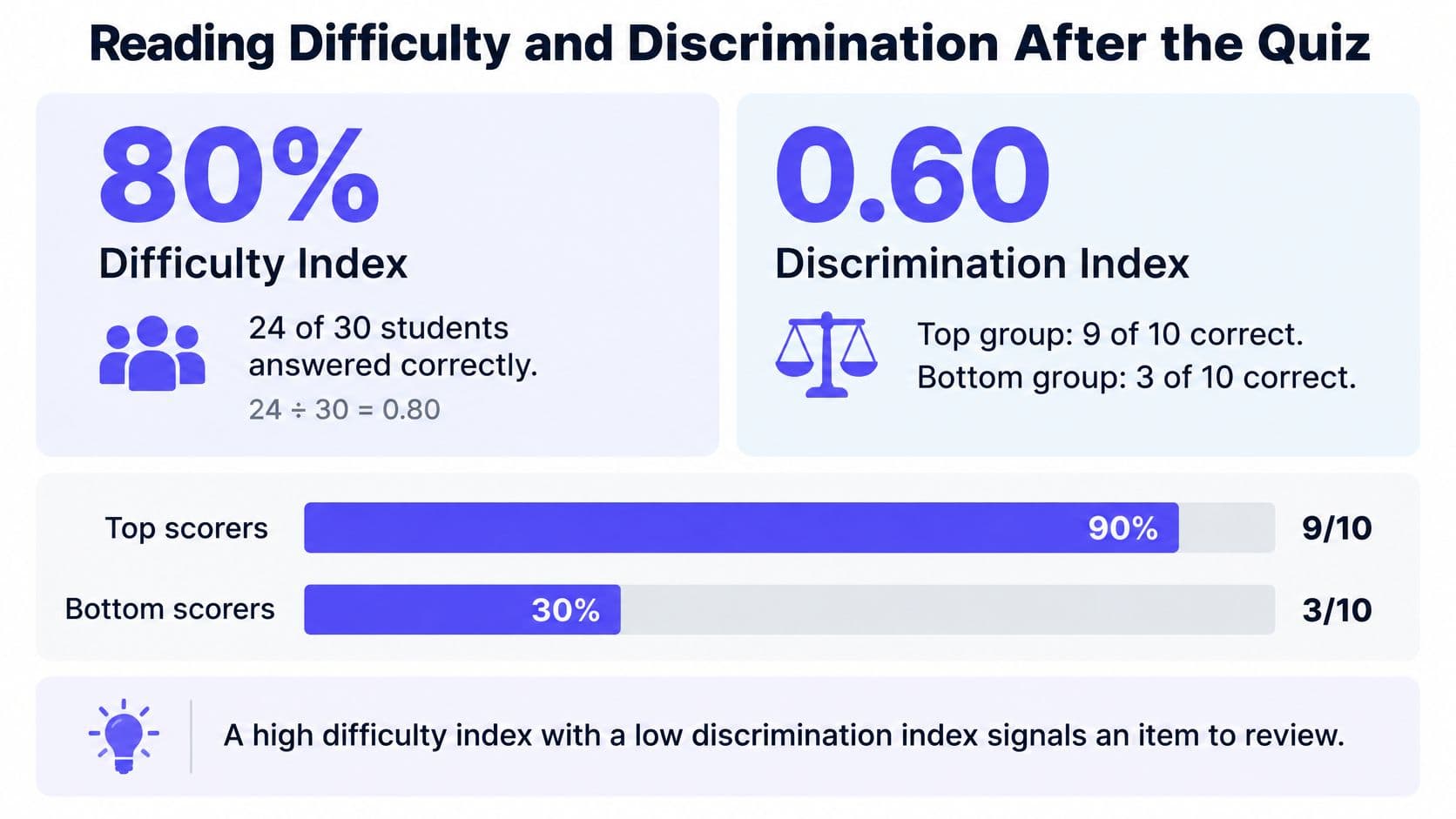
Item statistics and what to do with them
| Indicator | Target | Action if off target |
|---|---|---|
| Difficulty index (proportion correct) | Appropriate to the purpose: high for mastery checks; enough variation for diagnostic comparison | Check teaching coverage, challenge and ambiguity before changing it |
| Discrimination index (top group minus bottom group, divided by group size) | Positive, with higher scorers more likely to answer correctly | Inspect the key, clues, ambiguity and alignment |
| Distractor pick rate | Above the functional-distractor threshold described below | Replace an unused option with a plausible misconception, then check again |
Count which wrong answers students select
A peer-reviewed medical-education item analysis classified distractors selected by more than 5% of examinees as functional and those selected by fewer than 5% as nonfunctional. That's a useful review flag, not a universal K–12 quality boundary; small classes make percentages unstable.
An unused option may be implausible, or students may have learned the relevant distinction well. Inspect their work before replacing it, and don't treat the threshold as a rule about an option selected at exactly the boundary.
Low discrimination should prompt checks for a clue, weak distractor or mis-keyed answer, but it can also occur when nearly everyone has mastered the content. These statistics diagnose how an item behaved, not a student's fixed ability.
Use the patterns to plan a follow-up explanation, worked example or discussion. These formative assessment examples offer ways to gather the additional evidence a selected answer can't supply.
Common Pitfalls, Bias Checks and Fixes
The question seems clear to you, yet students who explained the concept confidently perform poorly. Before reteaching the whole topic, check whether your wording introduced a different task.
A student might understand elapsed time but struggle with an unfamiliar holiday tradition embedded in the problem. Another might know the science but lose track of a sentence packed with subordinate clauses.
Symptoms, causes and fixes for weak items
| Symptom | Likely cause | Fix |
|---|---|---|
| Correct answer is always the longest | The key is written with extra detail | Trim the key or expand the distractors to match |
| Students answer without reading the stem | Grammar or repeated words point to the key | Match grammar and remove words echoed only in the key |
| Two options are argued as correct | Vague qualifiers or missing context | Add context and replace “may” or “best” with precise wording |
| Strong readers outscore strong thinkers | Reading load or unfamiliar vocabulary | Shorten the stem and define terms the item does not test |
| “All of the above” keeps appearing | The writer ran out of distractors | Replace it with specific misconceptions |
| AI draft items look alike | The generator reuses one template | Vary stem types and check coverage against the unit |
Check access without changing the objective
Read the stem for vocabulary and sentence complexity. Replace idioms with literal wording, split long clauses, and retain technical terms only when knowing those terms belongs to the objective.
For digital assessments, use actual text rather than images of text, label options consistently, and check screen-reader order. Give every instructional image a written description that preserves the task without revealing its answer.
Where context is incidental, choose an accessible situation. A clearly explained bus timetable may serve an elapsed-time question better than knowledge of a particular celebration, though even timetable conventions may need teaching.
Ask: good for whom, under what conditions, and after what checking?
Reading a mathematics item aloud may remove an irrelevant decoding barrier. Reading aloud an item intended to assess independent decoding changes what you're measuring, so follow the assessment's purpose and the learner's agreed accommodations.
Inspect the whole generated set
AI-generated questions need review beyond sentence-level editing. Map them against the unit to identify omitted objectives, repeated structures and material that wasn't in the teaching source.
A varied-looking worksheet isn't necessarily balanced, either. Check what students must do in each item, not just whether the scenarios and names change.
Score Each Item Before You Assign It
Use a practical editorial rubric rather than relying on whether an item feels finished. Score objective alignment, stem clarity, a defensible key, plausible distractors, parallel options and accessible wording.
Give each criterion 0 for absent or failing, 1 for partly met, or 2 for securely met, for a maximum of 12. These are proposed classroom review rules, not validated psychometric cutoffs.
- 10 to 12: Assign once any remaining weakness is resolved.
- 7 to 9: Make a targeted fix to the lowest-scoring element.
- Below 7: Return to the stem and intended objective.
- Any zero: Fix that criterion before assigning, regardless of the total.
Try the rubric on a weak item
Consider: “Which of these is associated with erosion?” The options are “Rivers,” “Rain,” “A beach” and “Sand is important.”
A defensible illustrative score is 3 of 12: partial alignment, no focused stem, no unique key, no useful distractor set, nonparallel options, and accessible everyday vocabulary. The words are readable, but students can't know which association the writer intends.
Rewrite it as: “Which process is most likely to widen a river bend over several years?” Offer erosion of the outer bank, deposition on the inner bank, evaporation from the surface and freezing of surface water.
An illustrative 11 of 12 recognizes clear alignment, a focused question, a defensible key, parallel options and accessible wording, with distractor plausibility still needing classroom confirmation. Use this version only if the alternatives reflect errors your learners might make.
For external models, the New York State Education Department's released-test announcement states that in 2024 it released more than 75% of scored questions from its Grades 3–8 English Language Arts, Mathematics and elementary/intermediate Science tests; each released multiple-choice item included an answer key and standards map.
Generate a draft worksheet from your lesson plan, score every item, and assign only those that pass. Keep the response counts and revision notes for next year, when actual student errors can improve the next draft.
Kuraplan offers lesson planning and printable worksheet generation, including multiple-choice questions you can review against your objectives. Visit Kuraplan to draft an assessment from your lesson, then use the rubric and students' responses to refine it before reuse.