You walk into Monday morning with a class that looks manageable on paper and complicated in practice. Several students can already handle the reading independently, others need help decoding the directions, a few English learners are still building academic language, and at least one student finishes the mathematics before you've finished explaining it. The unit test is coming, the curriculum guide is moving, and the idea of writing a different lesson for every learner feels impossible.
That's the question behind how to differentiate instruction in mixed ability classrooms. The answer isn't to create three separate classrooms inside one room. It's to build lessons with flexible access, flexible grouping, and enough intellectual space for students to move further without waiting for everyone else.
Why Mixed Ability Classrooms Need a Plan, Not Heroics
Differentiation fails when it depends on improvisation. A whole-group lecture may move too quickly for students who need language or processing support, while a worksheet aimed at an imaginary “middle” leaves some students lost and others bored. The advanced student finishes early, receives more of the same work, and learns that being capable means waiting.
A stronger approach treats differentiation as a workflow problem. Start with one grade-level target, identify where students are likely to meet barriers, and design flexible routes into the same learning. You might vary the text support, the way students rehearse an idea, the composition of groups, or the format used to show understanding. You don't need to alter every part of every lesson.
Practical rule: Keep the destination common, but make the route adjustable.
This matters for high-achieving students as much as it does for students who need additional support. A 2022 systematic review of differentiated instruction found positive effects for high-achieving students' achievement and motivational-affective outcomes, while also identifying a gap in practice. Teachers typically didn't use differentiation for advanced learners proactively or regularly. In other words, differentiation is often treated as remediation when it should also create worthwhile problems, deeper questions, and open choices for students who are already secure with the core skill.
What usually breaks down
The common failure points are predictable:
- Overlong whole-group teaching: Students who need a slower release lose the thread, while students who are ready to apply the idea remain passive.
- Middle-of-the-road worksheets: The task is too difficult for some and too repetitive for others.
- Permanent labels: Students begin to see “support group” or “top group” as an identity rather than a temporary response to a learning need.
- Extra work as extension: Fast finishers get more questions, not more thinking.
Differentiation does require planning. Pretending otherwise is unfair to teachers. The return isn't a magical reduction in workload, but a lesson that spends less time on repeated directions, emergency scaffolding, behavior caused by frustration, and filler work for students who have already mastered the target. A reusable task shell, a short formative check, and a grouping decision can do more for a Monday lesson than a stack of beautifully formatted worksheets.
Building Lessons Around UDL's Three Means
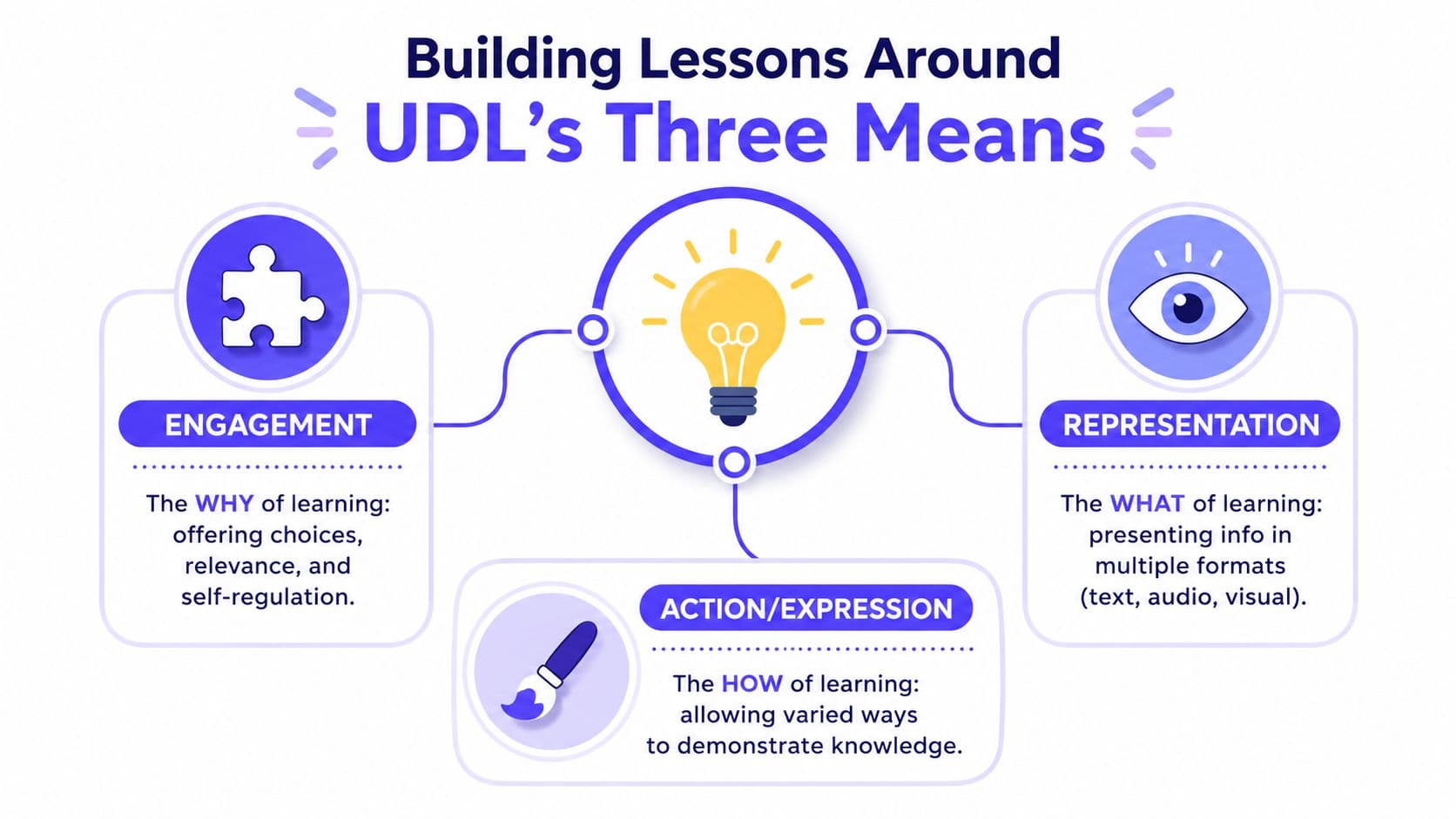
Universal Design for Learning becomes useful when it changes what you put on the planning page. Its three principles are multiple means of engagement, representation, and action and expression, as described in this open-access UDL research resource. Each principle answers a different classroom question: Why will students participate, how will they access the idea, and how will they demonstrate what they know?
Engagement is more than letting students choose
For a Grade 5 science lesson on ecosystems, engagement might begin with a choice of entry point. Students could examine a food-web image, listen to a short scenario about a habitat, or respond to a question about an ecosystem they know. The target remains the same, but students have a reason to connect with it.
Representation concerns the content itself. Pair a labelled ecosystem diagram with a short teacher-recorded explanation, a concise reading, and physical cards students can arrange into a food chain. Don't assume that offering a video alone differentiates the lesson. Students still need vocabulary, a clear purpose, and a way to connect the format to the learning target.
Action and expression concerns the product. Students might write an explanation of energy transfer, draw and label a food web, or give a brief oral response supported by the same key terms. The format changes, but the evidence required doesn't.
A planning template you can reuse
Write one line under each heading before the lesson:
- Engagement: What choice, relevance, or participation routine will invite students into the task?
- Representation: In what other format can students access the same essential content?
- Action and expression: What different forms could valid evidence take?
The trap is to differentiate only representation. Teachers often add a diagram, audio clip, or vocabulary list, then require every student to participate in the same way and produce the same response. That helps access, but it leaves motivation and expression untouched. The differentiation teaching strategies guide can support this kind of planning by helping turn a shared objective into varied lesson materials and response options.
Flexible Grouping That Moves With the Lesson
Grouping is a teaching decision, not a seating chart. Fixed groups may feel efficient, but they can label students and make yesterday's performance look like a permanent ability level. Homogeneous groups can make targeted instruction easier, yet they may limit peer interaction and keep students from seeing different ways to reason. Heterogeneous groups create opportunities for explanation and collaboration, but they won't always provide the focused practice a particular skill requires.
Flexible ability grouping solves part of this problem by making membership temporary and purposeful. Students regroup around a specific learning point, then the group dissolves once that content or skill has been addressed. The literature review on ability grouping distinguishes heterogeneous mixed-ability groups from homogeneous ability groups, giving teachers a basis for choosing rather than treating one model as universally correct.
Choose the grouping rule before you choose the names
Use readiness groups when the lesson depends on a particular skill, such as decoding a text feature, solving a computation type, or using evidence in a paragraph. Use interest or role-based groups for inquiry and project work, where different perspectives matter. Use random or deliberately mixed partners for routines that build classroom community and oral language.
A practical classroom rule is simple: if the content stays the same but readiness differs, regroup by need; if the task changes, regroup by lesson structure. A study of first- and second-grade classrooms found that teachers used grouping flexibly across the day and week. Their decisions drew on grade-level curriculum or content and observations of individual student needs, rather than fixed membership (classroom grouping research).
| Grouping Structure | Best Used For | Duration | Planning Load |
|---|---|---|---|
| Temporary readiness group | Targeted reteaching or extension | Until the skill need changes | Moderate |
| Heterogeneous group | Discussion, inquiry, and peer explanation | One task or lesson | Low to moderate |
| Interest or role group | Projects and open investigations | A project phase | Moderate |
| Strategic partners | Think-pair-share and rehearsal | Several minutes | Low |
| Station rotation | Different practice pathways | One lesson block | Moderate |
Tomorrow, try a think-pair-share with deliberately selected partners, then move students into temporary expert groups for one part of the task. A jigsaw can be reshuffled around a new question, and station groups can change when the evidence changes. No structure deserves to run all day, every day.
A group generator such as Kuraplan's group-generation tool can help you sketch arrangements when you're balancing readiness, participation, and support needs.
Designing Tasks That Stretch Every Student
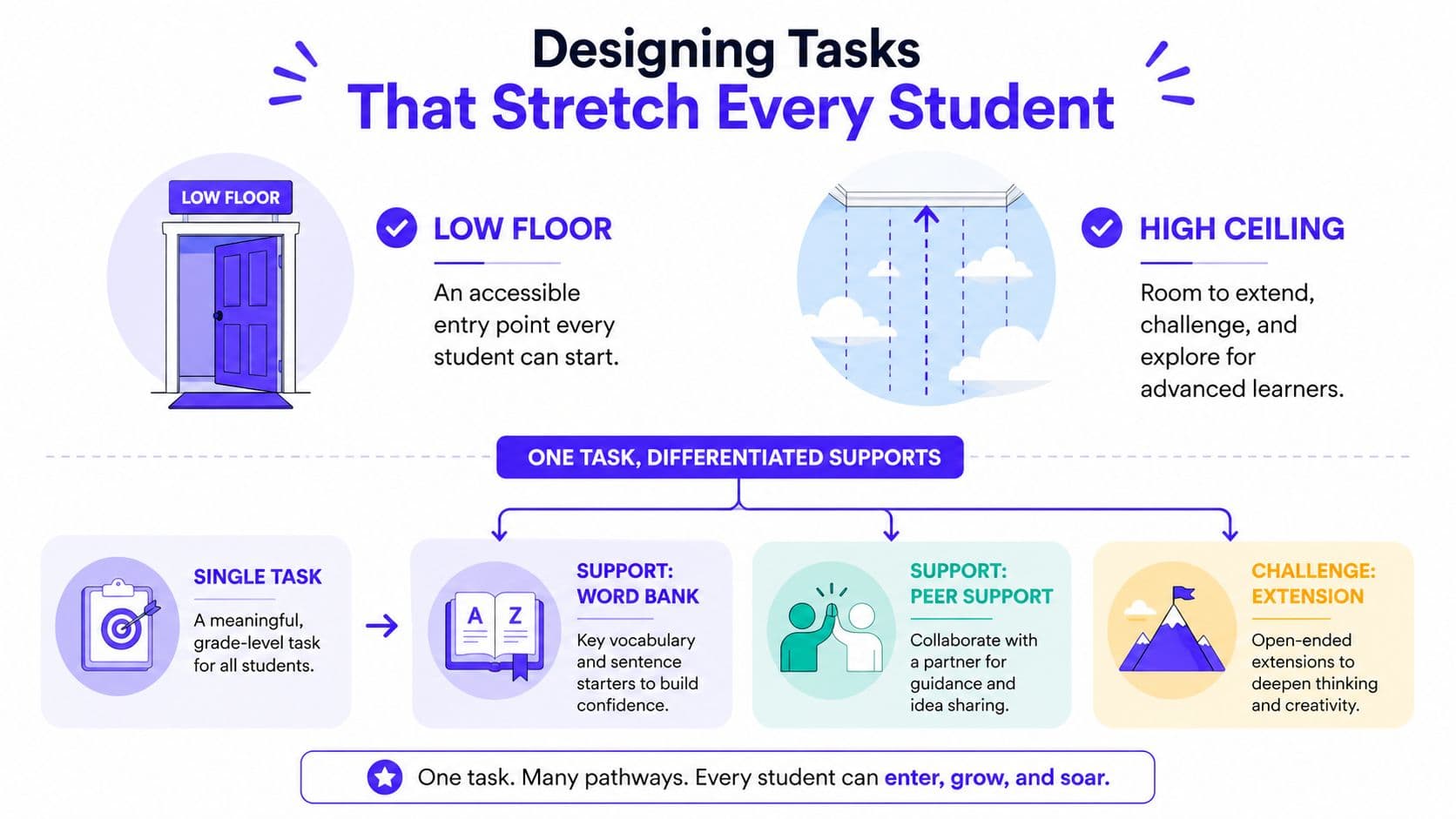
The most efficient differentiation happens inside the task. Build a low floor, so every student has an accessible starting point, and a high ceiling, so students who are ready can increase complexity without receiving a separate worksheet.
One text, different levels of thinking
In Grade 5 reading, give the class one shared source text. A student at the entry point might write a supported summary identifying the central idea and key details. Another student might make an evidence-based argument about the author's message. A student ready for extension might compare the text with a second source and evaluate how each develops the same idea.
Those aren't three unrelated lessons. They're three levels of complexity built around one text and one broad purpose. Supports might include a word bank, sentence frames, a paragraph organizer, or a model response. Extensions might ask students to address a counterclaim, compare author choices, or write for a different audience.
In Grade 8 mathematics, use one rich problem and provide three entry points. Students can begin with manipulatives or a diagram, represent the situation symbolically, or construct a proof explaining why the method works. The extension is not “solve five more.” It's “find another representation,” “identify a limitation,” or “prove that your strategy works for every case.”
Prompts that raise the ceiling
Keep a bank of prompts nearby:
- “What changes if one condition is removed?”
- “Can you find a second method and compare the two?”
- “Which evidence is strongest, and why?”
- “How would you explain this to a younger student?”
- “What pattern do you notice, and can you justify it?”
- “What would someone who disagrees with you say?”
Choice boards and parallel tasks work when every option demands the same essential thinking. Avoid the common mistake of treating extension as additional volume. Stretch comes from complexity, independence, transfer, or justification, not from extra pages.
Before copying a task, check three things: Can every student start? Can students show understanding in more than one valid form? Is there a prompt that requires deeper reasoning rather than more repetition?
Adjusting Assessment Without Lowering the Bar
Differentiated instruction creates a fairness problem if assessment stays rigid. If students receive different ways to access and process an idea, the final check should allow varied evidence while preserving the same grade-level outcome.
Three practical moves carry most of the work. First, use rubric tiers that describe increasing independence or complexity without changing the standard. Second, offer a choice board for the product. Third, use short exit tickets to identify who needs reteaching, practice, or extension before the next lesson.
Keep the standard stable
Suppose the ELA target is theme analysis. One student may use sentence frames to explain how a detail supports a theme. Another may write independently. A highly ready student may defend a theme interpretation in a Socratic discussion and respond to a peer's challenge. The access supports differ, but the evidence still needs to connect a theme, textual evidence, and reasoning.
| Tier | Task Format | Evidence Expected | Rubric Standard |
|---|---|---|---|
| Tier 1 | Written response with sentence frames | Identifies theme, selects evidence, explains connection | Accurate analysis with supported reasoning |
| Tier 2 | Independent written paragraph | Develops theme claim with relevant evidence | Clear analysis and logical explanation |
| Tier 3 | Socratic discussion or extended response | Defends interpretation and addresses another perspective | Precise analysis, evidence, and justification |
The rubric can score the same dimensions across formats: accuracy, relevance of evidence, reasoning, and communication. A visual model, oral defense, and written response can all reveal understanding if the criteria describe the learning rather than the medium.
Students aren't being graded against different expectations. They're being given different access to the same expectation. That distinction also helps explain differentiated grading to families and colleagues.
Let formative evidence change the plan
An exit ticket should answer a planning question, not create another paper pile. Ask students to solve one representative problem, explain one idea, or identify the evidence that supports a claim. Sort responses into groups such as secure, developing, and needs a new explanation, then use those groups for the next round of instruction.
The formative assessment examples guide offers structures you can adapt. The important move is acting on the information. Waiting until the summative assessment means students have already practiced the misunderstanding.
Cutting the Planning Burden Down to Size
The advice that differentiation is “just good teaching” can hide the hardest part. Teachers still have to inspect the standard, review student needs, prepare materials, honor accommodations, organize groups, and assess the work. Recent studies from 2024 to 2025 identify recurring implementation barriers including resource limitations, assessment difficulties, parental involvement issues, large class sizes, and heavy workload, particularly in mixed-ability and ESL settings (recent implementation research).
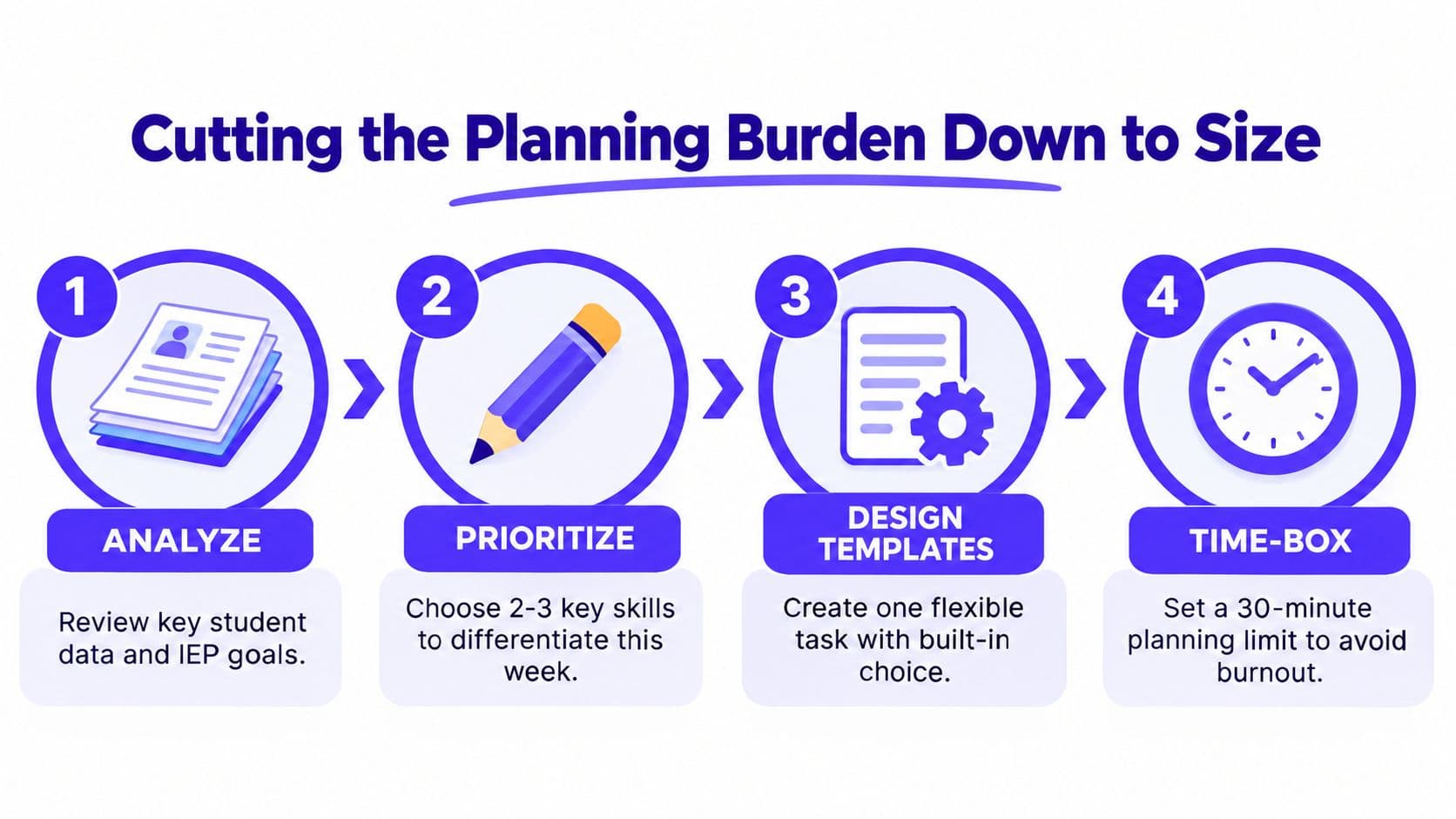
A workable routine has three moves.
- Identify the target and access barriers. Write what students must know or do, then note the likely barriers. Is the difficulty vocabulary, working memory, reading load, abstract representation, or confidence with oral participation?
- Design one low-floor, high-ceiling task. Prepare the core resource once. Add optional supports and one or two extension prompts instead of creating separate lessons.
- Plan the response moves. Use a small grid with student need, grouping, scaffold, and teacher question. Fill it in before the lesson, then adjust it after the first formative check.
Make the system repeatable
Reuse last week's task shell. Keep a running bank of extension prompts, sentence frames, worked examples, vocabulary supports, and discussion stems. Batch scaffolding notes by student need rather than by lesson, so a language support or computation scaffold can travel across subjects.
Time-box the planning. Give yourself a fixed planning window for differentiation, then stop polishing materials that students won't need. Once the routine is familiar, the weekly burden becomes a defined planning block rather than an open-ended promise to personalize everything.
The trade-off is real. You may spend more time before the first lesson, but you gain a clearer response when students struggle or finish early. You also avoid the heavier cost of inventing new activities for each group every night.
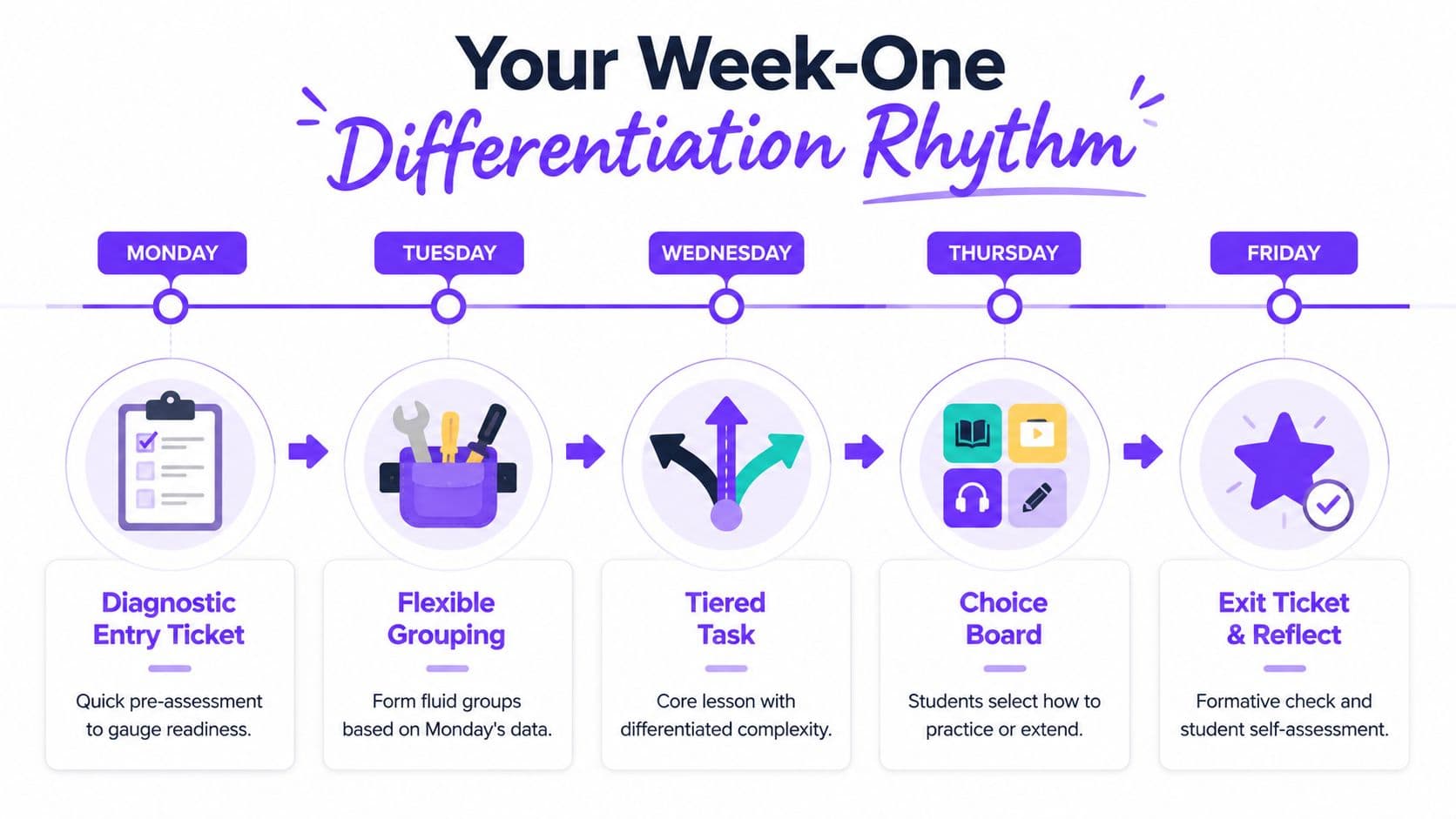
Your Week-One Differentiation Rhythm
A first week doesn't need a complete redesign. It needs a rhythm that turns evidence into the next teaching decision.
Monday and Tuesday
On Monday, use a diagnostic entry ticket tied directly to the week's standard. Keep it short enough to review before the next lesson. Look for readiness, misconceptions, language needs, and students who can already transfer the skill.
On Tuesday, teach a 10-minute mini-lesson, followed by 25 minutes of guided work and 15 minutes of sharing. During guided work, keep the whole class on the shared target while students use different supports or work with temporary partners. Regroup when the task requires it, not because a group name appears on your seating plan.
Wednesday through Friday
On Wednesday, repeat the core task with a new example or representation. Use a mid-lesson check to move students who need a clearer model to teacher support, while students who are ready work on an extension prompt.
Thursday is the small-group day. Target the readiness gap revealed on Monday, rather than reteaching the entire lesson to everyone. Other students can work through a choice board, complete a peer explanation, or tackle a high-ceiling version of the same task.
Friday closes the loop with a formative check and a choice-board task that reinforces the same standard. Ask students to reflect on the support they used and the evidence they produced.
| Lesson Need | Regrouping Move | Example |
|---|---|---|
| Skill practice | Group by readiness | Reteach, guided practice, or extension |
| Inquiry extension | Group by interest | Students investigate different questions |
| Reflection and discussion | Pair mixed readiness | Students explain and compare thinking |
| New activity structure | Group by role or task | Reader, recorder, questioner, checker |
This rhythm keeps differentiation visible without making it theatrical. A planning aid such as Kuraplan can help you sketch the regrouping flow, prepare standards-aligned task variations, and pull together support materials before the week becomes crowded. The teacher still makes the professional judgment. The tool reduces the blank-page work.
Kuraplan helps K–12 teachers create standards-aligned lessons, differentiated worksheets, assessments, rubrics, and visual resources from a shared learning target. Visit Kuraplan to turn your next mixed-ability lesson into one flexible task with purposeful supports, meaningful extensions, and a clearer grouping plan.