The bell's about to go, a student is still asking where the fraction strips are, and your carefully planned activity is running late. A useful lesson outline won't prevent every Tuesday scramble. It will make the next decision obvious.
Why a Lesson Plan Outline Pays Off in Real Classroom Time
Teachers in OECD education systems reported spending an average of 6.5 hours a week planning and preparing lessons, or 17% of their working time, in the OECD's TALIS 2018 survey---FINAL_version_(=_v8)_72.pdf). They spent another 4.2 hours marking and correcting student work. Planning demands aren't fixed, either: in several systems, teachers reported at least an hour less weekly planning time in 2018 than in 2013.
That makes a compact outline more than a tidy document. It's the working layer between curriculum goals and what happens when students walk in: the objective, learning tasks, materials, supports, quick checks and assessment evidence all visible at a glance. A case study of 16 intern teachers and 15 novice teachers in Illinois found that beginning teachers commonly planned day by day and used plans to guide classroom interactions and instructional outcomes. A clear structure helps turn that planning into choices a teacher can act on, even when the lesson needs adjusting.
Below is a copyable fractions lesson, followed by a build order, objective rewrites, differentiation options, an AI review checklist and a simple way to decide what comes next.
A Complete Lesson Plan Outline Example You Can Copy
Use this Year 5 fractions lesson as a starting point. Replace the standard and content with your own, but keep the row order: decide what students should learn, what will show they've learned it, and what you'll do with the evidence.
Template elements with a worked fractions example
| Element | What to write | Worked example: Year 5 fractions |
|---|---|---|
| Standard | Curriculum code and wording for the target skill | Fractions on a number line, from your state or national standard |
| Objective | Student-facing statement with a success threshold | Place 3 of 4 fractions correctly on a number line with at least 75% accuracy |
| Prerequisites | Skills the lesson assumes students already have | Equal parts of a whole; comparing whole numbers |
| Warm-up (5 min) | Retrieval question from earlier learning | Shade one-half of a rectangle and name the fraction |
| Explanation and visual model (10 min) | Verbal explanation plus one diagram | Number line from 0 to 1 split into four equal parts |
| Worked example (10 min) | One fully solved problem, steps spoken aloud | Teacher places 1/4 and 3/4 on the line, naming each step |
| Guided practice (15 min) | Tasks with teacher checks during work | Pairs place 2/3 and 5/6 on a 0 to 1 line; teacher checks the first two answers |
| Independent application (10 min) | Tasks close to the objective | Three fractions placed on a 0 to 2 number line |
| Exit ticket (5 min) | One item that tests the objective | Place 3/8 on a 0 to 1 line and circle any error type |
| Assessment evidence | Formative checks during the lesson and summative link | Exit ticket results plus a unit quiz in week three |
| Differentiation | Scaffold changes with the same objective | Fraction strips for support; 0 to 2 line for extension |
| Next-lesson decision | Extend, reteach or review prerequisites, with a cutoff set in advance | Reteach with fraction strips if fewer than the agreed share of students meet the threshold |
The six timed phases add up to 55 minutes. Retrieval warms up the relevant knowledge; a brief verbal explanation and a clear diagram introduce the idea; then you model a fully solved example and speak through the decisions. Guided practice lets you catch a mistaken placement before students practise alone.
For a 45-minute period, cut guided practice to 10 minutes and independent work to 5. Keep the exit ticket: place 3/8, for example, rather than asking whether students finished. Before class, decide what result will trigger reteaching with fraction strips. An agreed cutoff makes the next step easier to choose than a vague feeling that the class “mostly got it.”
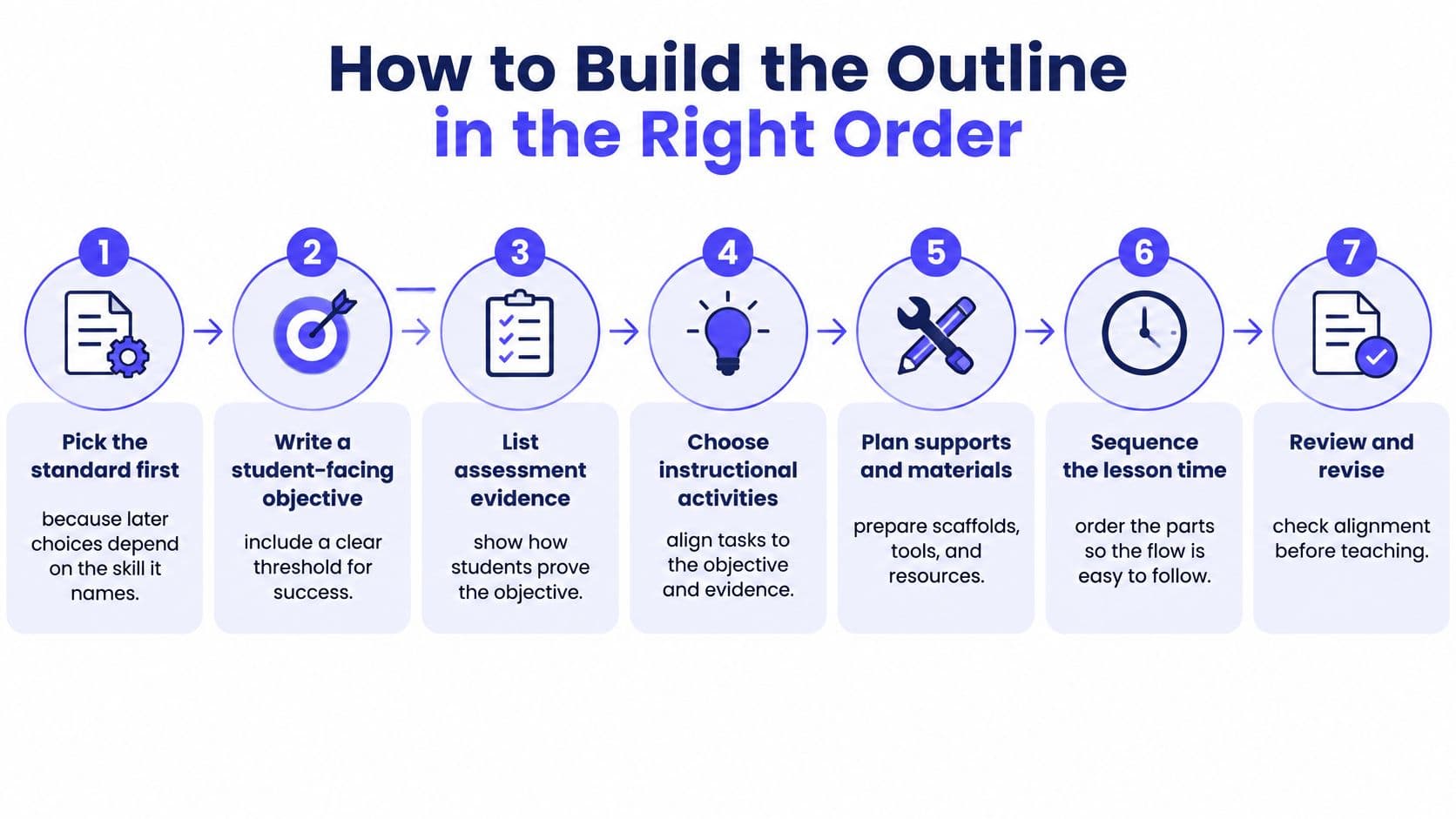
How to Build the Outline in the Right Order
Start with the learning outcome, then choose each classroom move for a reason. A lively activity can fill 10 minutes without giving students practice on the skill the lesson is meant to teach.
Choose the standard. It sets the intended learning and gives you a check for later decisions. The U.S. Department of Education's Curriculum Development Toolkit recommends identifying relevant standards before writing objectives or selecting activities.
Draft the objective. State what students will do and the threshold they need to meet, such as placing fractions on a number line with at least 75% accuracy. If the wording does not describe something you can observe, revise it before planning the activity.
Choose the evidence. Decide what students will produce or perform: an exit ticket, a worked problem, an observation checklist or a rubric line. That choice shapes what you need to watch for during the lesson and what you will collect at the end.
Name prerequisites and likely misconceptions. Students working with fractions might count tick marks instead of equal intervals or confuse the denominator with the number of steps. Prepare a question or model for each likely snag, so a wrong answer gives you a clear next move.
Set the time slots and order. One workable sequence is a 5-minute retrieval warm-up, 10 minutes to explain and draw, 10 minutes to model a worked example, then guided practice, independent problems and a 5-minute exit ticket. Explain, model, guide and release: students need a chance to try the process with support before working alone. If the period runs short, trim guided or independent practice first, while protecting time to check what students learned.
Plan prompts and feedback. Before teaching, identify a question that will surface a likely difficulty. During the model, think aloud; later, ask students to compare their work with the success criterion and make a correction. The Education Endowment Foundation estimates average progress of 8 additional months for metacognition and self-regulation approaches, and about 6 additional months for feedback, compared with similar pupils not receiving those approaches. Its guidance on metacognition and self-regulation explains the evidence behind the first estimate.
Schedule a return to the learning. Decide when students will retrieve the idea again, whether several weeks or months later, and set a cutoff for the next step. If their work meets the threshold, extend; if not, reteach or revisit prerequisites.
For a language lesson built around subject matter, content gives students something specific to communicate about. Teachers planning that approach can explore content driven Irish learning as an example of content-based language instruction.
Writing Objectives You Can Actually Assess
An objective earns its place when you can see and score what students do. It should name an observable behavior, say how well students must perform and identify the work or performance that will show their learning.
In a teacher-education project documented in the ERIC archive, preservice teachers selected two to four measurable objectives for a lesson and set a satisfactory performance level, such as 75% accuracy. They also specified how students would demonstrate understanding and how each objective aligned with standards. The examples below apply that same practical pattern.
| Weak objective | Measurable rewrite | What the teacher can check |
|---|---|---|
| Understand fractions | Represent three of four fractions correctly on a number line with at least 75% accuracy | Count correct placements on the exit ticket |
| Learn about the water cycle | Label the four stages of the water cycle on a diagram with all four labels correct | Diagram labels collected at the end of the lesson |
| Practice multiplication | Solve 8 of 10 two-digit by one-digit multiplication problems without a calculator | Score the independent task against the threshold |
| Write a good paragraph | Write a paragraph with a topic sentence and three supporting details | Apply a checklist to each student paragraph |
| Know the causes of World War I | Name three causes and explain one link between them in two sentences | Score a short written response with a rubric |
“Understand” and “learn” may describe your intention, but they don't tell you what to mark. Use verbs such as represent, label, solve or write, then check that each planned activity prepares students for that performance.
If you can't score the exit ticket against the objective, rewrite the objective or the ticket.
A formative assessment examples guide can help you choose quick evidence that fits the skill. A clear threshold also gives you room to adjust scaffolds or task complexity without changing the learning destination.
Adapting the Same Lesson for Different Learners
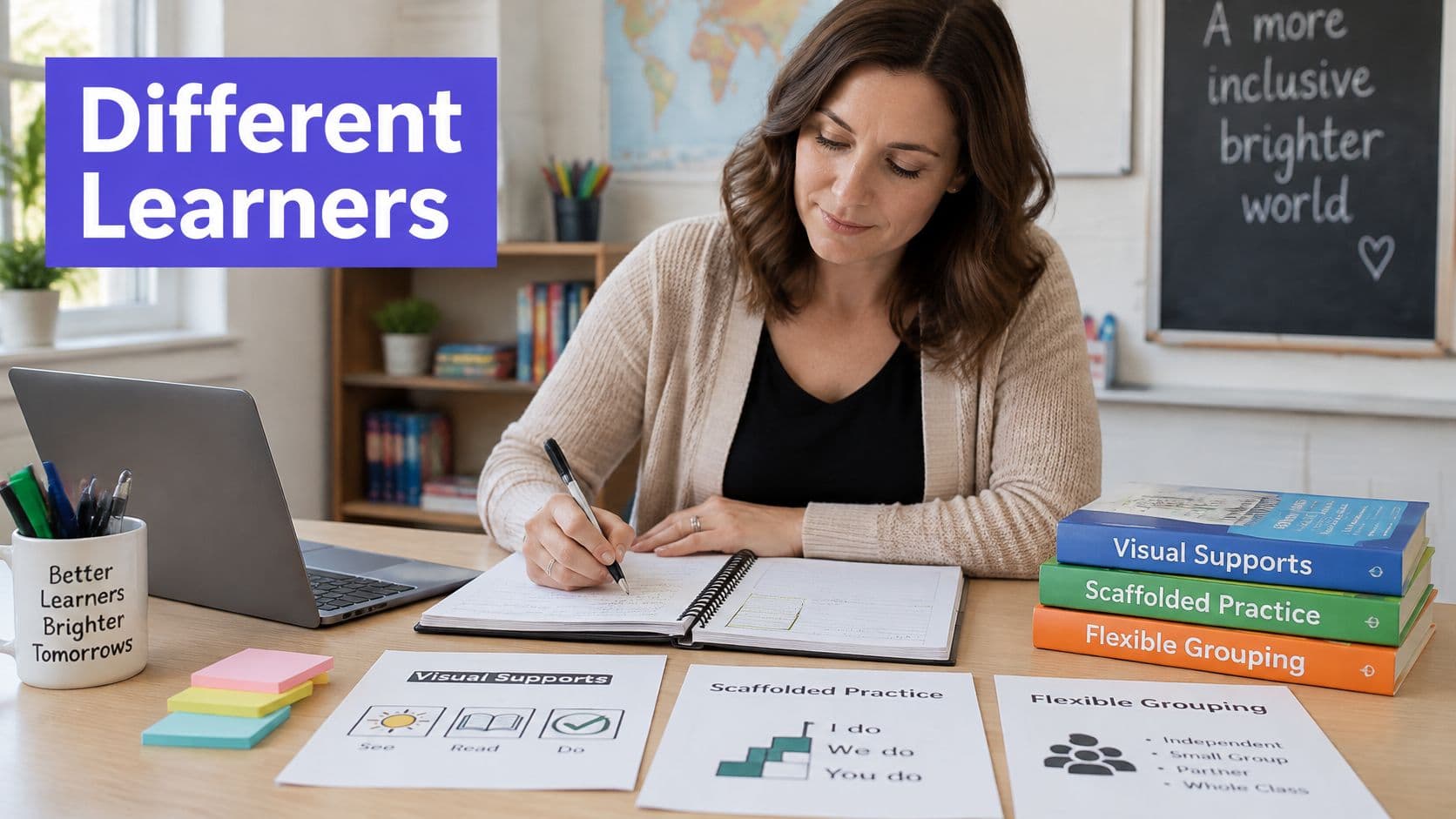
In a mixed class, students can work toward the same fractions objective without receiving identical materials. A word bank may help one learner explain a placement, while fraction strips let another test whether the intervals are equal. The success criterion and exit-ticket target stay the same, so you can still compare the evidence.
| Learner group | Scaffold to add | Keep unchanged | Watch for |
|---|---|---|---|
| Multilingual learners | Sentence frames and a labeled word bank | Objective, number line and exit ticket | Correct placements with unclear explanations |
| Students with disabilities | Fraction strips, larger print and fewer items | Success threshold and exit ticket | Accuracy on placements, not speed |
| Students below readiness | Start with halves and quarters only | Objective wording and assessment | Errors when counting equal parts |
| Students ready to extend | 0 to 2 number line with mixed denominators | Same objective with an added challenge | Quick correct answers in the warm-up |
| Students not yet meeting the objective | Reteach with a worked example, then re-check | Exit-ticket item | Repeated errors on the same item type |
Don't leave differentiation as a heading with no action attached. Write down the likely misconception, the quick check you'll use midway through, an alternate representation and the reteaching response. Generic templates often skip these decision points, leaving teachers to improvise when a student counts spaces incorrectly or can't yet connect a fraction strip to a number line.
After the lesson, note which scaffold each student used. If a learner places fractions accurately without strips, try fading that support next time. For practical approaches to adapting tasks while retaining the learning goal, see this guide to differentiation teaching strategies.
This classroom-focused video offers another perspective on planning for varied learners.
Checking AI-Drafted Outlines Before You Teach
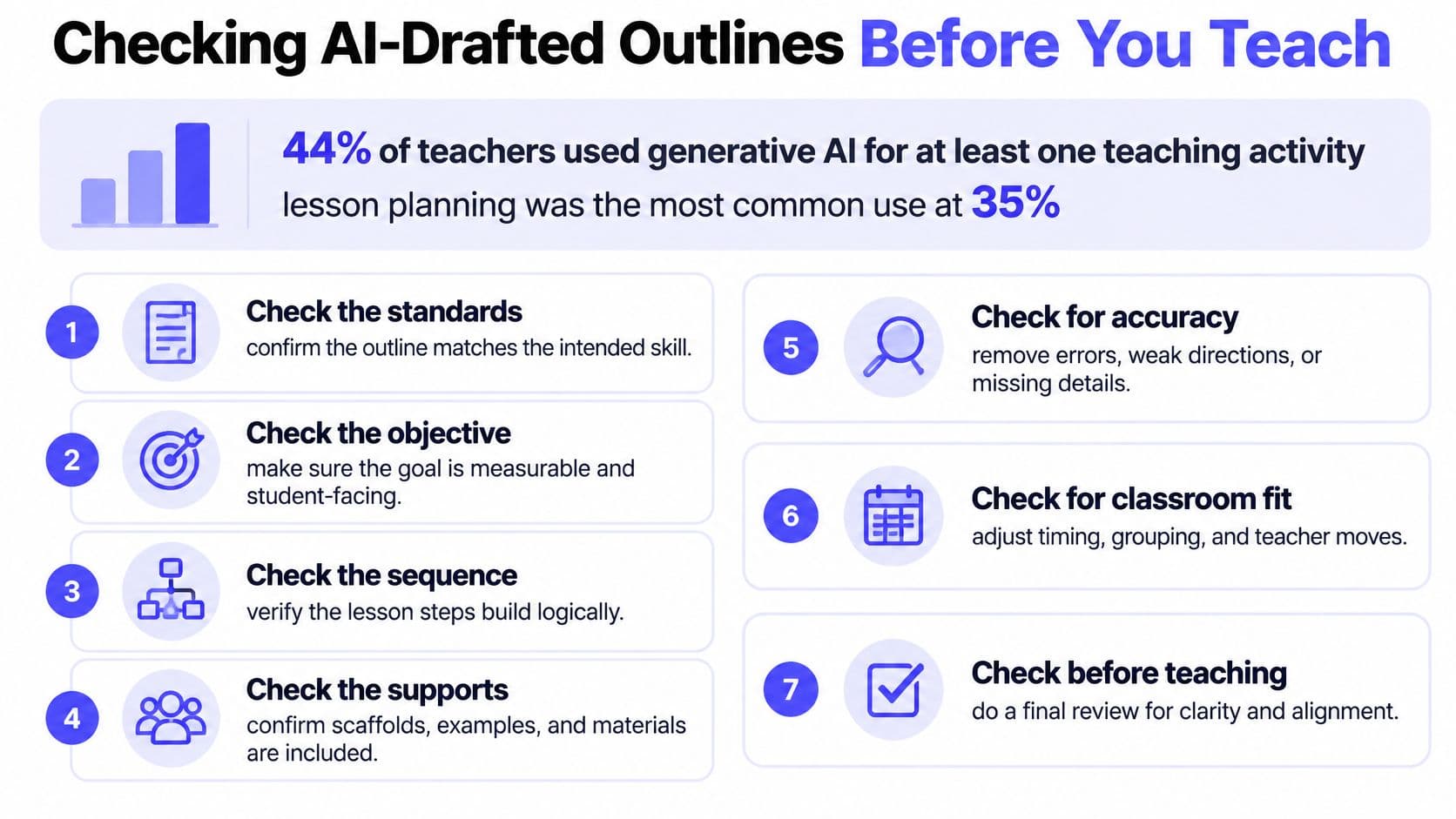
A fast first draft can save typing, but it still needs a teacher's review. In a 2024–25 technology survey, 44% of teachers reported using generative AI for at least one teaching activity, and lesson planning was the most common use at 35%; in one 2025 survey, 71% said AI reduced time on some tasks, but only 7% said it reduced their overall workload, according to this ERIC report on generative AI use by teachers. Drafting is only one part of the work when you still need to check whether the plan is accurate and teachable.
Run through these checks before the lesson:
- Standards alignment: Does the plan address the intended skill?
- Objective: Is the goal measurable and written for students?
- Accuracy: Are explanations, examples and answers correct?
- Developmental fit: Can students at this age follow the directions and reasoning?
- Fairness and access: Are examples culturally appropriate, accessible and free of avoidable bias?
- Cognitive demand: Do students have to do the thinking the objective requires?
- Evidence: Does the assessment measure the stated objective?
- Classroom flow: Does each task prepare students for the next, and do differentiated versions retain the same core goal?
Kuraplan is one AI lesson-planning option for producing standards-aligned drafts quickly, but the teacher still needs to check the content, sequence and classroom fit. For a broader look at using AI responsibly in schools, consult this guide to AI in schools. If a lesson depends on a short visual to introduce an idea, a tool such as LunaBloom AI for creating videos may help create one; it doesn't replace checking that the visual supports the learning goal.
Over-reliance on generated plans can leave teachers with weak directions or assessments that don't match the objective. Training matters, too. Treat the draft as a proposal: keep what fits, revise what doesn't, and remove anything you can't verify or explain.
Turn Your First Outline into a Reusable Template
A useful outline should be open beside you during class, not buried in a folder after planning. Keep the working version to one page, then save a blank copy with fields for the standard, objective, threshold, timed phases and next-lesson cutoff.
When a discussion runs long, shorten or reorder a phase rather than changing the objective on the fly. After class, record which scaffold each student used and whether they could place fractions accurately without it. Score the exit ticket while the lesson is still fresh, then choose whether the next lesson should extend the skill, reteach it or review a prerequisite.
Put a short retrieval quiz on the calendar for several weeks later, using an item like the exit ticket. Once the template works for your class, Kuraplan can turn a saved lesson into printable or shareable worksheets, while you remain responsible for the objective and review.
For Monday, start with one lesson: fill in the blank template, teach it, score the ticket and write down the next step. A small routine you reuse beats a polished plan you never open again.
Kuraplan helps K–12 teachers draft standards-aligned lessons, worksheets and assessments in one planning workflow. Use it to build a lesson plan outline, then review the draft against your students, curriculum and available class time. Visit Kuraplan to explore the planning tools.