You've just finished a lesson that seemed to go well. Students participated, the activity produced plenty of discussion, and several hands stayed raised. Then, while writing your notes, you face an uncomfortable question: What can students now do that they couldn't do before the lesson?
That question gets to the heart of what are learning outcomes. A learning outcome is a clear statement of what a learner is expected to know, do, understand, value, or demonstrate after completing an educational experience. UNESCO describes learning outcomes as the totality of the knowledge, understanding, attitudes, values, skills, competencies, or behaviours a learner is expected to master, and identifies knowledge, skills, and competences as major domains of learning (UNESCO's definition of learning outcomes).
The practical difference is important. A topic tells you what you'll cover. An outcome tells you what students should be able to show. That distinction helps you choose activities, design assessments, explain expectations, and decide what to teach next when the evidence doesn't match the intended learning.
Why Learning Outcomes Change Everything in Your Classroom
Consider a social studies lesson on primary sources. You prepare photographs, newspaper excerpts, and a lively partner discussion. Students annotate the documents and share observations. The room is engaged, but your plan says only, “Students will learn about primary sources.”
That sentence describes a topic, not an observable destination. It doesn't tell you whether students should identify a primary source, explain its context, compare two sources, or evaluate its reliability. Each possibility requires different instruction and different evidence.
A stronger outcome might be: Students will compare two primary sources from the same historical event and support a claim about how their perspectives differ, using evidence from both sources. Now the destination is visible. Students need to compare, make a claim, and cite evidence. You can design a task that lets you see those actions.
Outcomes are the destination, not the itinerary
UNESCO's framing reflects a major shift in curriculum design. Education is no longer described only through inputs such as content coverage or time spent in a classroom. Learning outcomes focus attention on what learners can demonstrate after instruction (UNESCO's glossary entry).
That shift affects three decisions:
- Teaching: Which explanation, model, discussion, practice task, or scaffold will help students reach the outcome?
- Assessment: What product or performance will provide credible evidence?
- Feedback: Which part of the outcome has been achieved, and which part needs more instruction?
The outcome also gives students a clearer way to understand progress. “We're studying fractions” is broad. “I can represent a fraction with a model and explain what the numerator and denominator mean” gives students something they can attempt, discuss, and improve.
Practical rule: If you can't imagine what a student would say, write, make, or perform to demonstrate the outcome, the outcome probably needs revision.
A useful outcome changes classroom conversations
Learning outcomes don't replace professional judgment or responsive teaching. They make that judgment more precise. When a student's response is incomplete, you can ask whether the difficulty lies in the knowledge, the process, the language of the task, or the performance criterion.
This matters across a whole school system. The OECD's Education at a Glance 2024 places educational outcomes and their relationship to labor-market outcomes at the center of international education analysis. At classroom level, the same principle is simpler: plan from the evidence you want to see, then teach toward it.
The Anatomy of a Strong Learning Outcome
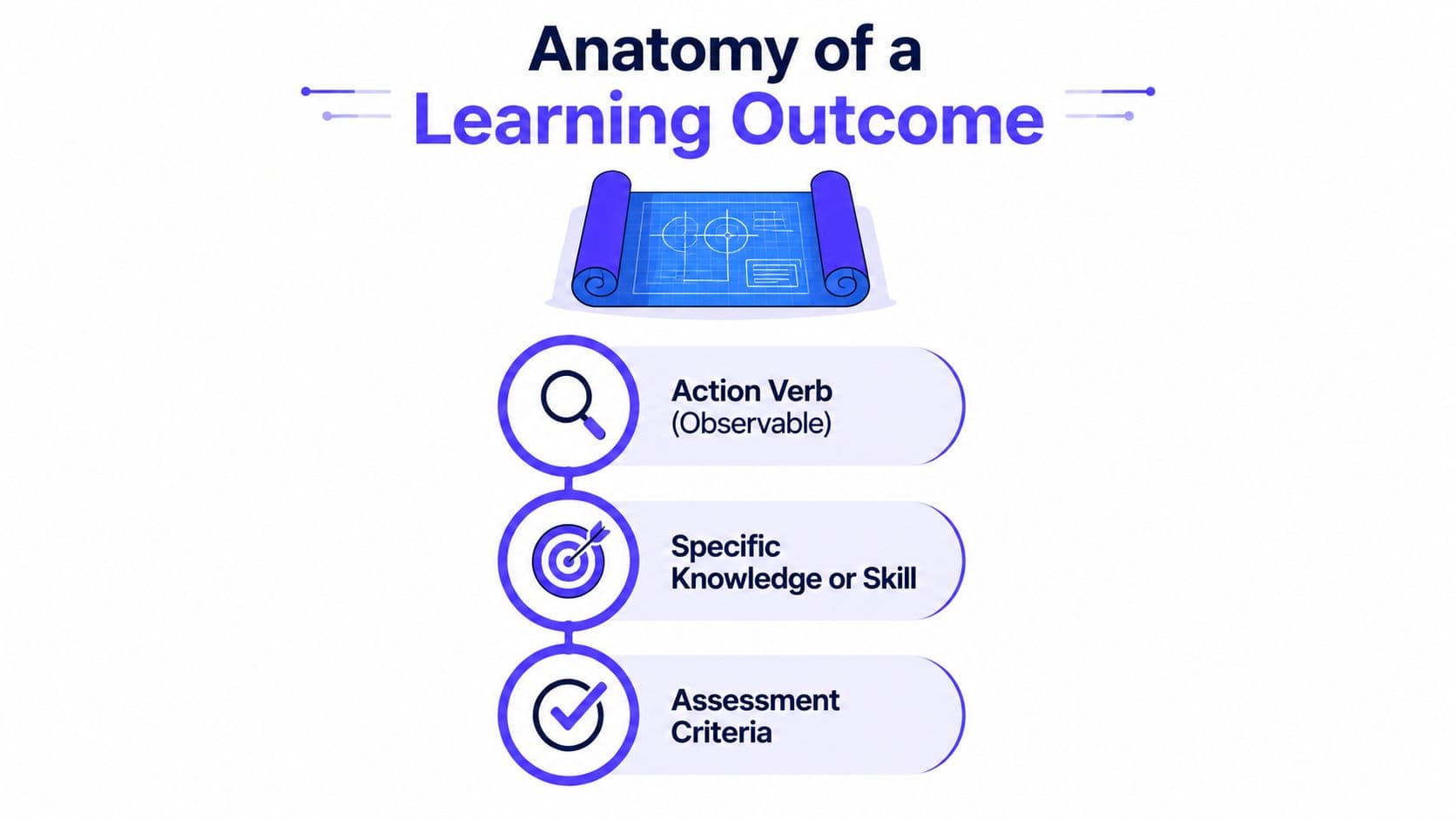
A strong learning outcome has enough detail to guide both instruction and assessment without turning into a paragraph of directions. A practical structure includes an action verb, a specific knowledge or skill, a context or condition, and a criterion for acceptable performance.
The Assessment Handbook from the University of Baltimore describes outcomes as performance statements that specify what learners can know, do, or demonstrate. It also emphasizes the value of an action, context, and degree or criterion.
Start with an observable action
The verb should describe something you can notice in student work or performance. University guidance commonly cautions against vague verbs such as “understand,” “know,” “learn,” “realize,” and “appreciate,” because they're difficult to assess directly (guidance on measurable learning outcomes).
Replace “understand ecosystems” with “classify organisms by their roles in a food web.” Replace “appreciate different viewpoints” with “compare two viewpoints and explain how each is supported by evidence.”
Bloom's Taxonomy can help you select a verb that matches the intended demand. The University of Calgary's course-design guidance connects learning outcomes to cognitive, affective, and psychomotor domains, and uses an Audience, Behaviour, Condition structure (University of Calgary guidance on course learning outcomes).
Add the content, context, and criterion
Use this adaptable formula:
As a result of participating in [learning experience], students will be able to [observable verb] [specific knowledge or skill] [under stated conditions] [to the defined criterion].
For example:
- Vague: Students will understand persuasive writing.
- Stronger: After analyzing mentor texts, students will write a persuasive paragraph that states a claim, includes relevant evidence, and explains how the evidence supports the claim.
The second statement tells you what students will produce and what you'll look for. The context might be a source set, a lab investigation, a map, or a problem-solving scenario. The criterion might describe required elements, accuracy, reasoning, or quality.
Learning intentions and success criteria guidance from Kuraplan can help you distinguish the destination from the signs that show students are reaching it.
Before adding an outcome to your plan, ask:
- Is the learner the subject?
- Does the verb describe observable behaviour?
- Is the knowledge or skill specific?
- Does the condition clarify the task?
- Can I identify acceptable evidence?
- Can students reasonably demonstrate it within the available time?
If the answer to the last question is no, narrow the outcome. One focused outcome is more useful than a crowded statement that tries to measure everything at once.
Connecting Outcomes to Standards and Assessment
Writing an outcome is only the first half of the work. The harder question is, How will you know the outcome has been achieved? An outcome statement can look measurable while the lesson activity or assessment measures something else.
Suppose the outcome asks students to evaluate the reliability of evidence. If the assessment asks them only to define “reliable” and “unreliable,” students may recall vocabulary without evaluating a source. The assessment is related to the topic, but it doesn't produce direct evidence of the intended performance.
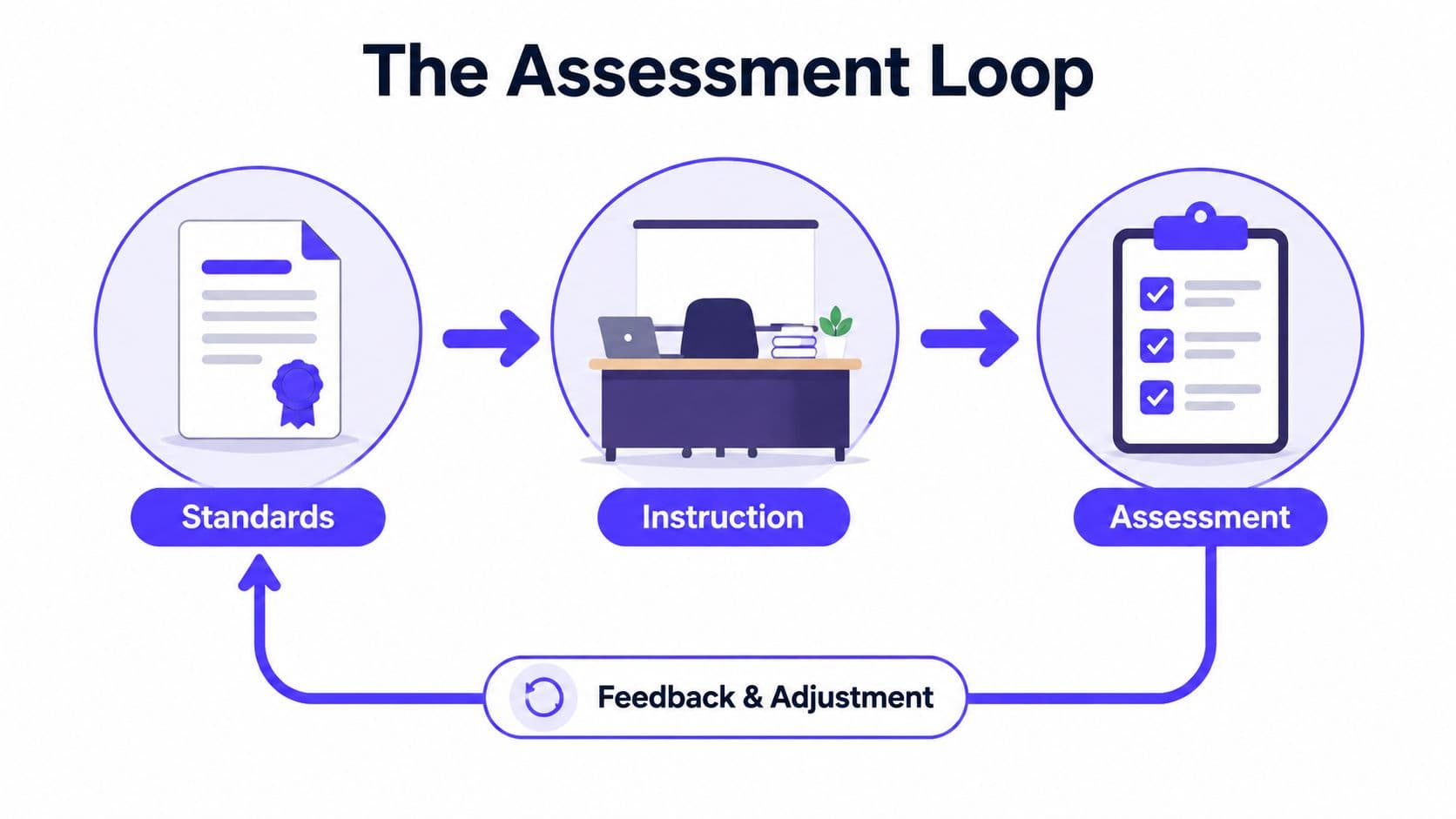
The closed assessment loop
A useful K–12 model is a continuous loop:
- Define: Unpack the standard and write a focused outcome.
- Align: Choose instruction and practice that develop the required knowledge and skill.
- Assess: Create a task that asks students to perform the outcome.
- Analyze: Examine responses using shared criteria.
- Adjust: Reteach, extend, regroup, or revise the curriculum based on the evidence.
UNESCO describes learning assessment as part of a broader process for understanding and improving learning (UNESCO's work on learning assessments). The value of the loop is that assessment doesn't end with a grade. It gives you information for the next instructional decision.
Alignment turns intentions into evidence
Constructive alignment means the outcome, learning activity, and assessment point in the same direction. If students must interpret data, they need opportunities to read, discuss, and manipulate data before the assessment. If they must construct an argument, a multiple-choice quiz may check background knowledge but won't fully prove argument construction.
Rubrics make the evidence easier to interpret. A rubric for a scientific explanation might separate the claim, evidence, reasoning, and use of scientific vocabulary. Differentiated tasks can preserve the same intellectual outcome while changing supports, texts, response modes, or access arrangements for multilingual learners and students with disabilities.
Teachers can use formative assessment examples from Kuraplan to connect quick checks to the specific performance described in an outcome. The key is to ask whether each check reveals the learning you care about.
A good outcome doesn't prove itself. Students prove it through work, performance, explanation, or another valid demonstration.
Learning Outcome Examples by Subject and Grade Level
A teacher may write, “Students will understand ecosystems,” then face a practical question: what student work would prove that understanding? The answer changes by subject, grade, and the performance named in the outcome. Early elementary outcomes often focus on identifying, representing, sorting, or explaining with support. Secondary outcomes more often ask students to analyze, evaluate, synthesize, or apply ideas independently.
| Subject and Grade Band | Sample Learning Outcome | Linked Assessment Type |
|---|---|---|
| English language arts, early elementary | Students will retell a familiar story in sequence and identify the central problem using a beginning, middle, and end organizer. | Oral retelling with a simple criteria checklist |
| Mathematics, upper elementary | Students will represent a multiplication situation with an equation, an array, and a written explanation. | Short constructed response with representations |
| Science, middle school | Given data from an investigation, students will identify a pattern and use it to explain how a variable affects the outcome. | Data-analysis performance task |
| Social studies, middle school | Students will compare two accounts of an event and cite details that reveal differences in perspective. | Source comparison response scored with a rubric |
| English language arts, secondary | Students will develop an evidence-based claim about a text and explain how selected details support that claim. | Rubric-scored analytical paragraph |
| Mathematics, secondary | Students will model a contextual problem with a linear function and interpret the meaning of key features in the situation. | Multi-step modeling task |
| Science, secondary | Students will evaluate competing explanations of a phenomenon using evidence from a model or investigation. | Written explanation and oral defense |
| Social studies, secondary | Students will construct an argument about a historical development using evidence from multiple sources and addressing a counterclaim. | Document-based essay |
Read each verb as an assessment instruction. “Retell” and “identify” fit foundational literacy performances. “Evaluate” and “construct” require students to reason with evidence and make decisions. The context still matters. A student who identifies a claim in a teacher-provided example may need further support before constructing an independent argument.
Match the assessment to the verb
Use the outcome's verb as a design test:
- Identify or define: Use a selected-response item, labeling task, or short response.
- Explain or compare: Ask for a constructed response, discussion, or annotated representation.
- Apply or model: Provide a problem or authentic situation for students to solve.
- Analyze or evaluate: Use a source set, investigation, case, or argument that requires reasoning.
- Create or perform: Assess a product, presentation, demonstration, or project with clear criteria.
The assessment should make the named performance visible. If the outcome says “model,” students need to produce or interpret a model. If it says “construct an argument,” their work must show a claim, relevant evidence, and reasoning. A quiz may check supporting knowledge, but it cannot by itself demonstrate every complex performance.
Grade level helps set the expected independence and complexity. It should not turn assessment into a harder version of the same task without purpose. A well-matched task gives students an appropriate challenge and gives the teacher usable evidence for the next instructional decision.
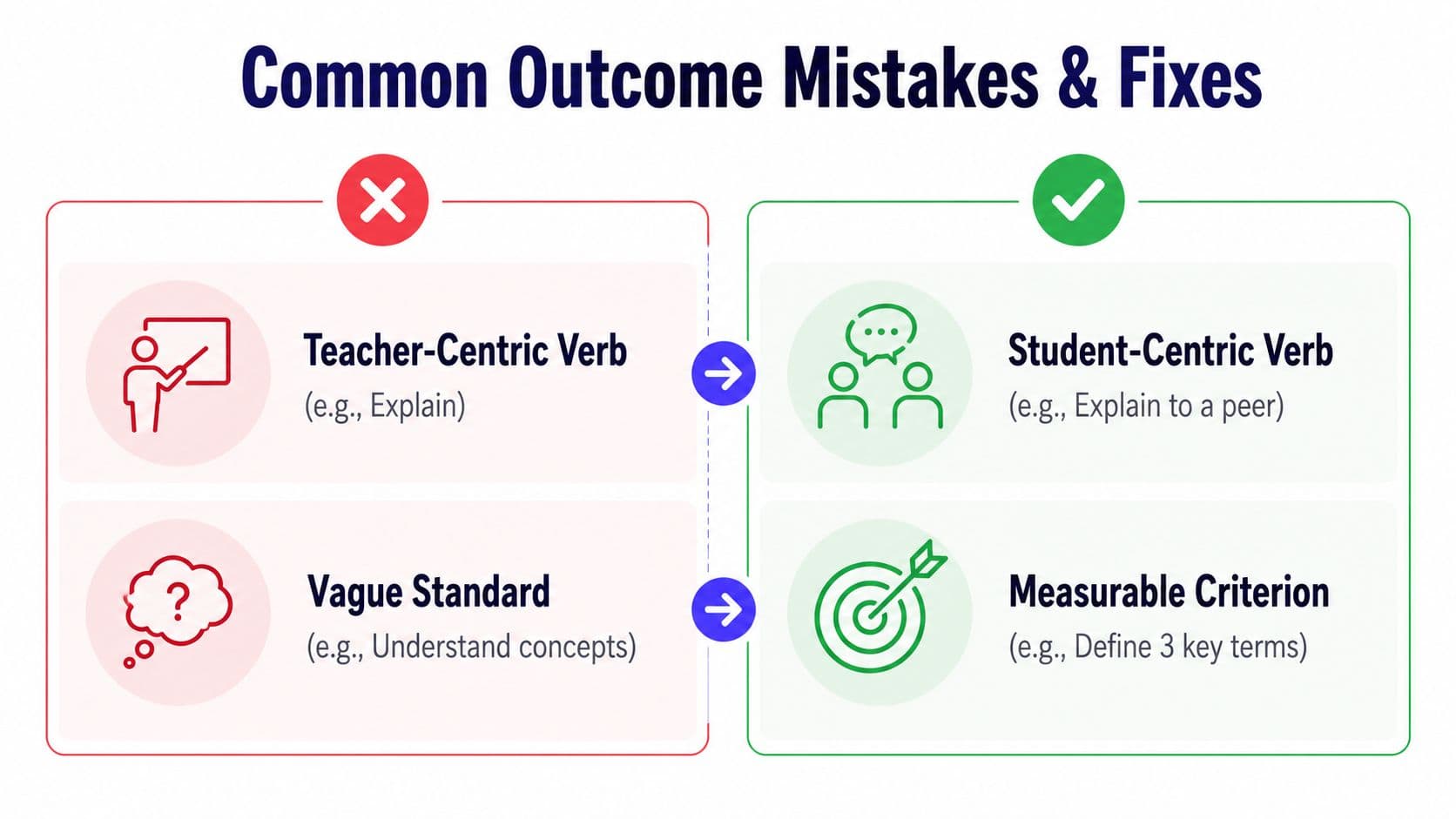
Common Learning Outcome Mistakes and How to Fix Them
Many weak outcomes sound professional because they use curriculum language. Their problem appears later, when a teacher tries to select an assessment and can't decide what counts as success.
Mistake one, describing the teacher's action
- Weak: The teacher will explain equivalent fractions.
- Fix: Students will represent equivalent fractions with visual models and explain why the values are equal.
The first statement belongs in the teaching plan. It tells you what you'll do, not what students will learn. The revised outcome points toward student evidence.
Mistake two, hiding several outcomes in one sentence
- Weak: Students will identify, explain, compare, evaluate, and create a presentation about ecosystems.
- Fix: Students will analyze a food web and explain how a change in one population affects another.
The original statement combines multiple performances and may be impossible to assess well in one lesson. Separate outcomes when students need distinct evidence, or choose the central performance and treat the rest as supporting skills.
Mistake three, using an invisible verb
- Weak: Students will understand theme.
- Fix: Students will identify a theme in a literary text and support it with two relevant details.
The revised version makes the thinking visible. The Cornell guide to setting learning outcomes also connects outcomes with backwards course design, which starts by clarifying what students should demonstrate.
Mistake four, setting one outcome for every learner without examining access
A single outcome can hide major differences in starting points. Recent reporting on U.S. achievement gaps indicates that lower-performing students continue to fall behind while higher-performing students account for much of the limited recovery (achievement gap findings). The same source reports that 33% of elementary administrators and educators described mathematics learning loss as severe or very severe, while 31% said the same for English language arts (the same U.S. learning-loss report).
Keep the intellectual destination clear, but vary the route. Provide vocabulary, models, accessible texts, assistive technology, sentence frames, visual supports, or an alternative response mode when those supports let students demonstrate the intended learning rather than changing the construct.
A Practical Workflow for Writing and Using Learning Outcomes
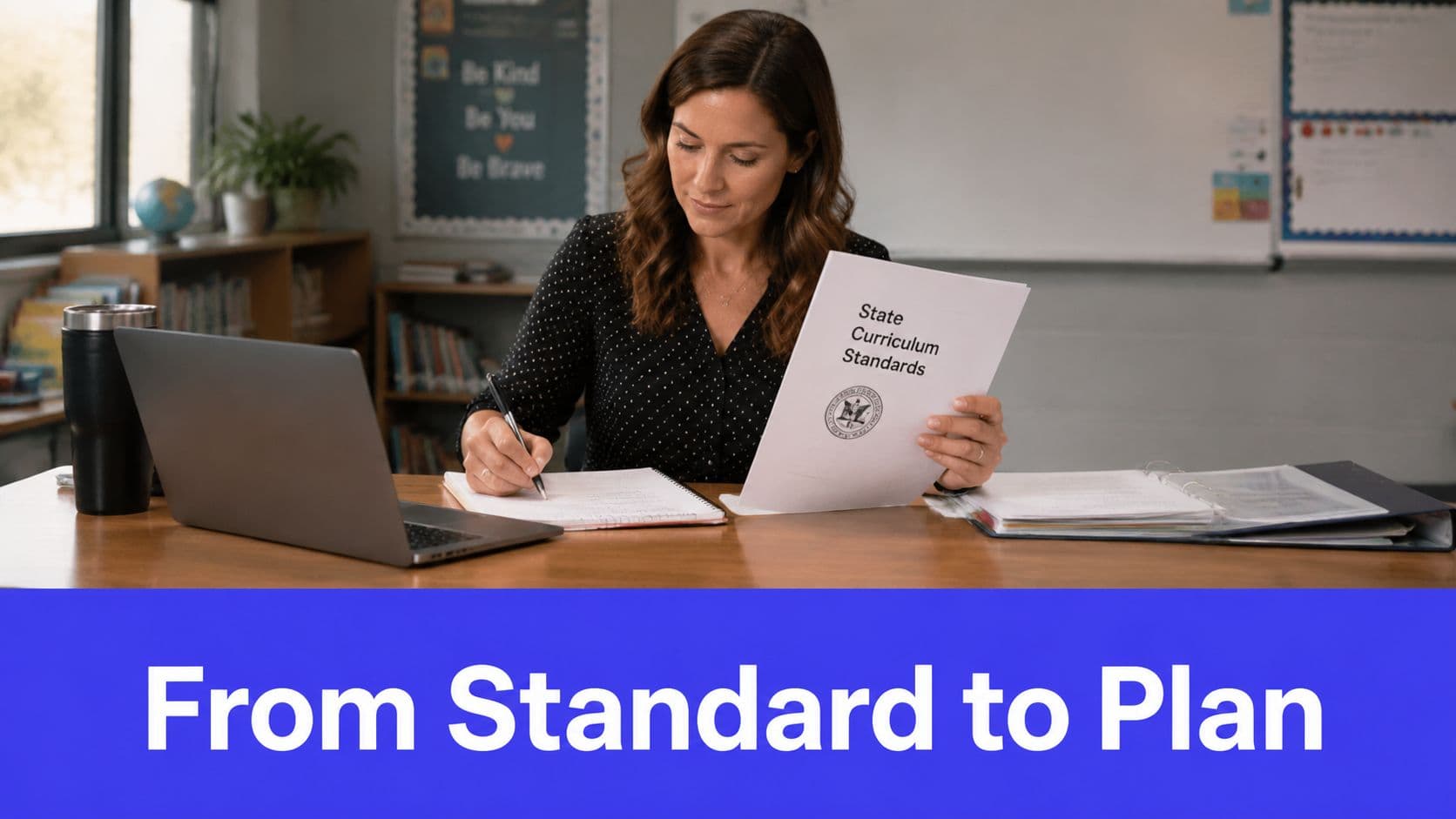
Start with the standard, but don't copy it into your lesson plan and call it an outcome. Standards often contain several skills, concepts, and conditions. Your first job is to identify the specific performance students need to demonstrate in this lesson or unit.
Work backwards from the evidence
Use this sequence:
- Unpack the standard. Circle the content students need and underline the performance students must demonstrate.
- Write one to three focused outcomes. Choose verbs that match the expected cognitive demand.
- Design the evidence first. Decide what students will produce, perform, explain, or solve.
- Plan instruction around the evidence. Include modeling, guided practice, independent practice, and checks for understanding.
- Set the criteria. Describe what a successful response includes, using student-friendly language.
- Plan the response to results. Decide how you'll reteach, extend, regroup, or adjust the next lesson.
Your assessment should be visible in the plan before you choose every activity. A colorful activity can still be misaligned if it doesn't give students a chance to perform the outcome.
After the outcome and assessment are clear, planning tools can reduce the administrative work. Kuraplan is one option that creates standards-aligned lesson and unit plans, maps objectives, supports differentiated instruction, and attaches assessment rubrics. It can also turn a lesson into printable or shareable worksheets with multiple-choice items, images, and age-appropriate question types. Teachers can begin with a lesson plan template from Kuraplan and then review every generated outcome and task against the actual needs of their class.
A tool can accelerate drafting, but it can't replace your knowledge of students. Check the language level, cultural relevance, accessibility, time demand, and match between the proposed task and the outcome.
Here's a short video you can use as another planning reference:
Before teaching, place the outcome and success criteria where students can use them. During the lesson, collect evidence that answers the outcome directly. Afterward, sort responses by the part of the performance students can do and the part that still requires support.
Using Learning Outcomes as a Daily Teaching Tool
Learning outcomes work best when students encounter them before, during, and after instruction. Introduce the outcome in plain language, connect it to the task, and return to it during feedback. Instead of saying, “You need to meet the standard,” say, “Today you'll compare two sources and use details to explain how their viewpoints differ.”
At the end of the lesson, ask yourself:
- Student clarity: Could students explain what they were learning and what successful work would show?
- Evidence: Did the task require the exact performance named in the outcome?
- Feedback: Did comments identify a specific strength or next step?
- Equity: Could students access the task and demonstrate the outcome through appropriate supports?
- Next move: What will you reteach, extend, or practice tomorrow?
Shared outcomes also help grade-level and subject teams examine student work with a common lens. Teachers can compare responses, discuss whether the criteria were clear, and adjust instruction without reducing learning to a single score.
Learning outcomes aren't paperwork to complete and file away. They're a daily habit for making the destination visible, checking whether students are reaching it, and using evidence to decide what happens next.
Kuraplan helps K–12 teachers create standards-aligned lesson and unit plans with measurable learning outcomes, differentiated activities, worksheets, and assessment rubrics. Visit Kuraplan to connect the outcome you write with the instruction and evidence your students need.