First Year · Science · 2 minutes
How do plants make their own food?
carbon dioxide + water → glucose + oxygen
Key terms
- photosynthesis
- The way plants make their own food, a sugar called glucose, using water, carbon dioxide and light.
- glucose
- The sugar that plants make as their food.
- xylem
- Thin tubes that carry water from the roots up into the leaves.
- stomata
- Tiny holes on the underside of a leaf that let carbon dioxide in and oxygen out.
- chloroplast
- A part inside leaf cells packed with chlorophyll, where light energy is trapped.
- chlorophyll
- The green pigment that traps light energy from the Sun.
Transcript
This oak tree has never eaten a meal in its life. Yet it grew from a tiny acorn into a giant, weighing many tonnes. So where did all that food come from?
The answer is photosynthesis. Plants make their own food, a sugar called glucose. They just need three things: water, carbon dioxide, and light.
Let's follow the water first. Roots soak it up from the soil, and it travels up through thin tubes called xylem, all the way into the leaves.
Now zoom into a leaf. On its underside are tiny holes called stomata, each one guarded by two cells that open and close it. Carbon dioxide from the air drifts in through them.
Inside the leaf cells are chloroplasts, packed with a green pigment called chlorophyll. Chlorophyll traps light energy from the Sun, and uses it to join carbon dioxide and water together.
That makes glucose, the plant's food. Oxygen is made too, and it escapes out through the stomata. So here's the word equation. Carbon dioxide plus water gives glucose plus oxygen, with light and chlorophyll above the arrow.
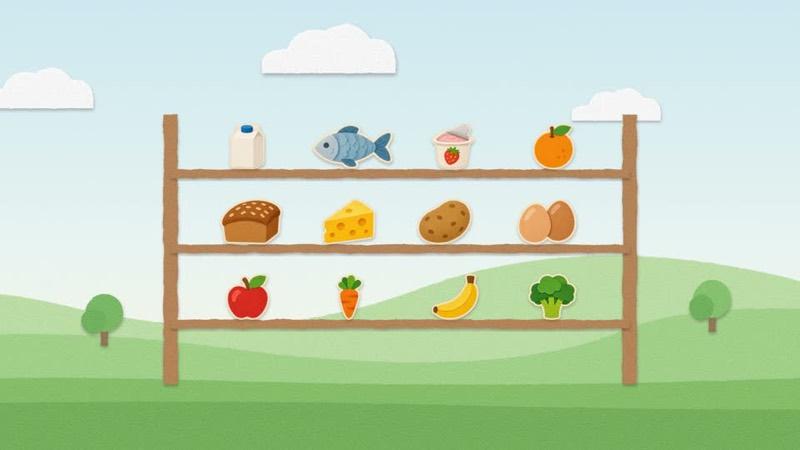
Why should you care? Every food chain starts with a plant. So the energy in your porridge, and in the milk on top, began as sunlight. And the oxygen in every breath you take was made by photosynthesis.
So remember. Plants take in carbon dioxide and water. Chlorophyll in the chloroplasts traps light energy. And out come glucose and oxygen.
Sources
Every fact in the video, and where it comes from.
- 1bbc.co.uk/bitesize/guides/zb9fy9q/revision/1
- Photosynthesis is the process by which green plants make their own food (glucose) using light energy.
- 2bbc.co.uk/bitesize/guides/zb9fy9q/revision/2
- Word equation: carbon dioxide + water -> glucose + oxygen, in the presence of light and chlorophyll.
- Water is absorbed by the roots and carried up to the leaves in xylem vessels.
- Oxygen is released as a waste product of photosynthesis.
- 3sciencelearn.org.nz/resources/1520-leaf-structure
- Carbon dioxide enters the leaf through stomata, small pores mostly on the underside of the leaf; oxygen leaves through them.
- 4sciencelearn.org.nz/resources/1510-photosynthesis
- Photosynthesis takes place in chloroplasts; the green pigment chlorophyll absorbs light energy.
- The oxygen in Earth's atmosphere was produced by photosynthesis.
- Most of a tree's mass comes from carbon dioxide taken from the air, not from the soil (a mature oak can weigh many tonnes).
- 5bbc.co.uk/bitesize/topics/zbnnb9q
- Plants are producers: food chains begin with a producer, usually a green plant.
Image and sound credits
- All illustrations drawn in code
Teaching this next week?
Kuraplan turns this topic into a lesson plan, slides and a worksheet for your class in about a minute.
Plan a lesson on this topic