ScienceFreePrintable

Carbohydrates: Structure and Function

A free science worksheet ready for your classroom. Open in Kuraplan to grab the print-ready PDF, customize it for your students, or generate a fresh version in seconds.
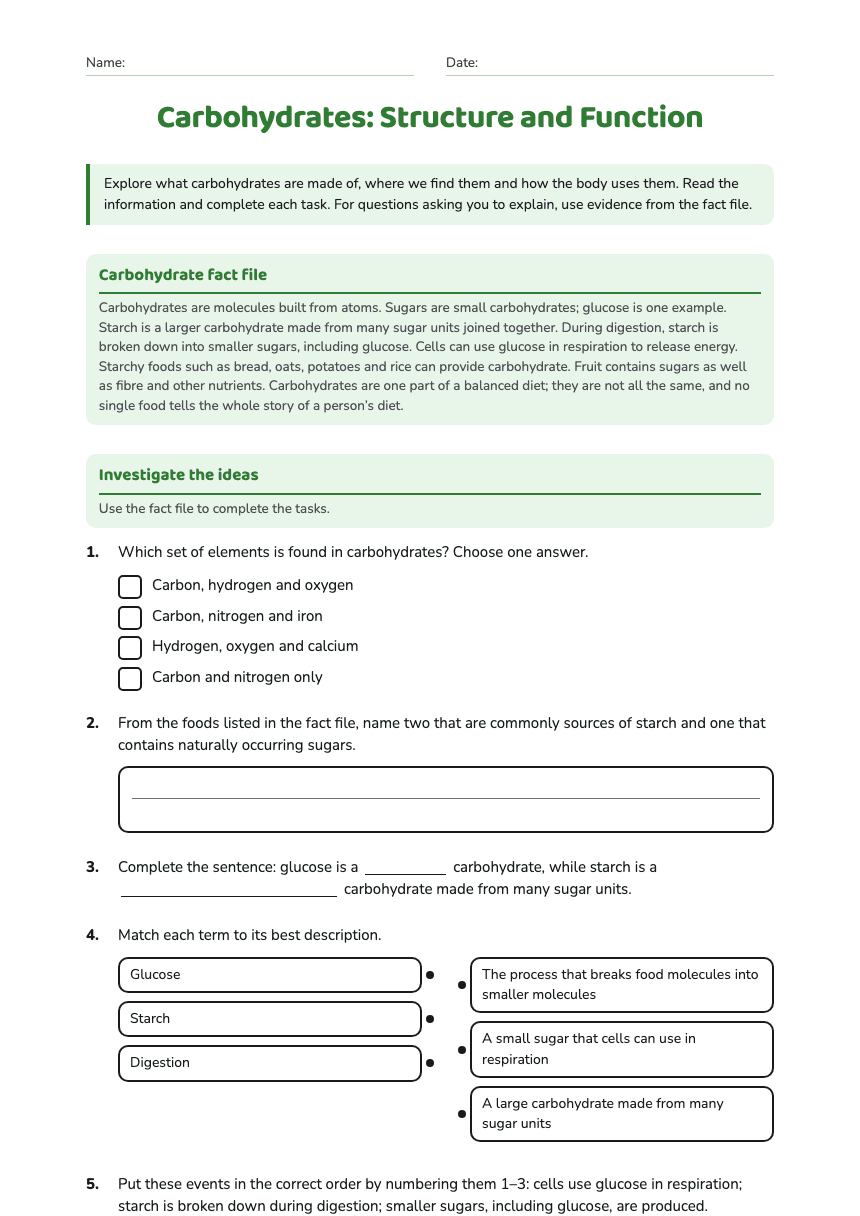
Carbohydrates: Structure and Function worksheet preview
Name:Date:

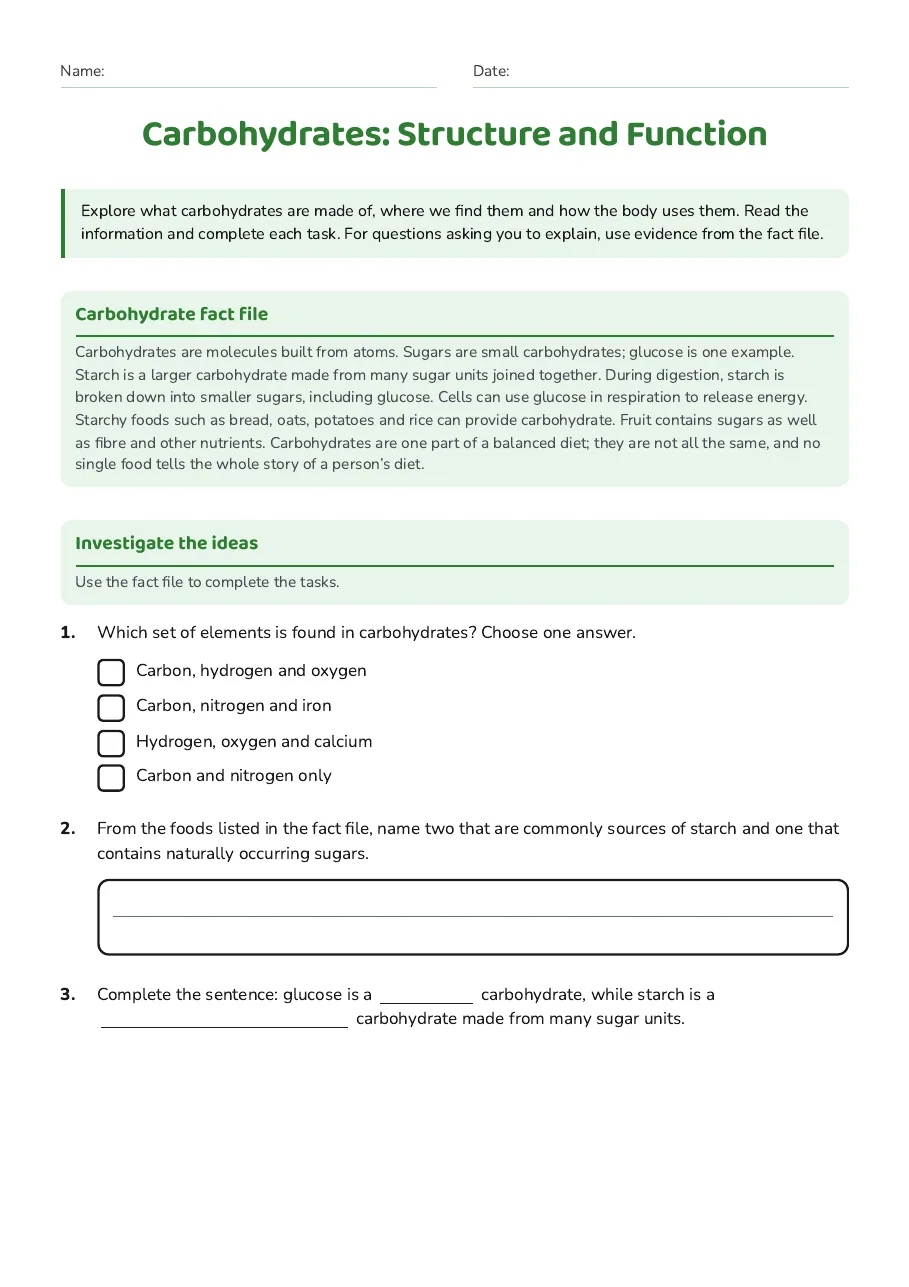
Carbohydrates: Structure and Function

Explore what carbohydrates are made of, where we find them and how the body uses them. Read the information and complete each task. For questions asking you to explain, use evidence from the fact file.

Carbohydrate fact file

Carbohydrates are molecules built from atoms. Sugars are small carbohydrates; glucose is one example. Starch is a larger carbohydrate made from many sugar units joined together. During digestion, starch is broken down into smaller sugars, including glucose. Cells can use glucose in respiration to release energy. Starchy foods such as bread, oats, potatoes and rice can provide carbohydrate. Fruit contains sugars as well as fibre and other nutrients. Carbohydrates are one part of a balanced diet; they are not all the same, and no single food tells the whole story of a person’s diet.

Investigate the ideas

Use the fact file to complete the tasks.

1.Which set of elements is found in carbohydrates? Choose one answer.
  • Carbon, hydrogen and oxygen
  • Carbon, nitrogen and iron
  • Hydrogen, oxygen and calcium
  • Carbon and nitrogen only
2.From the foods listed in the fact file, name two that are commonly sources of starch and one that contains naturally occurring sugars.
3.Complete the sentence: glucose is a carbohydrate, while starch is a carbohydrate made from many sugar units.
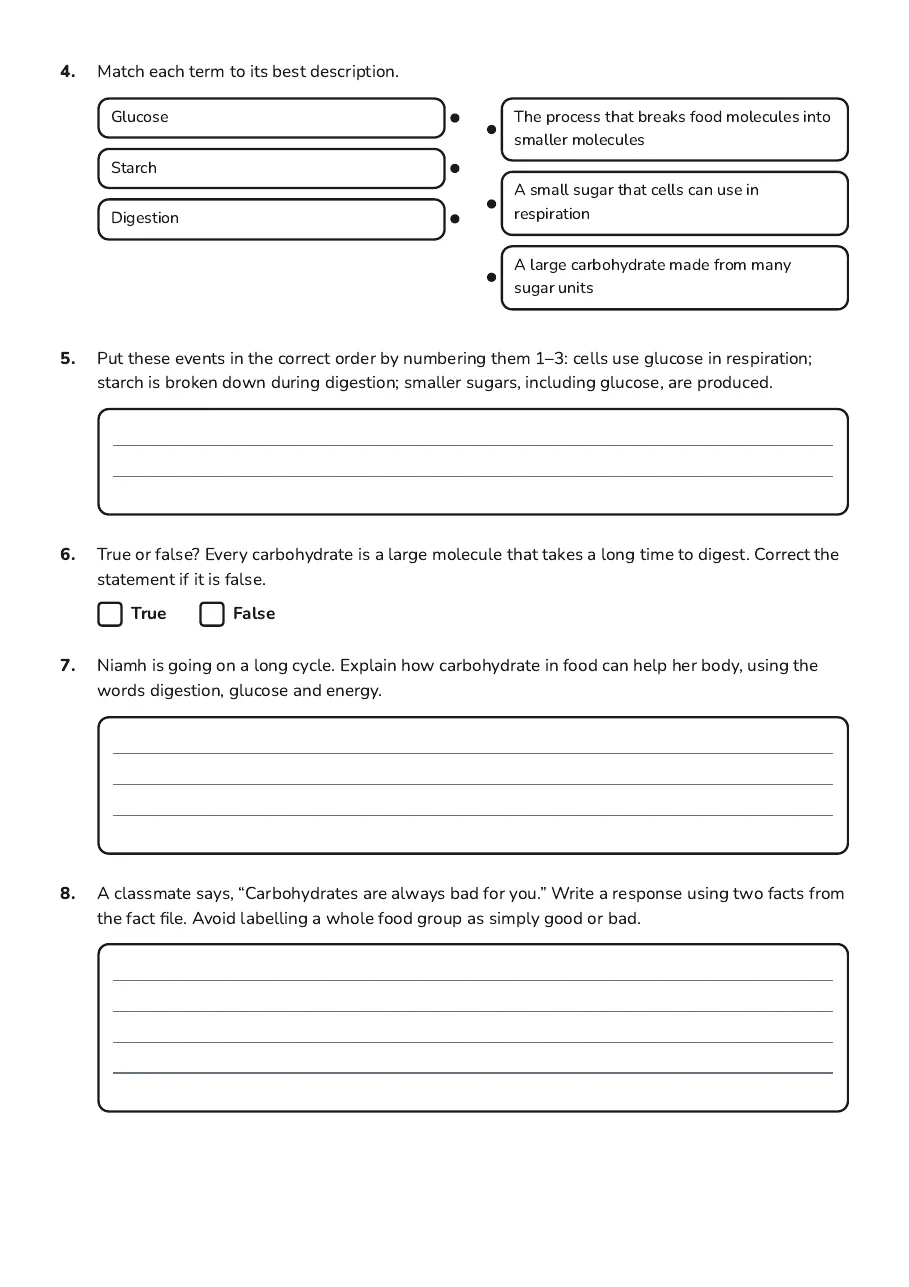
4.Match each term to its best description.
  • Glucose
  • Starch
  • Digestion
  • The process that breaks food molecules into smaller molecules
  • A small sugar that cells can use in respiration
  • A large carbohydrate made from many sugar units
5.Put these events in the correct order by numbering them 1–3: cells use glucose in respiration; starch is broken down during digestion; smaller sugars, including glucose, are produced.
6.True or false? Every carbohydrate is a large molecule that takes a long time to digest. Correct the statement if it is false.
TrueFalse
7.Niamh is going on a long cycle. Explain how carbohydrate in food can help her body, using the words digestion, glucose and energy.
8.A classmate says, “Carbohydrates are always bad for you.” Write a response using two facts from the fact file. Avoid labelling a whole food group as simply good or bad.
9.Use the formula C₆H₁₂O₆ to draw and label a simple model of one glucose molecule. How many atoms of each element does it contain? Use labelled symbols or circles; the drawing does not need to show the atoms’ precise arrangement.

3 printable pages

  • Carbohydrates: Structure and Function, page 1 of 3: Carbohydrate fact file, Investigate the ideas

    Page 1

  • Carbohydrates: Structure and Function, page 2 of 3: 4. Match each term to its best description.

    Page 2

  • Carbohydrates: Structure and Function, page 3 of 3: 9. Use the formula C₆H₁₂O₆ to draw and label a simple model of one glucose molecule. How…

    Page 3

About This Worksheet

Free in Kuraplan

Sign up free, grab the PDF, and customize it for your class.

Print-Ready

Formatted for standard paper. Clean layout, easy to read.

AI-Generated

Created with Kuraplan's AI, designed for real classroom use.

For Teachers & Parents

Use in classrooms, for homework, tutoring, or homeschool.

Need a custom version of this worksheet?

Kuraplan's AI generates custom worksheets in seconds — differentiated for every learner, aligned to your curriculum.

Generate Custom Worksheets — Free
No credit card Curriculum-aligned Under 60 seconds

More Science Worksheets