Sound and Vibrations Exploration
A free science worksheet ready for your classroom. Open in Kuraplan to grab the print-ready PDF, customize it for your students, or generate a fresh version in seconds.
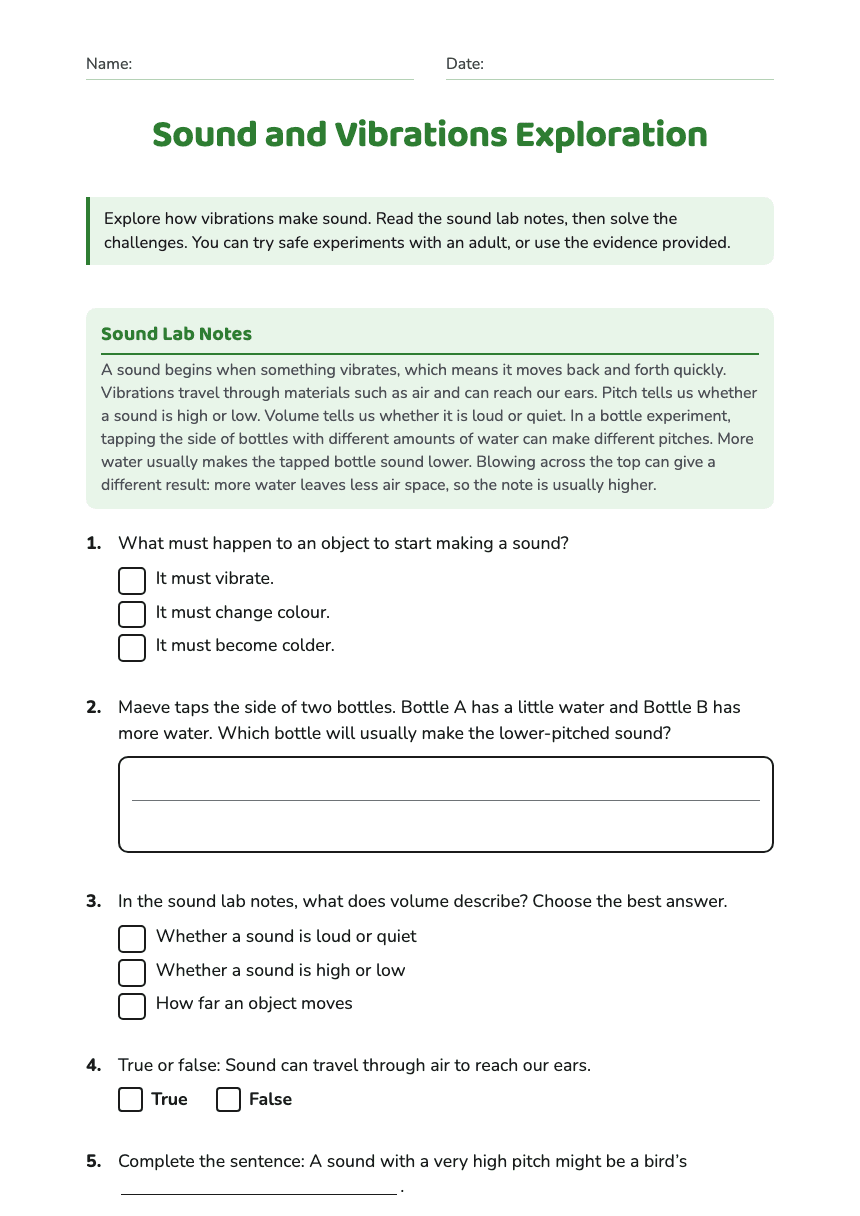
Sound and Vibrations Exploration
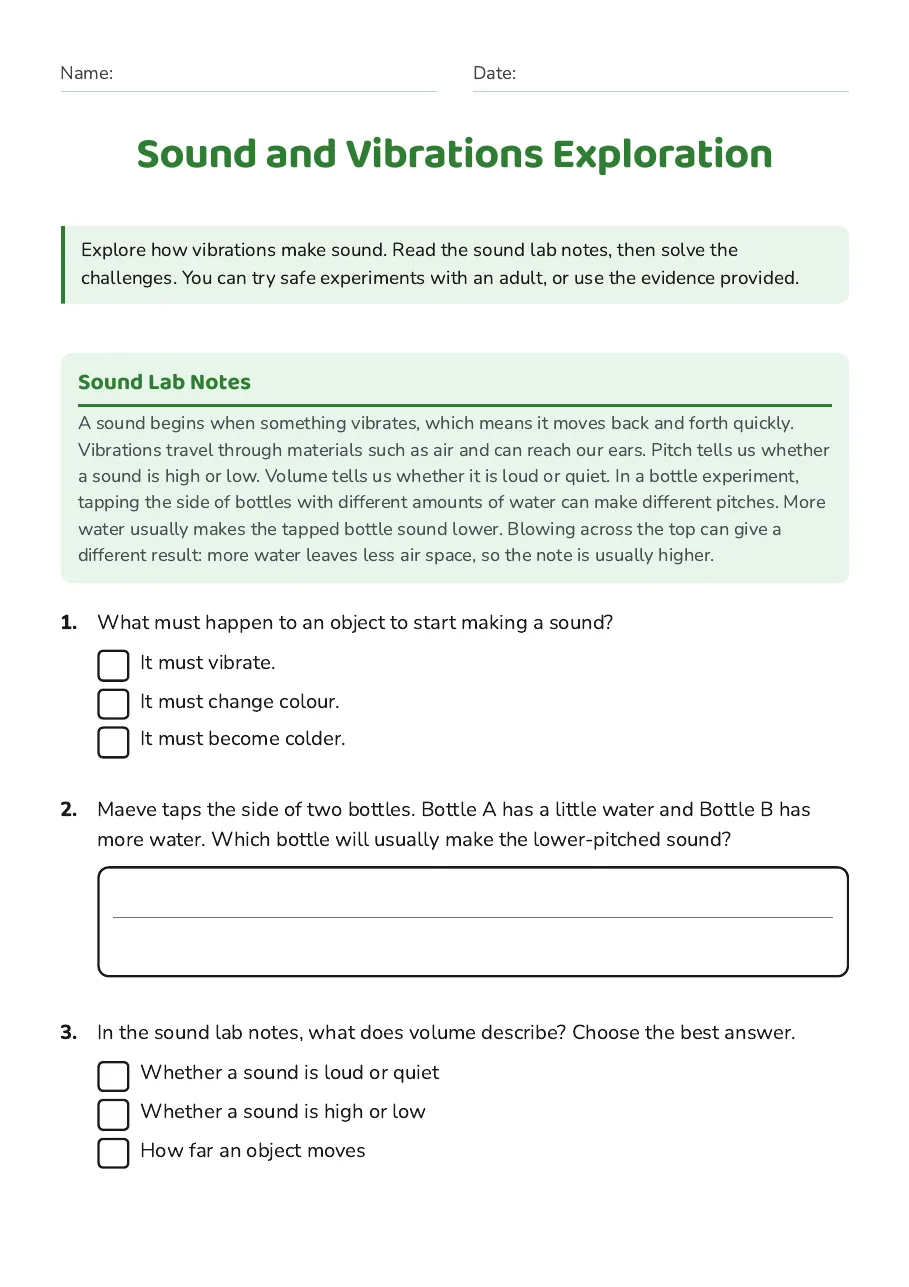
Sound Lab Notes
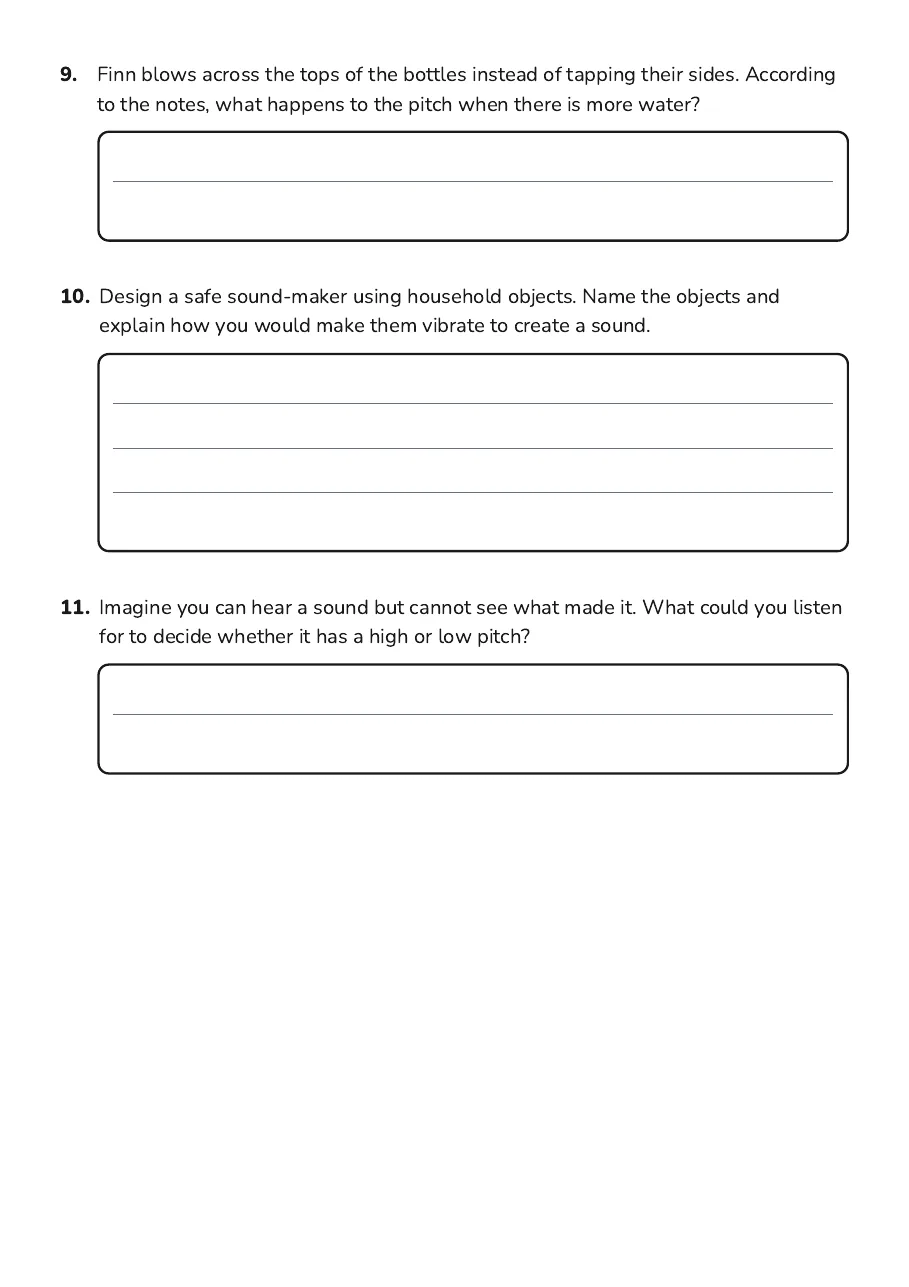
A sound begins when something vibrates, which means it moves back and forth quickly. Vibrations travel through materials such as air and can reach our ears. Pitch tells us whether a sound is high or low. Volume tells us whether it is loud or quiet. In a bottle experiment, tapping the side of bottles with different amounts of water can make different pitches. More water usually makes the tapped bottle sound lower. Blowing across the top can give a different result: more water leaves less air space, so the note is usually higher.
- It must vibrate.
- It must change colour.
- It must become colder.
- Whether a sound is loud or quiet
- Whether a sound is high or low
- How far an object moves
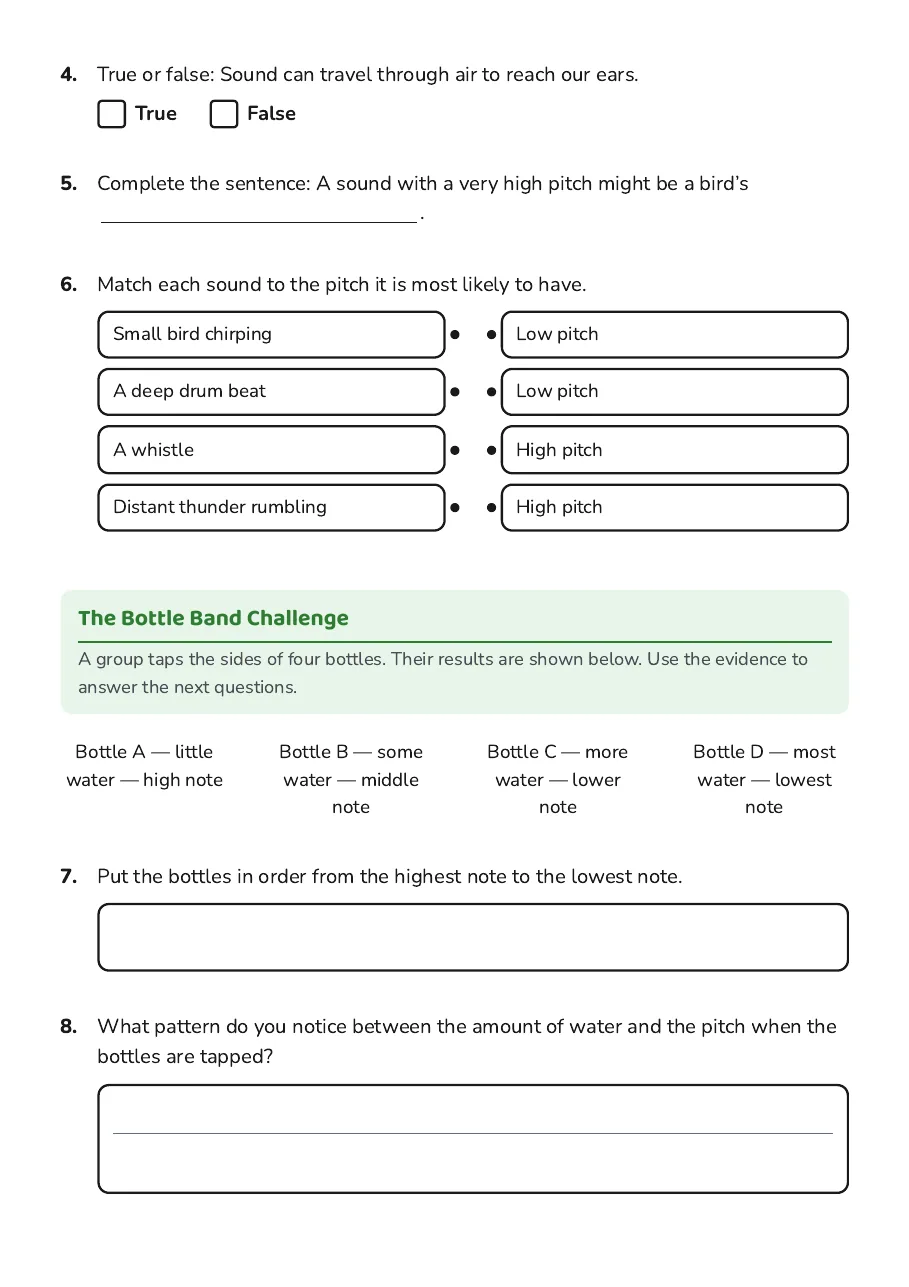
- Small bird chirping
- A deep drum beat
- A whistle
- Distant thunder rumbling
- Low pitch
- Low pitch
- High pitch
- High pitch
The Bottle Band Challenge
A group taps the sides of four bottles. Their results are shown below. Use the evidence to answer the next questions.
Bottle A — little water — high note
Bottle B — some water — middle note
Bottle C — more water — lower note
Bottle D — most water — lowest note
3 printable pages
Page 1
Page 2
Page 3
About This Worksheet
Free in Kuraplan
Sign up free, grab the PDF, and customize it for your class.
Print-Ready
Formatted for standard paper. Clean layout, easy to read.
AI-Generated
Created with Kuraplan's AI, designed for real classroom use.
For Teachers & Parents
Use in classrooms, for homework, tutoring, or homeschool.
Need a custom version of this worksheet?
Kuraplan's AI generates custom worksheets in seconds — differentiated for every learner, aligned to your curriculum.
Generate Custom Worksheets — Free