
You've just graded a quiz where almost everyone got the right answer, then asked one student to explain it and watched the room go quiet. They can recall it, circle it, and repeat it back word for word. They can't use it. That gap isn't a motivation problem most days. It's a question problem, and it's fixable without a new program.
The pattern shows up in the data, too. A synthesis of classroom questioning found stronger gains when higher-cognitive questions rose well above the roughly 20% commonly observed in classrooms, reaching approximately 50% or more in the studies summarized in Cotton's classroom questioning review hosted by Monash University. That review also linked the shift to longer responses, more student-to-student interaction, and more speculative thinking. The effect on achievement was positive but small, which is why counting questions isn't enough.
What follows are eight higher order thinking questions examples sorted by the reasoning they demand, not by how impressive the wording sounds. Each one gives you a usable prompt, a scaffold that keeps the thinking intact, a stretch for students who finish fast, and a simple way to score what they produce. You can also turn every prompt into a worksheet item or a discussion task with the same conversion routine. If drafting from scratch is the bottleneck, Kuraplan can generate a first set tied to your standards so you can spend your time refining instead of typing.
1. Cause-and-Effect Chain Questions
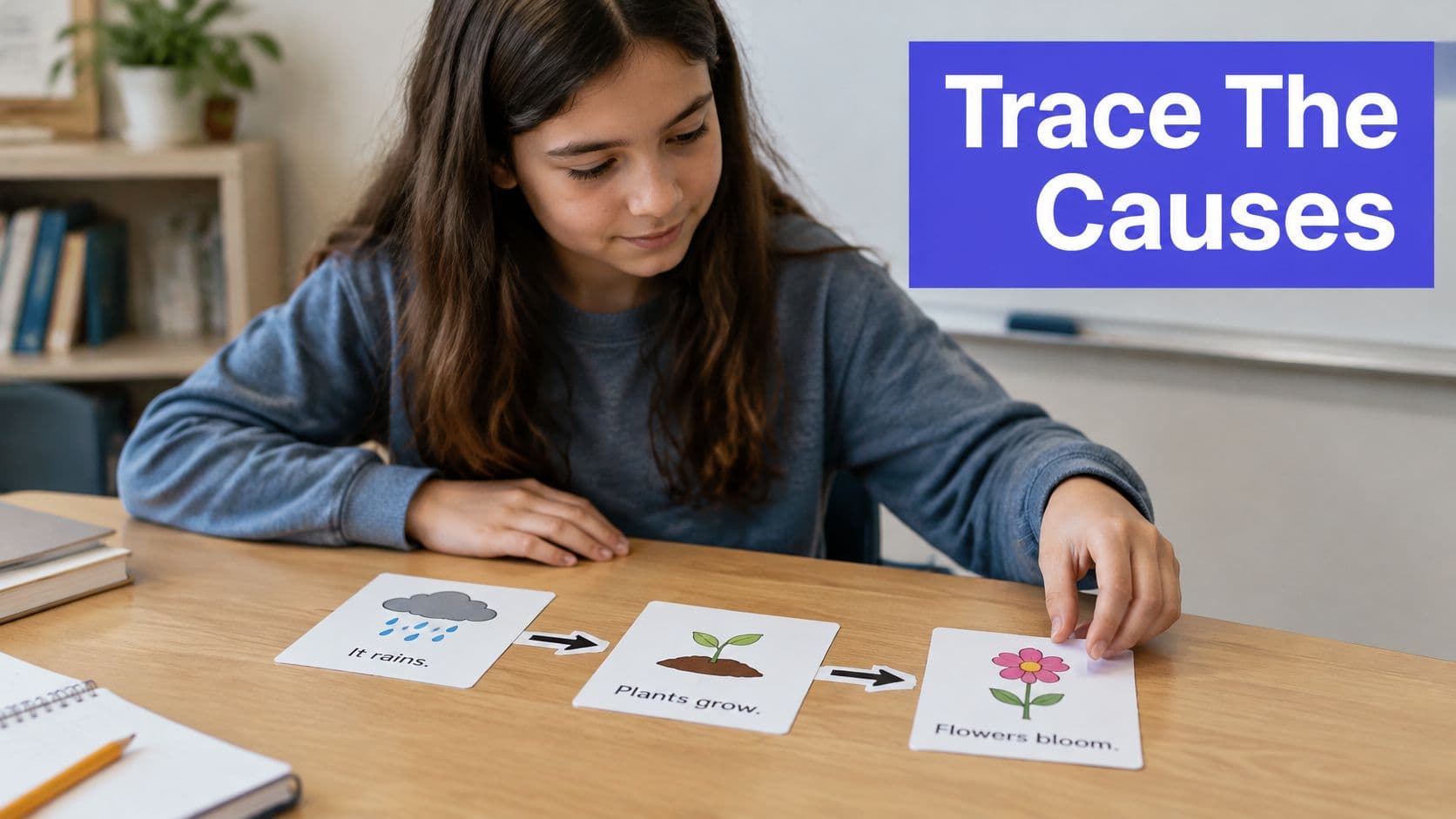
Don't ask what happened. Ask what it set in motion. A chain question forces students to separate a primary cause from contributing factors and explain how each link changes the next one. That's analysis, and it quickly reveals who understands the content versus who memorized a timeline.
Prompts You Can Use Monday
- History: "What were the three most important causes of the Dust Bowl, and how did each one make the others worse?"
- Science: "Trace how a drop in rainfall could eventually change the population of a predator species in a grassland food web."
- ELA: "How did Scout's decision to walk Boo Radley home change the way other characters viewed her father?"
The visual template does most of the scaffolding work here. Give struggling readers a chain of blank boxes with arrows and prefilled cause cards they can sort before writing. They still have to justify each arrow in one sentence, so the reasoning stays theirs. Start younger students with two-step chains before you ask for branching networks.
To stretch advanced students, add the removal test. Ask, "What would have happened if this factor were removed?" If nothing changes, the factor probably wasn't a real cause, and students have to revise the chain themselves.
Score two things only, at least at first. Score whether each arrow has a plausible mechanism, not just two events placed side by side, and score whether the student distinguishes necessary causes from background conditions. To convert this into a worksheet, print the empty chain, add a sentence frame under each arrow, and leave the last box open for a consequence students predict themselves. Kuraplan can draft cause-and-effect sets tied to your unit standards, which leaves you free to check that the chains are actually causal.
2. Compare and Contrast Questions
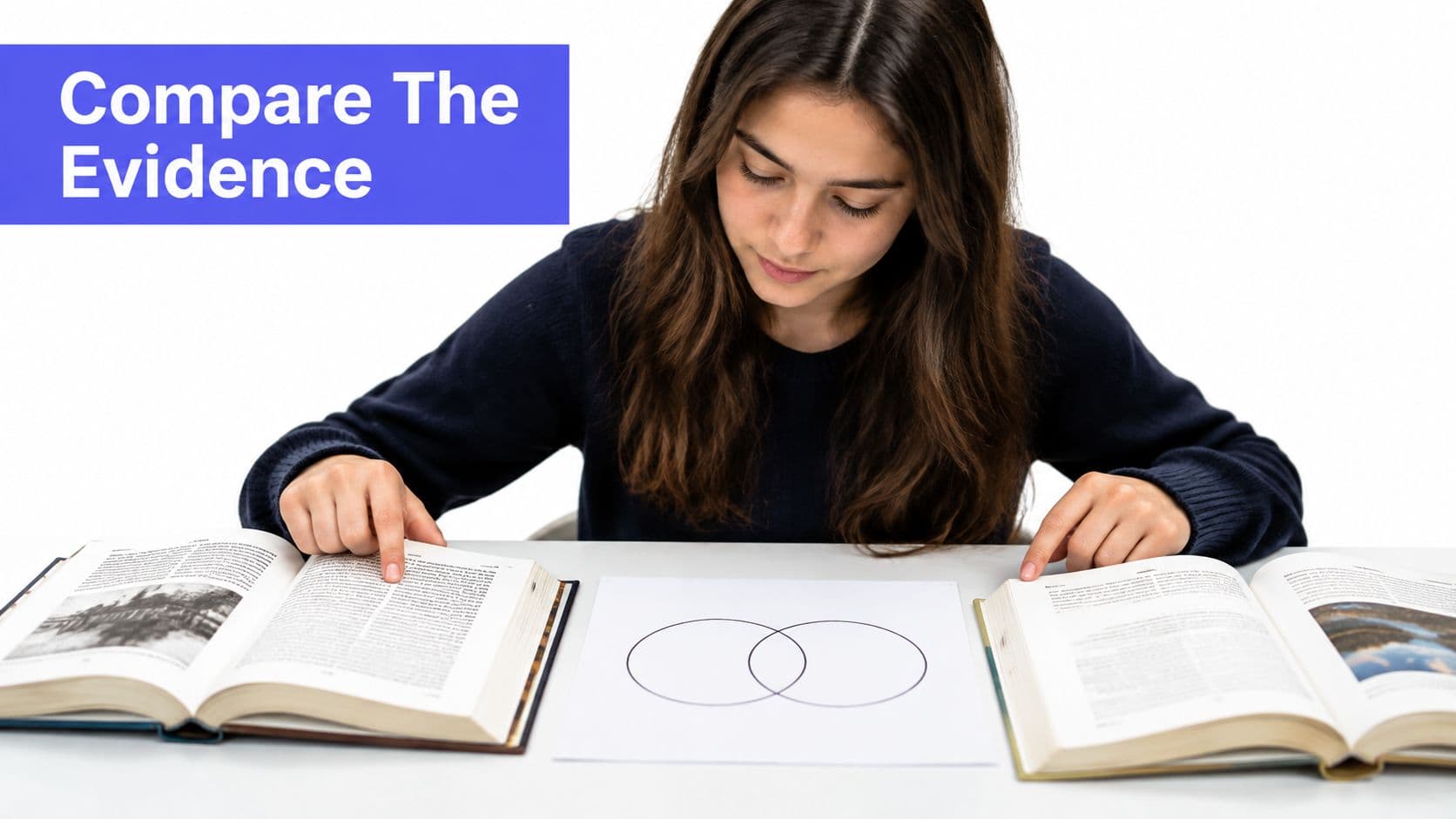
Comparison only becomes higher-order when students answer so what. Listing similarities is organizing, not analyzing. The thinking starts when a student explains why a difference matters, for whom, and under what conditions. That's also where binary thinking breaks down, because most honest comparisons involve trade-offs.
Prompts With a Built-In Payoff
- Social Studies: "Compare the Articles of Confederation with the U.S. Constitution. Which weakness in the first did the second most directly address, and why?"
- Science: "How are aerobic and anaerobic respiration alike in purpose, and why do they produce such different amounts of energy?"
- Math: "Compare the graphs of y = 2x and y = 2^x. What does each reveal about how the functions grow?"
Give students three criteria upfront, such as purpose, cost, and efficiency, then require them to add a fourth criterion of their own. That last step is your scaffold and your diagnostic at once, because choosing a lens shows whether they can frame the analysis. For struggling readers, keep the same criteria but provide short, labeled evidence excerpts for each side instead of full texts.
After every similarity or difference, make students write one sentence beginning "This matters because." Without that sentence, you've assigned a sorting exercise.
For a stretch, attach a short evaluation step. Ask which approach they'd choose for a school with limited funding, and require them to use their comparison as evidence. Score the criteria, the accuracy of the comparison, and the interpretation as three separate columns. A student can be accurate and still shallow, and the rubric should show that. As a worksheet, use a table with criteria down the side and a final row for the verdict. Kuraplan's visual generator can produce a clean comparison graphic for students who need a concrete starting point.
3. Source and Evidence Evaluation Questions

Students who can't judge a source will believe whichever one they read last. These questions ask them to examine who created it, when, for what audience, and what's left out before they accept a claim. That's evaluation in the strictest sense, because they must weigh evidence against stated criteria and defend a judgment.
Three prompts cover most subjects. In history, "Read this 1930s propaganda poster. What techniques does it use to persuade, and which claims could you verify with other sources?" In science, "A company claims its fertilizer doubles crop yield. What data would you need before you trusted this, and what does the ad leave out?" In ELA, "Compare two news articles on the same event. Which is more trustworthy, and what criteria did you use?"
A Routine Worth Teaching Explicitly
- Sourcing: Who made this, when, and why?
- Contextualizing: What else was happening then that shapes what it says?
- Corroborating: What does an independent source say, and where do they disagree?
The scaffold is a 1 to 4 rating scale students defend in writing, with the three routine steps printed beside the source. Mix reliable and unreliable sources deliberately, or students learn the wrong shortcut and start treating every document as either safe or suspect. For a stretch, hand them a second source after they've committed to a rating and ask them to revise, or explain why they won't. That revision models intellectual humility better than any lecture about it.
Score the criteria named, the specific detail cited, and the willingness to qualify the judgment. Vague answers like "it seems biased" earn nothing until a student points to a word choice, an omission, or a missing data point. A ready-made structure such as this source evaluation worksheet works well as the printed version, with the rating moved to the end so students can't decide before they look.
4. Criteria-Based Judgment Questions
"I think this one's better" isn't evaluation. It's a preference. Judgment questions become higher-order only when students name their criteria first, then apply them, because criteria are where the trade-offs live. An option that wins on cost often loses on durability, and students need to say so out loud.
Prompts That Force Criteria Into the Open
- Math: "You have a $200 budget for a class party. Which combination gives the best value, and what criteria did you use to define best?"
- Science: "Which of these three water filters would you recommend for a rural community, and what would change your recommendation?"
- Civics: "Should the school adopt a later start time? Judge it using student health, family schedules, and transportation costs."
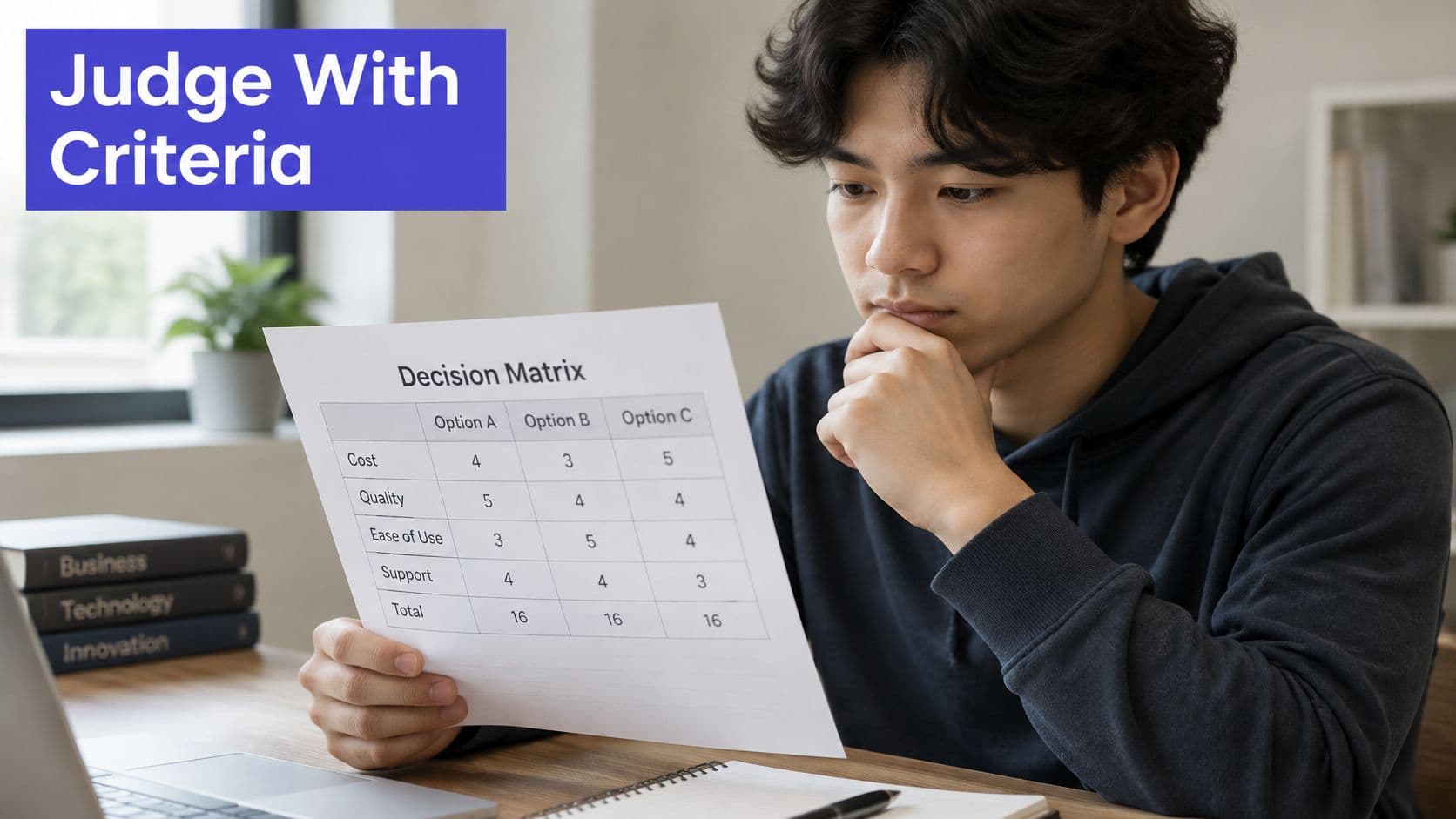
Model the criteria-building with a think-aloud before students attempt it alone, because most of them have never watched anyone decide what counts as "good." For struggling students, supply the criteria and a decision matrix to score each option, which keeps the cognitive load on applying standards rather than inventing them. The reasoning goal stays the same. Only the entry point changes.
Advanced students should then attack their own matrix. Ask, "Where might this matrix mislead you?" Equal weighting is usually the flaw, and catching it is real evaluation.
Score with three columns, criteria clarity, evidence use, and counterargument quality. If you want the verbs aligned to the level you're targeting, this guide to Bloom's Taxonomy verbs is a handy check while you write the rubric. Kuraplan's rubric generation gives you a workable starting draft for judgment tasks, and you can tighten the criteria language for your class. On paper, the conversion is simple. Print the matrix, require one sentence per score, and end with "I would change my mind if."
5. Design and Create a Solution Questions
Creation sits at the top of the revised taxonomy for a reason. That revision, published in 2001, turned the categories into active verbs and placed Create above Evaluate, as summarized in the history of Bloom's Taxonomy. But making something isn't automatically creating. A poster copied from the textbook is decoration, not design.
Strong design prompts have three ingredients, a real audience, firm constraints, and a way to test the result. Try this in science, "Design a shelter that keeps an ice cube from melting the longest using only classroom materials. What did your tests show, and what would you change?" In social studies, "Create a proposal for a new park serving three different community groups. How did you balance their needs?" In ELA, "Write an alternate ending that changes the outcome of the central conflict, and justify each plot choice with evidence from the text."
The scaffold that matters most is the written design rationale beside the product. Give struggling writers a four-line frame covering the problem, the choice, the reason, and the test. They still design. They just don't have to invent the explanation format at the same time. Set one or two hard constraints, such as budget or materials, because unlimited choice produces unfocused work.
This short clip is useful for showing students what a test-and-revise cycle looks like in practice before they start.
Stretch advanced students with a mid-project checkpoint where they must revise based on feedback and document what changed and why. Score content accuracy, feasibility under the constraints, and quality of the rationale separately, so a polished product with thin reasoning doesn't earn full credit. Kuraplan can draft the project brief and rubric together, and you adjust the reading level and constraint list for your group.
6. Hypothetical and Counterfactual What If Questions
Change one condition and see if students can still run the system in their heads. Counterfactuals sit between analysis and creation, because a student has to understand how the parts connect before predicting what a change would do. They're also your fastest check for surface learning. A student who memorized the carbon cycle can label it. Only a student who understands it can break it.
Prompts Across Subjects
- Biology: "What would happen to the carbon cycle if all decomposers disappeared from a forest ecosystem?"
- History: "What if the Allies had lost the Battle of Midway? Which later events would most likely have changed?"
- Math: "What happens to the mean and median if the largest value is removed? Which measure changes more?"
Require every student to state one assumption their prediction depends on. That's the move that makes reasoning visible and stops the guessing game, because an assumption can be examined in a way an opinion can't. For scaffolding, change one small variable first and give students the first step of the chain, then let them continue it. Oregon and Ohio guidance makes a similar distinction, describing higher-cognitive questions as those requiring students to manipulate information rather than recall it in Ohio State's research-based questioning strategies for teachers.
For a stretch, widen the scale of the change or add a time dimension, asking for short-term and long-term effects separately. Students who can predict both, and explain why they differ, are doing genuinely complex work.
Score the causal chain, the stated assumption, and the use of content evidence. Don't award marks for a confident conclusion with no mechanism behind it. As a worksheet item, this converts neatly into a prediction table with columns for immediate effect, later effect, and evidence. Kuraplan's AI teaching assistant is remarkably useful here for brainstorming counterfactuals for a specific unit when you're planning at ten at night.
7. Error Analysis and Find the Flaw Questions
Hand students a wrong answer and ask them to explain it. To do that well, they have to understand the correct process thoroughly enough to see exactly where the incorrect one departs from it. That diagnostic work is analysis at its most practical, and it builds the checking habit that pure practice problems don't.
The math version is the clearest. "Maya solved 3(x + 4) = 21 by writing 3x + 4 = 21. Explain her error, then solve correctly." In ELA, "This thesis claims a character is 'good.' Which part is too vague, and how would you sharpen it?" In science, "A student concluded the plant grew taller because of blue light. What other variables might explain it, and what control would you add?"
Building Errors That Teach
- Use real mistakes: Pull errors from last year's assessments, because invented ones rarely match what your students actually think.
- Hide a correct one: Include one sound solution among the flawed ones so students must evaluate instead of assuming everything's broken.
- Name the misconception: Have students write a short mistake note explaining the thinking behind the error, not just the fix.
Scaffold by telling struggling students which line contains the error, then let them explain it. You've lowered the search demand without lowering the reasoning demand. For advanced students, give them an answer that's numerically right but justified with faulty logic, and ask whether it deserves full credit.
Score detection, explanation of the underlying misconception, and the corrected version as separate points. Explanation should carry the most weight, since that's the higher-order part. Kuraplan can generate worked examples and multiple-choice distractors, which saves real time when you're building a set of flawed solutions for a single concept.
8. Socratic Assumption-Probing Questions
Sometimes the best question isn't the one you open with. It's the follow-up. "What do you mean by that?" "What's your evidence?" "What would someone who disagrees say?" Socratic probing teaches students to test a claim against logic, evidence, and competing viewpoints instead of defending the first thing they said.
In literature, try, "You said the protagonist is selfish. What would a character who loved him say about that choice, and which details would they point to?" In civics, "You argued voting should be mandatory. What assumption about citizenship does that rely on, and would it hold if enforcement changed?" In science, "You said the experiment proved the hypothesis. What else could explain the result, and what data would rule that out?"
Keep a card of six or seven stock follow-ups on your desk. "What would change your mind?" and "How does that connect to what she just said?" will carry most discussions. Then protect the thinking time, because probing fails without it. Students generally need at least 3 seconds to process and begin speaking while teachers typically allow less than 1 second, according to the Illinois Center for Innovation in Teaching and Learning questioning strategies page.
Practical rule: Ask the question, count silently to five, and resist rephrasing. Rephrasing tells students the first version didn't really need an answer.
Scaffold with a few minutes of silent writing before discussion, so quieter students arrive with something ready. Assign roles such as questioner, summarizer, and evidence checker. If you're structuring a full seminar, this Socratic seminar guide lays out roles and norms you can lift directly. Score use of evidence, responsiveness to others, and willingness to revise, not airtime. Kuraplan's AI teaching assistant can suggest follow-ups for a specific text when your own list runs dry.
How the eight higher order question types compare at a glance
Use this table as a planning shortcut. Find the row that matches the thinking your unit needs, and the scaffolding note tells you where to start with students who aren't ready for the full version yet. Stretching works the same way in reverse: remove the scaffold, add a second text or variable, and let advanced students set their own criteria.
| Item | Bloom's Level | Scaffolding Note | Best Subjects | Best Assessment Use |
|---|---|---|---|---|
| Cause-and-Effect Chain Questions | Analyze | Start with two-step chains ("What happened because of X?"), then extend to multi-cause maps | History, science, literature | Assess causal reasoning and links between events |
| Compare and Contrast Questions | Analyze | Supply the criteria at first ("compare cost and durability"); older students choose and defend their own | Social studies, science, math, ELA | Assess use of comparison criteria and interpretation |
| Source and Evidence Evaluation Questions | Evaluate | Walk one shared source through a reliability check together before students compare conflicting accounts | History, science, ELA | Assess source reliability, evidence, and justification |
| Criteria-Based Judgment Questions | Evaluate | Co-build the rubric first; students judge only after they can restate each criterion | Math, science, civics | Assess evidence-based decisions and trade-off reasoning |
| Design and Create a Solution Questions | Create | Cap the scope: one constraint and one revision round beats an open-ended project | Science, social studies, ELA, STEAM | Assess application, design reasoning, testing, and revision |
| Hypothetical and Counterfactual 'What If' Questions | Analyze / Create | Anchor the scenario to known content and change one variable, never three at once | Science, history, economics, literature, math | Assess prediction, system understanding, and reasoning |
| Error Analysis and 'Find the Flaw' Questions | Analyze | Begin with worked examples carrying one planted error; advance to flawed student work | Math, ELA, science | Assess misconception diagnosis and correction |
| Socratic Assumption-Probing Questions | Evaluate | Have the speaker restate their own assumption before the class challenges it | Literature, civics, science | Assess reasoning, evidence use, and response to alternatives |
One conversion routine works for every row. Take the question type, write one prompt tied to tomorrow's content, attach the scaffold as a worksheet hint, and write the stretch as an extension line at the bottom. Score against the column on the right, and your rubric writes itself.
Pick One Question Type and Use It This Week
Eight question types is a starting menu. On Monday you need one that fits the unit already on your board. Choose cause-and-effect chains if your history or science students list events without connecting them. Choose error analysis if your math students nail the procedure until the format shifts slightly. Write three prompts, and for each one build a scaffold version and a stretch version. That gives you a working set instead of a wish list.
Plan for the true cost. Higher-order questions take longer to answer, longer to score, and longer to discuss than recall prompts, so you will cover fewer items per lesson. Some days that feels like falling behind. The international picture suggests the trade is still worth weighing. In the OECD's PISA 2022 creative-thinking assessment, 78% of students on average reached at least Level 3 while only 27% reached Levels 5 or 6 as top performers, as reported in the OECD PISA 2022 Results Volume III report. Most students can produce an appropriate idea. Far fewer produce an original, well-supported one. That gap is a reason to practice original, supported thinking deliberately, and question design is one lever you control in every lesson, though many factors sit behind results like these.
Two mechanics carry most of the load, and teachers skip both under time pressure. The first is wait time. Guidance from the New South Wales Department of Education notes that higher-cognitive questions may benefit from 10 seconds or more, compared with about 3 seconds for lower-cognitive ones, in its key questioning strategies for teacher questioning. Ten seconds of silence feels endless. Give it anyway, and put paper or a whiteboard in front of students so the time produces something visible. The second mechanic is a follow-up that asks for evidence or criteria, because that is what turns an opinion into reasoning you can score.
Difficult and higher-order are different properties. A punishing recall question about an obscure date still only asks for retrieval, while a short question about which of two explanations fits the data asks for evaluation. The peer instruction guide on question structure and purpose lays out that gap between the thinking a question appears to demand and the thinking it actually produces. Before you teach a prompt, run one diagnostic: could a student answer it well without reasoning? If so, add the evidence requirement, the criteria, or the assumption check.
Keep teaching lower-order questions alongside the harder ones. Students cannot evaluate evidence they never understood, and they cannot design solutions around content they never learned. A controlled biology study found that practicing higher-order clicker questions improved students' performance on later low-order exam questions but not on higher-order ones, as described in the study of high-order cognitive skill clicker questions. Read that practically. Deeper prompts reinforce foundational knowledge, and they still leave students needing explicit content teaching plus targeted practice with complex tasks. Sequence beats the label on any single question.
Hold the intellectual demand constant across the room and vary everything else. Vocabulary previews, chunked evidence sets, sentence frames, think time, and oral or written response options can all sit around the same core judgment. Differences in student abilities and limited instructional time are named as major implementation challenges in teacher research on higher-order questioning, so design for them in advance rather than hoping they resolve themselves. Rigor means support that leaves the thinking with the student.
Then run every prompt through the same conversion routine: write the stem, list what a strong answer must show, draft the scaffold and stretch versions, and decide how you will score it. Start with one class set and a three-column rubric. Accurate or not, evidence present or missing, reasoning connected or asserted. Score it, find where the reasoning broke down, and fix the scaffold instead of dropping the question type. Add a second type next unit once the first runs smoothly. Kuraplan can handle the drafting stage with standards-aligned prompts, leveled worksheet versions, and matching rubrics, which puts your planning time on the follow-ups. You decide which questions your students are ready to think through. That judgment is the teaching.
If building scaffold and stretch versions eats your planning period, Kuraplan generates standards-aligned higher order thinking questions, worksheet versions at different reading levels, and matching rubrics for your current unit. Print a set, adjust the wording for your room, and spend the saved time on the follow-up questions that push students past their first answer.