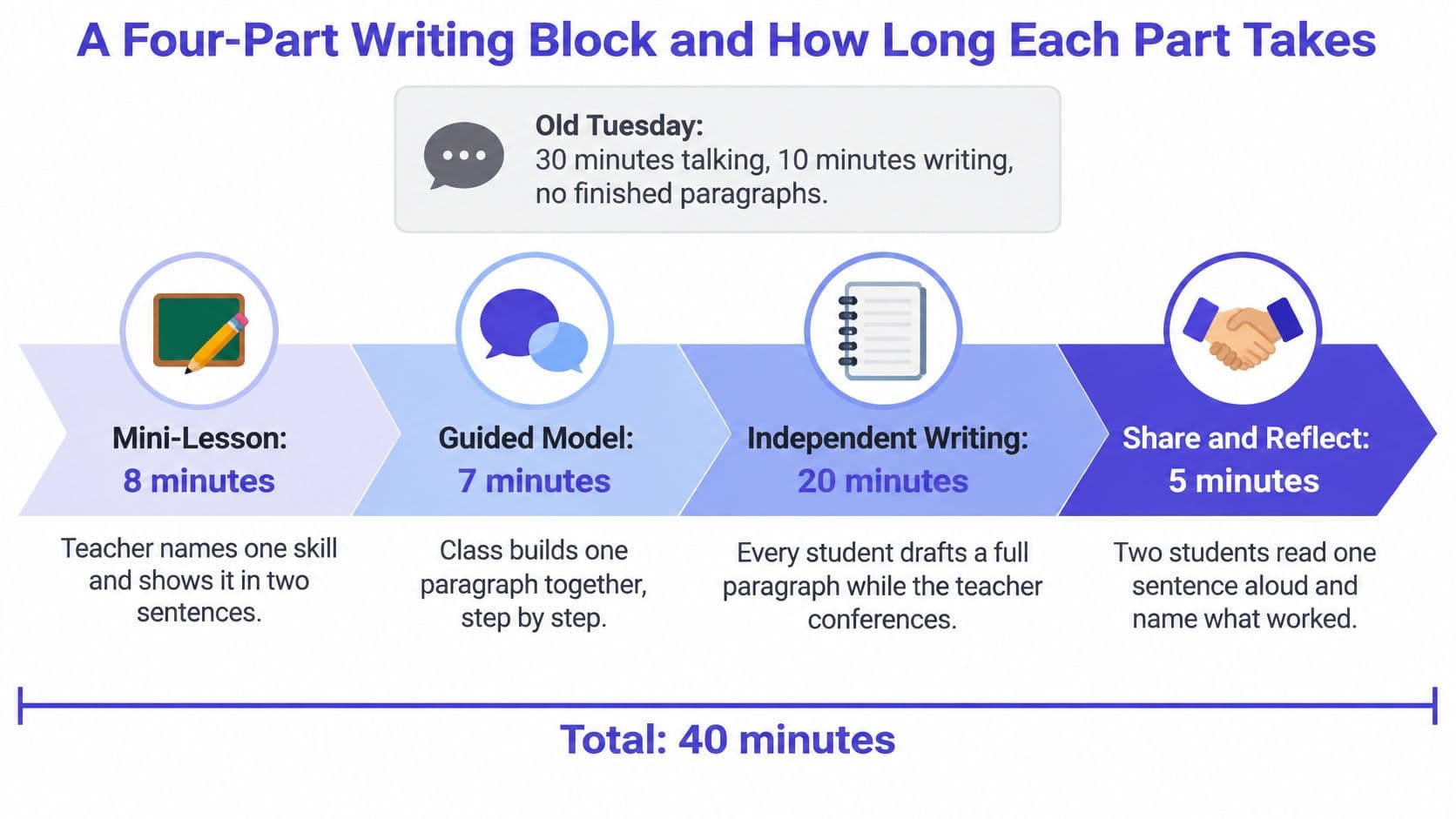
It's Tuesday. You've talked for thirty minutes about strong paragraphs, students have ten minutes left to write, and nobody finishes one. The problem isn't necessarily motivation: you've used most of the writing time explaining writing.
Knowing how to teach writing means deciding what students will practise, showing them how, and then getting out of the way long enough to see what they can do.
A Four-Part Writing Block and How Long Each Part Takes
Build the block around a single skill, not a complete tour of good writing. If today's target is explaining evidence, save introductions, vocabulary upgrades, and comma rules for another lesson.
Use these as planning ranges, not research-prescribed timings. Choose within them to fit your timetable, and shorten teacher-led work before cutting independent writing.
Writing block components and minutes by grade band
| Component | What the teacher does | K–2 (min) | 3–5 (min) | 6–8 (min) | 9–12 (min) |
|---|---|---|---|---|---|
| Mini-lesson | Models one skill with a think-aloud | 5–8 | 10–12 | 12–15 | 10–15 |
| Guided practice | Co-writes or revises with the class or a small group | 5–8 | 8–10 | 10–12 | 10–15 |
| Independent writing | Students draft or revise their own work | 15–20 | 20–25 | 25–30 | 30–40 |
| Conferencing and sharing | Short one-to-one talks, then 2–3 students share | 5–10 | 10–15 | 10–12 | 10–12 |
During the mini-lesson, name the move and demonstrate it aloud. Guided practice asks students to make that same decision with you; it shouldn't become another lecture with occasional hands raised.
Independent writing gets the largest share because students need to apply the skill to their own ideas. Circulate, read over shoulders, and ask a student to explain a choice instead of interrupting everyone with another announcement.
For a shorter lesson, this example compresses the structure into a forty-minute block.
Protect the writing time
For K–2, try splitting a shorter block into two fifteen-minute sessions rather than expecting sustained seatwork. Use the first for modeling, oral rehearsal, and beginning a draft; return later for more writing and sharing.
I would protect conferencing before adding another whole-class explanation. Aim to meet four or five students during a ten-minute stretch of independent work, carrying a sticky-note checklist with one goal beside each name.
Conference rule: Leave the student with one next move, not a catalogue of everything that's wrong.
Keep writing folders ready with a stuck list: reread the last sentence, say the next idea aloud, consult the model, or sketch the idea. Display a timer, and make finishing mean moving to the next step in the draft, not earning free time.
Which Writing Practices Have the Strongest Evidence
The grammar finding should change Monday's lesson planning. In Steve Graham and Dolores Perin's 2007 meta-analysis of writing interventions for Grades 4–12, isolated grammar instruction averaged an effect size of −0.32; across 154 effect sizes, strategy instruction and summarization led at 0.82 each, followed by peer assistance at 0.75, explicit product goals at 0.70, word processing at 0.55, sentence combining at 0.50, and prewriting and process writing at 0.32 each.
An effect size expresses the average difference between intervention and comparison outcomes in standardized units. The leading estimate is substantial in educational terms, but it isn't a percentage gain or a promise about your class.
The practical distinction is between teaching a decision and assigning an activity. A planning sheet can help students organize reasons, but handing it out doesn't teach them how to reject a weak reason or choose evidence.
Turn the ranking into teaching moves
- Make strategies visible. Model how to plan, test paragraph order, revise meaning, and check sentences. Leave a usable routine students can follow without waiting for you.
- Teach summarization deliberately. Ask students to identify the central idea, select essential details, and remove repetition. Copying the opening sentence isn't summarizing.
- Give peers a precise job. During revision, have the partner underline the reason and point to the evidence supporting it. Replace broad requests for feedback with something a reader can verify.
- Post a product goal. Before drafting, specify what successful work must contain, such as an explanation connecting evidence to a claim.
Prewriting and process writing provide a useful structure, but the structure isn't the instruction. Students can complete every box on an organizer and still produce an unsupported argument.
Word processing removes some friction from changing text. It doesn't decide which paragraph needs moving or whether the evidence is convincing.
Keep grammar, change its placement
The negative grammar result doesn't mean conventions don't matter. It cautions against making disconnected drills the central route to better composition.
Teach a sentence boundary when students need to separate tangled ideas in their drafts. Teach sentence combining by comparing alternative versions and discussing which relationship each version communicates.
Before adding another activity, check whether students already receive explicit strategy teaching, focused peer assistance, and a clear product goal. Include summarization when understanding source material is part of the task.
A lively activity earns its place when students use it to make a better writing decision. Engagement alone isn't enough.
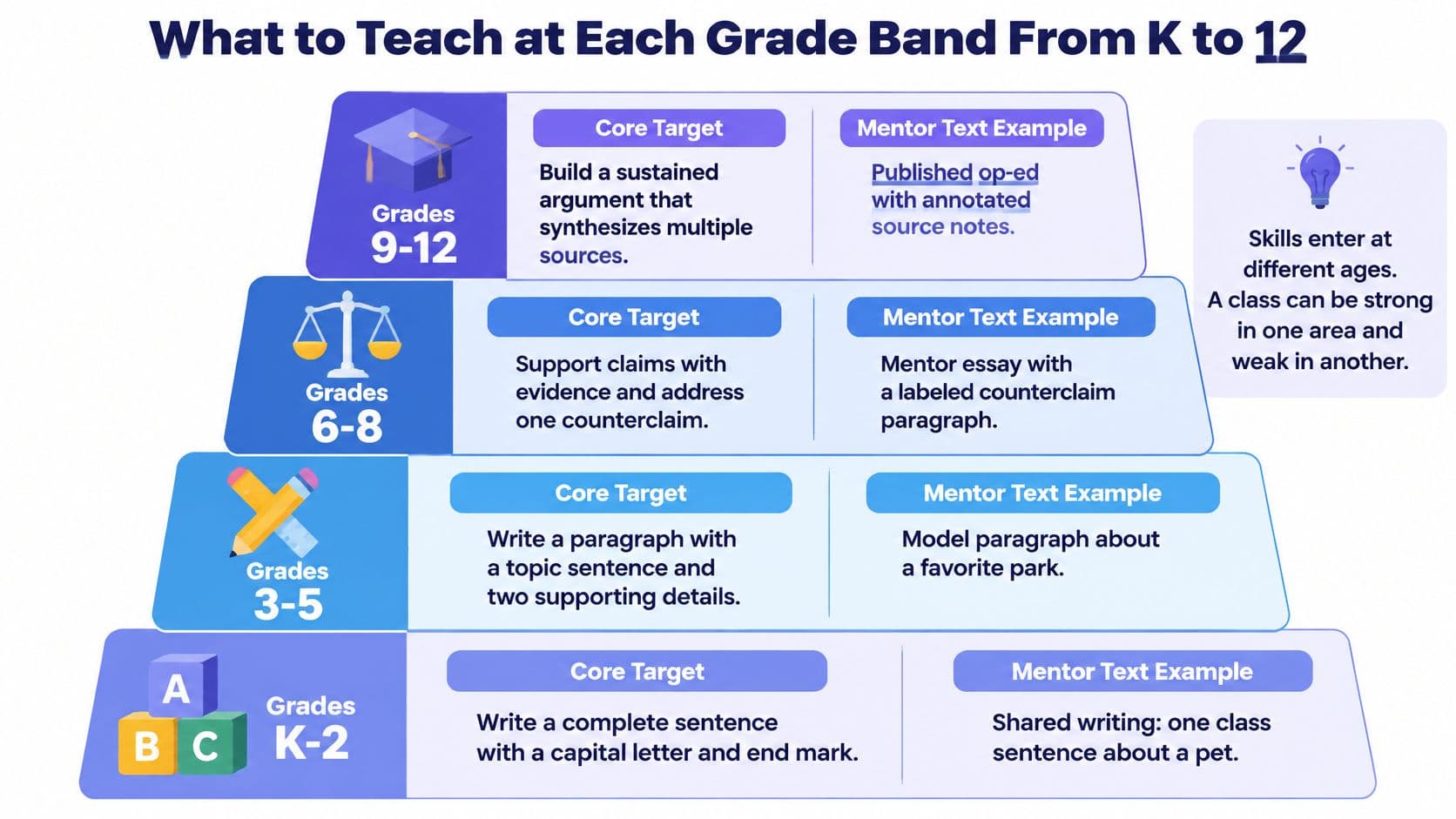
What to Teach at Each Grade Band From K to 12
Writing isn't a single ladder with a tidy rung for every grade. A student can explain complex ideas aloud while struggling to form sentences, or write fluent paragraphs that contain very little reasoning.
Use these targets to choose instruction, not to label students permanently.
Writing targets, mentor texts and common mistakes by grade band
| Grade band | Core target | Mentor text to use | Mistake to avoid |
|---|---|---|---|
| K–2 | Label a picture, then write 2–3 linked sentences about one topic | Class shared writing and picture books with repeated patterns | Correcting every spelling error before the child finishes the sentence |
| 3–5 | Topic sentence, two reasons with details, closing sentence | Short model paragraphs from kids' magazines, annotated by the class | Teaching the five-paragraph essay as a fixed form before paragraph structure is solid |
| 6–8 | Claim with reasons and evidence, organized by importance | Editorials and student exemplars with the moves labeled | Treating citation format as the lesson instead of the reasoning behind it |
| 9–12 | Argument with counterclaims, analysis of evidence and sustained revision | Published opinion essays and speeches, with a paragraph-by-paragraph map | Grading only the final draft and skipping the revision evidence |
The broad progression is useful, provided students can return to an earlier skill without being given younger ideas.
Match the routine to the bottleneck
The 2012 elementary writing meta-analysis found average effect sizes of 1.02 for explicit strategy instruction, 0.89 for peer assistance, 0.76 for explicit product goals, and 0.30 for extra writing practice. More writing helps, but merely extending the assignment is a weaker response than teaching students what to do differently.
In K–2, handwriting and spelling deserve direct attention because effort spent producing letters leaves less attention for composing. Practise formation separately, then let children use those skills to communicate something worth saying.
In Grades 3–5, move from a shared paragraph to an independently planned one. Fade the paragraph frame when students can select relevant details without copying the model's sentence pattern.
Teach the missing argument move
Say a seventh grader argues for a later school start, supplies three sensible reasons, and never considers transport or family schedules. The next lesson isn't another full essay: it's a paragraph that acknowledges a competing priority and explains why the claim still holds.
Offer a temporary frame: A reader might object that… The stakes are that… However… Remove it when students can express the relationship in their own language.
For Grades 9–12, expect sustained revision across drafts, including replacing evidence or reorganizing an argument. Fade teacher checkpoints as students begin identifying those needs themselves.
Don't move a class to harder assignments just because its sentences sound polished. Check ideas, organization, conventions, and audience awareness separately.
Rubric Scores and Rules for AI Help
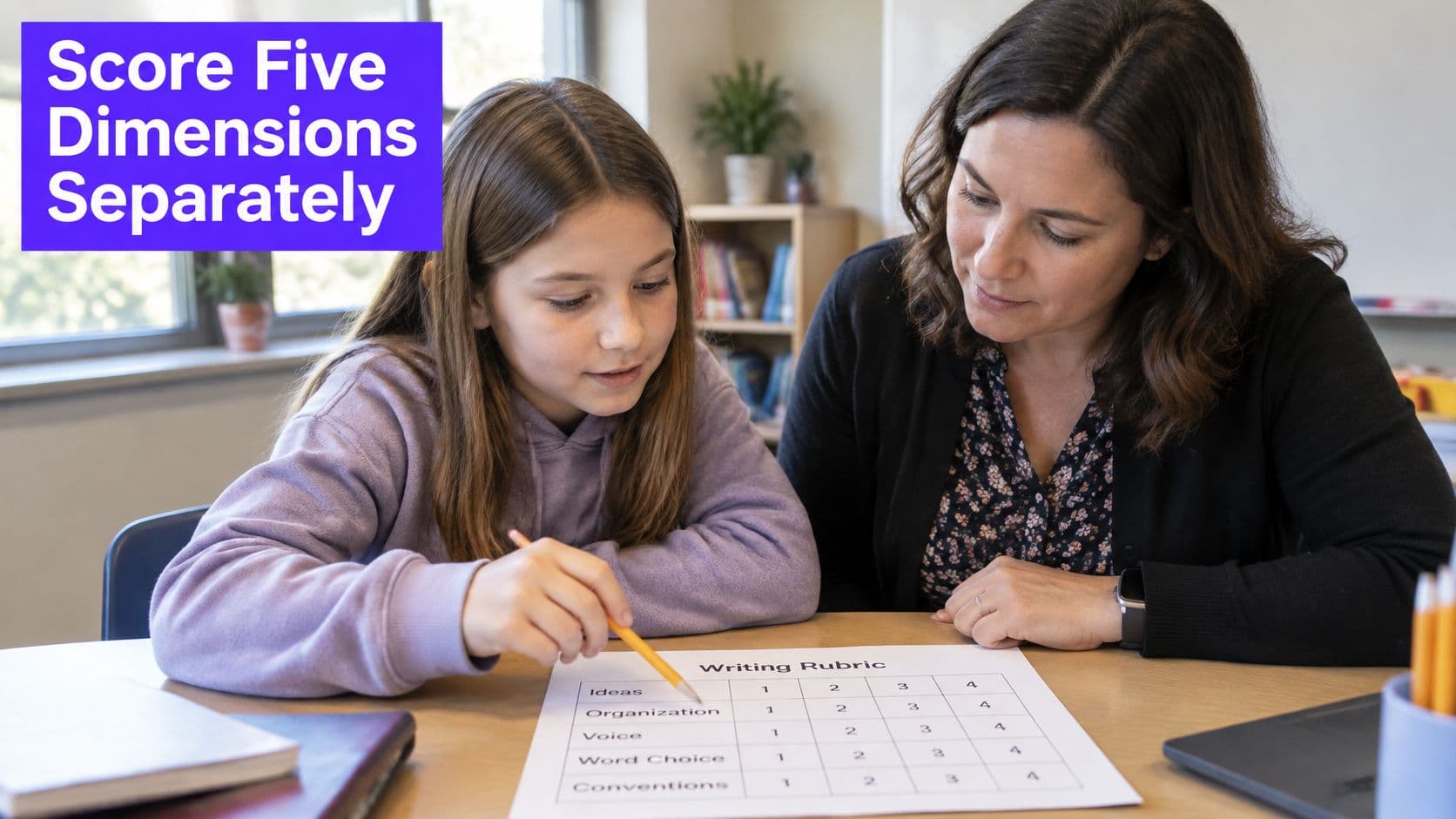
The rubric decides what you can see. Combine everything into a single impression and a student's spelling can hide strong ideas, while fluent sentences can conceal weak reasoning.
Score the dimensions separately, using the descriptions below as anchors. Write intermediate descriptors before grading, rather than deciding what they mean halfway through the stack.
Writing rubric descriptors for strong and developing work
| Dimension | Score 4: strong | Score 2: developing |
|---|---|---|
| Ideas | Clear claim, specific reasons, relevant details | Vague claim, reasons that repeat each other |
| Organization | Each paragraph has one job; transitions show the logic | Paragraphs blur together and the order feels random |
| Sentence fluency | Varied sentence length and openers, no run-ons | Repetitive openers or fragments in most paragraphs |
| Conventions | Errors don't block meaning and most are caught in editing | Errors interfere with meaning or repeat across the piece |
| Audience awareness | Anticipates a reader's question or objection | Written as if the reader already knows everything |
Use a rubric generator to draft descriptors, then adjust them for the genre and students' developmental level.
Keep the rubric visible during conferences, not just at grading time.
Check the work behind the score
Aim for formative checks that take under two minutes. Use an exit ticket asking students to state their claim, identify evidence for their first reason, and name today's change; in conferences, ask them to show a revised sentence and explain the decision.
Have students date changes in a revision log. If you're considering automated scoring, Humantext.pro's explanation of how AI essay grading works offers useful context for deciding what still needs teacher judgment.
Set boundaries by grade band
A 2025 systematic review of 14 empirical studies identified potential support for ideation, organization, and language development when students retained decision-making, but also noted short studies and limited evidence outside EFL contexts. That isn't grounds for promising lasting writing gains.
I recommend these classroom boundaries:
- K–5: No generated draft text. Permit only teacher-approved vocabulary support and examples.
- 6–8: Allow brainstorming questions, with prompts logged and rejected suggestions explained.
- 9–12: Allow feedback on an existing draft, requiring source checks for factual claims and an oral defense of a paragraph.
Require a process log for any AI use and offer a non-AI route using peer questions or teacher feedback. Assess reasoning, revision decisions, and ownership, not just polish.
How to Run a Gradual-Release Mini-Lesson
For Grade 4, use this objective: Support a claim with two reasons, each backed by one piece of evidence. Prepare a short mentor paragraph and a source sheet about an accessible school issue, such as creating a quiet reading area.
The Institute of Education Sciences elementary writing guide recommends explicit teaching of writing strategies and gradually transferring responsibility to students. In practice, gradual release of responsibility means students take over the decisions you first demonstrate, not merely copy your finished paragraph.
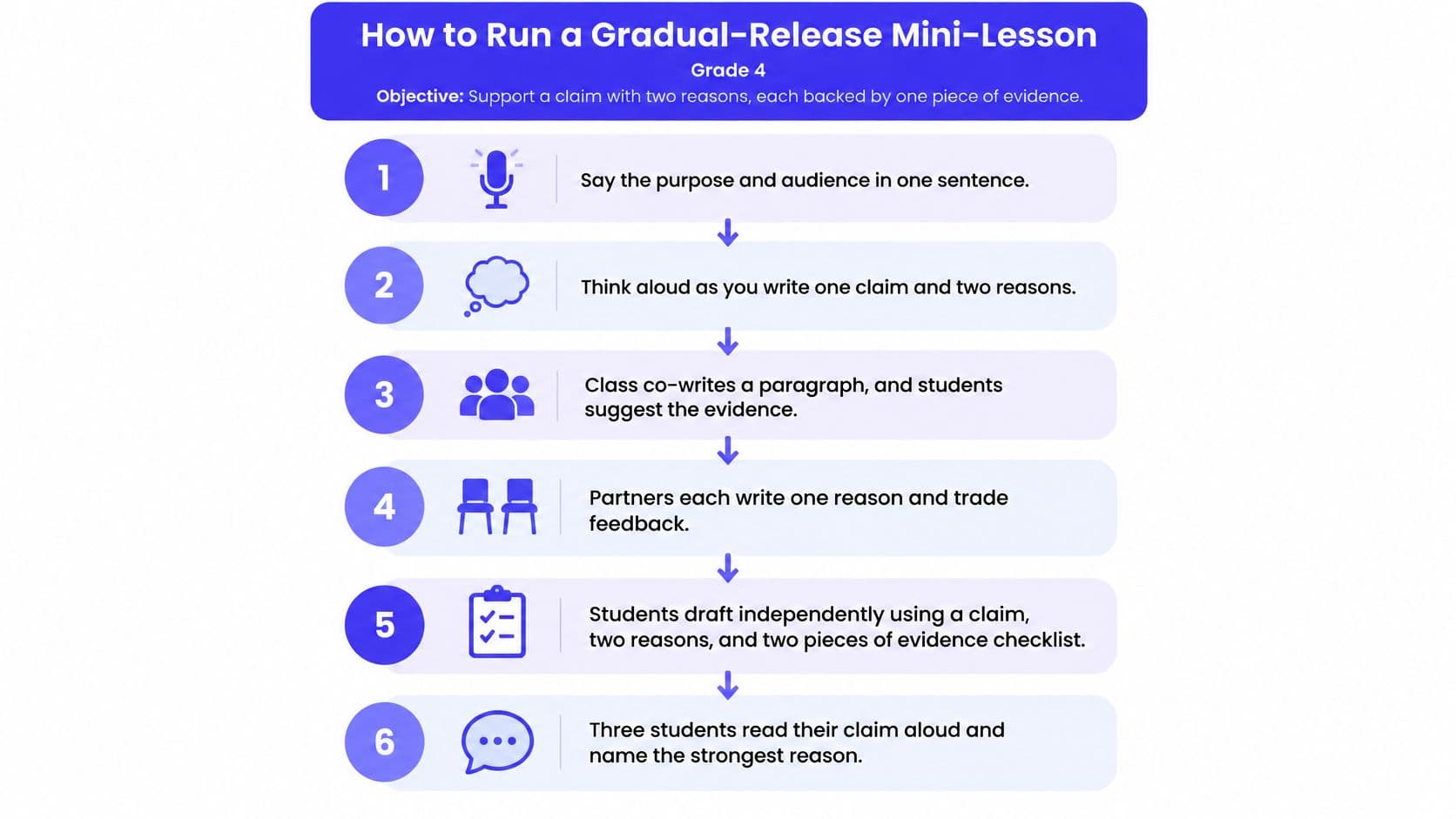
This visual offers a compact version of the lesson sequence.
Model the choice, then hand it over
State purpose and audience. Put this on the board: We're writing to persuade the principal to create a quiet reading area. Naming a real reader helps students choose relevant reasons instead of collecting anything they like about reading.
Read the mentor paragraph aloud. Point out a reason followed by evidence, then ask students what the evidence helps the reader believe; don't annotate every feature of the paragraph.
Think aloud while planning. Say: My reader will ask why we need this space. My first reason is that students need somewhere to read without interruptions; now I need evidence from our source sheet. Cross out It would be nice because it expresses a preference without explaining a benefit.
Co-construct a second paragraph, letting students vote on the reason before you write it. Ask them to nominate supporting evidence, and briefly have partners explain whether it truly fits; accept the stronger match, not the most popular suggestion.
Release students to draft for fifteen to twenty minutes. Provide a three-line checklist: state the claim; give two reasons; support each reason with evidence. Students can draft a compact argument paragraph before expanding its reasons into separate paragraphs later.
Revise meaning before editing conventions. Ask students to draw a line from each piece of evidence to its reason; when they can't explain the connection, send them back to the plan to replace the evidence or change the reason.
Share and assess. Read a volunteer's paragraph and apply only the ideas and organization descriptors. Let the writer explain a choice before classmates suggest a change, then have everyone identify their own next revision.
A planning tool can draft this lesson's skeleton, but the think-aloud decisions must be yours. Prepare an imperfect reason deliberately: a flawless demonstration hides the very thinking students need to learn.
Use the video as an additional teaching resource, while keeping the live demonstration tied to your class's actual text.
End with evidence of learning
Use a three-question exit ticket: What is your claim? Which evidence supports your first reason? What did you change, and why? Sort responses by the next teaching need, not just completion.
Finishing a draft doesn't close planning. If the evidence changes the argument, students need permission to reopen the plan.
Treating the stages as a checklist completed once produces compliance, not independence. The useful lesson is knowing when to return to an earlier decision.
Supporting English Learners and Students With Disabilities
Extra time and speech-to-text can remove barriers, but neither teaches a student how to develop a reason. Keep necessary accommodations while explicitly teaching the composing strategy.
In a 2025 survey of special-education teachers, only about one-third of 336 respondents had completed an undergraduate course in writing instruction. Teachers need usable routines and model scripts, not another broad direction to differentiate.
Writing supports by learner need and when to fade them
| Learner need | Support in the mini-lesson | When to fade it |
|---|---|---|
| Emerging English learner | Sentence frames, a word bank and two minutes of oral rehearsal before drafting | After three unassisted sentences with varied openers |
| Developing English learner | Annotated model with transitions highlighted, plus a paragraph organizer | Once the student plans two pieces in a row without the organizer |
| Language-based learning disability | Strategy cards with one step each, plus speech-to-text for drafting | When the student self-checks with the card correctly in two conferences in a row |
| Dysgraphia or motor difficulty | Typed or dictated drafts and a scribe for planning | When handwriting is fluent enough for short notes; keep typing for long drafts |
| Reading well below grade level | Read-aloud of the mentor text with the same grade-level ideas | When the student reads the model independently and names its key moves |
These are proposed classroom checkpoints, not automatic withdrawal rules. Fade instructional prompts when students demonstrate independence; don't remove an access accommodation just because their reasoning improves or they use a checklist successfully.
Change access without lowering the ideas
For English learners, pre-teach the prompt's academic words, such as justify, compare, or evidence. Have partners rehearse the opening sentence before drafting, while keeping the same intellectual task as the rest of the class.
For a student with a language-based learning disability, use a strategy card with observable actions: state the claim, name the reason, add evidence, check the connection. Separate step cards can introduce the routine; combine them into a compact card as the student becomes familiar with it.
Use differentiation teaching strategies to plan support and its removal before the first lesson. Otherwise, an organizer can become permanent because nobody scheduled a chance to write without it.
Record what the student can explain
Report idea quality separately from transcription and spelling. For monthly progress checks, track a small set of indicators: explaining a reason in their own words, selecting relevant evidence, and noticing an unsupported statement.
The fade-out test is transfer: can the student perform the move on a new topic without the instructional prompt? If so, the scaffold has done its job.
Pick One Unit and Run It for Two Weeks
Don't rebuild the entire writing curriculum this weekend. Choose a manageable objective and prepare enough connected practice to see whether students can use it independently.
Turn the objective into reusable materials
Pick the target. Choose an objective suited to the grade band, then narrow it to the weak point in students' work. Explain how evidence supports a reason is more teachable than write a strong essay.
Build the four-part block around that decision. Prepare the model, a guided attempt, independent writing time, and a conference prompt before adding extension activities.
Convert the mentor text into a worksheet. Use six questions: three multiple-choice items identifying craft moves, two short answers explaining the writer's choices, and one revision task applied to the student's own paragraph. Avoid questions students can answer without reading the text.
Turn the exit ticket into a three-item Friday quick check. Change the topic or example so students demonstrate the skill rather than remember yesterday's wording.
Attach the rubric before drafting. Highlight the dimensions this unit targets. Students should know what you're looking for before they submit the work.
Save the unit for next year, replacing the mentor text while retaining the useful sequence. Keep notes about where students needed more support so reuse doesn't mean repeating an ineffective lesson.
Kuraplan is one option alongside a shared planning document and teacher-made templates: it can build a standards-aligned plan from a topic and grade, convert a saved plan into a worksheet in one click, and offer differentiation for English learners and students with IEPs. Check every generated question against the actual mentor text, especially answer keys and explanations; generic examples make weak worksheets.
Run the unit for two weeks, then compare an early sample with a fresh independent piece. Check which rubric dimension moved least, inspect the specific difficulty, and make that dimension the focus of your next lesson.
Kuraplan offers standards-aligned writing lessons, worksheets, and assessment rubrics you can adapt to a clear skill target. Visit Kuraplan to draft your next writing unit, then bring your own mentor text, modeling decisions, and knowledge of your students.