A solid secondary lesson plan template isn't just another document to fill out. Think of it as your strategic playbook—the tool that transforms the daily chaos of planning into a clear, repeatable process.
This framework is what helps you consistently connect your activities to standards, nail differentiation, and make sure every single lesson has a clear purpose. The result? You save a ton of time and cut way down on stress.
Why a Smart Lesson Plan Template Is a Teacher's Best Friend
Let’s be honest. Teaching secondary school feels like you're constantly juggling. You've got complex subjects, a huge range of student needs, and those ever-present curriculum standards. A great lesson plan template isn't just more paperwork; it’s your command center.
It gives you a consistent structure that slashes decision fatigue. That means less brainpower spent on administrative box-ticking and more energy for the creative, fun part of teaching.
Imagine getting your Sunday nights back. Instead of staring at a blank page and starting from scratch every single week, you have a reliable system in place. This isn't about boxing you in or limiting your creativity. It’s about building a dependable framework that actually empowers it. When the core components are already there, you can focus on what really matters: crafting lessons that genuinely connect with your students.
Slashing Planning Time and Boosting Focus
The sheer scale of secondary education is mind-boggling. By 2024, there were a staggering 651.68 million pupils enrolled in secondary schools across the globe—that's a 45% jump in just two decades.
With teachers spending an average of 5-7 hours every week just on planning, a standardized template becomes a total lifeline. The right structure helps you organize your thoughts efficiently, making sure every minute of prep time actually counts. You can check out more about these global secondary education trends on Statista.com.
This is where smart tools can make a huge difference. For example, AI-powered platforms like Kuraplan are designed to help with this. They can fill out a template with standards-aligned objectives and activity ideas in seconds. Instead of hunting for resources, you're just refining high-quality, pre-built content.
A good template doesn’t create more work; it makes the work you do more impactful. It’s the difference between building a house brick-by-brick with no plan and using a professional blueprint.
Building Consistency for You and Your Students
A consistent lesson plan format is a huge win for your students, too. When lessons follow a predictable rhythm—a quick opener, some direct instruction, collaborative practice, and a solid wrap-up—students know what to expect. This routine can lower classroom anxiety and help them focus on the material instead of trying to figure out the structure of the day.
This consistency is also invaluable for things like collaboration and observations. When your whole department uses a similar template, sharing resources or covering for a sick colleague becomes a breeze. An administrator can walk in, glance at your plan, and instantly get what the lesson is all about.
Check out our article on the essentials of effective lesson planning to learn more. At the end of the day, a well-designed template is a professional tool that streamlines your workflow and makes your teaching even better.
The Core Components of a Powerful Lesson Plan Template
A truly effective secondary lesson plan template is more than just a series of boxes to fill out. It’s a strategic tool designed to guide your thinking, ensuring every minute of class time is purposeful. When you nail the core components, your template becomes a blueprint for lessons that are clear, engaging, and ready for the realities of a secondary classroom.
Forget generic headers. A powerful template creates a natural flow, starting with the big picture (your standards) and drilling down to the small, crucial details (like which handouts need copying). It forces you to think through the entire learning experience before the first bell even rings.
A well-structured template acts as your organizational backbone. Think about it—just as a winning Model UN position paper template provides a clear framework for success, a solid lesson plan template does the same for your teaching. The goal is a document that serves you, not the other way around.
To get there, let’s break down the essential sections that make a template truly work.
Anatomy of a Game-Changing Secondary Lesson Plan Template
Here’s a look at the key sections every secondary lesson plan template should have. This table breaks down what each component is, why it's so important, and gives a quick example for a 9th-grade English class to make it concrete.
| Component | What It Is | Why It Matters (And What to Include) |
|---|---|---|
| Standards | The official state or district learning requirements your lesson addresses. | Connects your lesson to the bigger curriculum map. Include the specific code (e.g., CCSS.ELA-LITERACY.RL.9-10.2) to ensure alignment and make it easy for administrators to see you're on track. |
| Objectives | A clear, student-focused statement of what learners will know or be able to do by the end of the lesson. | This is your lesson’s destination. It should be measurable and written in plain language. Example: Students will be able to analyze how an author develops a central theme over the course of a text. |
| Activities & Pacing | A step-by-step sequence of the lesson, including estimated timings for each phase. | This is the "how" of your lesson. Breaking it down into an opener (5-10 mins), instruction (15-20 mins), practice (20-25 mins), and closure (5 mins) keeps the lesson on pace and moving forward. |
| Materials & Tech | A simple checklist of everything you need for the lesson to run smoothly. | Prevents last-minute panic. List everything from handouts and markers to specific websites or the HDMI adapter you always forget. |
| Differentiation | Specific strategies to support struggling learners and challenge advanced ones. | Ensures you're teaching all students, not just the middle. Include concrete supports (e.g., sentence starters for ELs) and extensions (e.g., challenge questions for early finishers). |
| Assessment | How you will check for understanding and measure if students met the objective. | Closes the loop on your lesson. This can be informal (observing group work) or formal (an exit ticket, a short quiz). It tells you what worked and what needs reteaching. |
Building a template with these components from the start transforms it from a compliance document into your most valuable teaching assistant.
Start with Standards and Objectives
Every great lesson has to start with a clear destination. What, exactly, do you want students to know or be able to do by the end of the period? This section is non-negotiable and needs two distinct parts.
- Learning Standards: This is where you connect your lesson to the curriculum. Simply listing the standard (e.g., CCSS.ELA-LITERACY.RL.9-10.2) ensures you’re hitting your required benchmarks.
- Student-Friendly Objectives: This is the standard translated into plain language. An objective like, "Students will be able to analyze how an author develops a central theme over the course of a text," is crystal clear for you, your students, and any observer who walks into your room.
Getting this part right makes everything else fall into place. For a deeper dive, check out our guide on how to write clear objectives for your lesson plans.
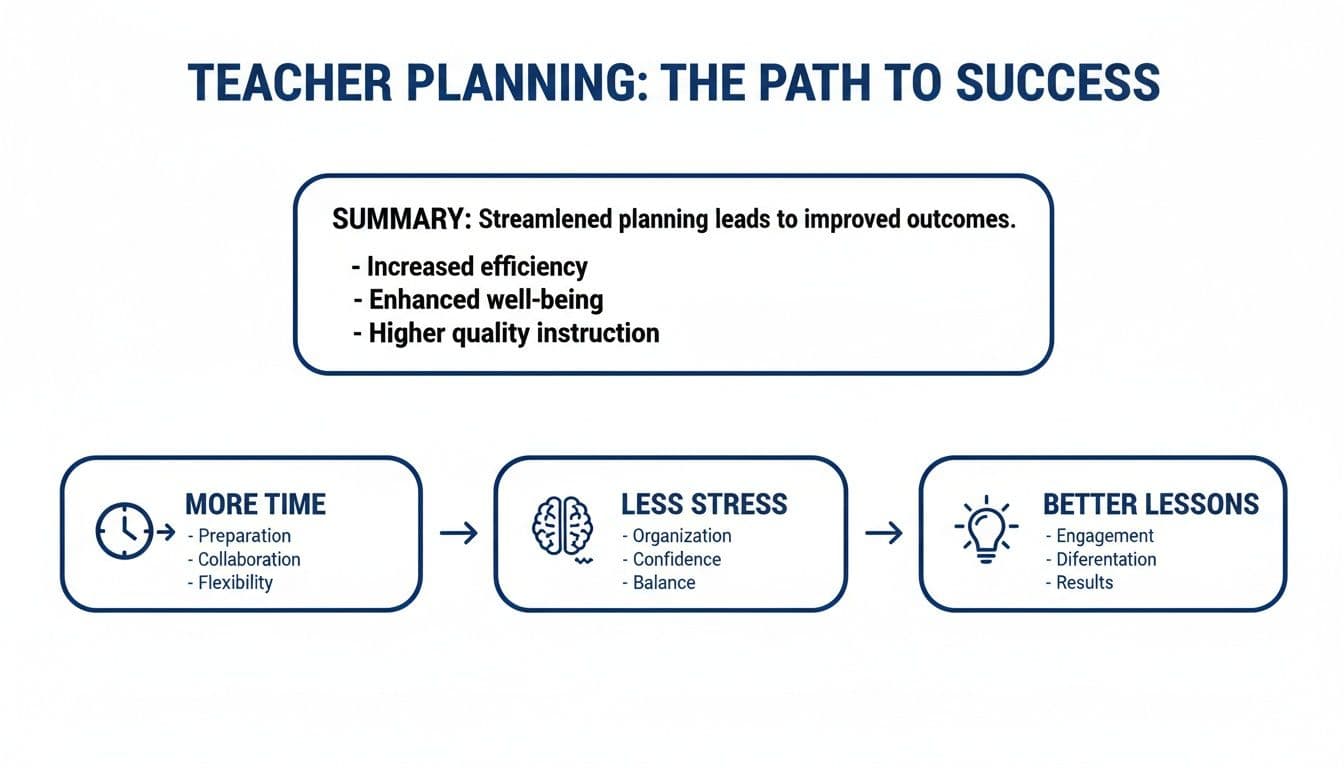
This structure is what frees up the mental space you need for creative and impactful teaching.
Outline Activities and Materials
This is the "how" of your lesson—a step-by-step sequence of what you and your students will actually do. A good template prompts you to think in phases:
- Opener/Hook (5-10 mins): How will you grab their attention and connect to what they already know?
- Instruction/Modeling (15-20 mins): What’s the core content? This could be a mini-lecture, a demonstration, or analyzing a source together.
- Guided & Independent Practice (20-25 mins): What activity will students do to apply the new skill or knowledge?
- Closure (5 mins): How will you wrap things up and check for understanding?
Next to each activity, list the specific materials and tech needed. This small step is a lifesaver, preventing those frantic mid-lesson searches for the right video link or realizing you forgot to print the exit tickets.
A great template doesn't just ask what you're doing; it asks why you're doing it and what you need to make it happen smoothly. It’s the difference between hoping a lesson goes well and ensuring it does.
Integrate Differentiation and Assessment
Finally, a powerful secondary template has dedicated spaces for differentiation and assessment. These can't be afterthoughts. By building them in from the start, you’re planning for all your learners, right from the jump.
Under differentiation, jot down specific strategies for support (like providing sentence starters for ELs) and extension (like having challenge questions ready for advanced students).
For assessment, define exactly how you'll measure the objective. Will it be a quick exit ticket, your observations during group work, or a formal quiz? This makes your teaching intentional, responsive, and far more effective.
How a Good Template Works in the Real World
A blank secondary lesson plan template is a great starting point, but let’s be real—the magic happens when you see it in action. A structured plan isn’t about boxing you in; it’s about making sure every activity, question, and assessment is laser-focused on the learning goal.
Seeing a template filled out for your own subject area is often the "aha!" moment. It's what connects abstract standards to a concrete, engaging classroom experience. Let's walk through a few examples to show how a solid template works across different secondary subjects.
A 10th-Grade Biology Lab on Cell Division
Imagine you're planning a lab on mitosis. A good template forces you to think beyond just the procedure itself and map out the entire learning arc for a 90-minute block.
- Objective: Students will be able to identify the stages of mitosis in onion root tip cells and explain the significance of each stage.
- Activities: The plan kicks off with a quick 5-minute bell ringer asking what students already know about cell growth. Next, a 15-minute mini-lesson with diagrams clarifies key vocabulary like prophase and metaphase. The bulk of the class—about 45 minutes—is dedicated to the microscope lab.
- Differentiation: The template has a dedicated spot for this. For struggling students, you've noted to provide a pre-labeled diagram. For advanced learners, you’ve planned a challenge question: "Predict what would happen if a cell skipped anaphase."
- Assessment: The closure isn't just "clean up your station." It’s a 10-minute exit ticket where students draw one stage from memory and describe what's happening. This quick check tells you exactly who got it and who needs a follow-up.
An 8th-Grade History Debate on the Constitution
Now, let's jump over to an 8th-grade U.S. History class debating the Bill of Rights. This lesson is all about critical thinking and argumentation, and the template keeps it all on track.
The objective is clear: Students will be able to construct an argument for or against the necessity of the Bill of Rights, using evidence from primary source excerpts. The plan allocates 15 minutes to analyze Federalist and Anti-Federalist quotes, 20 minutes for small groups to build their cases, and 15 minutes for the debate itself.
By building the debate structure directly into the template, you ensure the activity is more than just a chaotic discussion. It becomes a focused, objective-driven exercise in historical thinking.
The assessment is already built in. You're not grading the "winner" of the debate but each student's submitted argument outline, checking for their use of evidence.
A 9th-Grade Algebra I Lesson on Linear Equations
Even in a skills-heavy subject like math, a template provides crucial structure. For a lesson on graphing linear equations, the flow is everything.
- Opener (5 mins): A quick "Do Now" problem that reviews plotting points on a coordinate plane.
- Instruction (15 mins): You model how to graph an equation using the slope-intercept formula (y = mx + b).
- Guided Practice (20 mins): Students work in pairs on a set of problems while you circulate and give real-time feedback.
- Assessment (5 mins): A single problem on an exit ticket asks them to graph one final equation on their own.
This structure ensures you're not just lecturing for 45 minutes straight. The template prompts you to build in active participation and a quick, effective check for understanding. It also reminds you to plan differentiation, like having a pre-filled table of values for students who need more scaffolding.
Thinking through all these components can be a heavy lift, which is where AI tools like Kuraplan can shine. They can generate these lesson flows, activity ideas, and differentiated materials automatically, cutting down your prep time.
Making Differentiation and Assessment Manageable
Every secondary classroom is a mix of learners, from students who need a serious challenge to those requiring significant support. Let's be real: differentiation and assessment are often the two things that feel the most overwhelming. The good news is your lesson plan template can make them manageable, baking them right into your workflow instead of leaving them as afterthoughts.
A smart template prompts you to think about diverse learners from the very beginning. Instead of scrambling to modify a lesson at the last minute, you build in scaffolds and extensions from the ground up. This proactive approach saves time and, more importantly, leads to far more effective teaching.
Low-Prep Differentiation Strategies
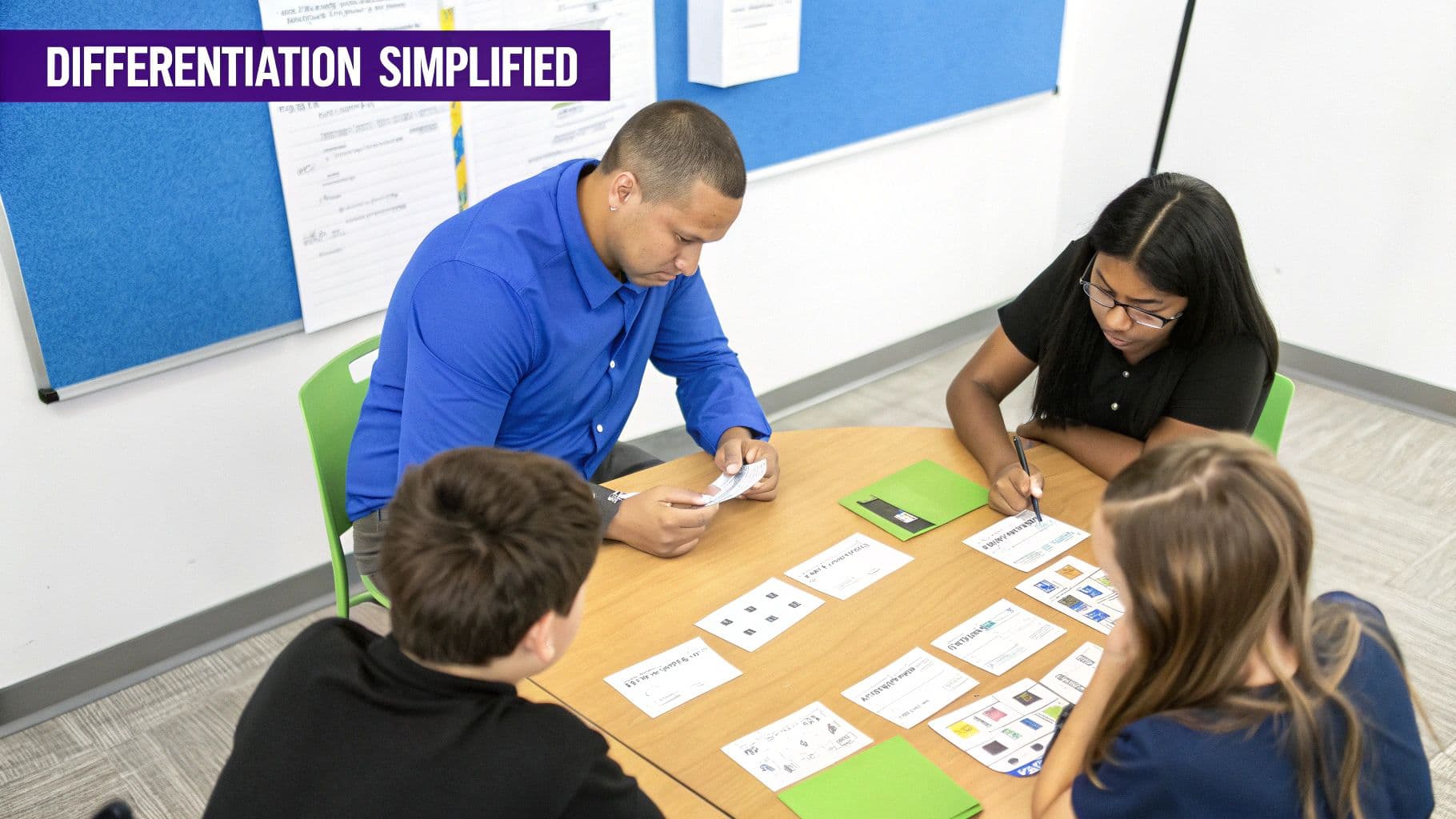
You don't need to create three different versions of every single lesson. Effective differentiation is often about providing flexible options, not just making more work for yourself. Building a dedicated "Differentiation" section into your secondary lesson plan template keeps these practical strategies top-of-mind.
Consider adding these low-prep options to your template:
- Choice Boards: Offer students a simple tic-tac-toe grid of nine activities. They choose three in a row to complete, with tasks varying in complexity and learning style.
- Tiered Questioning: Plan a few key questions for your lesson at different levels of Bloom's Taxonomy. During a discussion, you can direct recall-based questions to students who need more support and analytical or evaluative questions to those ready for a bigger challenge.
- Sentence Starters & Graphic Organizers: Have these ready for any writing or analysis task. They provide crucial scaffolding for English learners and students with processing challenges without watering down the core task.
The goal is to anticipate needs. When your template has a spot for "Support" and "Extension," you naturally start planning for the students at the edges, not just the ones in the middle.
Designing Assessments That Actually Inform
Your template should also have a clear space for assessment. This isn't just about the big test at the end of the unit; it’s about gathering real-time data to see what’s sticking and what isn't. Think of this section as your classroom feedback loop.
An assessment shouldn’t just be a grade. It should be a conversation. Your template is where you plan what questions you want to ask and how you’ll listen to the answers.
Quick, effective checks for understanding can be built right into your daily plan.
- Exit Tickets: A classic for a reason. Ask one or two focused questions tied directly to the day’s learning objective.
- 3-2-1 Summary: Ask students to write down 3 things they learned, 2 questions they still have, and 1 connection they made.
- Observe and Annotate: During group work, circulate with a clipboard or tablet and make quick notes on student progress against the lesson goals.
The need for effective differentiation is more critical than ever. While global lower secondary completion climbed to 78% in 2024, a staggering 272 million children and youth are still out of school, with wealth divides hitting 90% of countries. For special education teachers, a template with strong differentiation features is non-negotiable for meeting diverse needs. Tools that help, like Kuraplan, can generate templates with pre-built assessment rubrics and even create differentiated worksheets to support all learners. You can explore more about these global education goals and challenges from the UN.
Using Smart Tools to Supercharge Your Planning Workflow
Your secondary lesson plan template is the skeleton, but the right digital tools give it muscle. Let's be honest—the goal is to reclaim our evenings and weekends. The good news is that modern planning tools can actually make that happen, turning a tedious chore into something far more creative.
These platforms aren't just glorified word processors. They’re built to handle the thankless, time-sucking parts of our job. Think about it: how long does it take to hunt down the exact state standard you need? Or to brainstorm a genuinely engaging hook for a topic that makes teenagers' eyes glaze over? The right tools can do that heavy lifting for you.
For instance, technology can help with all sorts of classroom tasks, from automating daily plans to exploring smart tools for creating teacher lesson captions for instructional videos. It’s all about working smarter.
Automating the Administrative Tasks
The biggest time-drain in planning is usually the admin work. I'm talking about aligning every single activity to a specific standard, making sure you've baked in differentiation, and then creating assessments that actually measure what you taught. It’s a massive juggling act.
This is where AI-powered platforms can be a true game-changer. A tool like Kuraplan, for example, was designed specifically for this grind. You can plug in your topic, and it generates a complete, standards-aligned lesson plan in minutes. It doesn’t just fill in blanks; it suggests objectives, activities, and even assessment questions that fit your grade level and subject.
Instead of losing an hour digging through curriculum documents and another hour brainstorming activities, you can get a solid first draft in under five minutes. That frees you up to focus on the art of teaching—the part we all got into this profession for.
From Planning to Practice
The best tools don't just stop at the plan; they help you create the actual materials your students will use. A well-designed platform can instantly spin your lesson plan into student-facing resources like worksheets, bell ringers, or exit tickets.
This direct line from plan to materials is incredibly powerful. Imagine your lesson plan has a section on key vocabulary terms. A smart tool can automatically:
- Generate a vocabulary list with student-friendly definitions.
- Create a multiple-choice quiz to check for understanding.
- Design a simple visual aid, like a diagram or chart, to reinforce a core concept.
That kind of integration saves a ton of time. You’re no longer bouncing between three different apps to write a plan, find a standard, design a worksheet, and then create a visual. It all happens in one place. If you're curious about how this works, check out our guide on how to use AI to do lesson planning for teachers. It's about creating better, more cohesive lessons in a fraction of the time.
Common Questions About Secondary Lesson Planning
Even with a great template, a few nagging questions always seem to pop up. Let's tackle some of the most common sticking points teachers run into when trying to perfect their lesson planning process.
Getting your template just right is an ongoing project. Think of it less like a rigid form and more like a living document that grows with you. The whole point is to make it a tool that actually saves you time and sharpens your focus.
How Detailed Does My Lesson Plan Need to Be?
Ah, the million-dollar question. The sweet spot is somewhere between a roadmap and a full script. It needs enough detail for a substitute teacher to step in and get the gist, but not so much that it becomes a novel you can't possibly follow in the moment.
At a minimum, your plan should clearly lay out:
- The learning objective for the day. What will students know or be able to do by the time the bell rings?
- The sequence of activities with rough timings. A quick bell ringer, a short direct instruction, some group work, and a wrap-up.
- Key materials and links. No more frantic searching for that one YouTube clip you wanted to show.
- Crucial differentiation notes. A quick reminder of the scaffolds for one group or the extension activity for another.
A good template is a professional tool, not a creative straitjacket. It should guide your instruction and keep you on track without killing your ability to respond to your students in real time.
Is a Digital or Paper Template Better?
Honestly, this just boils down to your personal workflow. There's no single right answer, and I find many veteran teachers end up using a hybrid approach that gives them the best of both worlds.
A digital template—whether in Google Docs or a dedicated platform—is fantastic for quick edits, linking to online resources, and sharing with your department. It's searchable, and you can't spill coffee on it (a major plus). Tools like Kuraplan take this a step further, helping you build and organize a digital library of lessons you can reuse and adapt year after year.
On the other hand, there's something to be said for a paper template. It's perfect for jotting down quick notes during a lesson or for those of us who simply think better with a pen in hand. It never needs to be charged and can sit right on your podium for easy reference.
How Often Should I Tweak My Template?
Your core template shouldn't be set in stone. I'd plan on giving it a solid review at the end of each school year. This is the perfect time to reflect on what really worked and what you consistently ignored or worked around.
Was there a section you always skipped? Something you constantly found yourself scribbling in the margins? Use that feedback to refine the structure for the next year. Small adjustments during the semester are fine, of course, but try to save any major overhauls for the summer break. Your template should evolve right alongside your teaching practice.
Ready to stop wrestling with blank documents and start creating amazing lessons in minutes? Kuraplan is an AI-powered platform designed by educators, for educators. It helps you generate standards-aligned lesson plans, worksheets, and visuals so you can focus on what you do best—teaching. Try Kuraplan and get your planning time back.