So, what is cooperative learning, really? At its heart, it's a structured way for students to work together on a shared goal. It's not just putting kids in groups and hoping for the best; it's teamwork with a purpose, where every single student's contribution is essential for success.
More Than Just Group Work
Let's be honest. We've all assigned a "group project" only to watch one student do all the work while the others coast. That's the frustrating reality of unstructured group work.
Cooperative learning is the intentional, strategic alternative to that chaos.
Think of it like this: traditional group work is a potluck dinner. Everyone brings a random dish, and the final meal is unpredictable—sometimes great, sometimes a mess. Cooperative learning, on the other hand, is a high-performing kitchen crew. Each chef has a specific role, the final masterpiece depends on everyone executing their part perfectly, and the head chef (that's you!) has designed the entire process.
It’s an instructional strategy where small, diverse groups of students work together to maximize their own and each other's learning.
To help clear up any confusion, let's look at the key differences side-by-side.
Cooperative Learning vs Traditional Group Work at a Glance
| Element | Cooperative Learning | Traditional Group Work |
|---|---|---|
| Accountability | Individual and group accountability. Everyone is responsible for their part and the team's success. | Often only group accountability. Individual contributions can be unclear, allowing some to hide. |
| Interdependence | Positive Interdependence: Students must rely on each other to succeed. The task is designed for teamwork. | Low Interdependence: Students can often divide the work and complete it independently, with little real collaboration. |
| Group Structure | Teacher-selected, often heterogeneous groups to maximize learning opportunities. | Often student-selected, which can lead to social cliques and unbalanced skill levels. |
| Social Skills | Explicitly taught and practiced (e.g., communication, conflict resolution, encouragement). | Assumed students already have these skills. Little to no direct instruction is provided. |
| Teacher's Role | Facilitator, guide, and monitor. Actively observes, provides feedback, and supports group processes. | Manager and evaluator. Often steps back after giving instructions, intervening only when problems arise. |
| Assessment | Both individual and group performance are assessed. Focus on mastery and collaborative process. | Typically focused on the final product, with everyone in the group receiving the same grade. |
This table shows that the magic of cooperative learning is in its intentional structure, which fosters true collaboration and shared ownership of learning.
A Team Sport for the Mind
A great analogy for cooperative learning is a sports team. A basketball team can't win if only one person shoots the ball. Every player—the point guard, the center, the forward—has a unique role and must rely on their teammates to succeed. They practice together, communicate on the court, and share in the victory or defeat.
This is exactly how cooperative learning functions in a classroom. It’s built on a few core principles:
- Rely on each other: The task is structured so one person cannot complete it alone.
- Be individually accountable: Every student is responsible for their piece of the puzzle.
- Actively help and encourage: Success comes from teaching and supporting one another.
This isn't just about academics. It's about building crucial social and emotional skills—like communication, problem-solving, and empathy—that our students need for life.
Backed by Decades of Success
This method isn’t some new trend; it has been a cornerstone of effective teaching for years. The research consistently shows its powerful impact on student achievement.
In fact, one major review of 99 different studies found that in 78% of cases, cooperative learning had significant positive effects on student achievement, with zero negative results. You can learn more about these classroom applications of cooperative learning and see the data for yourself.
This long-standing evidence confirms what so many teachers already know from experience: when you structure it right, working together really works.
The Five Pillars of Successful Cooperative Learning
For cooperative learning to really work its magic, you can't just throw students into groups and hope for the best. It needs a solid foundation. Think of it like building a house—without strong pillars holding everything up, the whole thing comes crashing down.
These five pillars, identified by cooperative learning pioneers David and Roger Johnson, are the non-negotiables that separate true cooperative learning from just another group project.
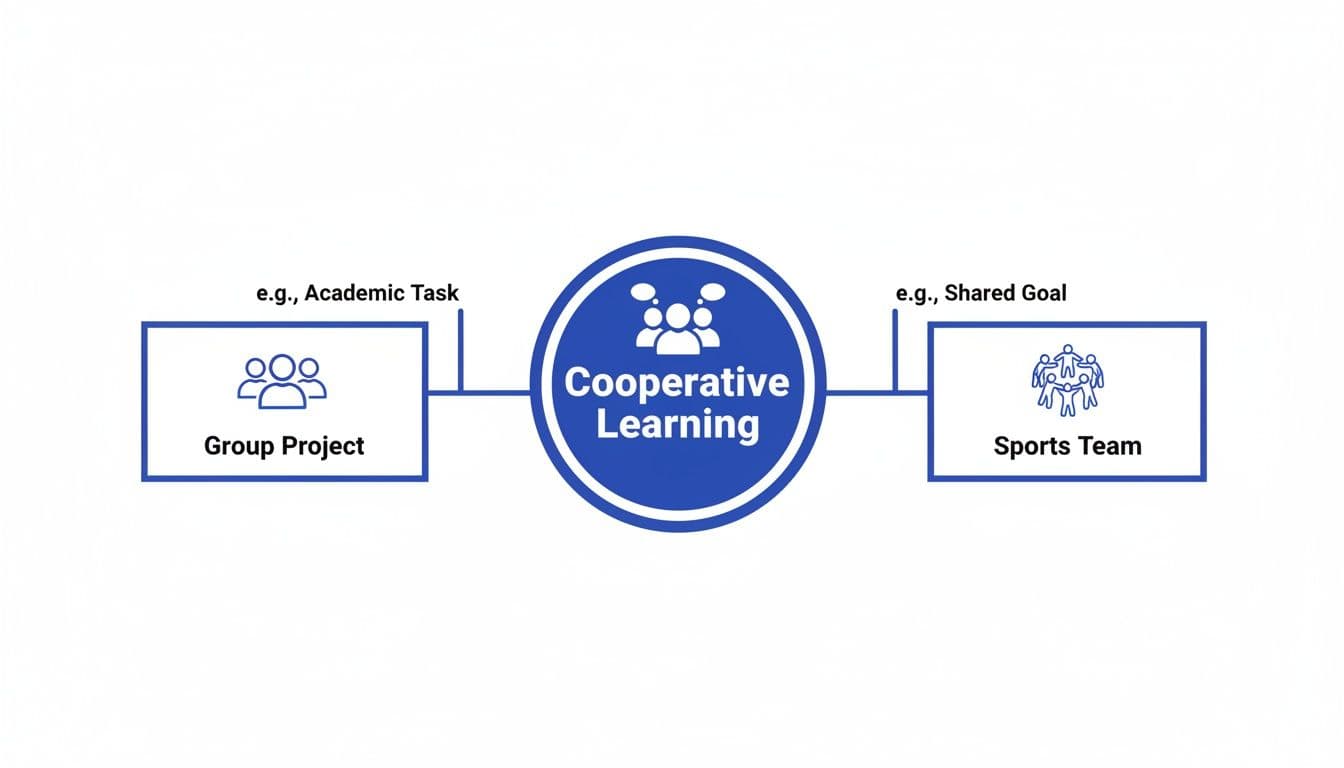
The takeaway here is that structure and genuine interdependence are what turn a simple group activity into a powerful learning experience.
1. Positive Interdependence (We Sink or Swim Together)
This is the absolute heart of the matter. Positive interdependence is the simple but powerful idea that "I can't succeed unless you do, and you can't succeed unless I do." Every student's effort is essential for the team to win.
The task is deliberately structured so students must rely on one another to get it done. It’s a team effort, through and through.
Here are a few ways to build this into your lessons:
- Shared Resources: Give each group only one worksheet or one set of lab equipment. They have no choice but to work together.
- Assigned Roles: Give each person a specific job like Scribe, Facilitator, or Timekeeper. The group can’t function if one person doesn’t do their part.
- Jigsaw Method: Each student becomes an "expert" on one piece of the puzzle and is responsible for teaching it to their group.
2. Individual Accountability (No Place to Hide)
This pillar is your secret weapon against the "hitchhiker" problem—you know, where one or two students do all the work and the others just coast along. While the group works together, each student is ultimately responsible for their own learning.
Individual accountability means every student is held responsible for their fair share of the work. It makes each student's contribution visible and essential.
To make this happen, you can:
- Give individual tests or quizzes after the group activity.
- Randomly call on students to present their group's findings or explain their process.
- Use different colored pens for each group member so you can see who contributed what to a shared document or poster.
3. Promotive Interaction (Cheer Each Other On)
This is where the real collaborative magic happens. Promotive interaction is all about students actively helping, encouraging, and supporting one another's learning. It’s that face-to-face (or knee-to-knee) discussion where they teach each other, challenge ideas respectfully, and give real feedback.
Instead of competing against each other, students learn to function as academic teammates. This peer-to-peer teaching is incredibly powerful—it solidifies understanding for both the "teacher" and the "learner" in the group.
4. Interpersonal and Small-Group Skills (Learning How to Work Together)
Let’s be honest: we can't just assume students know how to work together effectively. Cooperative learning requires us to directly teach crucial social skills like communication, trust-building, decision-making, and conflict resolution.
You might dedicate quick mini-lessons to skills like:
- Active Listening: How to paraphrase what a teammate says to show you understand.
- Disagreeing Respectfully: Using phrases like, "I see your point, but have you considered..."
- Encouraging Others: Simple words like, "That's a great idea!" can make a world of difference.
These skills aren't just for the classroom; they're for life. Research shows that when these pillars are in place, the benefits are undeniable. In one program, this structured approach helped bilingual math and science students jump 20-25 percentile points on standardized tests. You can read the full research about these powerful cooperative learning findings.
5. Group Processing (How Did We Do?)
Finally, group processing is the team huddle at the end. It’s where groups take a few minutes to talk about how well they’re achieving their goals and working together. What went well? What could be better next time?
This can be as simple as asking students to complete two sentences:
- One thing our group did well today was __________.
- Next time, our group could improve on __________.
By building these five pillars into your classroom culture, you create an environment where students aren't just learning content—they are learning how to learn together. That’s what makes all the difference.
Cooperative Learning Strategies You Can Use Tomorrow
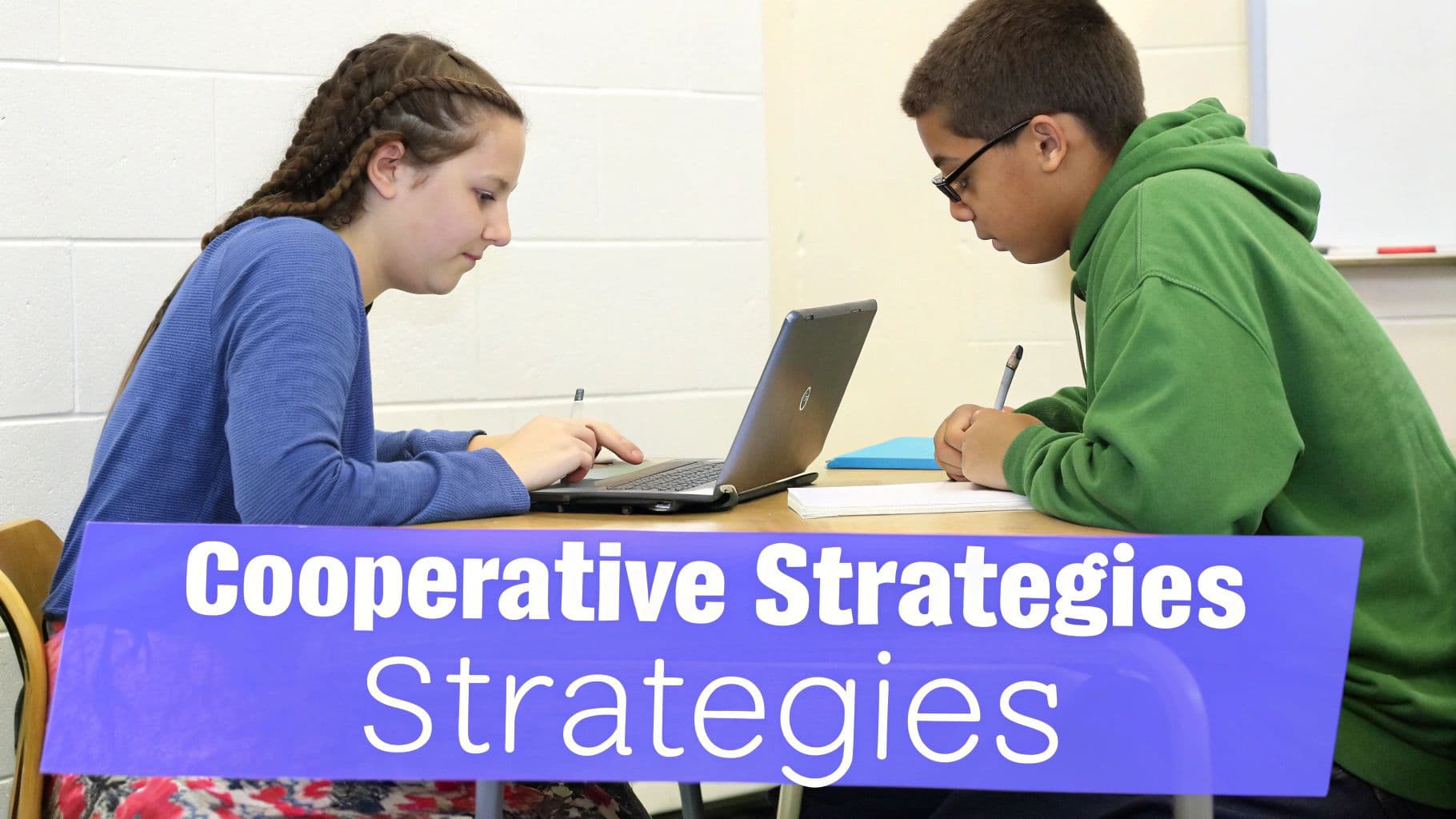
Ready to move from theory to practice? Knowing the five pillars is one thing, but seeing them in action is where the real excitement begins. This is your toolkit—a collection of proven, teacher-tested cooperative learning strategies you can implement in your classroom tomorrow.
These aren't just activities; they are structured routines that make collaboration meaningful and productive. For each one, we'll break down the "how" and, more importantly, the "why," showing you which lessons they fit best and how they bring the five pillars to life.
Jigsaw: The Ultimate Content Mastery Tool
Imagine you need students to understand four different causes of the American Revolution. Instead of a lecture, you can use the Jigsaw method. This strategy is brilliant for making every single student an essential expert on a piece of the puzzle.
How Jigsaw Works:
- Home Groups: First, divide your students into "home groups" of four. Give each member a number from 1 to 4.
- Expert Groups: Now, all the #1s from every group meet together, all the #2s meet, and so on. These are your new "expert groups."
- Become an Expert: Each expert group is responsible for mastering one chunk of content. For our example, the #1s learn about the Stamp Act, #2s about the Boston Tea Party, and so on.
- Return and Teach: Finally, students return to their original home groups and take turns teaching their expert topic to their teammates.
Jigsaw is a masterclass in positive interdependence and individual accountability. The home group can't complete the full picture without the unique expertise of every member. No one can hide because each student is the sole source of their information.
Think-Pair-Share: The Quick Engagement Win
Need to get every student thinking and talking? Think-Pair-Share is your go-to. It's a simple, low-prep structure that transforms passive listeners into active participants in seconds. It’s one of the most versatile and effective active learning strategies for students you can have in your arsenal.
It’s as easy as 1-2-3:
- Think: You pose a thought-provoking question (e.g., "What might have happened if the main character made a different choice?"). Students take a moment to think silently on their own.
- Pair: Students turn to a partner and discuss their thoughts. This gives them a safe space to verbalize their ideas before sharing with the whole class.
- Share: You call on a few pairs to share their combined ideas with the larger group.
This strategy is fantastic for building promotive interaction on a small scale. The "think" time ensures individual accountability, as every student must have something to contribute to their pair.
Numbered Heads Together: The All-Hands-On-Deck Review
This structure is a game-changer for review sessions, ensuring every student is ready to answer. It eliminates the classic problem of the same few kids always raising their hands.
Numbered Heads Together creates a dynamic where the group's success depends on making sure every single member understands the material, because any one of them could be called upon to represent the team.
Here’s the simple process:
- Number Off: Students in each group number off (e.g., 1 to 4).
- Pose a Question: You ask a question to the whole class.
- Heads Together: Teams put their "heads together" to discuss the answer and ensure everyone in the group knows it.
- Call a Number: You randomly call out a number (e.g., "All the #3s, please stand up!").
- Answer: The students with that number stand up and are responsible for answering on behalf of their team.
This method powerfully reinforces both individual and group accountability. Since no one knows which number will be called, the entire group is motivated to coach and prepare every single member.
RallyRobin: For Rapid Brainstorming
When you need to generate a list of ideas quickly, RallyRobin is perfect. It’s a simple paired activity where partners take turns sharing ideas out loud.
For example, you might ask students to brainstorm adjectives to describe a character or list the steps needed to solve a math problem. Partner A says one, then Partner B says one, and they go back and forth like a verbal tennis match until time is up. This structure is excellent for quick fluency practice and ensures equal participation between two partners. It’s a fast-paced way to get creative juices flowing.
The best cooperative learning strategies become routine. When students know the structures, you can seamlessly integrate them into any lesson, creating a classroom buzzing with purposeful talk and genuine collaboration. Planning these activities, especially differentiating materials for Jigsaw or creating unique prompts, can be time-consuming. This is where a tool like Kuraplan can be a huge help, allowing you to generate leveled texts or creative questions in just a few clicks, so you can focus more on facilitating and less on prep work.
How to Set Up Your Classroom for Cooperative Success
Creating the right environment is half the battle. Think of it like a gardener preparing the soil before planting seeds—setting up your classroom physically and culturally is what helps collaboration grow. This is about more than just moving desks around; it's about proactively designing a space and a culture where teamwork can actually flourish.
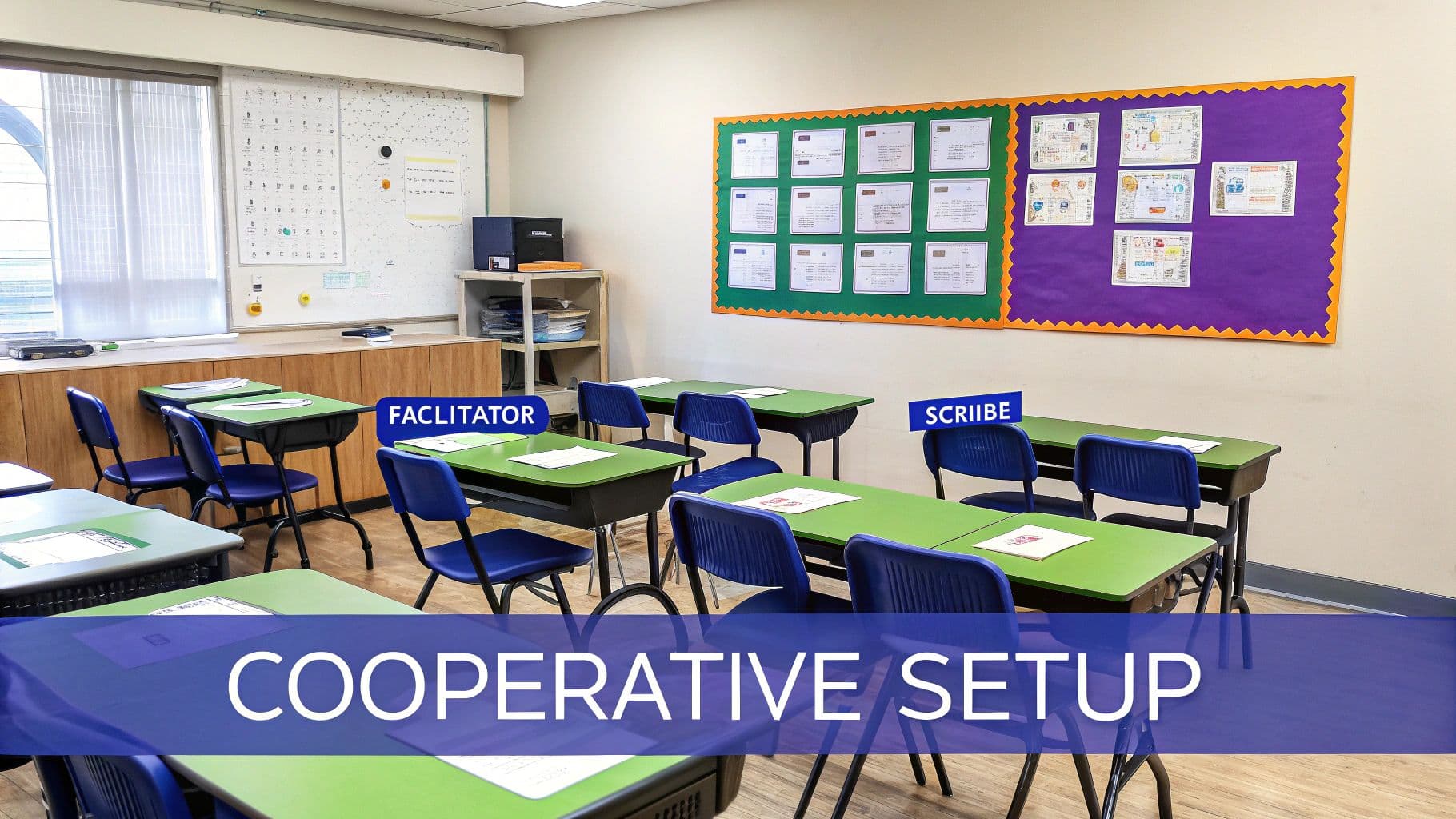
Before any group activity kicks off, you can set the stage for success by thinking carefully about how you form groups, define roles, and establish clear expectations.
The Art and Science of Forming Groups
How you group your students is one of the most powerful decisions you'll make. It’s tempting to let them pick their own groups, but that often leads to off-task chatter and unbalanced teams. A more intentional approach is key.
There are two main strategies that work wonders:
- Teacher-Selected Heterogeneous Groups: This is often the gold standard. You strategically create mixed-ability groups, balancing academic strengths, social skills, and personalities. It’s a great way to promote equity, giving every student a chance to learn from peers with different viewpoints.
- Strategic Random Grouping: Sometimes, the goal is just to mix things up. Simple methods like counting off or drawing popsicle sticks can build a stronger classroom community by helping students work with classmates outside their usual friend groups. It keeps things fresh.
The key is to be purposeful. Your grouping strategy should always match your lesson goals.
Empowering Students with Clear Roles
Once your groups are set, assigning specific roles is the secret sauce for ensuring everyone pulls their weight. Without roles, it’s too easy for one student to take over while others check out. Roles give every student a clear purpose and a reason to stay engaged.
Here are a few simple but effective roles to start with:
| Role | Responsibility |
|---|---|
| Facilitator | Keeps the group on task, makes sure everyone participates, and asks questions to deepen the discussion. |
| Scribe/Recorder | Writes down the group's ideas, answers, or key points on a shared document or worksheet. |
| Reporter | Shares the group's final conclusions or answers with the rest of the class. |
| Encourager | Actively praises contributions, offers positive feedback, and helps maintain a supportive group vibe. |
By explicitly teaching and modeling these roles, you empower students to manage their own collaboration. It takes a lot of the pressure off you.
Managing the Productive Buzz
One of the biggest fears teachers have is the noise. Will the room get too loud? Will students argue? The solution is to establish clear routines and teach collaborative skills directly.
A well-managed cooperative classroom isn't silent—it's filled with a low, productive buzz of on-task conversation. The goal is to manage the energy, not eliminate it.
To get there, you need to set clear expectations from day one. If you’re looking for ideas, our guide on classroom management plan samples offers some great starting points.
Here are a few techniques to keep things running smoothly:
- Establish Noise Levels: Use a visual signal or a simple 0-4 scale (0=Silent, 1=Whisper, 2=Table Talk) so students always know the expected volume.
- Teach How to Disagree: Practice sentence starters like, "I see your point, but have you considered..." This teaches students to challenge ideas, not people.
- Create Clear Routines: Have a consistent process for how students get into groups, gather materials, and clean up. Predictability minimizes transition time and disruptions.
And the research backs this up. A meta-analysis of 23 recent studies confirmed that cooperative learning has a strong, reliable impact in K-12 classrooms (ES=.43), fostering social and communication skills right alongside academics. You can read the full research about these cooperative learning findings to dig into the data yourself. By setting up your classroom for success, you're not just managing behavior; you're building a community of learners ready to work together.
Fairly Assessing Both Group Work and Individual Learning
One of the biggest hurdles that trips teachers up when they first try cooperative learning is the grading. How can you be fair? How do you assess a group project without the keeners carrying the whole team or leaving other students behind?
It’s a real concern, but the answer is a balanced approach that looks at both the final product and the messy, collaborative process that got them there.
The trick is to separate the group grade from the individual grade. The team might get a collective score on their presentation, but you also need to know what each student learned on their own. This is where individual accountability comes in.
Measuring Individual Mastery
Even when students work side-by-side, learning is personal. You have to know what each student has truly grasped, away from the safety of their group. This keeps everyone on their toes and puts an end to any "hitchhiking."
Here are a few simple ways to check for it:
- Individual Quizzes or Exit Tickets: After a group activity wraps up, hand out a short, individual quiz on the core concepts. It’s a quick, clean snapshot of what stuck with each student.
- Targeted Questioning: As you walk around, pull individuals aside for a quick chat. Ask them to explain a concept their group just discussed or to paraphrase what a teammate just said.
- Visible Contributions: Design the task so you can see who did what. Maybe each student uses a different colored pen on a shared poster, or you assign specific sections of a report to each person.
This method fits perfectly with modern assessment strategies. To dig deeper, check out our guide on what are performance based assessments and see how they can reveal what students truly understand.
Assessing the Collaborative Process
Just as important as the final outcome is how the students got there. You have to assess teamwork skills—like communication, participation, and encouragement—if you want to teach students how to collaborate effectively.
This doesn't have to be another complicated thing to track. Simple rubrics can make this manageable for you and totally transparent for your students.
To help, here is a simple rubric you can adapt for your classroom. It gives students clear expectations for what good collaboration looks like.
Sample Rubric for Assessing Group Collaboration Skills
| Criteria | Beginning (1) | Developing (2) | Proficient (3) | Exemplary (4) |
|---|---|---|---|---|
| Participation | Rarely contributes to group discussions or tasks; often off-task. | Contributes occasionally but needs reminders to stay engaged. | Actively participates in discussions and consistently contributes to tasks. | Consistently takes initiative, encourages others to participate, and helps group stay on track. |
| Communication | Does not listen to others; communication is unclear or disrespectful. | Listens some of the time but may interrupt or have difficulty expressing ideas clearly. | Listens respectfully to others and clearly communicates own ideas. | Actively listens, builds on others' ideas, and helps clarify points for the group. |
| On-Task Behavior | Frequently distracted and distracts others from the task. | Sometimes off-task and needs redirection to focus on group goals. | Stays focused on the task and helps keep the group on track most of the time. | Proactively manages time, keeps the group focused, and helps resolve any off-task behavior. |
By evaluating the process, you're sending a clear message: working well together is a skill that matters.
A fair assessment in cooperative learning doesn't just ask, "What did the group create?" It also asks, "How did each individual grow, and how well did they function as a team?"
Creating these materials from scratch can feel like just one more thing on your plate. This is where a tool like Kuraplan can be a real game-changer. You can quickly generate assessment rubrics and checklists that tie directly to your lesson goals, making it easy to measure both individual mastery and group performance without the extra work.
Solving Common Problems in Cooperative Learning
Even with the best-laid plans, cooperative learning isn't always smooth sailing. Let’s be real, we’ve all seen it: the group with a "hitchhiker" who lets everyone else do the work, or the one with a "dominator" who steamrolls every conversation. These classic group work headaches can be frustrating, but they’re definitely solvable.
Facing these challenges head-on is just part of the process. It's not a sign that your lesson failed; it's an opportunity to teach crucial life skills like conflict resolution and shared responsibility. The trick is to have a few proactive solutions ready in your back pocket.
Managing Unbalanced Participation
The two biggest culprits in derailing group work are the hitchhiker and the dominator. Both can poison a group's dynamic, but clear roles and individual accountability are powerful course-correctors.
- For the Hitchhiker: Assigning specific, non-negotiable roles (like Scribe or Reporter) makes it impossible for a student to just fade into the background. Individual assessments after the group task also send a clear message: everyone is accountable for the material, not just the group as a whole.
- For the Dominator: Give this student a role that channels their energy productively, like the Facilitator, whose job is to ensure everyone speaks. You can also provide sentence starters for the group, like, "Let's hear from someone we haven't heard from yet."
Differentiating for Every Learner
What about the diverse needs within one group? Cooperative learning is actually a fantastic setting for differentiation. You can support English Language Learners, challenge advanced students, and provide entry points for those with diverse learning needs—all within the same activity.
The goal of differentiation in a cooperative setting isn’t to give every student the same task, but to ensure every student has a meaningful way to contribute to the group’s shared goal.
This is where technology can be a teacher's best friend. Instead of spending hours adapting materials yourself, an AI tool like Kuraplan can automatically generate differentiated texts for a Jigsaw activity or suggest different question levels for a discussion. This frees you up to focus on facilitating the groups and ensuring every student has a role where they can shine.
To get a real pulse on what's happening in your groups, you can use anonymous feedback forms to get invaluable insights directly from the students' perspective.
Your Top Questions About Cooperative Learning, Answered
Jumping into cooperative learning always sparks a few questions. Let's walk through some of the most common ones I hear from teachers just like you, so you can start with total confidence.
Isn't This Just Group Work?
This is the big one, and the most important question to ask! We've all seen "group work" where one student carries the entire team. That's not cooperative learning.
The secret sauce is in the structure. Cooperative learning is built on positive interdependence (they need each other to succeed) and individual accountability (everyone is responsible for their own piece of the puzzle). The tasks are intentionally designed so no one can sit back and let others do the work.
What's the Ideal Group Size?
While there isn't a single magic number, the sweet spot for most activities is three to four students.
Pairs are perfect for quick turn-and-talks, like a Think-Pair-Share. But groups of three or four bring more ideas to the table without getting so big that students can get lost in the shuffle. A group of five can sometimes work, but it gets a lot harder to make sure everyone is pulling their weight.
How Do I Keep My High-Achievers From Getting Bored?
A very real concern! The key is to challenge them with complexity, not just more work.
Instead of extra problems, give them a more demanding role. They could be the Facilitator, tasked with asking deep, probing questions that push the group’s thinking. Or, they could be the Checker, responsible for making sure the group's reasoning holds up against a tough rubric. You can also tier the assignment itself, where the core task is the same but advanced groups get more complex resources to work with.
How Often Should I Use Cooperative Learning?
Think of it as one of your most powerful teaching strategies, not the only one. Balance is everything.
You don't need to force it into every lesson. It shines brightest during tasks that truly benefit from collaboration, deep discussion, and problem-solving. A great way to start is by weaving one or two cooperative learning activities into your week and seeing how your students respond.
Ready to design engaging, differentiated cooperative learning lessons but feeling short on time? Kuraplan is an AI lesson planning assistant that helps you create standards-aligned activities, generate tiered materials, and build assessment rubrics in minutes. Take back your planning time and get started with Kuraplan today.