Year 4 · Social Sciences · 2 minutes
Journeys to Aotearoa
Stars, swells, birds and clouds: the knowledge of the tūpuna.
Key terms
- Tūpuna
- Ancestors; the Polynesian voyagers who explored the Pacific were the tūpuna of Māori.
- Waka hourua
- A double-hulled voyaging canoe, with two hulls joined by a deck to keep it steady in big waves.
- Polynesian Triangle
- A giant triangle of ocean with Hawaiʻi in the north, Rapa Nui in the east and Aotearoa in the south.
- Navigator
- A person who finds the way, here by reading stars, ocean swells, birds and clouds instead of using a compass.
- Iwi
- A Māori tribe; each iwi tells the stories of Kupe in its own way.
- Hawaiki
- The homeland that Kupe is said to have sailed from before finding Aotearoa.
Transcript
Long before maps or compasses, people sailed across the biggest ocean on Earth, and found tiny islands in all that blue. How did they do it?
These explorers were Polynesian voyagers, the tūpuna, or ancestors, of Māori. Over many generations, they explored the Pacific, island by island.
Their journeys reached across a giant triangle of ocean. Hawaiʻi in the north, Rapa Nui in the east, and Aotearoa in the south. This is the Polynesian Triangle.
They sailed on waka hourua, double hulled voyaging canoes. Two hulls joined by a deck kept them steady in big waves, with room for people, food and plants.
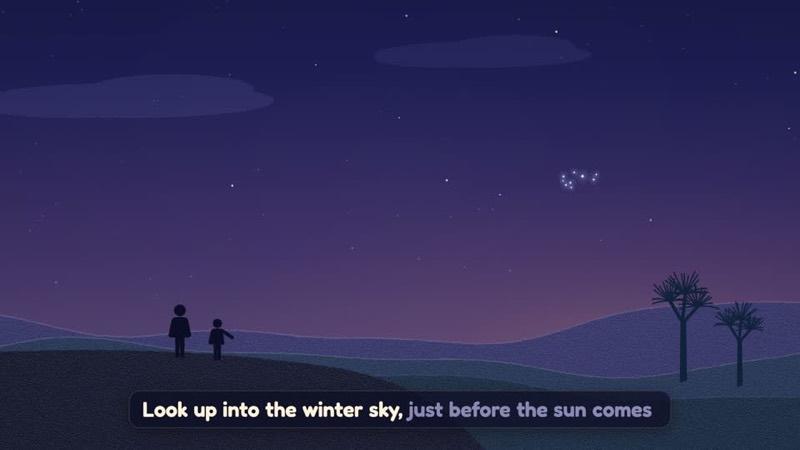
With no compass, navigators read nature. They followed rising and setting stars, felt the ocean swells, watched birds flying home to land, and looked for clouds piling up above islands.
Many Māori traditions tell of Kupe, a great navigator who sailed from Hawaiki, the homeland, and found Aotearoa. Each iwi tells these stories in its own way.
Scientists estimate the first people settled here about seven hundred to eight hundred years ago. Aotearoa was one of the last large lands on Earth that people found.
Today, people still build waka hourua and sail them by the stars, keeping the knowledge of the tūpuna alive.
So remember: Polynesian voyagers explored the Pacific on waka hourua. They found their way with stars, swells, birds and clouds. And they reached Aotearoa about seven hundred to eight hundred years ago.
Sources
Every fact in the video, and where it comes from.
- 1teara.govt.nz/en/pacific-migrations
- Polynesian voyagers, the ancestors of Māori, explored and settled the islands of the Pacific over many generations, moving eastward from the western Pacific (Tonga/Samoa) to central East Polynesia and then to Hawaiʻi, Rapa Nui and Aotearoa.
- Hawaiʻi, Rapa Nui (Easter Island) and Aotearoa New Zealand mark the corners of the Polynesian Triangle.
- 2sciencelearn.org.nz/resources/633-waka-hourua
- The first settlers probably reached Aotearoa on double-hulled voyaging canoes (waka hourua).
- Navigators found their way by wayfinding: stars, Sun, Moon, wind, wave patterns (swells) and birds.
- Traditional voyaging and navigation have been revived; waka hourua such as Te Aurere (built by Hekenukumai Busby, 1991–92) sail using traditional wayfinding today.
- 3teara.govt.nz/en/canoe-navigation
- Navigators also used signs such as clouds gathering over islands, and ocean currents.
- 4teara.govt.nz/en/when-was-new-zealand-first-settled/page-2
- Many Māori oral traditions name the explorer Kupe as the first to reach Aotearoa, sailing from Hawaiki, the ancestral homeland in tradition. Traditions differ between iwi.
- 5nzhistory.govt.nz/culture/encounters/polynesian-voyaging
- Scientists estimate permanent Polynesian settlement of New Zealand around 1250 to 1300 CE (about 700 to 800 years ago), based mainly on radiocarbon dating.
- 6teara.govt.nz/en/when-was-new-zealand-first-settled
- New Zealand was one of the last large land masses on Earth to be settled by people.
Image and sound credits
- “Haunui waka” by Michael R Perry, CC BY 2.0 (https://creativecommons.org/licenses/by/2.0)
- “Waka Hourua arriving Māhia, Tuia 250 commemoration 15 Dec 2019” by Lucy Firenze (CC0)
Teaching this next week?
Kuraplan turns this topic into a lesson plan, slides and a worksheet for your class in about a minute.
Plan a lesson on this topic