MathsFreePrintable
Advanced Geometry in Art
A free maths worksheet ready for your classroom. Open in Kuraplan to grab the print-ready PDF, customize it for your students, or generate a fresh version in seconds.
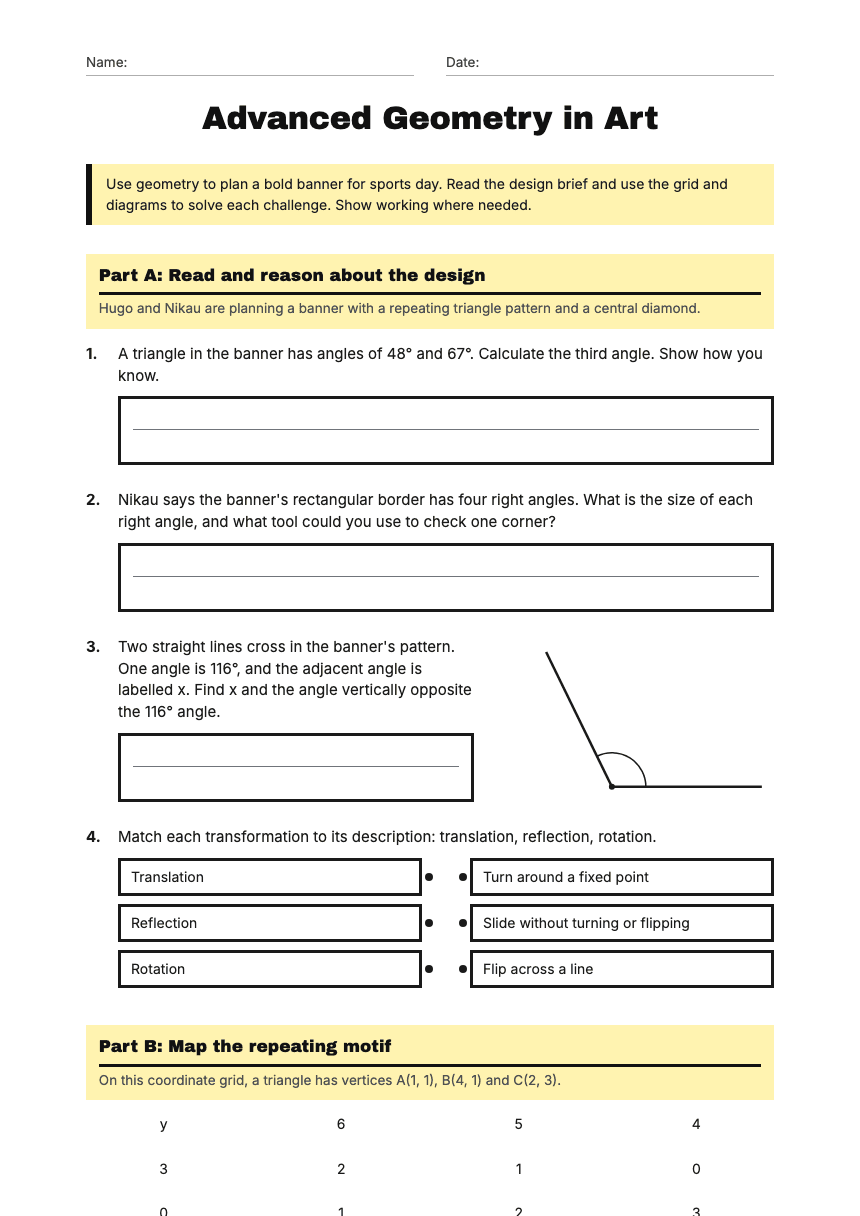
Name:Date:
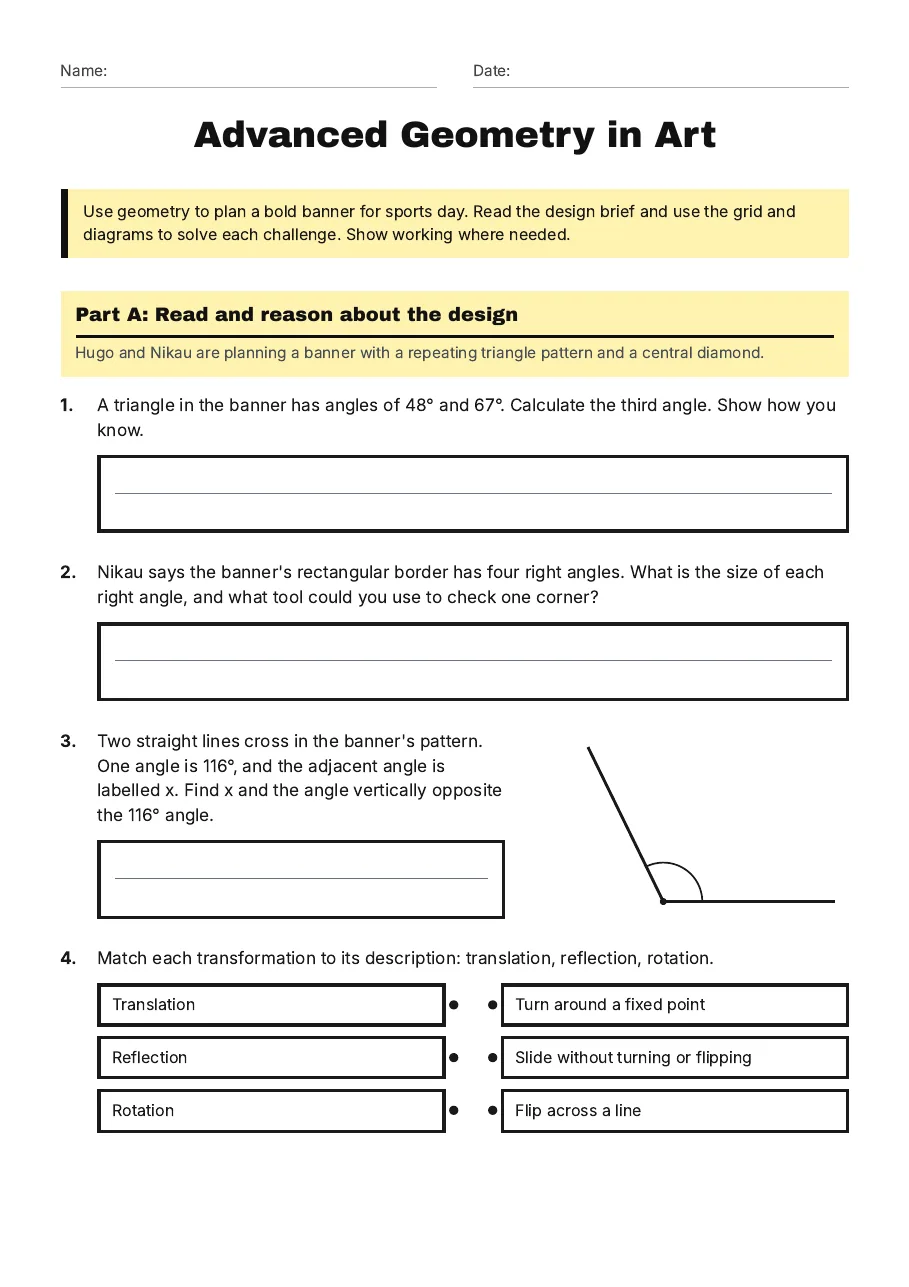
Advanced Geometry in Art
Use geometry to plan a bold banner for sports day. Read the design brief and use the grid and diagrams to solve each challenge. Show working where needed.
Part A: Read and reason about the design
Hugo and Nikau are planning a banner with a repeating triangle pattern and a central diamond.
1.A triangle in the banner has angles of 48° and 67°. Calculate the third angle. Show how you know.
2.Nikau says the banner's rectangular border has four right angles. What is the size of each right angle, and what tool could you use to check one corner?
3.Two straight lines cross in the banner's pattern. One angle is 116°, and the adjacent angle is labelled x. Find x and the angle vertically opposite the 116° angle.
4.Match each transformation to its description: translation, reflection, rotation.
- Translation
- Reflection
- Rotation
- Turn around a fixed point
- Slide without turning or flipping
- Flip across a line
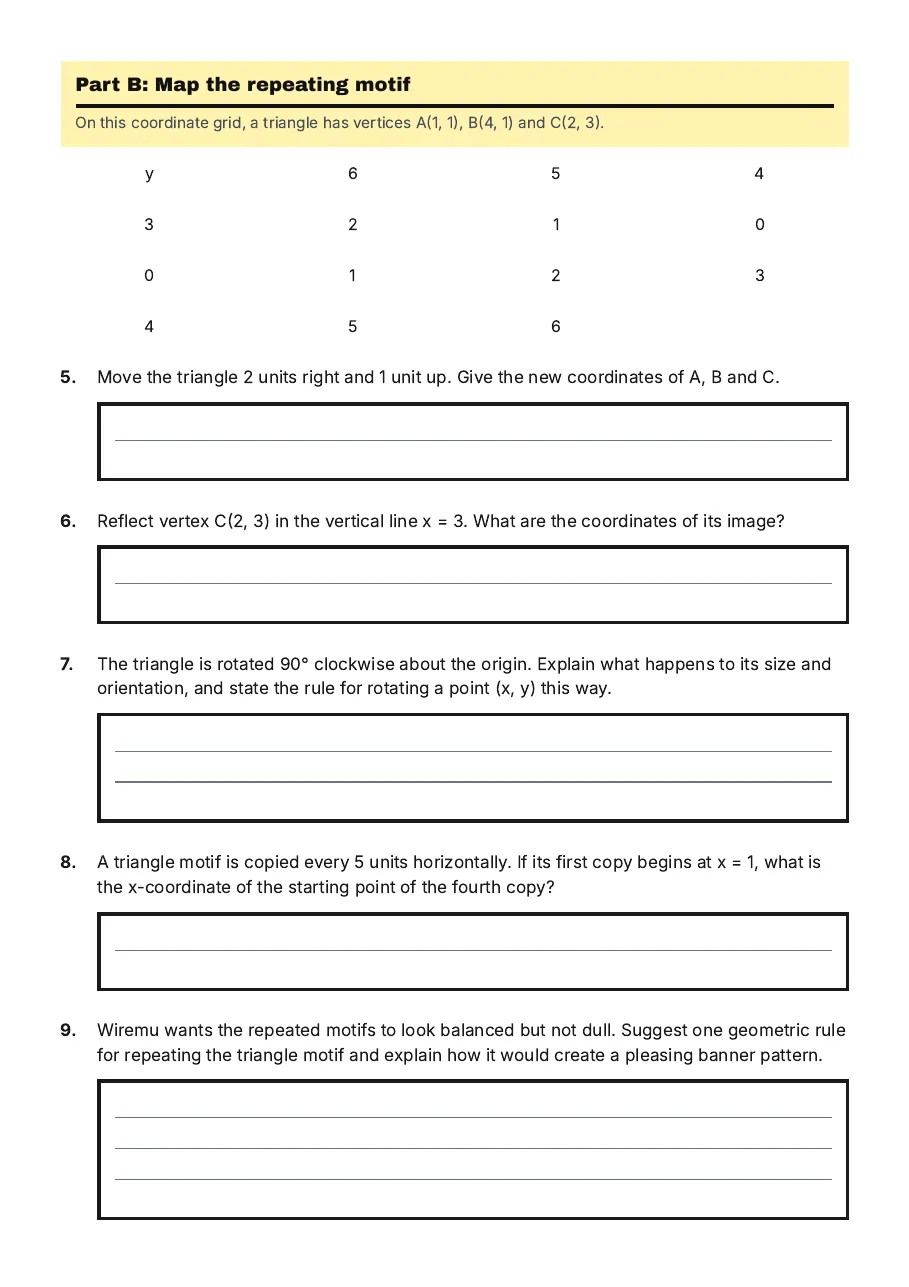
Part B: Map the repeating motif
On this coordinate grid, a triangle has vertices A(1, 1), B(4, 1) and C(2, 3).
y
6
5
4
3
2
1
0
0
1
2
3
4
5
6
5.Move the triangle 2 units right and 1 unit up. Give the new coordinates of A, B and C.
6.Reflect vertex C(2, 3) in the vertical line x = 3. What are the coordinates of its image?
7.The triangle is rotated 90° clockwise about the origin. Explain what happens to its size and orientation, and state the rule for rotating a point (x, y) this way.
8.A triangle motif is copied every 5 units horizontally. If its first copy begins at x = 1, what is the x-coordinate of the starting point of the fourth copy?
9.Wiremu wants the repeated motifs to look balanced but not dull. Suggest one geometric rule for repeating the triangle motif and explain how it would create a pleasing banner pattern.
2 printable pages
Page 1
Page 2
About This Worksheet
Free in Kuraplan
Sign up free, grab the PDF, and customize it for your class.
Print-Ready
Formatted for standard paper. Clean layout, easy to read.
AI-Generated
Created with Kuraplan's AI, designed for real classroom use.
For Teachers & Parents
Use in classrooms, for homework, tutoring, or homeschool.
Need a custom version of this worksheet?
Kuraplan's AI generates custom worksheets in seconds — differentiated for every learner, aligned to your curriculum.
Generate Custom Worksheets — Free No credit card Curriculum-aligned Under 60 seconds