MathsFreePrintable

Algebra for Preservation

A free maths worksheet ready for your classroom. Open in Kuraplan to grab the print-ready PDF, customize it for your students, or generate a fresh version in seconds.
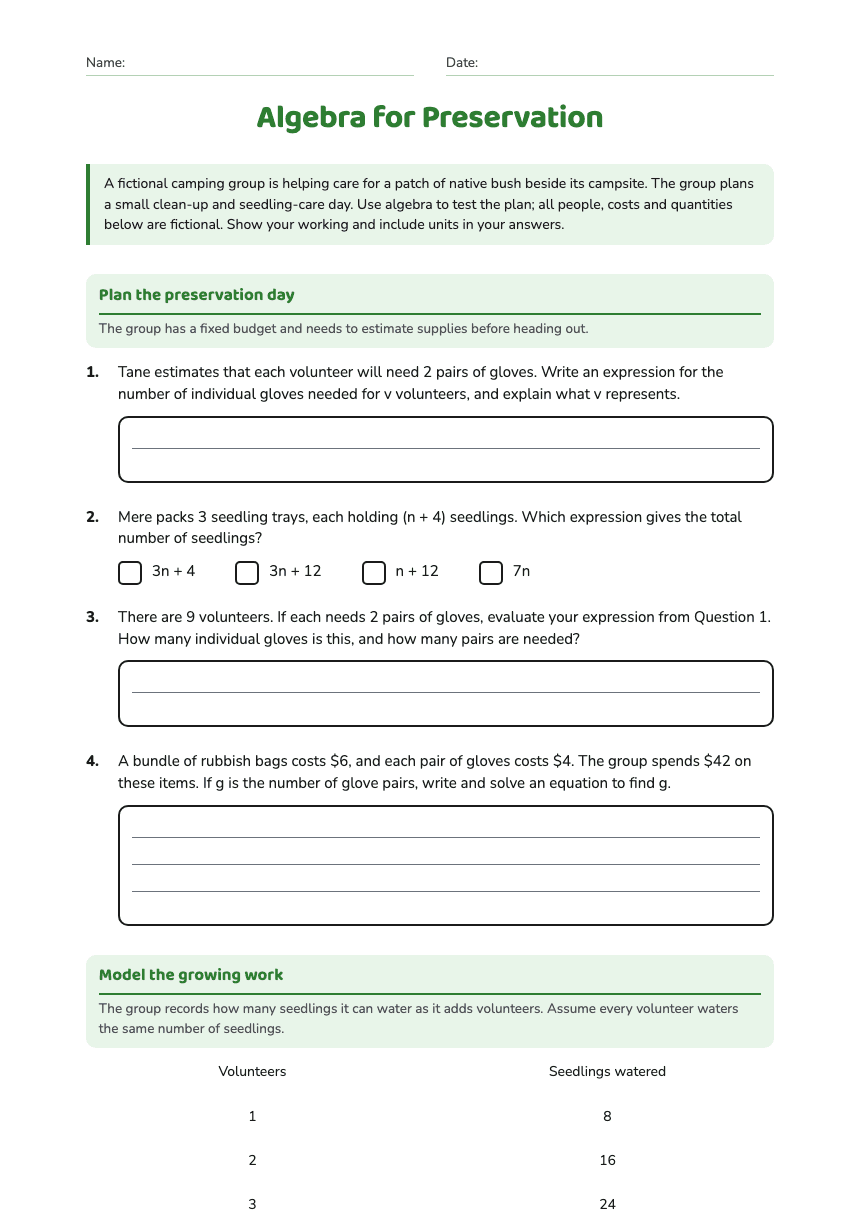
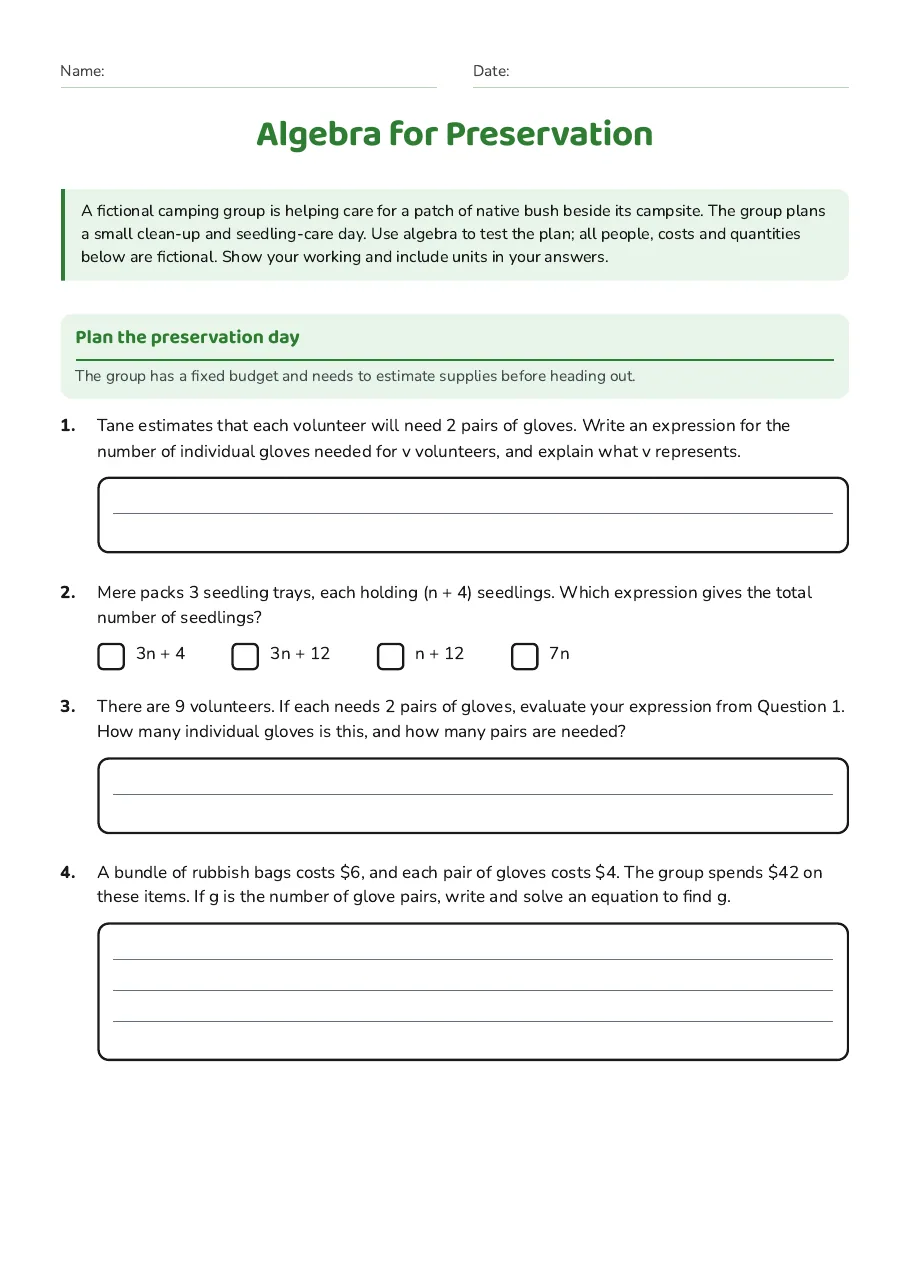
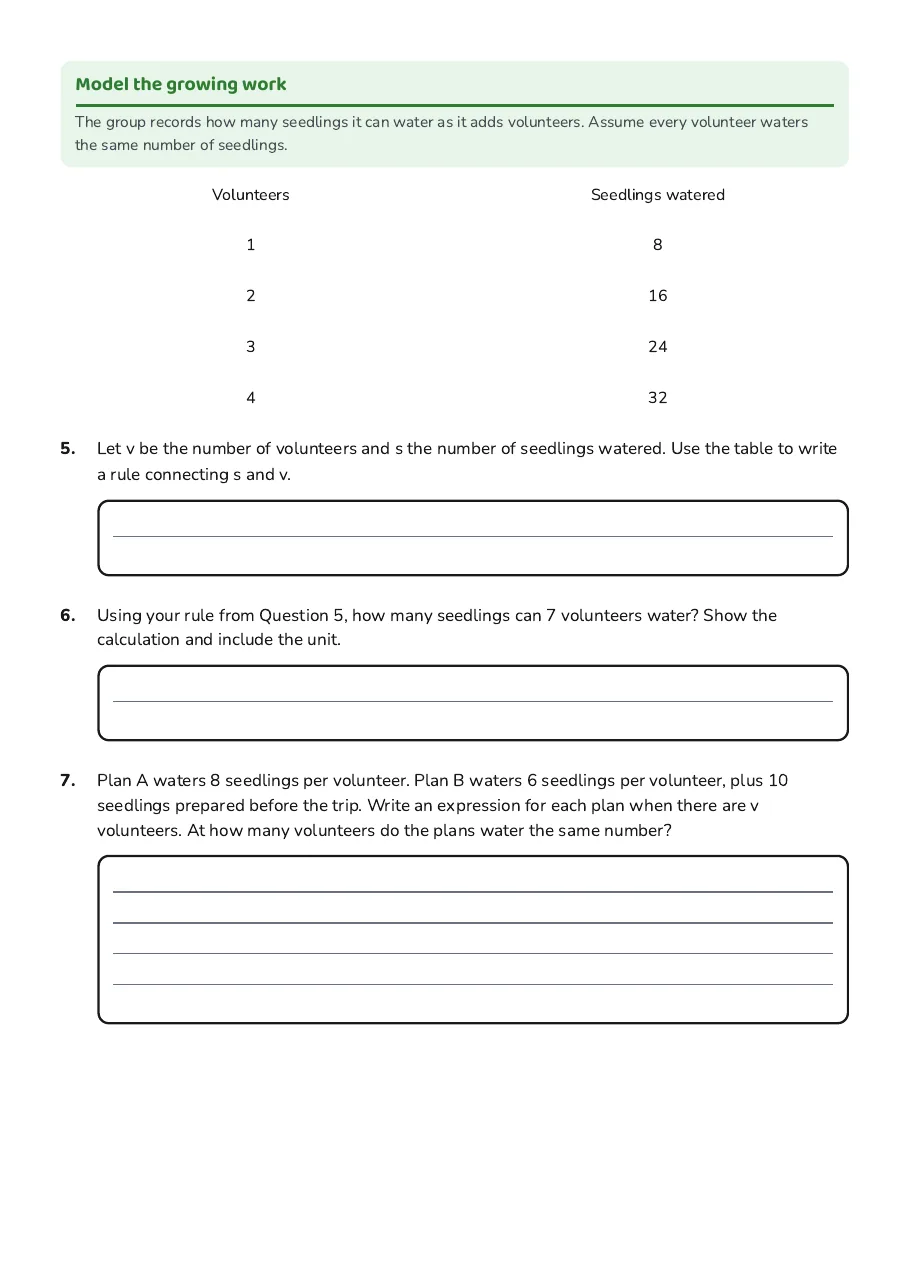
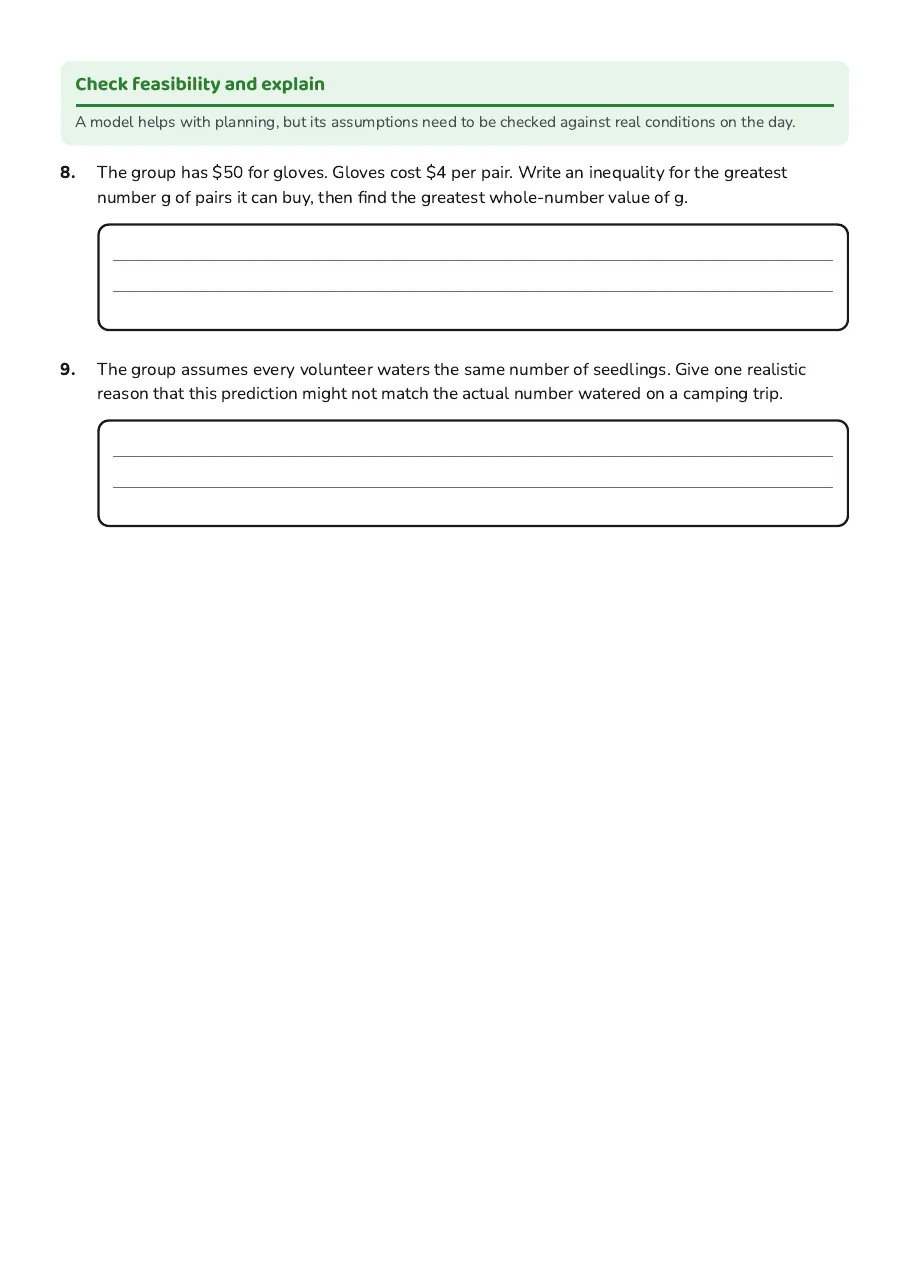
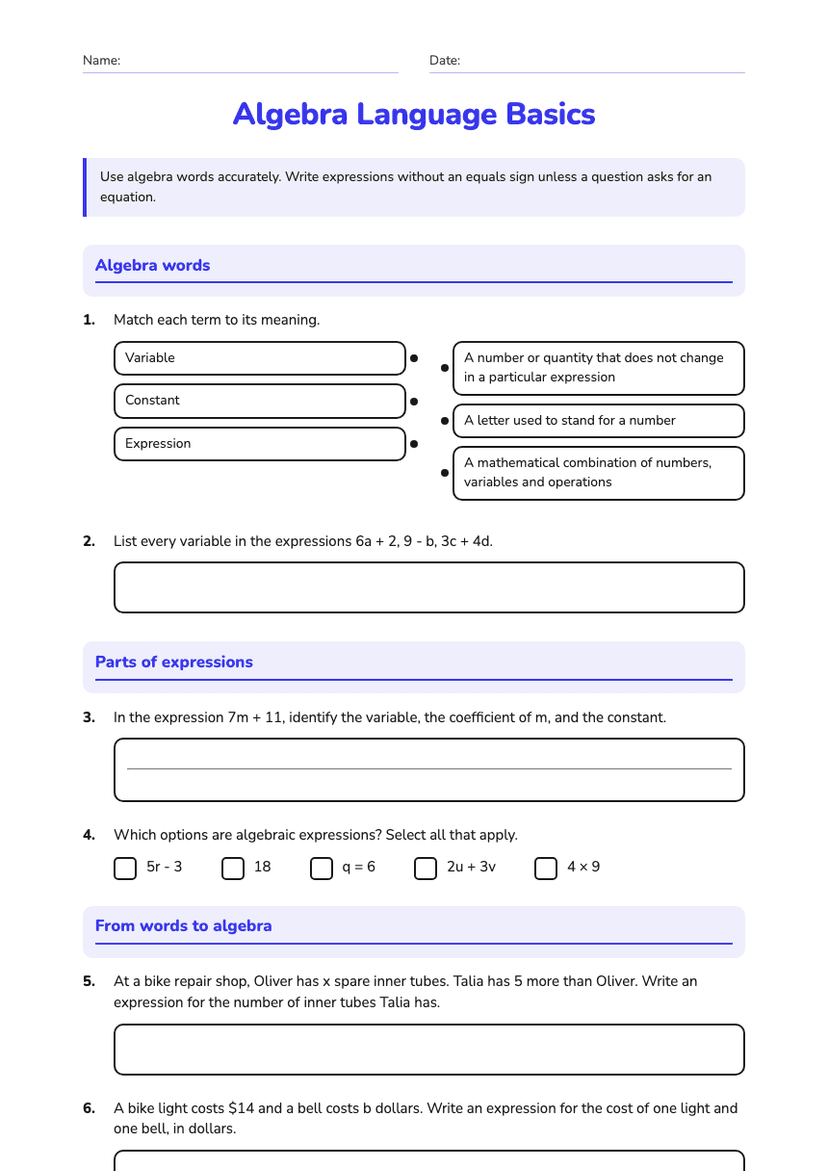
Algebra for Preservation worksheet preview

Algebra for Preservation

Worksheet illustration

Part 1: Choose and frame the proposal

WALT: use algebra to model a respectful preservation or revitalisation initiative.

Success criteria: I can define a need neutrally, identify measurable indicators, and explain what requires consultation and consent.

1. Choose one context. Tick one and add only details that are fictional or locally approved.

Fictional context

Locally approved context

Our scenario is: _________________________________________________

We will not speak for, name or represent a community without permission.

2. State the need in neutral language. Do not assume what a community wants.

Our proposal responds to a possible need for ________________________________

________________________________________________________________________

3. Write two or three measurable success indicators.

For example: number of participants, cost per person, travel access, or continuity over time.

a) _____________________________________________________________________

b) _____________________________________________________________________

c) _____________________________________________________________________

4. Identify consultation, consent and cultural-safety needs.

Who would need to guide, review or approve this proposal? What must not be recorded, shared or used without permission?

Checkpoint: We have a neutral need, measurable indicators, and a plan to seek guidance and consent.

Part 2: Build and test three algebraic representations

WALT: construct, solve and interpret algebraic models.

Success criteria: I can define variables, use at least three algebraic tools, show calculations, and explain whether the proposal is feasible.

5. Define the variables and units in your model.

Let _____ represent ____________________________________________

Let _____ represent ____________________________________________

Other useful variable: _____ represents ___________________________

6. Construct and solve at least three representations. Choose from expressions and evaluation, equations, formulae, sequences, tables, graphs, expansion or factorisation. Label each one.

Representation 1: ______________________________________________

Model and working:

Representation 2: ______________________________________________

Model and working:

Representation 3: ______________________________________________

Model and working:

7. Interpret your results and test feasibility.

In this context, the value __________________ means __________________________

Our proposal is feasible because ____________________________________________

One cost, participation, access or growth result we need to check is:

Checkpoint: We have checked our calculations and can explain what each important value means.

Part 3: Respectful communication and reflection

WALT: explain mathematical reasoning and communicate a culturally safe proposal.

Success criteria: I can explain assumptions and limitations, connect the proposal with kaitiakitanga, mana, access and intergenerational transmission, and respond to feedback.

8. Record assumptions, limitations and improvements.

Assumption: Our model assumes ____________________________________

Limitation: Our model may not show __________________________________

Improvement after advice or feedback: _____________________________

9. Complete the two-minute presentation plan.

0–20 seconds: State the need and recommendation: _____________________________

20–60 seconds: Explain the three algebraic representations: ____________________

60–85 seconds: Explain feasibility, assumptions and limitations: _________________

85–110 seconds: Explain consultation, consent, kaitiakitanga, mana, access and intergenerational transmission:

110–120 seconds: Finish with our recommendation: ______________________________

Presentation format:

oral  
visual  
video

10. Individual reflection. Complete this separately from the group proposal.

What algebra did I contribute?

What does one of our representations mean in context?

What is one limitation or assumption?

What is one improvement I would make after feedback?

Support choices

You may listen to the brief read aloud or use an audio version. Use speech-to-text, a calculator, spreadsheet or graphing tool, a quiet planning space, or rehearsed speaking notes if helpful. Use the sentence starters: “Our variable represents…” and “This model assumes…”

Extension: Change one assumption, compare the new result with the original, and explain how the recommendation changes.

About This Worksheet

Free in Kuraplan

Sign up free, grab the PDF, and customize it for your class.

Print-Ready

Formatted for standard paper. Clean layout, easy to read.

AI-Generated

Created with Kuraplan's AI, designed for real classroom use.

For Teachers & Parents

Use in classrooms, for homework, tutoring, or homeschool.

Need a custom version of this worksheet?

Kuraplan's AI generates custom worksheets in seconds — differentiated for every learner, aligned to your curriculum.

Generate Custom Worksheets — Free
No credit card Curriculum-aligned Under 60 seconds